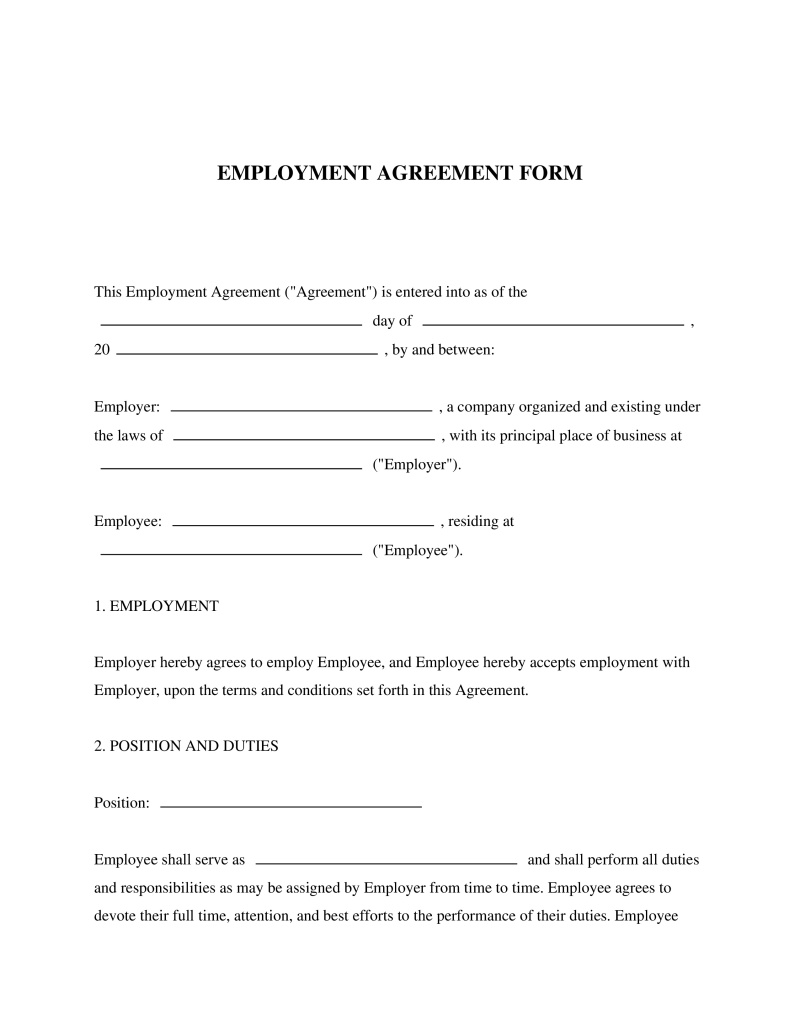
Employment Agreement
An Employment Agreement is a legally binding contract between an employer and an employee detailing the specific terms and conditions.
Agreement Effective Date
Enter the date when the agreement becomes effective.
Table of Contents
What is an Employment Agreement?
An employment agreement is a legally binding contract between an employer and an employee that outlines the terms and conditions of employment. Its primary purpose is to establish clear expectations regarding job responsibilities, compensation, benefits, and the duration and nature of the working relationship. This document serves to protect the interests of both parties by formalizing their understanding and providing a framework for dispute resolution. Employment agreements are utilized across various industries and at different organizational levels to define the specifics of a professional engagement.
Legal Requirements and Validity
For an employment agreement to be legally valid and enforceable, it must generally satisfy the fundamental elements of contract law. These elements ensure that both parties enter into the agreement knowingly and voluntarily, with a clear understanding of their respective rights and obligations. The absence of any of these core components can render an agreement void or voidable.
- Offer and Acceptance - The employer must make a clear offer of employment, detailing the terms, which the employee must unequivocally accept.
- Consideration - Both parties must exchange something of value; typically, the employer provides wages and benefits in exchange for the employee's services.
- Legal Purpose - The agreement's objective must be lawful and not violate any existing statutes or public policy.
- Capacity - Both the employer and employee must be legally competent to enter into a contract, meaning they are of legal age and sound mind.
- Mutual Assent - There must be a "meeting of the minds," where both parties agree to the same terms and conditions.
- Statute of Frauds - While many employment agreements can be oral, contracts for employment that cannot be performed within one year from the date of agreement must typically be in writing to be enforceable (varies by state law).
Key Elements of an Employment Agreement
A comprehensive employment agreement typically includes several crucial provisions that define the scope and conditions of the working relationship. These elements ensure clarity and mitigate potential misunderstandings or disputes between the employer and employee.
- Parties Involved - Full legal names and addresses of both the employer and the employee.
- Position and Duties - A detailed description of the job title, responsibilities, reporting structure, and performance expectations.
- Compensation - Specifics regarding salary, wage rate, commission structures, bonuses, payment frequency, and any other forms of remuneration.
- Benefits - Outline of employee benefits such as health insurance, retirement plans, paid time off (vacation, sick leave, holidays), and other perks.
- Term of Employment - Whether the employment is at-will, for a fixed term, or ongoing, and any provisions for renewal or extension.
- Termination Clauses - Conditions under which either party can terminate the agreement, including notice periods, reasons for termination (with or without cause), and severance pay.
- Confidentiality and Non-Disclosure - Provisions protecting the employer's proprietary information, trade secrets, and client lists, prohibiting unauthorized disclosure.
- Intellectual Property - Clauses addressing ownership of intellectual property created by the employee during the course of employment.
- Non-Compete and Non-Solicitation - Restrictions on the employee's ability to work for competitors or solicit clients/employees after leaving the company (enforceability varies significantly by state).
- Dispute Resolution - Methods for resolving conflicts, such as mediation or arbitration, before resorting to litigation.
- Governing Law - Specification of which state's laws will govern the interpretation and enforcement of the agreement.
- Entire Agreement Clause - A statement that the written agreement constitutes the complete and final understanding between the parties, superseding all prior discussions.
- Signatures and Date - Signatures of both the employer (or authorized representative) and the employee, along with the date of signing.
How to Draft an Employment Agreement
Drafting an employment agreement requires careful attention to detail to ensure it accurately reflects the terms of employment and complies with applicable laws. Following a structured process can help create a clear and legally sound document.
- Define the Role and Terms - Clearly articulate the job title, a comprehensive list of responsibilities, and the reporting structure. Establish the compensation package, including base salary, potential bonuses, commission structures, and a detailed description of benefits such as health insurance, retirement plans, and paid time off. This step ensures both parties have a mutual understanding of the work to be performed and the remuneration for it.
- Include Essential Clauses - Incorporate critical provisions that protect both the employer and employee. This includes clear termination clauses outlining conditions for dismissal, required notice periods, and any severance arrangements. Add robust confidentiality and non-disclosure clauses to safeguard proprietary information. Consider intellectual property clauses if the employee will be creating works for the company, and, where legally permissible, include non-compete or non-solicitation clauses.
- Review Legal Compliance - Ensure the entire agreement adheres to all relevant federal, state, and local employment laws. Verify that compensation terms meet minimum wage and overtime requirements, and that anti-discrimination provisions are respected. Check state-specific rules regarding the enforceability of non-compete clauses and at-will employment doctrines. Legal counsel should review the agreement to identify and rectify any potential legal vulnerabilities.
- Negotiate and Finalize - Present the draft agreement to the prospective employee and allow time for review. Be prepared to discuss and negotiate certain terms, particularly regarding compensation, benefits, or specific clauses. Once all parties agree to the terms, make any necessary revisions. Both the employer's authorized representative and the employee must sign and date the final document, with each party retaining a signed copy for their records.
Federal Laws Governing Employment Agreements
Several federal statutes establish baseline protections and requirements that influence the content and enforceability of employment agreements, regardless of state-specific provisions. These laws aim to ensure fair labor practices and prevent discrimination in the workplace.
- Fair Labor Standards Act (FLSA) - Mandates minimum wage, overtime pay eligibility, recordkeeping, and child labor standards for both full-time and part-time workers in the private and public sectors (29 U.S.C. § 201 et seq.).
- Title VII of the Civil Rights Act of 1964 - Prohibits discrimination by employers based on race, color, religion, sex, or national origin in all employment practices, including hiring, firing, promotion, and compensation (42 U.S.C. § 2000e et seq.).
- Americans with Disabilities Act (ADA) - Prohibits discrimination against individuals with disabilities in all areas of public life, including employment, and requires employers to provide reasonable accommodations (42 U.S.C. § 12101 et seq.).
- Age Discrimination in Employment Act (ADEA) - Protects individuals who are 40 years of age or older from employment discrimination based on age (29 U.S.C. § 621 et seq.).
- Family and Medical Leave Act (FMLA) - Entitles eligible employees of covered employers to take unpaid, job-protected leave for specified family and medical reasons with continuation of group health insurance coverage (29 U.S.C. § 2601 et seq.).
- National Labor Relations Act (NLRA) - Protects the rights of employees to organize, form unions, bargain collectively, and engage in concerted activities for mutual aid or protection (29 U.S.C. § 151 et seq.).
- Employee Retirement Income Security Act (ERISA) - Sets minimum standards for most voluntarily established retirement and health plans in private industry to provide protection for individuals in these plans (29 U.S.C. § 1001 et seq.).
State Laws and Common Law Principles
Beyond federal mandates, state laws and common law principles play a significant role in shaping the specific terms and enforceability of employment agreements. These regulations often address areas such as wage payment, termination, and post-employment restrictions, reflecting local legal traditions and public policy.
- At-Will Employment Doctrine - Most states operate under an at-will employment doctrine, meaning either the employer or employee can terminate the employment relationship at any time, for any reason, or no reason, as long as it is not an illegal reason. Employment agreements can override this doctrine by establishing specific terms for employment duration or termination (e.g., California Labor Code § 2922).
- Wage Payment Laws - States often have specific statutes dictating the frequency of wage payments, permissible deductions from wages, and the timing of final paychecks upon termination (e.g., New York Labor Law § 191).
- Enforceability of Non-Compete Agreements - The validity and scope of non-compete and non-solicitation clauses vary widely by state. Some states, like California, largely prohibit them (Cal. Bus. & Prof. Code § 16600), while others enforce them if they are reasonable in scope, duration, and geographic area, sometimes applying a "blue pencil" doctrine to modify overly broad clauses.
- Workers' Compensation Laws - State statutes require employers to provide insurance coverage for employees injured in the course of employment, limiting an employee's right to sue the employer for negligence (e.g., Texas Labor Code § 401.001 et seq.).
- Unemployment Insurance - State laws govern eligibility for unemployment benefits after job loss, which can be impacted by the reasons for termination as outlined in an employment agreement (e.g., Florida Statute § 443.091).
- Covenants of Good Faith and Fair Dealing - While not universally applied to at-will employment, some jurisdictions imply a covenant of good faith and fair dealing into contracts, which can affect how an employment agreement's terms are interpreted and executed.
Penalties for Non-Compliance
Failure to comply with the terms of an employment agreement or with relevant federal and state employment laws can result in significant legal and financial consequences for employers. These penalties are designed to deter violations and provide remedies for aggrieved parties.
- Breach of Contract Lawsuits - If an employer breaches an employment agreement, the employee may sue for damages, including lost wages, benefits, and potentially attorney's fees.
- Statutory Fines and Penalties - Violations of federal laws like the FLSA (e.g., minimum wage or overtime violations) or Title VII (e.g., discrimination) can lead to substantial fines, back pay awards, and punitive damages imposed by regulatory bodies or courts.
- Injunctions and Reinstatement - Courts may issue injunctions requiring employers to cease illegal practices or order the reinstatement of an employee who was wrongfully terminated.
- Reputational Damage - Legal disputes and non-compliance can severely harm an employer's reputation, affecting their ability to attract and retain talent, as well as their public image.
- Attorney's Fees and Court Costs - Losing a lawsuit can obligate the non-compliant party to pay the opposing party's legal expenses, adding significantly to the financial burden.
- Administrative Actions - Government agencies such as the Equal Employment Opportunity Commission (EEOC) or state labor departments can investigate complaints and impose administrative remedies.
Frequently Asked Questions
Not the form you're looking for?
Try our legal document generator to create a custom document
Disclaimer: The templates available on this website are provided for general informational purposes only and do not constitute legal advice. They are not intended to be, and should not be interpreted as, compliant with any specific legal, regulatory, or privacy requirements. These templates are not a replacement for professional legal guidance and should not be relied upon for any particular matter or circumstance. Users are strongly encouraged to seek advice from a qualified attorney licensed in their jurisdiction before using, modifying, or relying on any template.
All templates are provided on an "as is," "with all faults," and "as available" basis. The provider disclaims any and all warranties of any kind, whether express, implied, statutory, or otherwise, including without limitation warranties of merchantability, fitness for a particular purpose, title, or non-infringement.
LegalTemplates.com makes no guarantees or representations regarding the accuracy, completeness, expected outcomes, or reliability of the materials contained in these templates or any materials referenced or linked from them.