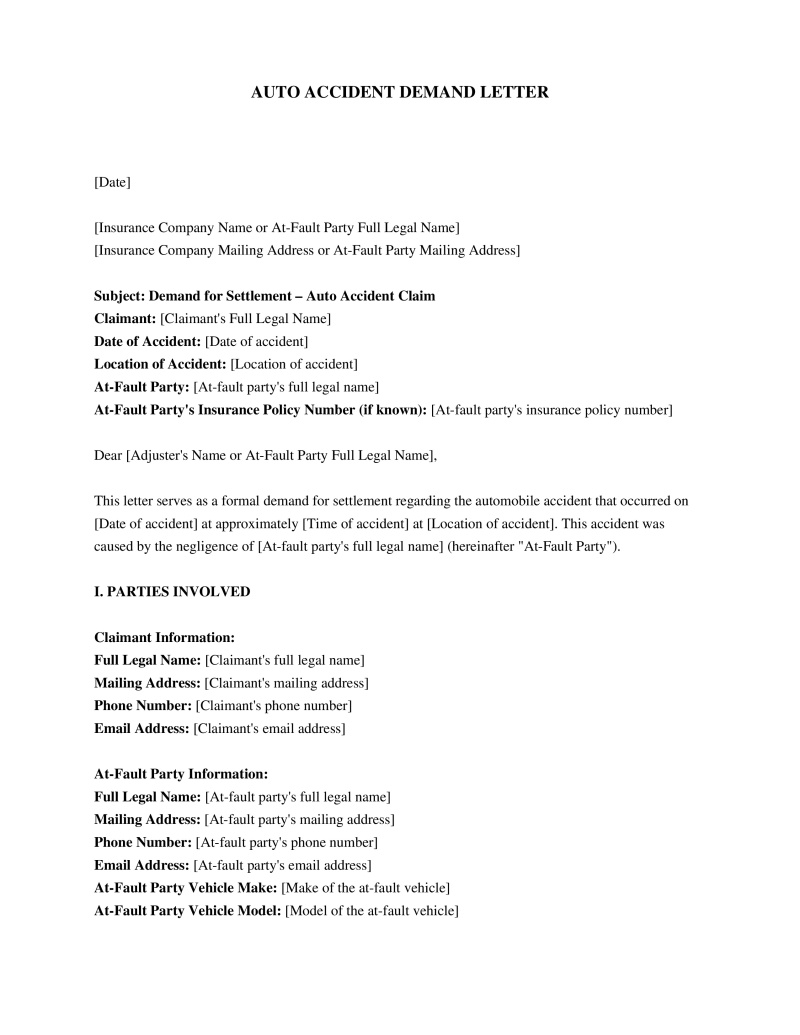
Auto (Car) Accident Demand Letter
An Auto (Car) Accident Demand Letter is a formal legal document issued by an injured party or their counsel to an at-fault driver or their insurer, outlining damages and asserting a claim for compensation.
Claimant Is Represented
Select 'Claimant' if you are the injured party or vehicle owner. Select 'Legal Representative' if you are acting on behalf of the claimant.
Enter the full legal name of the attorney, claims adjuster, or other representative.
If the representative is affiliated with a law firm or organization, enter its name.
Provide the complete mailing address for the legal representative.
Optional: Enter a phone number for follow-up.
Table of Contents
What is an Auto (Car) Accident Demand Letter?
An Auto Accident Demand Letter is a formal document typically sent by an injured party or their legal representative to the at-fault driver's insurance company, or directly to the at-fault driver, after a motor vehicle collision. Its primary purpose is to outline the facts of the accident, describe the injuries and damages sustained, and demand a specific amount of compensation to settle the claim without litigation. This letter serves as a crucial step in the pre-litigation negotiation process, aiming to resolve disputes efficiently.
Purpose and Function of a Demand Letter
The core function of an Auto Accident Demand Letter is to present a comprehensive summary of the claim to the opposing party or their insurer. It acts as a formal request for compensation, backed by evidence and legal arguments, before a lawsuit is filed. By clearly articulating the damages and the requested settlement amount, the letter encourages negotiation and potentially avoids the time and expense of court proceedings.
For instance, in certain contexts, a demand letter may serve a specific procedural role. The New York State Unified Court System provides a sample demand letter form, particularly for small claims cases in New York City Civil Court, illustrating its use in initiating a formal claim for damages (New York Courts). Similarly, the City of Houston Police Department outlines procedures for sending a 10-day demand letter, specifically for recovering a vehicle, which emphasizes a clear timeframe for response (City of Houston).
Key Components of a Demand Letter
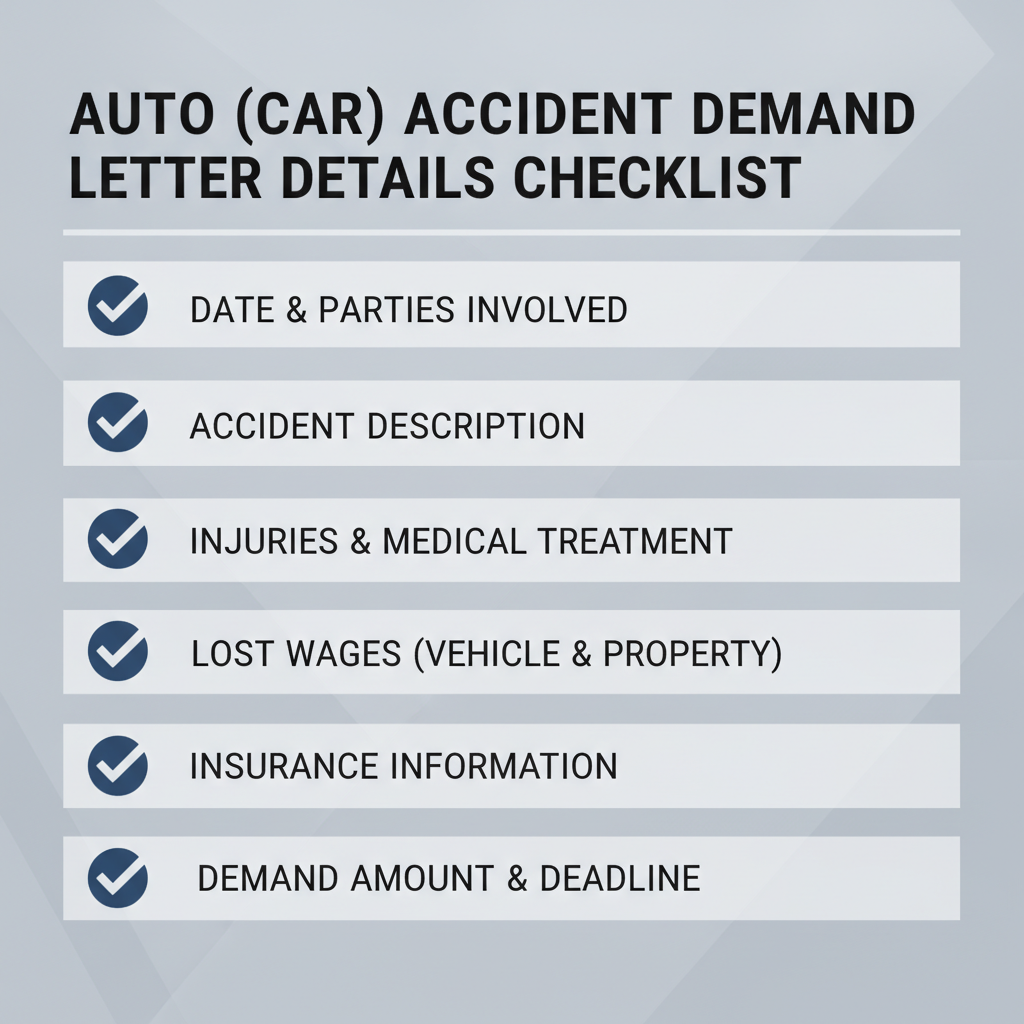
A well-structured Auto Accident Demand Letter typically includes several essential sections, each contributing to a clear and persuasive presentation of the claim. These components ensure all relevant information is provided to the recipient for proper evaluation.
- Date and Parties - The letter begins with the date and full contact information for the sender (the claimant or their attorney) and the recipient (the at-fault driver or their insurance company).
- Accident Details - A concise but thorough description of the accident, including the date, time, location, involved vehicles, and a brief narrative of how the accident occurred, assigning fault to the responsible party.
- Liability Argument - A clear explanation of why the recipient (or their insured) is legally responsible for the accident, often referencing traffic laws or negligence principles.
- Injuries Sustained - A detailed account of all physical injuries suffered by the claimant, including diagnoses, treatment received, prognosis, and any ongoing pain or limitations.
- Medical Treatment Summary - A chronological list of medical providers seen, types of treatment, and the total cost of medical bills incurred to date.
- Lost Wages and Other Economic Damages - Documentation of income lost due to inability to work, along with any other out-of-pocket expenses such as prescription costs, property damage, or transportation for medical appointments.
- Pain and Suffering (Non-Economic Damages) - A description of the emotional distress, physical pain, loss of enjoyment of life, and other non-monetary impacts resulting from the injuries.
- Supporting Documentation - A list of all enclosed evidence, which may include police reports, medical records, medical bills, wage loss verification, photographs of damage, and witness statements.
- Demand for Settlement - A specific monetary amount requested to resolve all aspects of the claim. This amount typically covers all economic and non-economic damages.
- Deadline for Response - A reasonable timeframe within which the recipient is expected to respond to the settlement offer, after which further legal action may be considered.
When to Send a Demand Letter
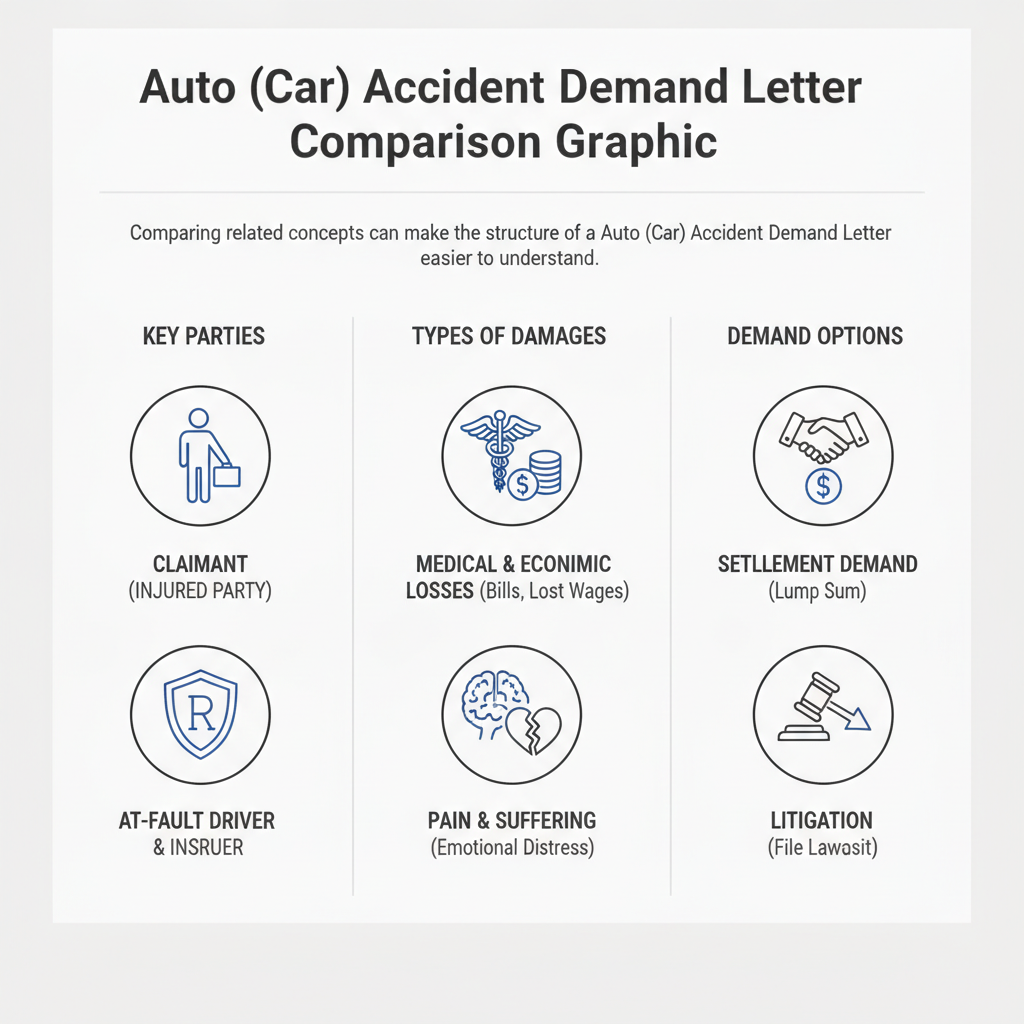
The timing for sending an Auto Accident Demand Letter is often strategic and depends on the claimant's medical recovery and the completeness of their damages. Generally, it is advisable to send the letter once the claimant has reached maximum medical improvement (MMI) or when their medical treatment is largely complete.
Sending the letter prematurely, before the full extent of injuries and associated costs is known, can lead to undervaluing the claim. Conversely, delaying too long might approach the statute of limitations for filing a lawsuit, which varies by jurisdiction. In specific scenarios, such as the City of Houston's procedure for vehicle recovery, a 10-day demand letter may be required, indicating a more immediate need for action (City of Houston).
Sending the Demand Letter and Potential Responses
After drafting the demand letter and compiling all supporting documentation, the next step involves its formal transmission. Proper delivery methods ensure proof of receipt and initiate the negotiation timeline.
- Delivery Method - Demand letters are typically sent via certified mail with a return receipt requested, or through a reputable courier service, to establish proof of delivery. Electronic delivery, such as email, may also be used in conjunction with physical mail.
- Documentation - Keep a complete copy of the sent letter and all enclosures, along with proof of mailing, for your records.
Upon receiving a demand letter, the insurance company or opposing party will review the presented evidence and may respond in several ways:
- Accept the Demand - The insurer may agree to pay the full demanded amount, leading to a settlement and release of liability.
- Issue a Counteroffer - More commonly, the insurer will offer a lower settlement amount, initiating a negotiation process.
- Deny the Claim - The insurer may deny liability or the extent of damages, requiring further negotiation or the filing of a lawsuit.
- Request Additional Information - The insurer may ask for more documentation or clarification before making a decision.
Claims Against Governmental Entities
Frequently Asked Questions
Sources
- Demand Letter | New York Courts - Provides a sample demand letter form for small claims cases in New York City Civil Court.
- 10-Day Demand Letter Procedures | City of Houston - Outlines procedures for sending a 10-day demand letter to recover a vehicle in Houston, Texas.
- Claim for Damages | Pierce County, WA - Details the process for filing a claim for damages against Pierce County, Washington.
Not the form you're looking for?
Try our legal document generator to create a custom document
Disclaimer: The templates available on this website are provided for general informational purposes only and do not constitute legal advice. They are not intended to be, and should not be interpreted as, compliant with any specific legal, regulatory, or privacy requirements. These templates are not a replacement for professional legal guidance and should not be relied upon for any particular matter or circumstance. Users are strongly encouraged to seek advice from a qualified attorney licensed in their jurisdiction before using, modifying, or relying on any template.
All templates are provided on an "as is," "with all faults," and "as available" basis. The provider disclaims any and all warranties of any kind, whether express, implied, statutory, or otherwise, including without limitation warranties of merchantability, fitness for a particular purpose, title, or non-infringement.
LegalTemplates.com makes no guarantees or representations regarding the accuracy, completeness, expected outcomes, or reliability of the materials contained in these templates or any materials referenced or linked from them.