Affidavit of Residency
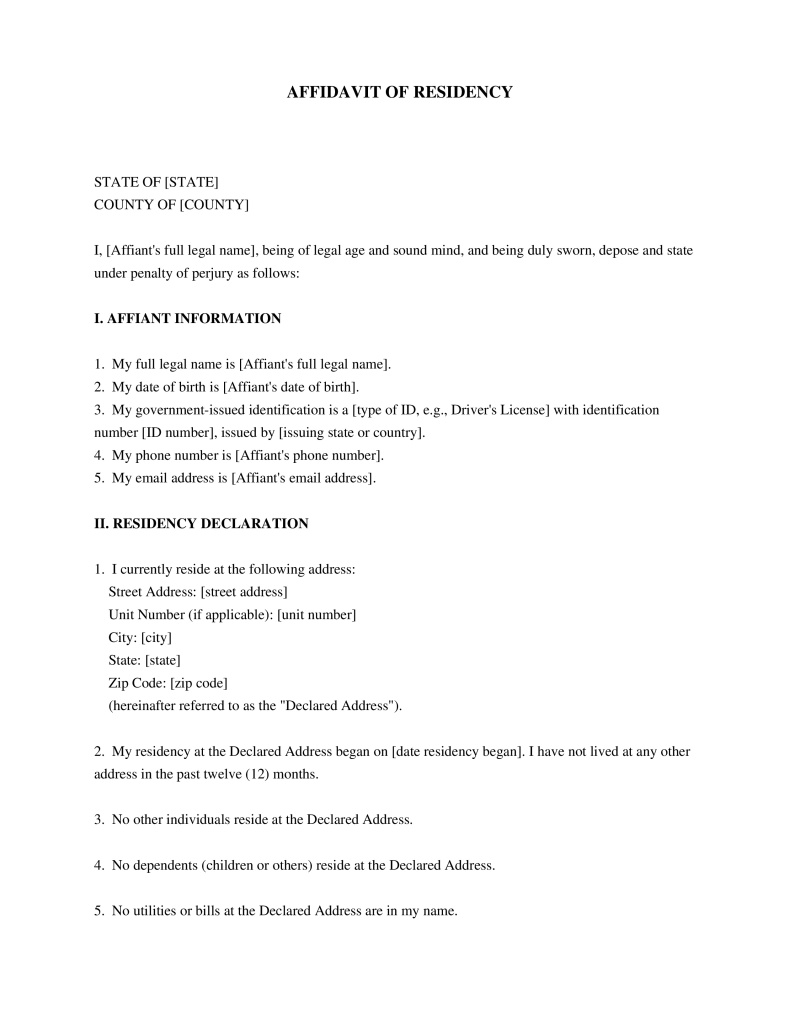
An Affidavit of Residency is a sworn legal statement, typically made under oath or affirmation, that formally attests to an individual's primary domicile or habitual place of abode for a specified duration.
Affidavit Purpose
Select the main reason you are providing this affidavit. This helps tailor the document for the intended recipient.
Provide details if your purpose is not listed above.
Table of Contents
What is an Affidavit of Residency?
An Affidavit of Residency is a legal document consisting of a sworn statement made by an individual to formally attest to their place of residence. This document is typically used to verify an individual's domicile for various official, administrative, or legal purposes. It serves as a declaration under oath, confirming that the person resides at a specific address within a particular jurisdiction.
Purpose and Common Uses
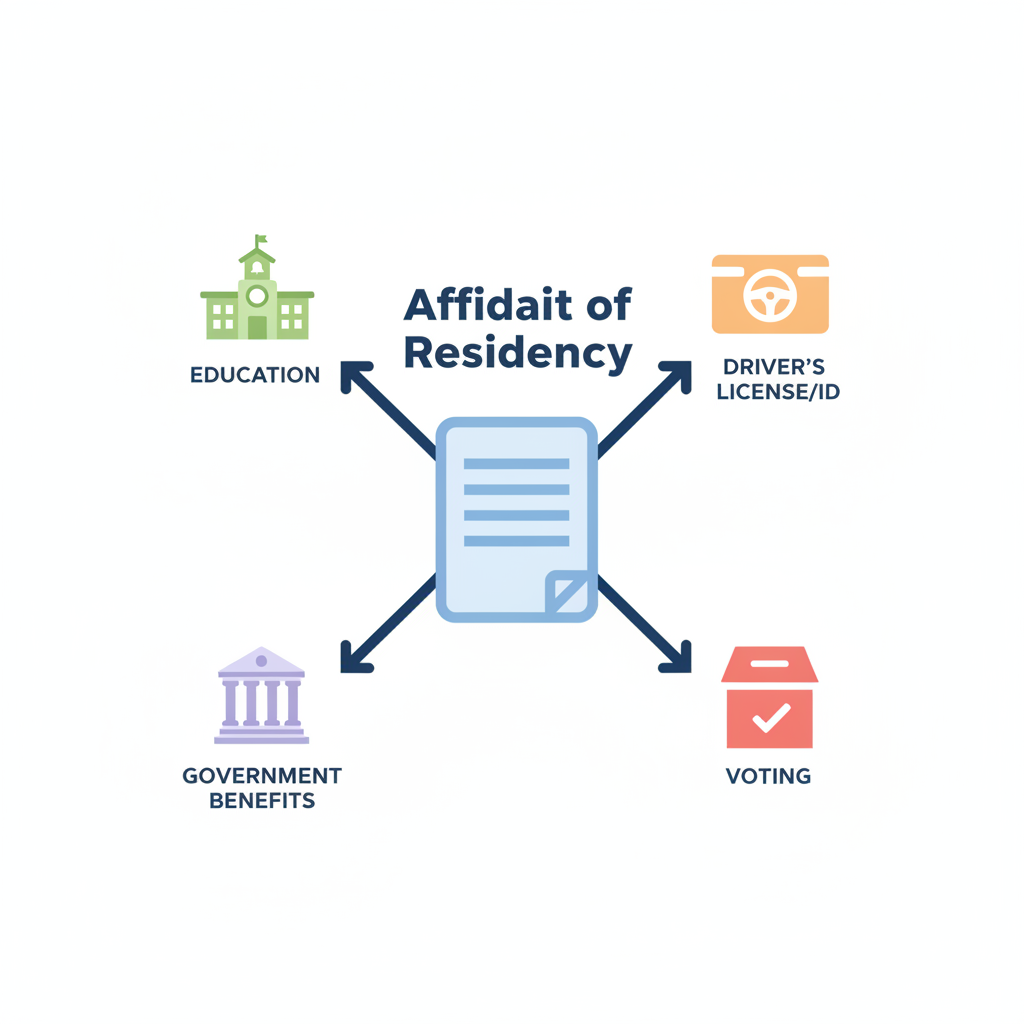
The primary purpose of an Affidavit of Residency is to establish and prove an individual's legal domicile when other forms of documentation may be insufficient or unavailable. Governmental agencies, educational institutions, and other organizations often require this affidavit to ensure compliance with residency-based rules and regulations. This helps prevent fraud and ensures that individuals receive benefits or services for which they are genuinely eligible based on their residency status.
- Educational Enrollment - Public schools, colleges, and universities frequently require proof of residency to determine eligibility for in-state tuition rates, local school district enrollment, or specific scholarships. For example, students in Monroe County, NY, and Broome County, NY, must apply for a Certificate of Residency to qualify for certain educational benefits, often requiring documentation like report cards or utility bills.
- Driver's Licenses and ID Cards - State departments of motor vehicles use affidavits to confirm residency for issuing driver's licenses and state identification cards. Texas, for instance, requires individuals to provide two documents verifying residency for these purposes, offering a Texas Residency Affidavit as an alternative if standard documents are not available.
- Government Benefits and Services - Eligibility for various state and local government programs, such as veteran benefits, housing assistance, or healthcare services, often hinges on residency. The U.S. Department of Veterans Affairs provides VA Form 10-2553, a Certificate of Residency, for veterans to confirm their residency status for specific programs.
- Taxation and Voting - Residency is a critical factor for determining an individual's tax obligations and eligibility to register and vote in local, state, and federal elections.
- Legal Proceedings - In certain legal cases, such as divorce, child custody, or probate, an Affidavit of Residency may be used to establish jurisdiction or confirm a party's domicile.
Key Elements and Information Included
An Affidavit of Residency typically contains specific information necessary to clearly identify the affiant (the person making the sworn statement) and the residential address being attested to. The document must be truthful and accurate, as any false statements made under oath can carry legal penalties.
- Affiant's Personal Information - Full legal name, current residential address, and contact information.
- Statement of Residency - A clear declaration that the affiant resides at the specified address. This often includes the date since which they have continuously resided there.
- Purpose of Affidavit - A brief explanation of why the affidavit is being submitted (e.g., for school enrollment, driver's license application).
- Supporting Documentation (if applicable) - A list or reference to any attached documents that further support the claim of residency, such as utility bills, lease agreements, or property tax statements.
- Signature of Affiant - The handwritten signature of the individual making the sworn statement.
- Notary Public Information - The signature, seal, and commission expiration date of the notary public who witnessed the signing.
Supporting Documentation for Residency
While an Affidavit of Residency is a sworn statement, it is often accompanied by or requires reference to other documents to substantiate the claim. These supporting documents provide objective evidence of continuous residence at the declared address. The specific types of documents accepted can vary by jurisdiction and the requesting entity.
Commonly accepted forms of documentation include:
- Utility Bills - Recent bills for services such as electricity, water, gas, or internet, showing the applicant's name and address.
- Lease Agreements or Mortgage Statements - A current lease or rental agreement, or a recent mortgage statement, indicating the residential address.
- Bank or Credit Card Statements - Official statements mailed to the residential address.
- Property Tax Statements - Documents showing property ownership and tax payments for the declared residence.
- Educational Records - Report cards, high school transcripts, or college enrollment verification showing the student's address (as seen in Monroe County, NY, and Broome County, NY, for Certificates of Residency).
- Government-Issued Mail - Correspondence from government agencies, such as the IRS or Social Security Administration, mailed to the residential address.
- Vehicle Registration or Insurance Documents - Documents showing the residential address for a registered vehicle.
In some cases, such as for a Texas driver's license or ID card, individuals are required to provide two documents verifying residency. If these are unavailable, a Texas Residency Affidavit can be used, often requiring the affiant to explain the circumstances.
Notarization and Legal Weight
For an Affidavit of Residency to be legally valid and enforceable, it typically requires notarization. Notarization is the process by which a notary public verifies the identity of the person signing the document and witnesses their signature. This process adds a layer of authenticity and legal weight to the sworn statement.
- Verification of Identity - The notary ensures that the person signing the affidavit is indeed the individual they claim to be, usually by checking a government-issued photo ID.
- Voluntary Signature - The notary confirms that the affiant is signing the document voluntarily and understands its contents.
- Sworn Oath or Affirmation - The affiant typically takes an oath or affirmation before the notary, swearing or affirming that the statements contained in the affidavit are true and correct to the best of their knowledge.
- Legal Consequences - Because an affidavit is a sworn statement, making false declarations within it can lead to legal penalties, including charges of perjury. This inherent legal risk reinforces the importance of providing accurate information.
Once notarized, the Affidavit of Residency becomes a legally binding document that can be presented to the requesting party as official proof of residence.
Distinction: Affidavit of Residency vs. Certificate of Residency
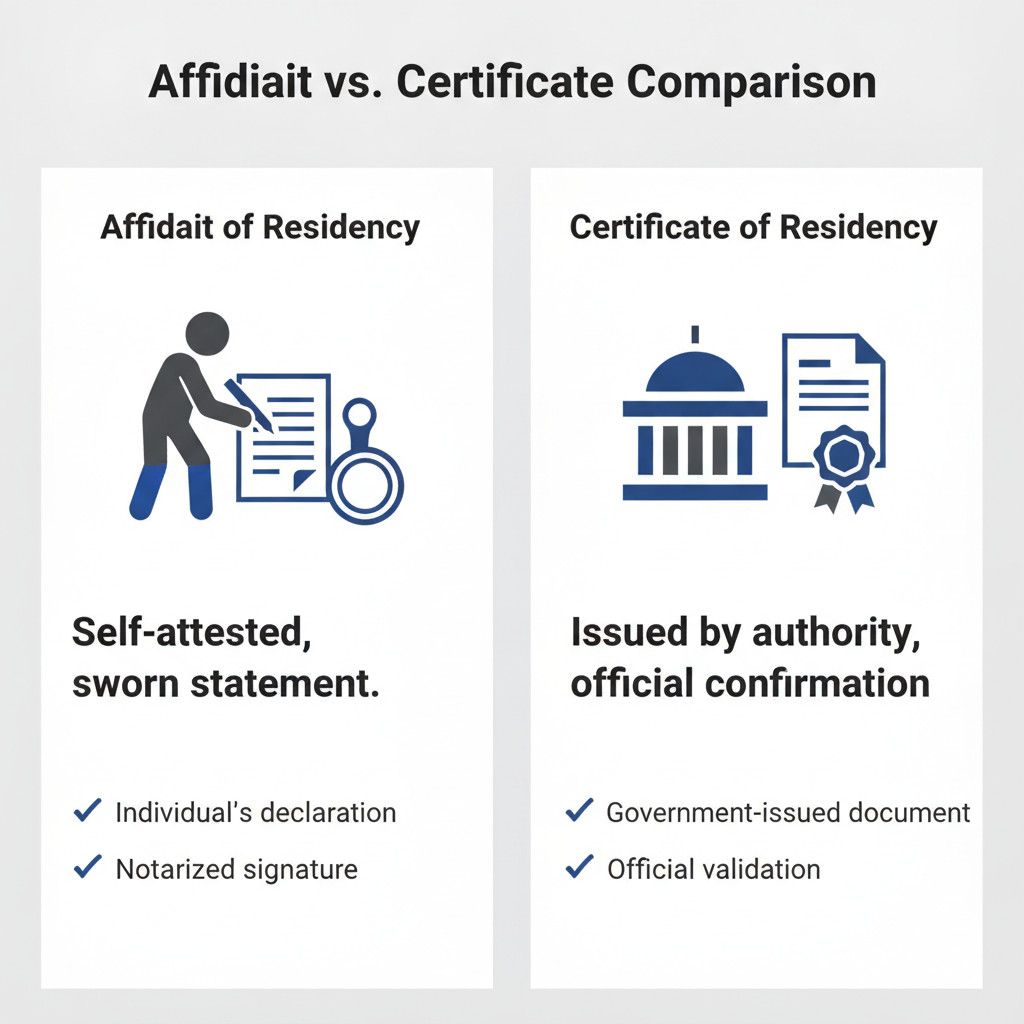
While often serving a similar purpose of verifying an individual's residence, the terms "Affidavit of Residency" and "Certificate of Residency" refer to distinct types of documents and processes. Understanding the difference is important when a specific document is requested.
- Affidavit of Residency - This is a self-attested, sworn statement made by an individual. The individual making the statement (the affiant) directly declares their residency under oath, typically before a notary public. The legal weight comes from the affiant's personal declaration and the notarization process. Massachusetts provides an Affidavit to Verify Massachusetts Residency, which residents can complete to confirm their status.
- Certificate of Residency - This is an official document issued by a governmental or institutional authority, certifying an individual's residency status. The authority itself, after reviewing submitted evidence, confirms the residency. Examples include the Certificate of Residency forms offered by Monroe County, NY, and Broome County, NY, for students, and VA Form 10-2553 from the U.S. Department of Veterans Affairs. These certificates are issued by the county or federal agency after a review of the applicant's submitted proof of address documents.
In essence, an affidavit is a statement by the individual, while a certificate is a statement from an authority about the individual's residency.
Frequently Asked Questions
Sources
- Certificate of Residency Form - Provides a Certificate of Residency form for students in Monroe County, NY, including requirements and acceptable proof of address documents.
- VA Form 10-2553 | Veterans Affairs - Provides the Certificate of Residency form (VA Form 10-2553) for veterans, including download link and related information.
- Affidavit to Verify Massachusetts Residency | Mass.gov - Offers an Affidavit to Verify Massachusetts Residency form, including instructions for online completion and submission.
- Certificate of Residency Instructions | Broome County - Details the requirements and application process for obtaining a Certificate of Residency in Broome County, NY.
- Texas Residency Requirement for Driver Licenses and ID Cards | Department of Public Safety - Explains the residency requirements for obtaining driver licenses and ID cards in Texas, including acceptable documents and the Texas Residency Affidavit.
Not the form you're looking for?
Try our legal document generator to create a custom document
Disclaimer: The templates available on this website are provided for general informational purposes only and do not constitute legal advice. They are not intended to be, and should not be interpreted as, compliant with any specific legal, regulatory, or privacy requirements. These templates are not a replacement for professional legal guidance and should not be relied upon for any particular matter or circumstance. Users are strongly encouraged to seek advice from a qualified attorney licensed in their jurisdiction before using, modifying, or relying on any template.
All templates are provided on an "as is," "with all faults," and "as available" basis. The provider disclaims any and all warranties of any kind, whether express, implied, statutory, or otherwise, including without limitation warranties of merchantability, fitness for a particular purpose, title, or non-infringement.
LegalTemplates.com makes no guarantees or representations regarding the accuracy, completeness, expected outcomes, or reliability of the materials contained in these templates or any materials referenced or linked from them.