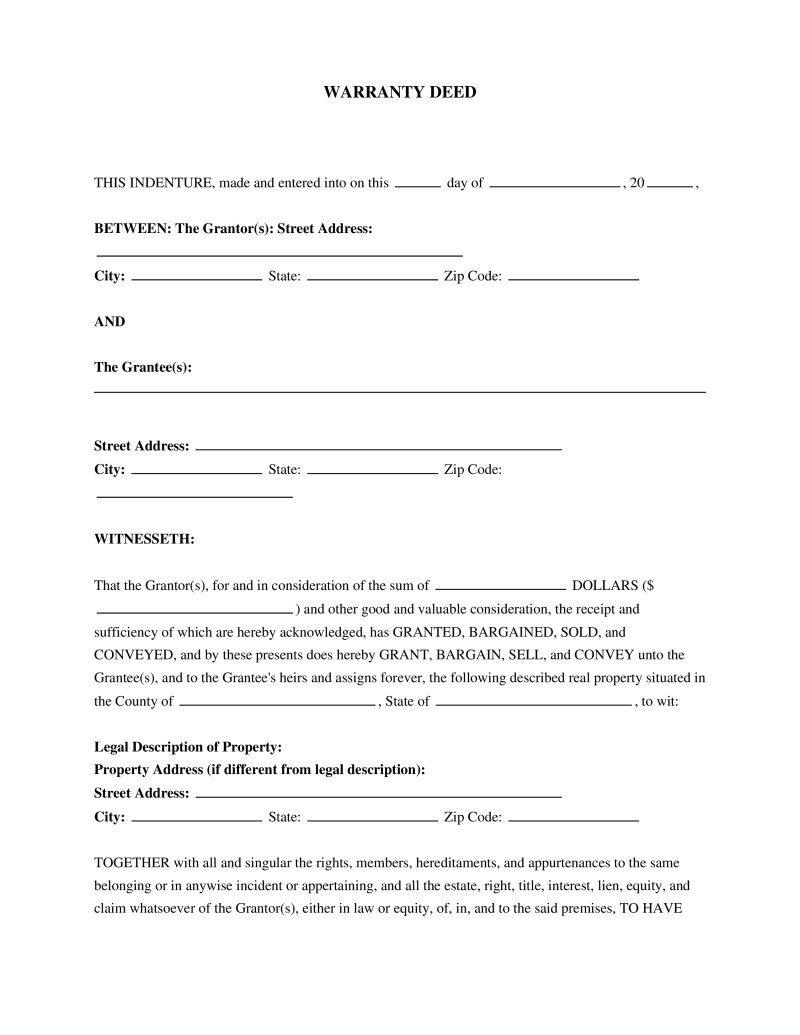
Warranty Deed
A Warranty Deed is a legal instrument that guarantees the grantor's clear title to real property and defends against future claims to ownership.
Type Of Ownership
Select the legal interest the Grantor is transferring. 'Fee Simple Absolute' is the most common and represents full ownership.
Provide details if 'Other' was selected above.
Table of Contents
What is a Warranty Deed?
A warranty deed is a legal instrument used to transfer real property ownership from one party (the grantor) to another (the grantee) with the highest level of protection for the grantee. It guarantees that the grantor holds clear title to the property, free from encumbrances, and has the legal right to sell it. This type of deed provides comprehensive assurances, including a promise to defend the grantee against any future claims to the title, making it a preferred choice in most residential and commercial real estate transactions.
Requirements
For a warranty deed to be legally effective and transferable, it must contain several fundamental components:
- Grantor and Grantee Identification - The full legal names and mailing addresses of both the current property owner (grantor) and the new owner (grantee) must be clearly stated.
- Statement of Consideration - The deed must include a statement indicating that consideration (something of value, typically money) has been exchanged for the property. While the exact purchase price is often omitted in public records, a nominal amount like "$10 and other good and valuable consideration" is commonly used.
- Granting Clause - This clause explicitly states the grantor's intention to transfer ownership of the property to the grantee. It typically uses language such as "grant, bargain, sell, and convey."
- Legal Description of Property - An accurate and unambiguous legal description of the property being transferred is essential. This is not a street address but a description based on surveys, metes and bounds, or lot and block numbers, ensuring the property can be precisely identified.
- Habendum Clause - This clause defines the extent of the ownership interest being conveyed, typically stating "to have and to hold." In a warranty deed, it confirms the transfer of fee simple absolute ownership.
- Warranties and Covenants - The specific promises made by the grantor regarding the title are detailed, including covenants of seisin, right to convey, against encumbrances, quiet enjoyment, and further assurances.
- Execution and Acknowledgment - The grantor must sign the deed in the presence of a notary public. The notary's acknowledgment verifies the grantor's identity and confirms the signature was made voluntarily.
- Delivery and Acceptance - The deed must be physically or constructively delivered by the grantor to the grantee, and the grantee must accept the deed for the transfer to be complete.
Covenants of Title
A warranty deed provides the grantee with five key covenants or promises regarding the property's title. These covenants offer significant protection, as they allow the grantee to sue the grantor if a defect in the title arises, even if the defect existed before the grantor owned the property:
- Covenant of Seisin - The grantor promises that they are the rightful owner of the property and hold the title being conveyed. This means the grantor actually possesses the estate they claim to convey.
- Covenant of Right to Convey - The grantor warrants that they have the legal authority to transfer the property. This covenant is closely related to the covenant of seisin but specifically addresses the grantor's legal capacity to execute the deed.
- Covenant Against Encumbrances - The grantor guarantees that the property is free from undisclosed liens, mortgages, easements, or other encumbrances that would diminish its value or use. If an undisclosed encumbrance is later discovered, the grantee can seek damages.
- Covenant of Quiet Enjoyment - The grantor promises that the grantee's possession of the property will not be disturbed by any third-party claims to a superior title. This protects the grantee from future challenges to their ownership.
- Covenant of Further Assurances - The grantor agrees to perform any reasonable acts necessary to perfect the title for the grantee, should any defects or omissions be discovered in the future. This might include signing additional documents or taking legal action.
How to Complete a Warranty Deed
The process of preparing and executing a warranty deed involves several crucial steps to ensure legal compliance and proper title transfer:
- Gather Necessary Information - Begin by collecting all pertinent details for the deed. This includes the full legal names and current mailing addresses of both the grantor(s) and grantee(s), the precise legal description of the property (found on the previous deed or property tax records), and the consideration being exchanged. Ensure all names are spelled correctly and addresses are up-to-date.
- Draft the Deed Document - Using a state-specific warranty deed form or template, accurately input all the gathered information. This includes the granting clause, the habendum clause, and explicitly stating the five covenants of title. It is crucial to use the exact legal description to avoid ambiguity or future title disputes.
- Review and Verify Content - Carefully review the entire drafted deed for accuracy and completeness. Double-check all names, addresses, the legal description, and the consideration. Any errors, even minor ones, could invalidate the deed or cause significant issues during recording or future transactions. Consider having a legal professional review the document.
- Sign and Acknowledge the Deed - The grantor(s) must sign the warranty deed in the presence of a notary public. The notary will verify the grantor's identity and witness the signature, then affix their seal and signature to acknowledge the document. Some states may require additional witnesses in addition to the notary.
- Deliver the Deed to the Grantee - After proper execution, the grantor must deliver the original signed and notarized deed to the grantee. Legal delivery signifies the grantor's intent to transfer title and the grantee's acceptance of that title. Delivery can be actual (physical handover) or constructive (intent to deliver is clear, even if not physically handed over immediately).
- Record the Deed with the County Recorder - The grantee should promptly record the warranty deed with the county recorder's office (or equivalent) in the jurisdiction where the property is located. Recording provides public notice of the transfer of ownership, protecting the grantee's interest against subsequent claims. A recording fee will typically be required.
Applicable Laws and Penalties
The creation, execution, and recording of warranty deeds are primarily governed by state law, though some federal regulations may indirectly impact property transfers.
Federal Considerations
While no single federal law directly dictates the form or substance of a warranty deed, certain federal statutes influence aspects of property transactions:
- Residential Lead-Based Paint Hazard Reduction Act - Requires sellers of homes built before 1978 to disclose known lead-based paint hazards and provide a lead hazard pamphlet to purchasers (42 U.S.C. § 4852d). Failure to comply can result in civil penalties.
- Real Estate Settlement Procedures Act (RESPA) - Governs the settlement process for most residential mortgages, requiring disclosures about closing costs and prohibiting certain practices like kickbacks (12 U.S.C. § 2601 et seq.). While not directly about deeds, it affects the transaction surrounding the deed transfer.
State Laws and Requirements
Each state has specific statutes governing real property transfers, including the precise requirements for a valid warranty deed. These laws cover aspects such as:
- Deed Form and Content - State statutes often prescribe statutory forms or minimum content requirements for deeds to be considered valid and recordable (e.g., California Civil Code § 1092; Florida Statutes § 689.02).
- Execution Requirements - Laws specify the number of witnesses required (if any, beyond a notary), acknowledgment procedures, and the format for signatures and notary seals (e.g., Texas Property Code § 12.001).
- Recording Procedures - Each county recorder's office operates under state law regarding how deeds are filed, the fees involved, and the timelines for recording (e.g., New York Real Property Law § 291).
- Transfer Taxes and Fees - Many states and local jurisdictions impose transfer taxes or documentary stamp taxes on the sale of real property, which must be paid at the time of recording (e.g., Florida Statutes Chapter 201; California Revenue and Taxation Code § 11911).
- Homestead Exemptions - State laws often provide homestead protection, requiring both spouses to sign a deed to convey a marital homestead, even if only one spouse is on the title (e.g., Florida Constitution Article X, Section 4; Texas Property Code § 41.002).
Penalties for Non-Compliance
Failure to adhere to the legal requirements for a warranty deed can lead to significant consequences:
- Invalid Deed - If a deed lacks essential elements (e.g., proper legal description, grantor's signature, acknowledgment), it may be deemed invalid, failing to transfer legal title.
- Unrecordable Deed - A deed that does not meet state or local recording requirements (e.g., incorrect formatting, missing notary seal) will be rejected by the recorder's office, preventing public notice of the transfer.
- Title Disputes - Errors or omissions in a deed can lead to future disputes over ownership, boundaries, or encumbrances, potentially requiring costly litigation to resolve.
- Liability for Grantor - If a grantor makes false warranties in a warranty deed, they can be sued by the grantee for breach of covenant, potentially incurring significant financial damages.
- Loss of Protection for Grantee - An unrecorded deed leaves the grantee vulnerable to subsequent claims against the property by third parties who may not have notice of the grantee's ownership.
Frequently Asked Questions
Not the form you're looking for?
Try our legal document generator to create a custom document
Disclaimer: The templates available on this website are provided for general informational purposes only and do not constitute legal advice. They are not intended to be, and should not be interpreted as, compliant with any specific legal, regulatory, or privacy requirements. These templates are not a replacement for professional legal guidance and should not be relied upon for any particular matter or circumstance. Users are strongly encouraged to seek advice from a qualified attorney licensed in their jurisdiction before using, modifying, or relying on any template.
All templates are provided on an "as is," "with all faults," and "as available" basis. The provider disclaims any and all warranties of any kind, whether express, implied, statutory, or otherwise, including without limitation warranties of merchantability, fitness for a particular purpose, title, or non-infringement.
LegalTemplates.com makes no guarantees or representations regarding the accuracy, completeness, expected outcomes, or reliability of the materials contained in these templates or any materials referenced or linked from them.