Lease Agreement Addendum
Create Lease Agreement Addendum
Lease Agreement Addendum
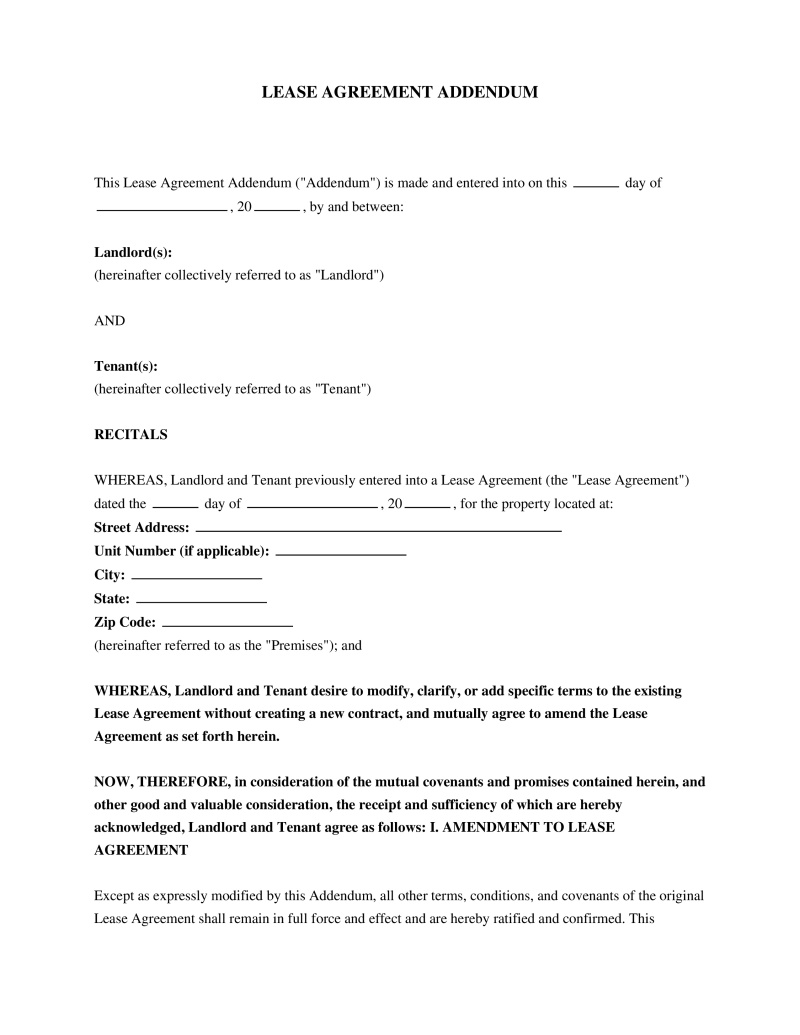
A Lease Agreement Addendum is a legal instrument that modifies or supplements the terms and conditions of an existing lease agreement without necessitating the creation of an entirely new contract.
Answer the question(s) below to create your Lease Agreement Addendum
Addendum Type
Select the main reason for this addendum. You can specify more details later.
Provide a brief description if you selected 'Other'.
Table of Contents
What is a Lease Agreement Addendum?
A lease agreement addendum is a legally binding document that is attached to an existing lease agreement, modifying or adding terms and conditions to the original contract. It serves to incorporate new provisions without requiring the complete renegotiation or rewriting of the entire lease. Both landlords and tenants utilize addenda to address specific situations, clarify existing clauses, or introduce new rules that were not part of the initial agreement.
Purpose and Function of an Addendum
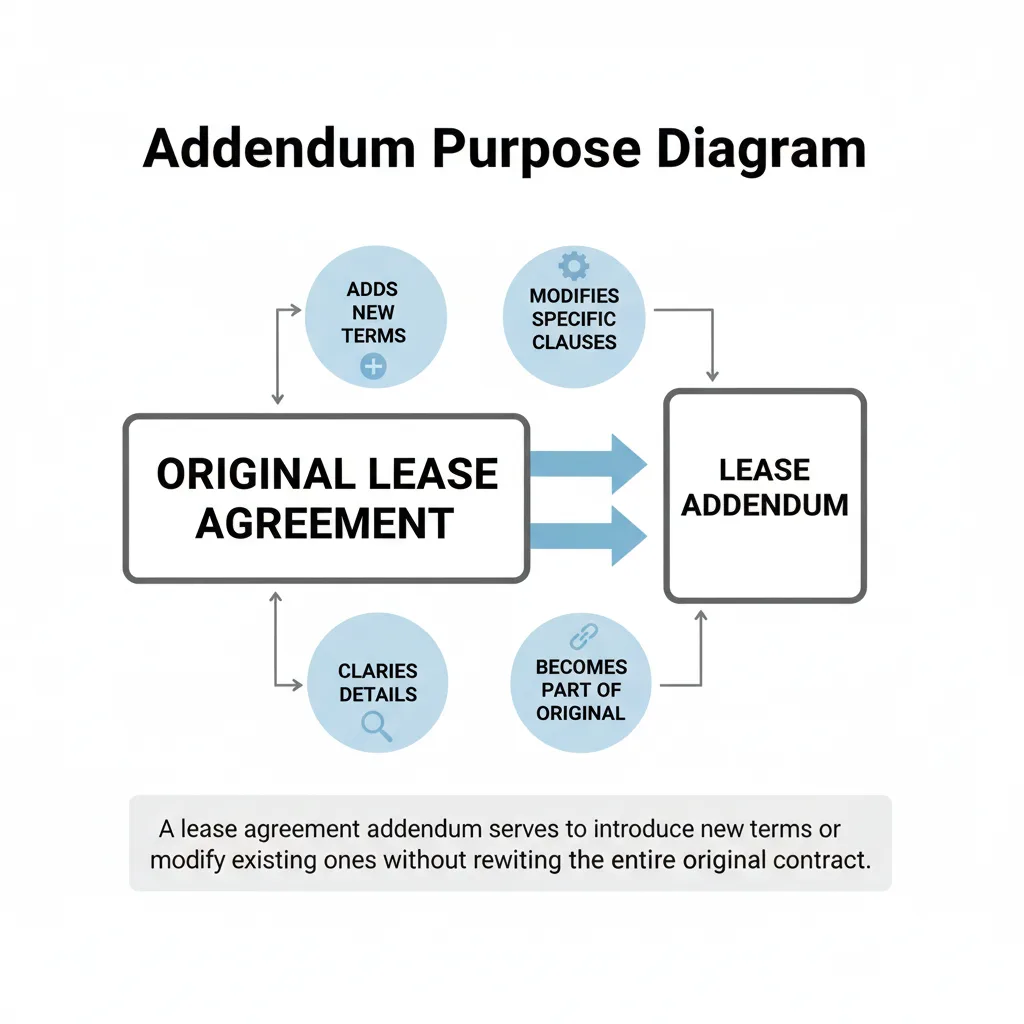
The primary purpose of a lease agreement addendum is to provide flexibility and adaptability to a long-term contractual relationship, such as a lease. Instead of drafting an entirely new lease, which can be time-consuming and redundant, an addendum allows parties to efficiently introduce changes or supplementary details. This ensures that the lease remains a comprehensive and current reflection of the agreement between the landlord and tenant.
Addenda are typically used when circumstances change or when specific details need to be addressed that were not foreseen or included in the original lease document. They become an integral part of the original lease once executed, meaning their terms are just as enforceable as those within the main agreement. This integration helps maintain the legal continuity and enforceability of the overall tenancy agreement.
Common Scenarios for Using an Addendum
Lease addenda are employed in a wide array of situations to tailor a standard lease agreement to particular needs or to respond to evolving conditions during a tenancy. Their utility lies in their ability to address specific concerns without overhauling the foundational contract.
Typical circumstances requiring a lease addendum include:
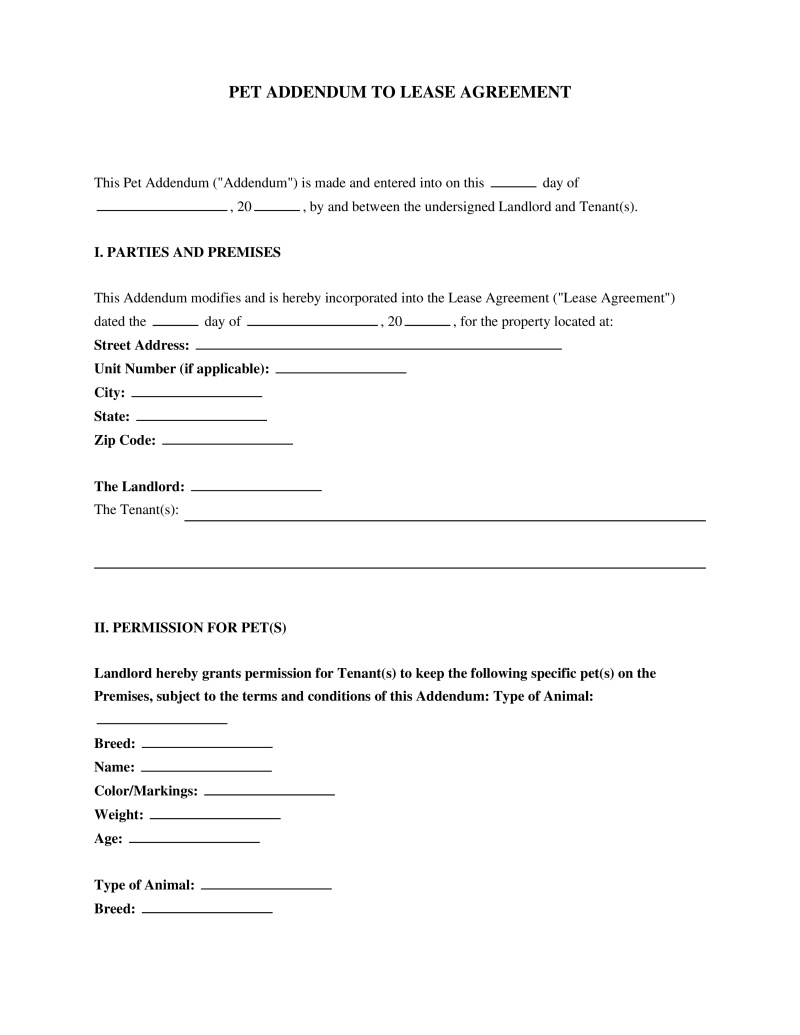
- Pet Policies - Introducing rules regarding pets, including types, sizes, number allowed, and any associated fees or deposits.
- Smoking Restrictions - Establishing limitations or prohibitions on smoking within the leased premises or common areas.
- Parking Arrangements - Specifying designated parking spaces, guest parking rules, or vehicle restrictions.
- Occupant Changes - Adding or removing tenants from the lease agreement.
- Appliance Additions - Detailing responsibilities for new appliances provided by the landlord or brought by the tenant.
- Maintenance Responsibilities - Clarifying specific maintenance duties for certain areas or items not explicitly covered in the main lease.
- Lead-Based Paint Disclosure - For properties built before 1978, federal law requires disclosure of known lead-based paint hazards (42 U.S.C. § 4852d).
- Early Termination Clauses - Outlining conditions and penalties for a tenant wishing to break the lease prematurely.
Key Elements of a Lease Agreement Addendum
For a lease agreement addendum to be legally sound and enforceable, it must contain several crucial components. These elements ensure clarity, proper identification of the parties and the original agreement, and mutual consent to the new terms.
Essential information commonly found in an addendum includes:
- Identification of Parties - Full legal names of all landlords and tenants involved in the original lease.
- Reference to Original Lease - Clear identification of the original lease agreement, including the date it was signed and the address of the leased property. This links the addendum directly to the primary contract.
- Effective Date - The specific date on which the terms of the addendum become active.
- New or Modified Terms - A precise and unambiguous description of the new clauses, rules, or conditions being added or changed. This section must be detailed to avoid misinterpretation.
- Statement of Integration - A clause explicitly stating that the addendum is attached to and becomes a part of the original lease agreement.
- Signatures of All Parties - Signatures of all landlords and tenants who are party to the original lease, indicating their mutual agreement and consent to the addendum's terms.
- Date of Signatures - The date each party signs the addendum.
Types of Lease Agreement Addenda
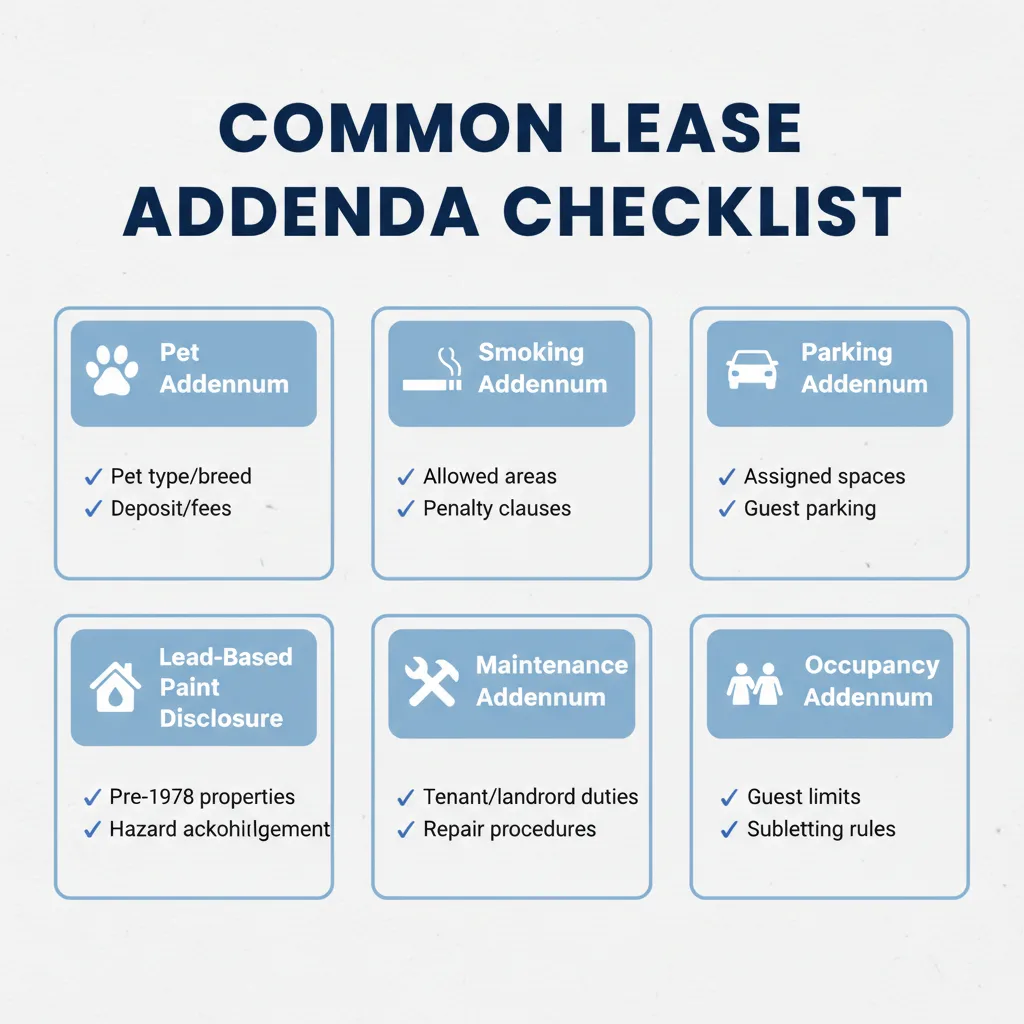
Addenda can be categorized by the specific subject matter they address, providing a structured way to manage various aspects of a tenancy. Each type serves to introduce particular rules or disclosures relevant to that specific area.
- Pet Addendum - Specifies whether pets are allowed, lists the types and number of pets, outlines pet fees or deposits, and details rules for pet behavior and owner responsibilities.
- Smoking Addendum - Prohibits or restricts smoking within the rental unit or on the property, often specifying designated smoking areas if any.
- Lead-Based Paint Disclosure Addendum - Mandated for rental properties built before 1978, this addendum informs tenants of the presence of lead-based paint hazards and provides an EPA-approved pamphlet.
- Parking Addendum - Allocates specific parking spaces, outlines rules for guest parking, and may include provisions for vehicle registration or towing policies.
- Maintenance Addendum - Clarifies or expands upon the maintenance responsibilities of both the landlord and the tenant for specific items or areas not fully detailed in the main lease.
- Occupancy Addendum - Addresses limits on the number of occupants, rules for long-term guests, or procedures for adding or removing tenants.
- Storage Addendum - Defines the use of any storage facilities provided with the rental unit, including access, size, and permitted items.
Addendum vs. Amendment: Key Distinctions
While often used interchangeably in casual conversation, a lease addendum and a lease amendment serve distinct purposes in modifying a contract. Understanding the difference is crucial for proper legal documentation.
An addendum is used to add new terms, conditions, or disclosures to an existing lease agreement without altering the original language of the main contract. It is a supplementary document that expands upon the original terms by including new provisions. For example, a pet policy would be an addendum because it introduces a new set of rules not present in the original lease.
An amendment, on the other hand, is used to change or modify existing terms within the original lease agreement. It directly alters or replaces specific clauses that were already part of the initial contract. For instance, changing the monthly rent amount, adjusting the lease term, or modifying a clause about utility responsibilities would typically be done through an amendment. Amendments explicitly state which original clause is being changed and what the new wording will be.
Legal Considerations and Enforceability
For a lease agreement addendum to be legally valid and enforceable, it must adhere to certain fundamental legal principles. These principles ensure that all parties are aware of and consent to the changes or additions.
Key legal considerations include:
- Mutual Assent - Both the landlord and all tenants named on the original lease must agree to the terms of the addendum. This is typically demonstrated through their signatures.
- Written Form - Addenda should always be in writing. Oral agreements to modify a written lease are generally difficult to prove and may not be enforceable.
- Consideration - In contract law, consideration refers to something of value exchanged between the parties. While often implicit in ongoing lease relationships, it reinforces the binding nature of the agreement.
- Integration with Original Lease - The addendum must clearly state its intention to be incorporated into and become a part of the original lease agreement.
- Compliance with Law - The terms of the addendum cannot violate any existing federal, state, or local landlord-tenant laws. For example, an addendum cannot waive a tenant's right to habitable living conditions.
- Clarity and Specificity - The language used in the addendum must be clear, unambiguous, and specific about the new or modified terms to prevent future disputes.
Frequently Asked Questions
Yes, an addendum can be added at any point during the lease term, provided all parties involved mutually agree to the new terms. Both the landlord and all tenants must sign the addendum for it to become legally binding.
Yes, typically all adult tenants named on the original lease agreement must sign the addendum for it to be legally enforceable against them. This ensures that everyone bound by the original contract also consents to the new terms.
If a tenant refuses to sign an addendum, the new terms generally do not become part of the existing lease agreement. The original lease terms remain in effect, unless the original lease contains a clause allowing unilateral modification under specific conditions.
An addendum generally should not contradict the original lease directly, but rather supplement or clarify it. If a direct contradiction occurs, the addendum might supersede the original clause if it explicitly states its intent to modify, or it could lead to ambiguity if not carefully drafted.
While some verbal agreements can be binding, it is strongly advised that all lease addenda be in writing and signed by all parties. Verbal agreements regarding lease modifications are often difficult to prove and enforce in a legal context.
Generally, a lease addendum does not require notarization to be legally binding. Signatures of all parties are usually sufficient to demonstrate mutual agreement and intent to be bound by the new terms.
Related Documents
Forms commonly used with Lease Agreement Addendum.
Not the form you're looking for?
Try our legal document generator to create a custom document
Disclaimer: The templates available on this website are provided for general informational purposes only and do not constitute legal advice. They are not intended to be, and should not be interpreted as, compliant with any specific legal, regulatory, or privacy requirements. These templates are not a replacement for professional legal guidance and should not be relied upon for any particular matter or circumstance. Users are strongly encouraged to seek advice from a qualified attorney licensed in their jurisdiction before using, modifying, or relying on any template.
All templates are provided on an "as is," "with all faults," and "as available" basis. The provider disclaims any and all warranties of any kind, whether express, implied, statutory, or otherwise, including without limitation warranties of merchantability, fitness for a particular purpose, title, or non-infringement.
LegalTemplates.com makes no guarantees or representations regarding the accuracy, completeness, expected outcomes, or reliability of the materials contained in these templates or any materials referenced or linked from them.