Caregiver Contract
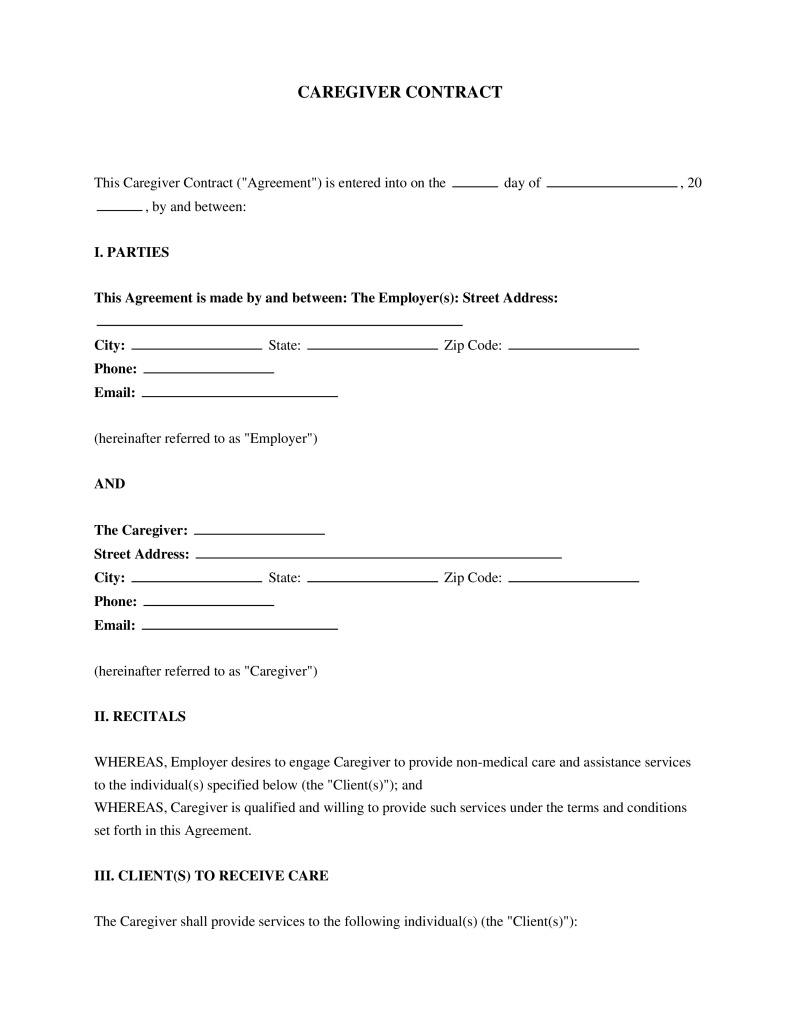
A Caregiver Contract is a legal agreement outlining the terms of services provided by a caregiver, including duties, compensation, and responsibilities.
Care Recipient Full Name
Enter the complete legal name of the individual who will receive care.
Provide the main address where care will be provided.
Enter the birth date of the care recipient.
Select 'Yes' if you are hiring a caregiver for more than one person.
Enter the complete legal name of the second individual receiving care.
Provide the main address for the second care recipient.
Select 'Yes' if you are hiring a caregiver for a third person.
Enter the complete legal name of the third individual receiving care.
Provide the main address for the third care recipient.
Table of Contents
What is a Caregiver Contract?
A caregiver contract (personal care agreement or elder care contract) is a legally binding document that outlines the terms and conditions of care services provided to an individual, often an elderly or disabled family member. Its primary purpose is to formalize the care arrangement, specifying the responsibilities of the caregiver, the needs of the care recipient, and the compensation structure. This document is frequently utilized by families seeking to ensure clarity, prevent misunderstandings, and establish a clear record of care services, particularly for purposes related to financial planning and potential Medicaid eligibility.
Requirements
For a caregiver contract to be considered legally valid and enforceable, it must satisfy several fundamental elements common to all contracts. These elements ensure that both parties understand and agree to the terms, and that the agreement serves a legitimate purpose. The absence of any of these components can render the contract void or voidable.
- Offer and Acceptance - One party must propose specific terms for care services, and the other party must unequivocally agree to those terms.
- Consideration - There must be an exchange of value between the parties. Typically, the caregiver provides services, and the care recipient (or their representative) provides financial compensation or other agreed-upon benefits.
- Legal Purpose - The objective of the contract must be lawful and not violate any public policy. Services provided must be legitimate care activities.
- Capacity to Contract - Both the caregiver and the care recipient must be of sound mind, of legal age, and competent to understand the terms and consequences of the agreement. If the care recipient lacks capacity, their legally appointed representative (e.g., power of attorney or guardian) must sign on their behalf.
- Written Form - While not always strictly required for all contracts, a caregiver contract should always be in writing to ensure clarity, provide evidence of the agreement, and prevent future disputes. This is especially crucial for financial and tax purposes, and for Medicaid planning.
- Specific Terms - The contract must clearly define the scope of services, compensation, schedule, and duration to avoid ambiguity.
How to Complete
Creating a comprehensive caregiver contract involves several crucial steps to ensure all essential aspects of the care arrangement are clearly documented and legally sound. Diligence in each step helps prevent future misunderstandings and disputes.
- Identify Parties and Scope of Care - Begin by clearly identifying the full legal names and addresses of both the caregiver and the care recipient. Detail the specific needs of the care recipient, such as assistance with activities of daily living (ADLs), instrumental activities of daily living (IADLs), medication management, or companionship. This initial assessment forms the foundation for defining the services.
- Define Services and Schedule - Create an exhaustive list of all services the caregiver will provide, including specific tasks like bathing, dressing, meal preparation, transportation, light housekeeping, and errands. Establish a clear schedule, specifying the days of the week, hours per day, and total weekly hours the caregiver will work. Define how additional hours or emergency services will be handled and compensated.
- Determine Compensation and Payment Terms - Outline the agreed-upon rate of pay, whether hourly, daily, weekly, or a fixed monthly stipend. Specify the payment frequency (e.g., weekly, bi-weekly) and the method of payment (e.g., direct deposit, check). Clearly state whether the compensation includes benefits like paid time off, holidays, or mileage reimbursement, and detail any provisions for annual raises or performance reviews.
- Establish Term and Termination Conditions - Define the start date of the agreement and whether it is for a fixed term (e.g., one year) or ongoing until terminated. Crucially, include specific conditions under which either party can terminate the contract, such as a notice period (e.g., 30 days written notice), breach of contract, or a change in the care recipient's health status. Outline procedures for final payment upon termination.
- Address Contingencies and Dispute Resolution - Include provisions for unforeseen circumstances, such as the caregiver's illness, vacation, or the care recipient's hospitalization. Specify how these situations will affect the schedule and compensation. Additionally, consider including a clause for dispute resolution, such as mediation or arbitration, to provide a structured approach for resolving disagreements outside of court.
- Review, Sign, and Distribute - Before signing, both parties should thoroughly review the entire contract, preferably with independent legal counsel, to ensure full understanding and agreement with all terms. Once satisfied, both the caregiver and the care recipient (or their legal representative) must sign and date the document. Each party should receive a signed copy for their records, and it is advisable to have the document notarized for added legal weight.
Rights and Obligations
A well-drafted caregiver contract clearly delineates the rights and obligations of both the caregiver and the care recipient, fostering a transparent and mutually respectful relationship. Understanding these responsibilities is vital for the effective implementation of the care plan and for upholding the legal integrity of the agreement.
The caregiver's obligations typically include:
- Provision of Services - The primary obligation is to deliver the specific care services as detailed in the contract, adhering to the agreed-upon schedule and standards of care.
- Professional Conduct - Maintaining a professional demeanor, respecting the care recipient's privacy and dignity, and acting in their best interest.
- Communication - Regularly communicating with the care recipient and their designated family members or representatives regarding the care recipient's condition, needs, and any changes in the care plan.
- Record Keeping - Maintaining accurate records of services provided, hours worked, and any significant observations or incidents.
- Confidentiality - Protecting the care recipient's personal, medical, and financial information, often guided by privacy regulations.
The care recipient's obligations (or their legal representative's) typically include:
- Timely Compensation - Ensuring the caregiver receives payment for services rendered according to the terms specified in the contract.
- Safe Environment - Providing a safe, clean, and appropriate working environment for the caregiver.
- Cooperation - Cooperating with the caregiver in receiving care and providing necessary information relevant to their health and well-being.
- Respectful Treatment - Treating the caregiver with respect and dignity.
- Disclosure of Relevant Information - Informing the caregiver of any significant changes in health status or care needs that may impact the services provided.
When a family member acts as a caregiver, their rights and obligations are largely similar, but the contract helps to distinguish their role as an employee or independent contractor from their familial relationship. This distinction is crucial for tax purposes, employment law compliance, and potential Medicaid eligibility considerations.
Applicable Federal and State Laws
Caregiver contracts operate within a complex framework of federal and state laws, which can significantly impact their formation, enforcement, and implications. Understanding these legal contexts is essential for both caregivers and care recipients.
Federal Statutes
Several federal laws govern aspects of employment, privacy, and financial planning that can affect caregiver contracts:
- Fair Labor Standards Act (FLSA) - Establishes minimum wage, overtime pay, recordkeeping, and youth employment standards affecting employees in the private sector and in federal, state, and local governments (29 U.S.C. § 201 et seq.). The application to domestic service workers, including caregivers, has specific exemptions and considerations.
- Social Security Act - Governs the Social Security and Medicare programs, including the collection of FICA taxes (Social Security and Medicare) from wages paid to employees (42 U.S.C. § 301 et seq.). This is highly relevant if the caregiver is considered an employee.
- Health Insurance Portability and Accountability Act (HIPAA) - Sets national standards for the protection of protected health information (PHI) (45 CFR § 164.508). While a private caregiver contract itself isn't directly covered by HIPAA unless the caregiver is a "covered entity," the principles of patient privacy are paramount, and a contract can incorporate HIPAA-like confidentiality clauses.
State Laws and Requirements
State laws play a significant role, particularly concerning contract enforceability, labor standards, and Medicaid eligibility:
- State Contract Law Principles - Each state has statutes and common law governing the formation, interpretation, and enforcement of contracts, including requirements for offer, acceptance, consideration, and capacity (e.g., California Civil Code § 1549 et seq.).
- State Labor Laws - States often have their own minimum wage, overtime, workers' compensation, and unemployment insurance laws that may apply to caregivers, sometimes offering greater protections than federal law (e.g., New York Labor Law § 650 et seq.).
- Medicaid Look-Back Period and Transfer Rules - State Medicaid programs have specific rules regarding asset transfers for less than fair market value, often imposing a "look-back period" (typically five years) before applying for long-term care benefits (e.g., N.Y. Soc. Serv. Law § 366). A properly structured caregiver contract, demonstrating fair market value compensation for services, can help avoid penalties.
- Uniform Commercial Code (UCC) - While primarily governing commercial transactions for goods, the UCC's general principles of good faith and fair dealing can sometimes be referenced in contract disputes, though it does not directly apply to service contracts (e.g., Uniform Commercial Code § 1-304).
Penalties for non-compliance with these laws can be substantial. For instance, a poorly structured caregiver contract that is not deemed to provide fair market value for services may result in the care recipient being penalized with a period of Medicaid ineligibility. Failure to comply with federal and state labor laws can lead to significant fines, back pay, and other legal liabilities for the employer (the care recipient or their family). Additionally, a breach of contract can result in civil litigation, with the non-breaching party seeking damages or specific performance.
Frequently Asked Questions
Not the form you're looking for?
Try our legal document generator to create a custom document
Disclaimer: The templates available on this website are provided for general informational purposes only and do not constitute legal advice. They are not intended to be, and should not be interpreted as, compliant with any specific legal, regulatory, or privacy requirements. These templates are not a replacement for professional legal guidance and should not be relied upon for any particular matter or circumstance. Users are strongly encouraged to seek advice from a qualified attorney licensed in their jurisdiction before using, modifying, or relying on any template.
All templates are provided on an "as is," "with all faults," and "as available" basis. The provider disclaims any and all warranties of any kind, whether express, implied, statutory, or otherwise, including without limitation warranties of merchantability, fitness for a particular purpose, title, or non-infringement.
LegalTemplates.com makes no guarantees or representations regarding the accuracy, completeness, expected outcomes, or reliability of the materials contained in these templates or any materials referenced or linked from them.