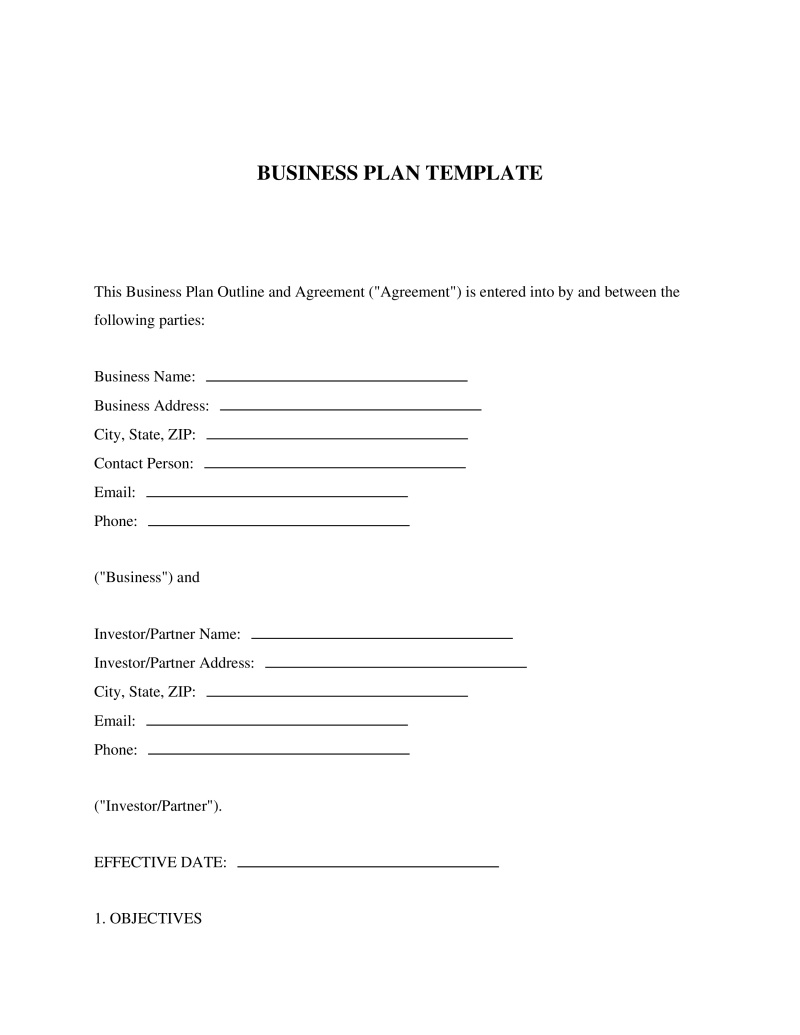
Business Plan Template
Create Business Plan Template
Business Plan Template
A Business Plan Template outlines a company's goals, strategies, and financial projections, serving as a roadmap for business development.
Answer the question(s) below to create your Business Plan Template
Business Name
Type the official name of your business as it appears in registration documents or licenses. Make sure to include any legal designations, such as LLC, Inc., or Corp., if applicable. This name will be used in legal documents, so it must be accurate and match your business records.
Table of Contents
What Is a Business Plan Template?
A Business Plan Template is a structured document that provides a pre-defined framework for outlining a company's goals, strategies, operations, and financial projections. Teams use it to systematically organize their vision, articulate their market approach, and forecast their financial performance, serving as a critical roadmap for both internal strategic alignment and external communication with investors or partners.
What Is Included
- Executive Summary - This section is crucial because it provides a high-level overview of the entire business plan, capturing the reader's attention and summarizing key points like the company's mission, products/services, market opportunity, and financial highlights.
- Company Description - Essential for establishing identity, this part details the business's legal structure, mission statement, vision, values, and long-term objectives, helping stakeholders understand the core purpose and direction.
- Products and Services - This section defines what the business offers, describing the unique features, benefits, and competitive advantages of each product or service, which is vital for communicating value to customers and investors.
- Market Analysis - Understanding the market is paramount; this component includes research on the target market, industry trends, customer demographics, market size, and competitive landscape, informing strategic decisions and demonstrating market viability.
- Marketing and Sales Strategy - Crucial for revenue generation, this outlines how the business will reach its target customers, including pricing strategy, promotion tactics, distribution channels, and the sales process.
- Management Team - Investors and partners often invest in people; this section introduces the key personnel, their roles, experience, and expertise, showcasing the team's capability to execute the plan.
- Operations Plan - This describes the day-to-day logistics of the business, including facilities, equipment, manufacturing processes, supply chain management, and quality control, ensuring operational efficiency and scalability.
- Financial Projections - Absolutely critical for assessing viability and attracting funding, this includes detailed forecasts such as income statements, balance sheets, cash flow statements, and break-even analysis for the next 3-5 years.
- Appendix (Optional) - This supplementary section holds supporting documents like resumes, market research data, permits, licenses, or letters of intent, providing credibility and additional detail without cluttering the main plan.
Who Should Use This Template?
Best For
- Early-Stage Startups Seeking Funding - New ventures needing to articulate their vision, market opportunity, and financial needs to angel investors, venture capitalists, or banks will find a structured business plan template indispensable for presenting a cohesive and professional case.
- Existing Businesses Planning Expansion - Companies looking to launch a new product line, enter a new market, or secure a loan for growth initiatives can use a template to methodically outline the strategic and financial implications of their expansion.
- Entrepreneurs Developing a Lean Startup - While often associated with comprehensive documents, a well-designed template can be adapted for a lean business plan, focusing on core hypotheses, value propositions, and key metrics for rapid iteration and validation.
- Internal Strategic Planning Teams - Teams within larger organizations can leverage a template to develop departmental or project-specific plans, ensuring alignment with overall company objectives and providing a clear roadmap for execution.
- Individuals Exploring Business Ideas - Anyone in the ideation phase can use a template as a structured thought exercise to evaluate the feasibility of a business concept before committing significant resources, comparing different models or approaches.
Not Ideal For
- Businesses Requiring Highly Agile, Daily Iteration - For teams operating in extremely dynamic environments where strategies change daily, a rigid, long-form business plan template might become outdated too quickly, hindering agility. Lean canvases or single-page strategic plans might be more suitable.
- Sole Proprietors with Minimal External Stakeholders - A very small, self-funded business with no immediate plans for growth or external investment might find a full template overly burdensome. A simpler operational outline or a detailed financial spreadsheet might suffice initially.
- Organizations with Established, Complex Internal Planning Systems - Large, mature enterprises often have proprietary, sophisticated strategic planning frameworks already in place. Integrating a generic template could disrupt existing workflows rather than enhance them.
- Projects Focused Purely on Technical Development - For R&D teams whose primary focus is product engineering without immediate market or financial considerations, a technical specification document or project plan template would be more appropriate than a full business plan.
Quick Start Guide
- Define Your Core Idea and Value Proposition: Before filling in sections, clearly articulate what problem your business solves, for whom, and how your solution is uniquely better. This foundational clarity will guide all subsequent sections, especially your Company Description and Products/Services.
- Conduct Thorough Market Research: Dedicate time to understanding your target market, competitors, and industry trends. Utilize online resources, industry reports, and customer surveys. This data is critical for the Market Analysis section and informs your Marketing and Sales Strategy.
- Outline Your Business Model and Operations: Sketch out how your business will create, deliver, and capture value. Consider your revenue streams, cost structure, key activities, and resources. This will naturally inform your Operations Plan and initial Financial Projections.
- Draft the Executive Summary Last: Although it appears first, the Executive Summary should be written after all other sections are complete. It's a distillation of your entire plan, so having all the details finalized ensures accuracy and conciseness.
- Develop Realistic Financial Projections: Collaborate with an accountant or financial expert if possible. Base your projections on conservative revenue estimates and realistic expense forecasts. Include a break-even analysis and clearly state your assumptions to build credibility.
- Review and Refine for Clarity and Cohesion: After completing the first draft, take a step back. Review the entire document for consistency, clarity, and logical flow. Ensure that the narrative is compelling and that all sections support each other. Seek feedback from trusted advisors or mentors.
- Adapt the Template to Your Specific Needs: Don't treat the template as rigid. If a section isn't relevant to your specific business (e.g., extensive manufacturing for a service business), simplify or remove it. Conversely, if you have a unique aspect, add a dedicated subsection. The goal is utility, not strict adherence.
Frequently Asked Questions
The ideal length of a business plan varies, but typically ranges from 15 to 40 pages for a comprehensive plan. For a lean startup or internal strategy, a shorter plan (5-10 pages) or even a single-page canvas can be more effective.
Yes, a business plan is valuable even without external funding. It serves as a strategic roadmap for your business, helping you define goals, understand your market, and anticipate challenges, guiding your decisions and growth.
You should review and update your business plan at least annually, or whenever significant changes occur in your business environment, strategy, or financial situation. This keeps it a living document relevant to your current operations.
A business plan is a detailed, comprehensive document outlining all aspects of your business. A pitch deck is a shorter, visual presentation (typically 10-20 slides) designed to quickly convey the most critical information to potential investors.
Absolutely. While the financial sections might differ (focusing on funding, grants, and operational costs rather than profit), the core structure of defining mission, programs, operations, and management is highly relevant for non-profits.
Common mistakes include unrealistic financial projections, neglecting thorough market research, an overly long or generic executive summary, failing to clearly articulate a competitive advantage, and not proofreading for errors. Be specific, realistic, and concise.
You should include a concise summary of key management team members' experience in the 'Management Team' section. Detailed resumes can be placed in an optional Appendix, especially if seeking external funding, to provide further credibility.
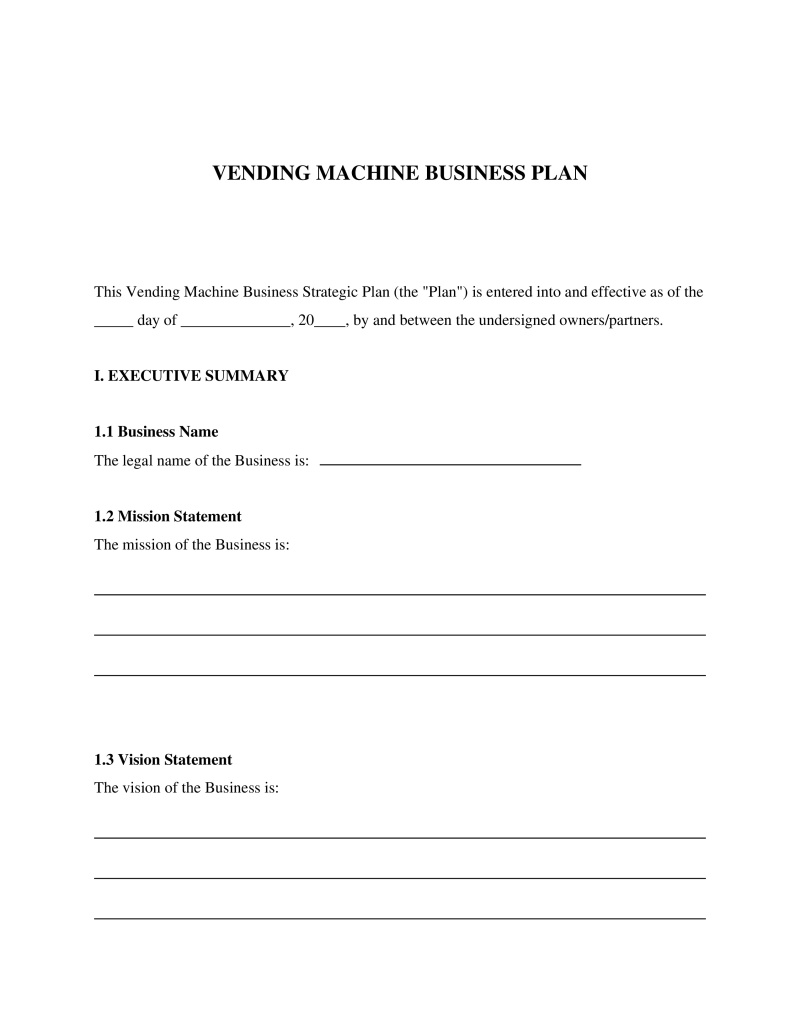
Business Plan Template Sample
0% Complete
0/0 Fields
Related Documents
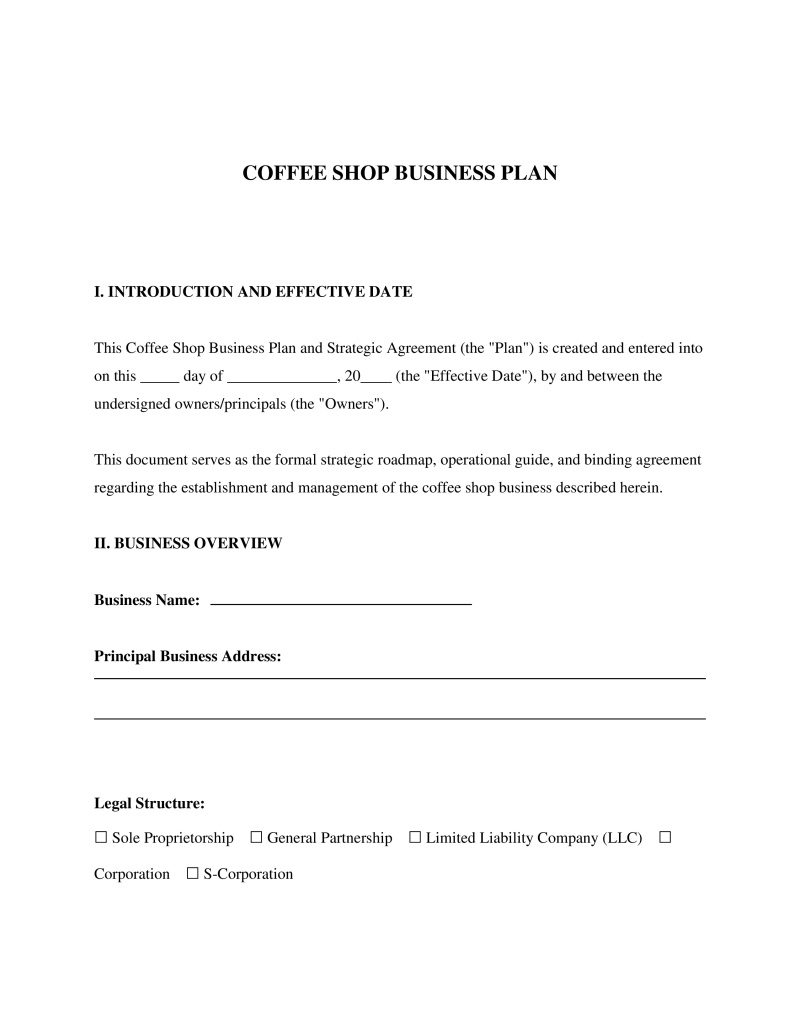
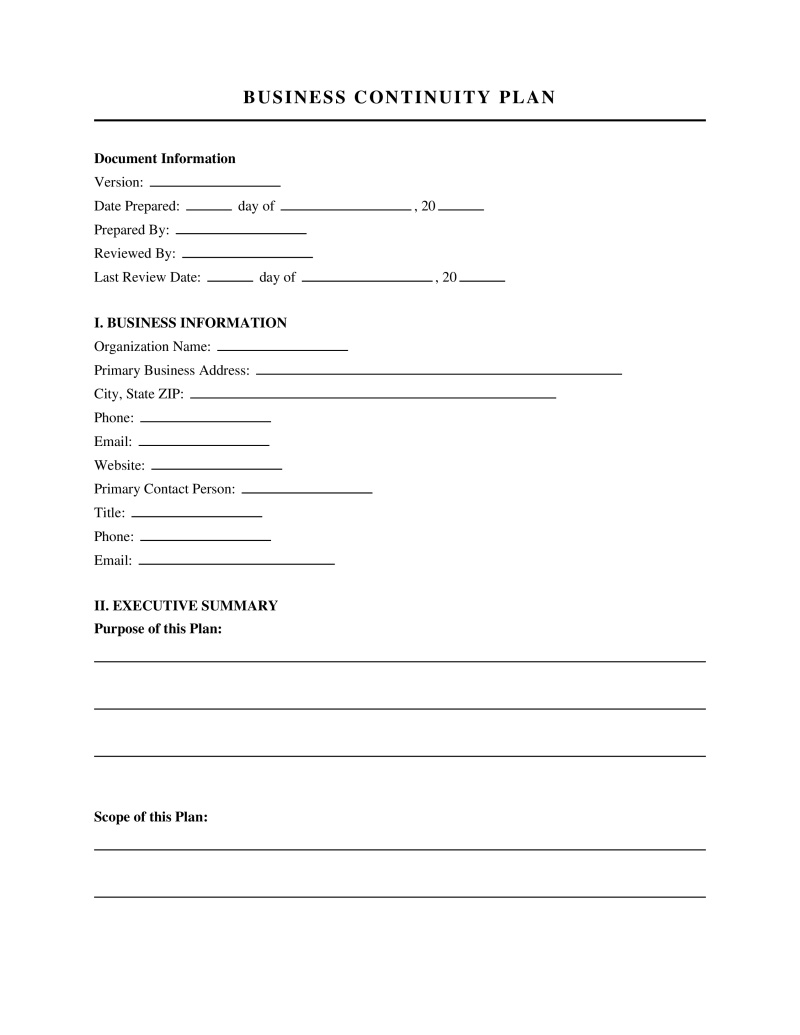
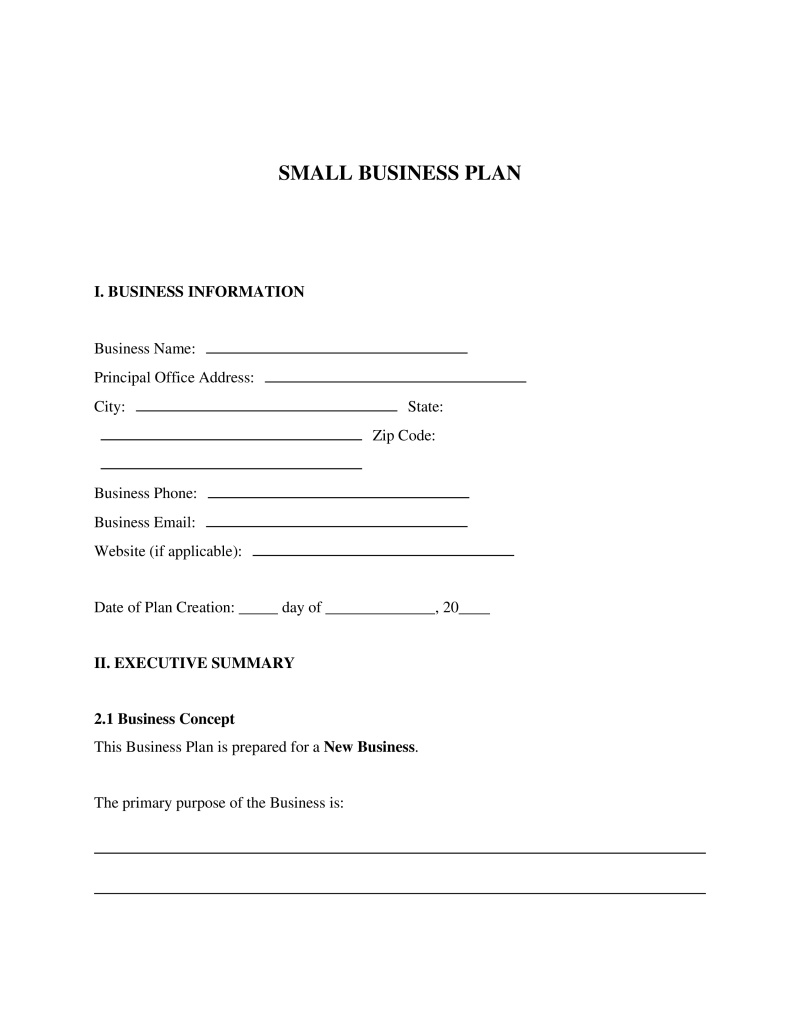
Forms commonly used with Business Plan Template.
Not the form you're looking for?
Try our legal document generator to create a custom document
Disclaimer: The templates available on this website are provided for general informational purposes only and do not constitute legal advice. They are not intended to be, and should not be interpreted as, compliant with any specific legal, regulatory, or privacy requirements. These templates are not a replacement for professional legal guidance and should not be relied upon for any particular matter or circumstance. Users are strongly encouraged to seek advice from a qualified attorney licensed in their jurisdiction before using, modifying, or relying on any template.
All templates are provided on an "as is," "with all faults," and "as available" basis. The provider disclaims any and all warranties of any kind, whether express, implied, statutory, or otherwise, including without limitation warranties of merchantability, fitness for a particular purpose, title, or non-infringement.
LegalTemplates.com makes no guarantees or representations regarding the accuracy, completeness, expected outcomes, or reliability of the materials contained in these templates or any materials referenced or linked from them.