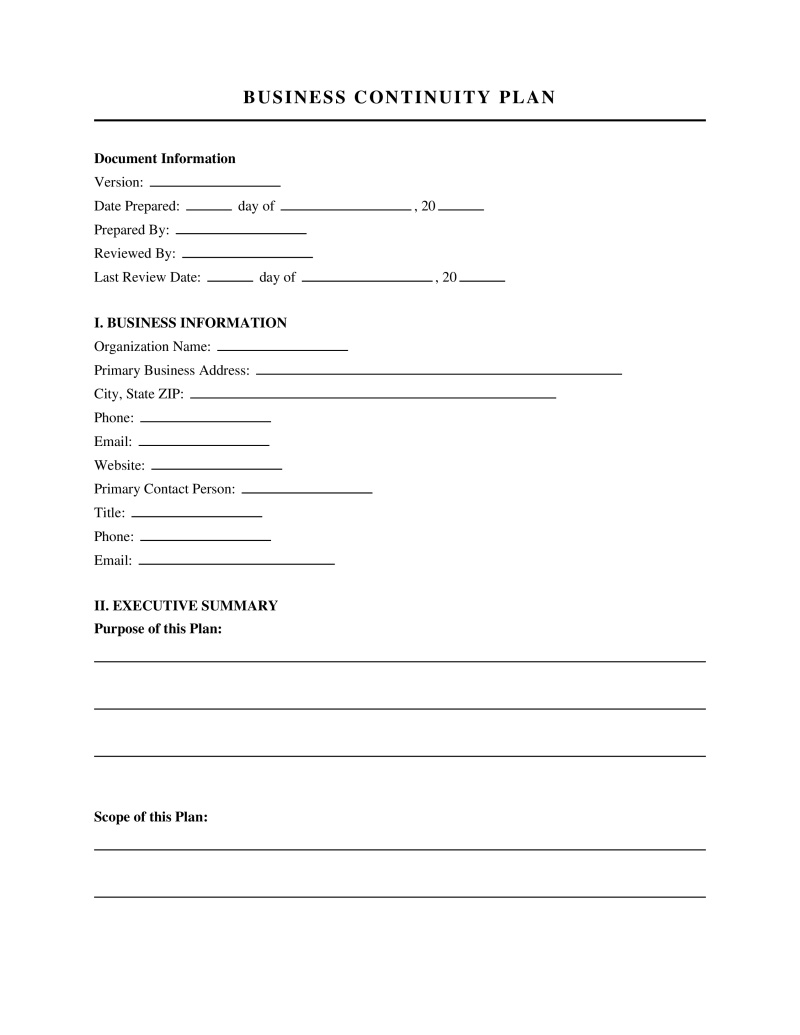
Business Continuity Plan
A Business Continuity Plan outlines strategies to maintain operations during disruptions, ensuring organizational resilience and recovery.
Plan Scope
Select whether this plan covers the entire organization, a specific department, or a particular location.
Specify the department if the plan is not organization-wide.
Provide the address if the plan is for a specific site.
Table of Contents
What Is a Business Continuity Plan Template?
A Business Continuity Plan (BCP) template serves as a structured framework designed to help organizations prepare for, respond to, and recover from potential disruptions to their operations. It outlines critical processes, resources, and actions necessary to maintain essential business functions during and after an adverse event, such as natural disasters, cyberattacks, or supply chain failures. Teams utilize this template to systematically identify risks, establish recovery strategies, and ensure the resilience of their operations, minimizing downtime and financial losses.
What Is Included
A comprehensive Business Continuity Plan template typically includes several key sections, each playing a vital role in ensuring organizational preparedness:
- Executive Summary - Provides a high-level overview of the plan's purpose, scope, and key objectives, allowing stakeholders to quickly grasp the document's essence and importance.
- Incident Response Team & Roles - Defines the individuals or teams responsible for executing the BCP, detailing their specific roles, responsibilities, and contact information during a crisis. This ensures clear leadership and accountability.
- Critical Business Functions & Processes - Identifies the core operations and processes that are essential for the organization's survival and must be maintained or quickly restored. Understanding these priorities guides recovery efforts.
- Impact Analysis & Risk Assessment - Assesses the potential impact of various disruptions on critical functions (e.g., financial, operational, reputational) and evaluates the likelihood of identified risks. This data informs recovery priorities and resource allocation.
- Recovery Strategies & Procedures - Outlines the detailed steps and resources required to restore critical functions and IT systems to an operational state within defined recovery time objectives (RTOs) and recovery point objectives (RPOs). This section is the actionable core of the plan.
- Communication Plan - Specifies how internal and external stakeholders (e.g., employees, customers, suppliers, media) will be informed before, during, and after a disruption. Clear communication is crucial for managing expectations and maintaining trust.
- Testing, Training & Maintenance Schedule - Establishes a regular schedule for testing the plan's effectiveness, training personnel, and reviewing/updating the BCP to reflect changes in the business environment or identified vulnerabilities. A plan is only as good as its last test.
- Appendices & Supporting Documentation - Includes supplementary materials such as vendor contracts, emergency contact lists, floor plans, system diagrams, and data backup procedures, providing all necessary context and details in one place.
Who Should Use This Template?
Best For
- Mid-sized to Large Enterprises: Organizations with complex operations, diverse departments, and a significant number of employees will find the structured approach of a Business Continuity Plan template invaluable for coordinating responses across various teams.
- Businesses with Critical Operations: Companies whose services or products are essential for customer safety, public infrastructure, or other vital functions (e.g., healthcare, financial services, utilities, manufacturing) need a robust plan to minimize service interruption.
- Organizations Facing Regulatory Compliance: Businesses operating in regulated industries often have mandates to demonstrate resilience and have a documented Business Continuity Plan in place, making a template a practical starting point.
- Teams Seeking Standardized Preparedness: Any organization looking to move beyond ad-hoc crisis management to a formalized, repeatable process for identifying risks, planning responses, and ensuring operational continuity.
- Companies with Significant IT Dependencies: Businesses heavily reliant on technology infrastructure and data will benefit from a template that guides the development of IT disaster recovery components within the broader Business Continuity Plan.
Not Ideal For
- Micro-businesses or Sole Proprietorships with Low Complexity: Very small operations with minimal infrastructure, few employees, and non-critical services might find a full-blown Business Continuity Plan template overly burdensome. A simpler emergency preparedness checklist might suffice.
- Organizations Requiring Highly Specialized, Bespoke Plans: Industries with extremely unique operational models or highly unusual risk profiles may find that a generic template doesn't capture the nuanced specifics of their environment and may need a custom-built solution from the ground up.
- Companies Lacking Internal Resources for Implementation: While the template provides structure, its successful implementation requires dedicated time, personnel, and expertise to conduct risk assessments, develop strategies, and maintain the plan. Without these resources, even a good template can sit unused.
Quick Start Guide
- Assemble Your Core Business Continuity Team: Designate a small, cross-functional team (e.g., IT, Operations, HR, Management) to lead the BCP development. Assign a project manager to oversee progress and ensure accountability.
- Identify & Prioritize Critical Business Functions: Work with department heads to list all essential services and processes. Determine which ones absolutely must continue or be restored first to keep the business viable and meet customer expectations.
- Conduct a Comprehensive Risk Assessment: Brainstorm potential threats (e.g., power outages, cyberattacks, supply chain disruptions, pandemics) and assess their likelihood and potential impact on your critical functions. Prioritize risks based on severity.
- Develop Tailored Recovery Strategies: For each critical function and identified risk, outline specific steps and resources needed for recovery. This includes data backup plans, alternate work locations, vendor agreements, and communication protocols.
- Integrate with Existing Emergency Procedures: Ensure your Business Continuity Plan aligns seamlessly with any existing emergency response plans, IT disaster recovery plans, or safety protocols to avoid conflicting instructions during a crisis.
- Schedule and Execute Regular Testing & Drills: Don't just write the plan; test it! Conduct tabletop exercises or full-scale simulations at least annually to identify gaps, refine procedures, and familiarize your team with their roles.
- Establish a Review and Update Cycle: Business environments change. Set a recurring schedule (e.g., quarterly, semi-annually) to review the plan, update contact information, incorporate lessons learned from tests or real incidents, and reflect new technologies or processes.
- Train All Relevant Employees: Provide training to employees on their roles and responsibilities within the Business Continuity Plan. Ensure they know how to access relevant information and who to contact in an emergency.
Frequently Asked Questions
Business Continuity Plan Sample
Not the form you're looking for?
Try our legal document generator to create a custom document
Disclaimer: The templates available on this website are provided for general informational purposes only and do not constitute legal advice. They are not intended to be, and should not be interpreted as, compliant with any specific legal, regulatory, or privacy requirements. These templates are not a replacement for professional legal guidance and should not be relied upon for any particular matter or circumstance. Users are strongly encouraged to seek advice from a qualified attorney licensed in their jurisdiction before using, modifying, or relying on any template.
All templates are provided on an "as is," "with all faults," and "as available" basis. The provider disclaims any and all warranties of any kind, whether express, implied, statutory, or otherwise, including without limitation warranties of merchantability, fitness for a particular purpose, title, or non-infringement.
LegalTemplates.com makes no guarantees or representations regarding the accuracy, completeness, expected outcomes, or reliability of the materials contained in these templates or any materials referenced or linked from them.