Medical Power of Attorney Create a Medical Power of Attorney

Medical Power of Attorney

Updated Dec 05, 2025
0 Comments
5 (1)
12 Downloads

A Medical Power of Attorney is a legal document that appoints a trusted person to make healthcare decisions on your behalf when you become unable to make or communicate those decisions yourself.
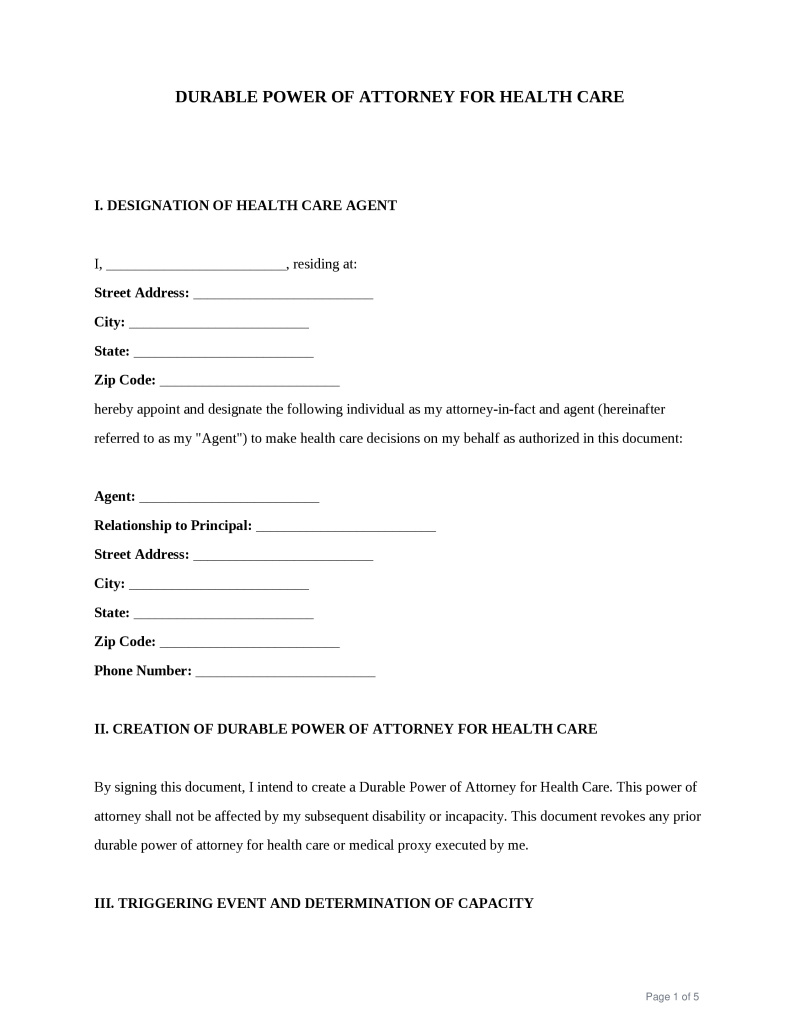
Principal Name

In this field, write your full legal name as it appears on your official documents, such as your driver's license or passport. This includes your first name, middle name (if applicable), and last name. Accurate information is important because it identifies you legally in this document.

Table of Contents

0% Complete 0/0 Fields

MEDICAL POWER OF ATTORNEY

This Medical Power of Attorney (hereinafter referred to as the "Document") is made and executed on .

DESIGNATION OF HEALTH CARE AGENT

I, , residing at , hereby appoint:

Name:
Address:
Phone:
Email:

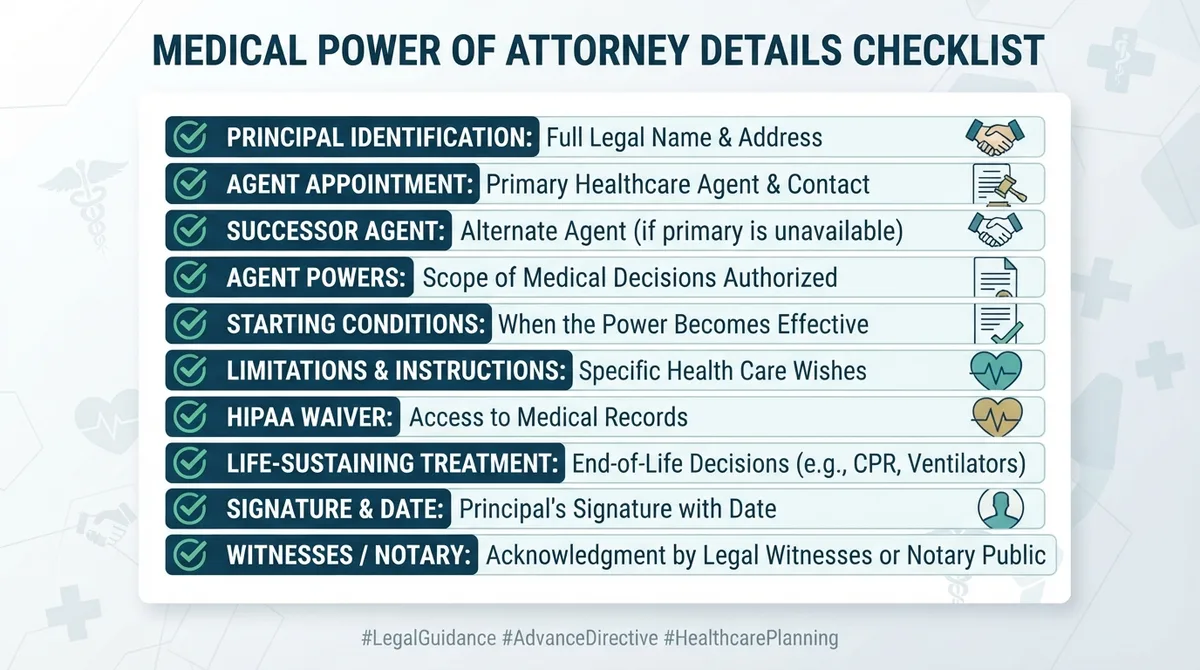
as my agent (attorney-in-fact) to make any and all health care decisions for me, except to the extent I state otherwise in this document. This Medical Power of Attorney takes effect if I become unable to make my own health care decisions and this fact is certified in writing by my physician.

ALTERNATE AGENTS

AGENT'S AUTHORITY

My agent is authorized to make all health care decisions for me, including decisions to provide, withhold, or withdraw artificial nutrition and hydration and all other forms of health care to keep me alive, except as I state here: 

WHEN AGENT'S AUTHORITY BECOMES EFFECTIVE

AGENT'S OBLIGATIONS

My agent shall make health care decisions for me in accordance with this power of attorney, any instructions I give in this document, and my other wishes to the extent known to my agent. To the extent my wishes are unknown, my agent shall make health care decisions for me in accordance with what my agent determines to be in my best interest. In determining my best interest, my agent shall consider my personal values to the extent known to my agent.

NOMINATION OF GUARDIAN

If a guardian of my person needs to be appointed for me by a court, I nominate my agent (or alternate) named above for appointment as guardian to serve without bond or security.

HIPAA RELEASE AUTHORITY

I intend for my agent to be treated as I would be with respect to my rights regarding the use and disclosure of my individually identifiable health information or other medical records. This release authority applies to any information governed by the Health Insurance Portability and Accountability Act of 1996 (HIPAA), 42 U.S.C. 1320d and 45 CFR 160-164, and the regulations promulgated thereunder. I authorize any physician, healthcare professional, dentist, health plan, hospital, clinic, laboratory, pharmacy, or other covered healthcare provider, any insurance company, and the Medical Information Bureau, Inc., or other healthcare clearinghouse that has provided treatment or services to me, or that has paid for or is seeking payment from me for such services, to give, disclose, and release to my agent, without restriction, all of my individually identifiable health information and medical records regarding any past, present, or future medical or mental health condition.

SPECIFIC MEDICAL DIRECTIVES

ORGAN DONATION

Status:

Governing Law

This Medical Power of Attorney is governed by the state laws of .

EFFECT OF COPY

A copy of this Medical Power of Attorney has the same effect as the original.

SIGNATURE

I sign my name to this Medical Power of Attorney on .

Principal Signature: ______________________________
Print Name: _______________

ACCEPTANCE BY AGENT

I accept this appointment and agree to serve as agent for health care decisions. I understand I have a duty to act consistently with the principal's desires as stated in this document or otherwise made known to me. I understand that this document gives me authority to make health care decisions for the principal only if the principal becomes incapacitated. I understand that I must act in good faith in exercising my authority under this power of attorney. I understand that the principal may revoke this power of attorney at any time in any manner.

If I choose to withdraw as agent, I must inform the principal of my decision. If the principal is not capable of understanding my withdrawal, I must inform the principal's caregivers of my withdrawal.

Agent Signature: ______________________________
Print Name: _______________
Date:

What is a Medical Power of Attorney?

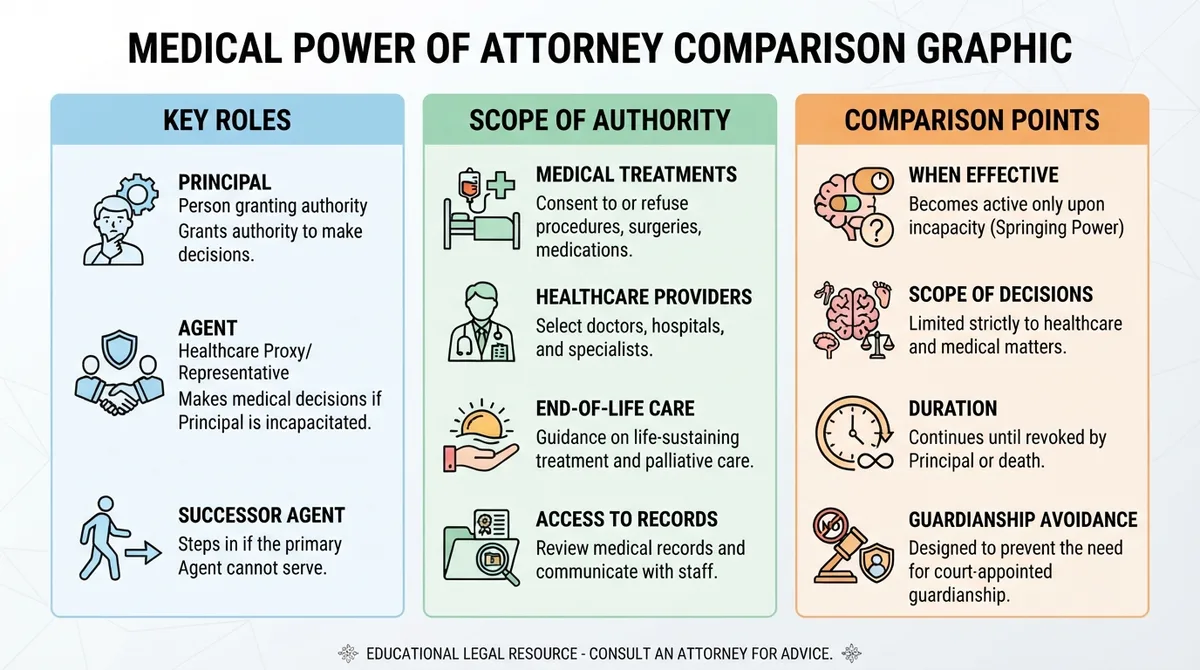
A Medical Power of Attorney, frequently referred to as a durable power of attorney for healthcare or a healthcare proxy, is a legal instrument that designates a specific individual to make medical decisions on behalf of a principal should that person become incapacitated. The primary purpose of this document is to ensure that a patient's medical preferences regarding treatment, care providers, and end-of-life interventions are upheld when they lack the cognitive or physical capacity to communicate effectively. This legal tool is a fundamental component of advance care planning and is distinct from a financial power of attorney, as its authority is strictly limited to healthcare matters. It is utilized by adults of all ages to protect their autonomy and provide guidance to medical professionals and family members during emergencies.

Scope of Authority: Rights and Limitations

The authority granted to an agent under a medical power of attorney rights and limitations framework is extensive but not absolute. Generally, the designated agent possesses the right to consent to or refuse medical procedures, including surgical interventions, diagnostic tests, and the administration of pharmaceuticals. They are typically empowered to select healthcare facilities, such as hospitals or long-term care centers, and to hire or discharge medical personnel. A critical aspect of this authority involves decisions regarding life-sustaining treatments, such as artificial nutrition, hydration, and mechanical ventilation. The agent is legally obligated to act according to the principal's known wishes, often referred to as substituted judgment, or in the principal's best interest if specific wishes are unknown.

However, significant limitations exist to prevent abuse and ensure the principal's safety. An agent cannot authorize treatments that the principal has explicitly refused in a valid advance directive or living will, nor can they consent to procedures that violate standard medical ethics or state laws, such as active euthanasia or assisted suicide in jurisdictions where it is prohibited. Furthermore, the agent's power is generally dormant until a medical professional, usually the attending physician, formally declares the principal incapacitated. If the principal regains the capacity to make decisions, the agent's authority is suspended, and the right to self-determination reverts to the patient.

Default Decision Making: The Hierarchy of Surrogacy

In the absence of a designated proxy, state laws dictate who makes medical decisions without power of attorney through a mechanism known as statutory surrogacy. While specific hierarchies vary by jurisdiction, most states prioritize the spouse, followed by adult children, parents, and then adult siblings. This statutory default attempts to approximate who would best represent the patient's interests, but it is a rigid system that may not reflect the patient's actual family dynamics or preferences. Reliance on these default laws can lead to significant legal and familial conflict, particularly in cases of estrangement or when multiple family members at the same priority level disagree on a course of treatment.

A common misconception involves the question is your spouse automatically your medical power of attorney. While statutory surrogacy laws often place the spouse at the top of the decision-making hierarchy, this is not a true power of attorney, which is an appointed role. Automatic surrogacy rights can be complicated by separation, pending divorce, or the existence of adult children from previous relationships. Furthermore, for unmarried partners or close friends, statutory laws rarely grant automatic decision-making authority. Without a formal designation, these individuals may be legally excluded from the decision-making process, necessitating court intervention to appoint a guardian, which is a time-consuming and costly public legal proceeding.

How to Execute a Medical Power of Attorney

The process of establishing a healthcare proxy involves several critical steps to ensure the document is legally binding and recognized by medical institutions. Individuals seeking to establish this protection must understand how to get medical power of attorney in compliance with their specific state's regulations.

  1. Step 1: Selection of an Agent – The principal must choose a trustworthy individual, often called an agent, proxy, or attorney-in-fact. This person should be capable of making difficult decisions under pressure and willing to advocate for the principal's preferences against opposing viewpoints. Alternate agents should also be identified in case the primary choice is unavailable.
  2. Step 2: Acquisition of the Correct Form – The principal must obtain a valid Medical Power of Attorney form. While generic forms exist, it is advisable to use state-specific templates to ensure compliance with local statutes. These can often be found through state bar associations, state departments of health, or legal aid organizations.
  3. Step 3: Drafting and Specification – The document is completed by detailing the agent's powers. The principal may choose to limit the agent's authority regarding specific treatments or grant broad, unrestricted powers. This stage often involves concurrent preparation of a HIPAA release to ensure the agent can access necessary medical records.
  4. Step 4: Formal Execution – To be valid, the document must be signed in accordance with state laws. This typically requires the principal to sign in the presence of two witnesses who are not related to the principal or named as agents. Many states also require the document to be notarized.
  5. Step 5: Distribution and Storage – Copies of the executed document should be given to the designated agent, the primary care physician, and any specialist providers. The principal should retain the original and inform family members of its existence to prevent confusion during a medical crisis.

Legal Framework and Federal Statutes

The legal validity of a medical power of attorney is rooted in state statutes, but it is also supported by federal legislation. The Patient Self-Determination Act (PSDA) of 1990 is a federal law that requires healthcare institutions participating in Medicare and Medicaid programs to inform patients of their rights to make decisions concerning their medical care, including the right to accept or refuse treatment and the right to formulate advance directives. This act ensures that the existence of a medical power of attorney is acknowledged upon a patient's admission to a facility.

Additionally, the Health Insurance Portability and Accountability Act (HIPAA) plays a pivotal role in the function of a healthcare proxy. Under the Privacy Rule, medical providers are prohibited from sharing a patient's protected health information. For a medical power of attorney to be effective, it must often be accompanied by a HIPAA release clause or a separate document authorizing the agent to access the principal's medical records. Without this access, the agent may lack the critical information necessary to make informed medical decisions.

At the state level, many jurisdictions have adopted variations of the Uniform Health-Care Decisions Act (UHCDA). This model law attempts to standardize the rules regarding advance directives and surrogacy across states, providing a comprehensive framework for the creation, validity, and implementation of healthcare powers of attorney. These laws also typically include immunity clauses, protecting healthcare providers who act in good faith reliance on the agent's instructions from civil or criminal liability.

Revocation and Validity

A medical power of attorney is generally "durable," meaning it remains effective despite the principal's incapacity. However, it is not irrevocable. A competent principal retains the right to revoke the document at any time. Revocation can typically be achieved by destroying the original document, executing a written revocation, or creating a new medical power of attorney form that explicitly supersedes previous versions. In many states, the dissolution of a marriage automatically revokes the designation of a former spouse as the agent, though this varies by jurisdiction and should be verified against local statutes.

Frequently Asked Questions

Generally, a Medical Power of Attorney does not expire and remains valid until the principal dies or revokes the document. However, some states may allow for an expiration date to be written into the document if the principal chooses, though this is uncommon.
Typically, a Living Will takes precedence over a Medical Power of Attorney regarding end-of-life decisions because the Living Will represents the patient's direct instructions. However, if the Living Will is ambiguous or silent on a specific issue, the agent named in the Power of Attorney usually has the authority to interpret the patient's wishes.
While most states recognize valid advance directives from other states under the principle of reciprocity, laws regarding witnessing and notarization vary. It is often recommended to update your documents if you move to a new state to ensure full compliance with local statutes.
A Medical Power of Attorney strictly grants authority for healthcare decisions, such as surgery and placement in a facility. A Financial Power of Attorney grants authority over business and monetary matters, such as paying bills and managing investments; the two roles are legally distinct and require separate documents.
While it is legally possible in some jurisdictions to appoint co-agents, it is generally discouraged by legal professionals due to the risk of disagreement and deadlock during critical moments. The preferred method is to appoint one primary agent and one or more successor agents to act if the primary is unavailable.
In most standard agreements, the agent's authority only begins when a physician determines that the principal lacks the capacity to make their own medical decisions. Some documents can be drafted to be effective immediately, but this is less common for medical proxies compared to financial ones.

Not the form you're looking for?

Try our legal document generator to create a custom document

Community Discussion

Share your experience and help others

0

Comments (0)

Leave a Comment

Your email will not be displayed publicly. It is used for validation purposes only and will never be used to send unwanted emails or sold to third parties.

No comments yet. Be the first to comment!

Legal Notice: Comments are personal opinions and do not constitute legal advice. Always consult a qualified attorney for matters specific to your situation.