Caregiver Affidavit
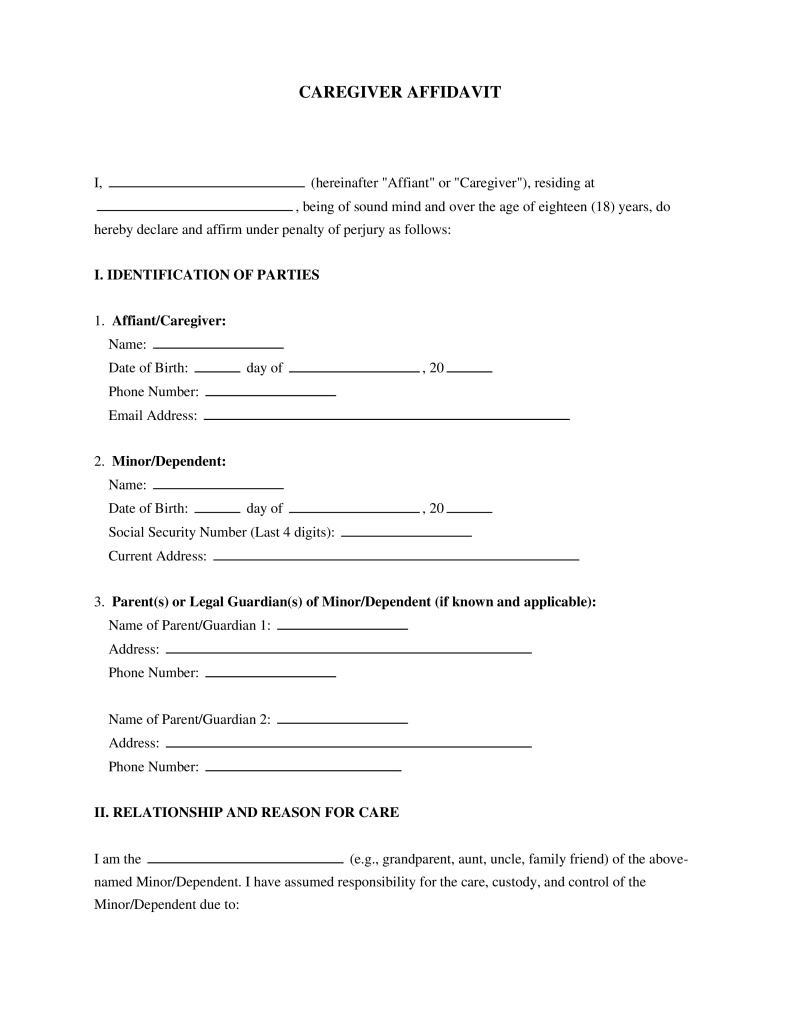
A Caregiver Affidavit is a sworn legal statement executed by an individual providing care, attesting to specific facts, responsibilities, and conditions related to the care provided to another person.
Affidavit Purpose
Select the primary areas in which the Caregiver will have decision-making authority.
Describe any additional authority not listed above.
Table of Contents
What is a Caregiver Affidavit?
A Caregiver Affidavit is a legal document that grants a non-parental caregiver temporary authority to make decisions regarding a minor child's education, medical care, and general well-being. This sworn statement is typically executed by a parent or legal guardian, empowering another adult to act on their behalf when the parent is temporarily unavailable or unable to fulfill their parental duties. Its primary purpose is to ensure that a child receives necessary care and support without requiring formal guardianship proceedings, which can be lengthy and complex. The document provides a streamlined mechanism for delegating parental authority, particularly in situations involving extended travel, military deployment, or periods of illness.
Legal Framework and Purpose
The legal framework surrounding a Caregiver Affidavit is rooted in the principle of parental delegation of authority, which allows parents to temporarily transfer certain decision-making powers without relinquishing their fundamental parental rights. This instrument is particularly vital in ensuring continuity of care and access to essential services for children living with relatives or other trusted adults. It bypasses the need for court intervention in many cases, offering a practical solution for families facing temporary separations or challenges.
The primary purpose of a Caregiver Affidavit is to provide the caregiver with legal standing to enroll a child in school, consent to routine or emergency medical treatment, and make other day-to-day decisions. Without such a document, caregivers might face significant obstacles in obtaining necessary services for the child, as institutions typically require proof of parental authority. This affidavit serves as that proof, enabling the caregiver to act in the child's best interest during the period of delegation.
How to Complete a Caregiver Affidavit
Completing a Caregiver Affidavit requires careful attention to detail to ensure its legal validity and effectiveness. The process typically involves several key steps:
- Identify the Parties and Child - Begin by clearly identifying the parent or legal guardian delegating authority (the affiant), the caregiver receiving authority, and the full legal name and date of birth of the minor child. Include current addresses for all adults involved.
- Specify the Delegated Powers - Detail the specific powers being granted to the caregiver. This often includes authority over medical decisions, educational enrollment, and general welfare. Be explicit about any limitations or exclusions to these powers.
- Define the Duration of Authority - Clearly state the start and end dates for the delegated authority. While some affidavits might be open-ended, many states require a specific duration, often renewable. If the duration is tied to an event, describe that event clearly.
- Include Necessary Disclosures and Affirmations - The affiant must affirm their parental or guardianship status and declare that the statements made in the affidavit are true and accurate to the best of their knowledge. Some states require specific language regarding the parent's intent not to abandon the child.
- Sign and Notarize the Document - The parent or legal guardian must sign the affidavit in the presence of a notary public. Notarization verifies the identity of the signer and confirms that the document was signed voluntarily, adding a crucial layer of legal authenticity.
- Provide Copies to Relevant Institutions - Once executed, provide copies of the notarized affidavit to the child's school, healthcare providers, and any other relevant institutions that may require proof of the caregiver's authority. Keep an original for personal records.
Rights and Obligations of Parties Involved
A Caregiver Affidavit establishes distinct rights and obligations for all parties involved, ensuring clarity and accountability in the care of a minor child. Understanding these roles is crucial for the effective implementation of the document.
The **parent or legal guardian** retains ultimate legal responsibility for the child. Their primary obligation is to ensure the caregiver is a suitable individual and to provide clear instructions regarding the child's care, preferences, and any specific limitations on the delegated authority. They have the right to revoke the affidavit at any time, typically by providing written notice to the caregiver and relevant institutions. They are also obligated to communicate any changes in their availability or the child's needs to the caregiver.
The **caregiver** assumes temporary decision-making authority for the child, primarily concerning medical treatment, educational enrollment, and day-to-day welfare. Their obligations include acting in the child's best interest, adhering to the scope of authority granted by the affidavit, and keeping the parent informed of significant developments. The caregiver has the right to access necessary information about the child, such as medical records or school reports, to fulfill their responsibilities. They are generally expected to provide a safe and nurturing environment, consistent with the parent's wishes and legal standards.
The **child** is the central focus of the affidavit. While not a signatory, their well-being is the document's paramount concern. The affidavit ensures the child's right to continued access to education, healthcare, and stable living arrangements even in the temporary absence of their parents. The child's perspective and needs, particularly as they mature, should ideally be considered within the framework of the care arrangement, though the affidavit primarily concerns adult delegation of authority.
Legal Requirements and Validity
For a Caregiver Affidavit to be legally recognized and effective, it must adhere to specific requirements, which can vary by state. General requirements for validity typically include:
- Written Format - The affidavit must be in writing, clearly stating the intent to delegate parental authority.
- Identification of Parties - It must accurately identify the parent/guardian, the caregiver, and the minor child, including their full legal names and addresses.
- Specific Powers Granted - The document must explicitly enumerate the powers being delegated, such as medical consent, educational decisions, or general welfare.
- Duration of Authority - A clear start and end date for the delegated authority must be specified. Some states may have statutory limits on the maximum duration.
- Parental Signature - The affidavit must be signed by the parent or legal guardian delegating the authority.
- Notarization - The parent's signature must be notarized by a notary public, confirming the identity of the signer and the voluntary nature of the signing.
- Absence of Abandonment - Many state statutes require an affirmation that the parent is not abandoning the child by executing the affidavit.
- Compliance with State Specific Forms - Some states provide statutory forms for caregiver authorizations, which, if available, should be used to ensure full compliance with local laws.
Failure to meet these requirements can render the affidavit invalid or unenforceable, potentially creating legal hurdles for the caregiver attempting to act on the child's behalf.
Applicable Federal and State Laws
The operation and acceptance of a Caregiver Affidavit are influenced by a combination of federal and state laws, particularly those related to health information privacy, educational records, and the rights of minors.
Federal Statutes
Several federal laws impact the use and acceptance of caregiver affidavits:
- Health Insurance Portability and Accountability Act (HIPAA) - Governs the privacy and security of protected health information (PHI). While HIPAA generally requires patient consent for disclosure, a properly executed caregiver affidavit can grant the caregiver authority to access the child's medical records and consent to treatment, acting as a personal representative (45 CFR § 164.502(g)).
- Family Educational Rights and Privacy Act (FERPA) - Protects the privacy of student education records. A caregiver affidavit, depending on its scope and state law, may grant the caregiver the right to access the child's educational records and make decisions regarding their schooling, similar to a parent (20 U.S.C. § 1232g).
- Social Security Act - While not directly governing affidavits, provisions related to child welfare and benefits may interact with situations where a caregiver is responsible for a child, particularly concerning benefit eligibility or reporting requirements for foster care (42 U.S.C. § 301 et seq.).
State Laws and Requirements
State laws often provide the most direct legal framework for Caregiver Affidavits, sometimes establishing specific forms or criteria:
- Caregiver Authorization Affidavits - Many states, such as California (Cal. Fam. Code § 6550-6552) and Texas (Tex. Fam. Code § 34.001 et seq.), have specific statutes authorizing and defining the scope of caregiver affidavits for medical and educational decisions. These statutes often specify the maximum duration of such affidavits and the conditions for their revocation.
- Minor Consent Laws - State laws regarding a minor's ability to consent to medical treatment (e.g., for reproductive health, mental health, or substance abuse) may interact with the caregiver's authority, especially for older minors. The affidavit generally grants consent for treatments the parent could authorize.
- General Affidavit Statutes - Broader state statutes governing the creation and validity of affidavits, including requirements for notarization and sworn statements, apply to caregiver affidavits.
- Child Welfare Laws - State child welfare statutes may define what constitutes abandonment or neglect, and caregiver affidavits typically include language affirming that the parent is not abandoning the child by delegating authority.
Penalties for non-compliance with these laws can vary. For instance, a caregiver who misrepresents their authority could face legal challenges, and institutions that fail to respect a valid affidavit may be subject to legal action for denying services. Conversely, a parent who uses an affidavit to circumvent child support or abandonment laws could face severe legal consequences, including criminal charges or loss of parental rights.
Frequently Asked Questions
Not the form you're looking for?
Try our legal document generator to create a custom document
Disclaimer: The templates available on this website are provided for general informational purposes only and do not constitute legal advice. They are not intended to be, and should not be interpreted as, compliant with any specific legal, regulatory, or privacy requirements. These templates are not a replacement for professional legal guidance and should not be relied upon for any particular matter or circumstance. Users are strongly encouraged to seek advice from a qualified attorney licensed in their jurisdiction before using, modifying, or relying on any template.
All templates are provided on an "as is," "with all faults," and "as available" basis. The provider disclaims any and all warranties of any kind, whether express, implied, statutory, or otherwise, including without limitation warranties of merchantability, fitness for a particular purpose, title, or non-infringement.
LegalTemplates.com makes no guarantees or representations regarding the accuracy, completeness, expected outcomes, or reliability of the materials contained in these templates or any materials referenced or linked from them.