Non-Court Temporary Guardianship Letter
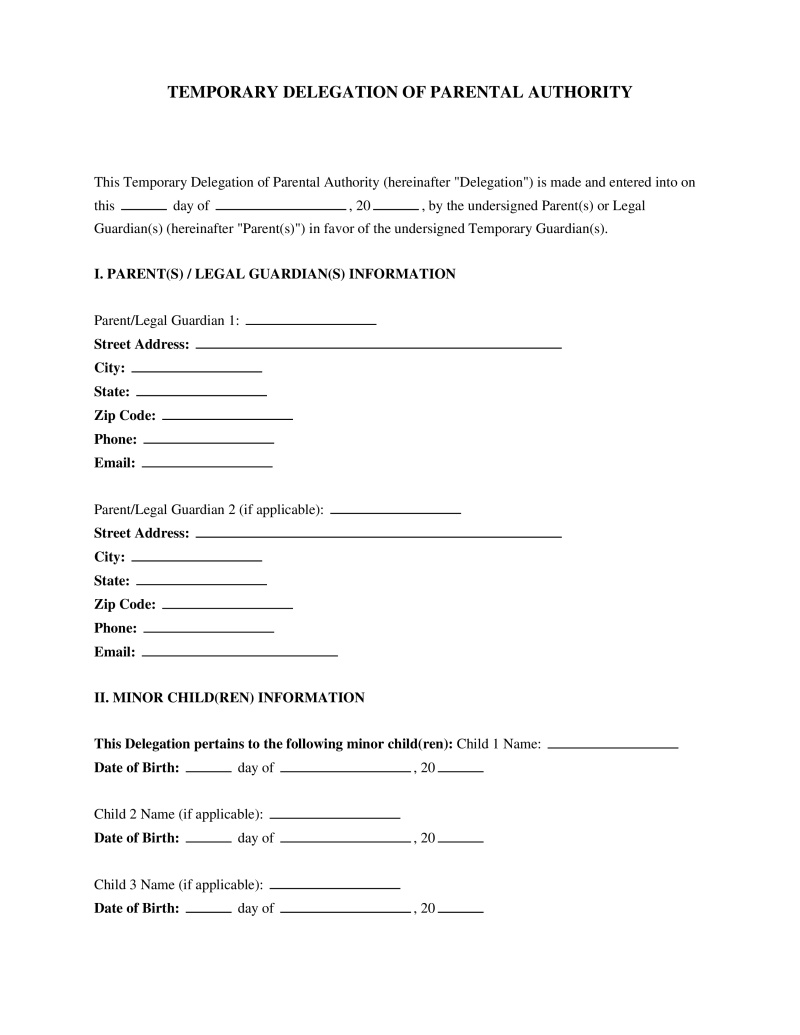
A Non-Court Temporary Guardianship Letter is a legal instrument by which a parent or legal guardian designates another individual to assume temporary care and decision-making authority for a minor child, without direct court intervention.
Guardianship Reason
Select the main reason for appointing a temporary guardian. This will be included in the letter for clarity.
Provide a brief explanation if 'Other' was selected.
Table of Contents
What is a Non-Court Temporary Guardianship Letter?
A non-court temporary guardianship letter is a legal document through which a parent or legal guardian delegates parental authority to a chosen individual for a specified, limited period without direct court intervention. This instrument serves to authorize a temporary caregiver to make decisions regarding a minor's care, education, and medical treatment when the parents are unavailable or incapacitated. It is typically utilized for situations such as extended travel, military deployment, illness, or other circumstances requiring a temporary delegation of authority. The letter provides a practical solution for ensuring continuity of care for children in the absence of their primary guardians.
Legal Requirements and Validity
The legal validity of a non-court temporary guardianship letter hinges on adherence to specific requirements, which can vary by state. While designed to avoid immediate court proceedings, these letters derive their authority from state statutes that permit parental delegation of authority. Proper execution and content are crucial for the document to be recognized and respected by schools, medical providers, and other institutions.
Key requirements for the legal validity of such a letter typically include:
- Parental Consent - The letter must clearly state the full legal names of the parent(s) or legal guardian(s) granting the authority, along with their explicit consent for the delegation.
- Identification of Parties - Full legal names, dates of birth, and contact information for the minor child(ren) and the designated temporary guardian must be provided.
- Scope of Authority - The specific powers being delegated must be clearly outlined, such as authority over medical care, educational decisions, and daily living arrangements.
- Duration - A precise start and end date for the temporary guardianship must be specified. State laws often impose maximum durations, typically ranging from 6 months to 1 year, after which court intervention may be required for continued guardianship.
- Notarization and Witnessing - Many states require the letter to be notarized to attest to the authenticity of the parent's signature. Some jurisdictions may also recommend or require the presence of witnesses.
- Reason for Delegation - While not always legally mandated, including a brief explanation for the delegation (e.g., parental travel, military service) can add weight and clarity to the document.
How to Complete a Non-Court Temporary Guardianship Letter
Creating a non-court temporary guardianship letter involves several important steps to ensure it is legally sound and effectively serves its purpose. Attention to detail throughout the process is paramount for the document to be recognized and accepted by third parties.
- Gather Essential Information - Begin by compiling all necessary personal details for the parents, the minor child(ren), and the prospective temporary guardian. This includes full legal names, dates of birth, current addresses, and contact telephone numbers. It is also beneficial to have social security numbers or other identifying information readily available for all parties, as this may be required by certain institutions for verification purposes.
- Draft the Document with Clear Delegation of Powers - Clearly articulate the specific powers being granted to the temporary guardian within the letter. This includes authority over medical decisions, educational enrollment and participation, and day-to-day care. Avoid vague language and specify any limitations on the guardian's authority. For instance, you might state that the guardian can consent to routine medical care but not elective surgery without further parental consent.
- Specify the Duration and Conditions - Clearly state the start and end dates for the temporary guardianship. Ensure the duration complies with any state-specific limits on non-court delegations of parental authority. Include any conditions under which the guardianship might terminate earlier, such as the parent's earlier return or a change in circumstances. This clarity helps prevent ambiguity and potential disputes regarding the guardian's authority.
- Execute the Letter with Proper Notarization and Witnessing - Once drafted, the parent(s) or legal guardian(s) must sign the document in the presence of a notary public. Many states require notarization for this type of document to be legally binding and accepted by third parties. Some jurisdictions may also recommend or require one or two disinterested witnesses to sign the document, further validating the parent's intent and signature.
- Distribute Copies to Relevant Parties - After execution, provide original or certified copies of the letter to the temporary guardian, the child's school, the child's primary care physician, and any other relevant medical or educational institutions. It is advisable for the parents to retain an original copy for their records. Ensuring all relevant parties have access to the document facilitates its use and minimizes potential delays or challenges.
Rights and Obligations of Parties Involved
A non-court temporary guardianship letter establishes a clear framework of rights and obligations for all parties involved, ensuring the child's welfare remains the central focus. Understanding these roles is crucial for the effective implementation of the temporary guardianship arrangement.
The primary parties and their respective roles include:
- Parents/Legal Guardians - The parents retain ultimate legal custody and responsibility for the child. Their primary obligation is to designate a suitable temporary guardian and clearly define the scope and duration of delegated authority. They maintain the right to revoke the guardianship at any time, provided they are capable of resuming care. Parents must also ensure the temporary guardian has sufficient resources and information to fulfill their duties effectively.
- Temporary Guardian - The temporary guardian assumes responsibility for the child's daily care, education, and medical needs as outlined in the letter. Their obligations include acting in the child's best interests, providing a safe and nurturing environment, and adhering to the scope of authority granted by the parents. They must communicate regularly with the parents, especially regarding significant decisions or emergencies. The temporary guardian does not gain permanent parental rights or responsibilities.
- Minor Child(ren) - The child(ren) are the subject of the guardianship and their well-being is the paramount concern. While they do not have legal obligations in this context, their stability and continuity of care are the direct benefits of this arrangement. The temporary guardian is obligated to consider the child's needs and, where appropriate, their wishes, consistent with their age and maturity.
Applicable Federal and State Laws
While a non-court temporary guardianship letter aims to avoid formal court proceedings, its effectiveness and legal standing are underpinned by various federal and state laws. These laws provide the framework for parental delegation of authority, protect children's information, and ensure the recognition of temporary care arrangements across jurisdictions.
Federal Statutes
Several federal laws influence the practical application of a temporary guardianship letter, particularly concerning privacy and interstate recognition:
- Health Insurance Portability and Accountability Act (HIPAA) - This act sets standards for the protection of protected health information (PHI) (45 CFR § 164.508). A temporary guardianship letter that explicitly grants medical decision-making authority often includes language allowing the temporary guardian to access the child's medical records and consent to treatment, thereby satisfying HIPAA's authorization requirements for disclosure to a personal representative.
- Family Educational Rights and Privacy Act (FERPA) - FERPA protects the privacy of student education records (20 U.S.C. § 1232g). A properly executed temporary guardianship letter can authorize the temporary guardian to act as a parent for the purpose of accessing education records and making educational decisions, as it demonstrates the parent's consent for the guardian to stand in their place.
- Uniform Child Custody Jurisdiction and Enforcement Act (UCCJEA) - While primarily governing court-ordered custody, the UCCJEA provides mechanisms for enforcing custody orders across state lines (9 U.L.A. 261 (1997)). In situations where a temporary guardianship letter is used for a child moving between states, understanding UCCJEA principles can be relevant, especially if a formal custody dispute arises or if the temporary arrangement needs court validation.
State Laws and Requirements
The authority to create and the limitations of a non-court temporary guardianship letter are primarily governed by state-specific statutes. These laws vary significantly in their scope, duration limits, and formal requirements.
- Parental Delegation of Authority Statutes - Most states have specific statutes that permit a parent to delegate certain parental powers to another individual for a temporary period. These statutes typically define the maximum duration of such delegation (e.g., 6 months, 1 year) and the formal requirements for the letter, such as notarization (e.g., Fla. Stat. § 751.01; Tex. Fam. Code § 34.01).
- Minor Consent to Medical Treatment Laws - State laws often address who can consent to medical treatment for a minor. A temporary guardianship letter, when properly drafted and executed, should explicitly grant the temporary guardian the authority to consent to medical care, aligning with these state provisions and ensuring healthcare providers can act without parental presence (e.g., Cal. Fam. Code § 6922).
- School Enrollment and Educational Decision-Making - State education codes and regulations govern who has the authority to enroll a child in school and make educational decisions. A temporary guardianship letter must clearly convey this authority to the designated guardian to facilitate the child's educational continuity (e.g., N.Y. Educ. Law § 3202).
- Penalties for Non-Compliance - While direct penalties for an improperly drafted non-court temporary guardianship letter are rare, the primary consequence is that the letter may be deemed invalid or unenforceable. This can lead to significant practical challenges, such as a school refusing enrollment, a medical provider denying treatment, or legal action being required to establish formal guardianship. In cases of fraud or misrepresentation in creating the document, more severe legal consequences could apply.
Limitations and Scope
While a non-court temporary guardianship letter offers a practical solution for delegating parental authority, it is crucial to understand its inherent limitations. This document is designed for temporary situations and does not confer the full legal rights and responsibilities associated with permanent guardianship or adoption.
Key limitations of this type of letter include:
- Temporary Nature - The authority granted is strictly temporary, with a defined start and end date. State laws typically set maximum durations for these arrangements, after which a court order may be necessary for continued guardianship.
- No Permanent Legal Status - A temporary guardianship letter does not alter the legal parent-child relationship. The parents retain ultimate legal custody and can revoke the delegation at any time, provided they are able to resume care.
- Limited Scope of Authority - While broad powers related to care, education, and medical decisions can be delegated, the letter generally cannot authorize actions that fundamentally alter the child's legal status, such as consenting to adoption or changing the child's surname.
- Jurisdictional Challenges - While many states recognize these letters, their acceptance can vary, particularly across state lines or in situations involving complex legal issues. Some institutions may still require a court order, especially for significant medical procedures or long-term educational placements.
- Not a Substitute for Court Order - For situations involving parental unfitness, abuse, neglect, or long-term incapacitation, a non-court letter is insufficient. These circumstances necessitate formal court proceedings to establish legal guardianship or custody, which provides a higher level of legal scrutiny and protection for the child.
Frequently Asked Questions
Not the form you're looking for?
Try our legal document generator to create a custom document
Disclaimer: The templates available on this website are provided for general informational purposes only and do not constitute legal advice. They are not intended to be, and should not be interpreted as, compliant with any specific legal, regulatory, or privacy requirements. These templates are not a replacement for professional legal guidance and should not be relied upon for any particular matter or circumstance. Users are strongly encouraged to seek advice from a qualified attorney licensed in their jurisdiction before using, modifying, or relying on any template.
All templates are provided on an "as is," "with all faults," and "as available" basis. The provider disclaims any and all warranties of any kind, whether express, implied, statutory, or otherwise, including without limitation warranties of merchantability, fitness for a particular purpose, title, or non-infringement.
LegalTemplates.com makes no guarantees or representations regarding the accuracy, completeness, expected outcomes, or reliability of the materials contained in these templates or any materials referenced or linked from them.