Statement of Work Template
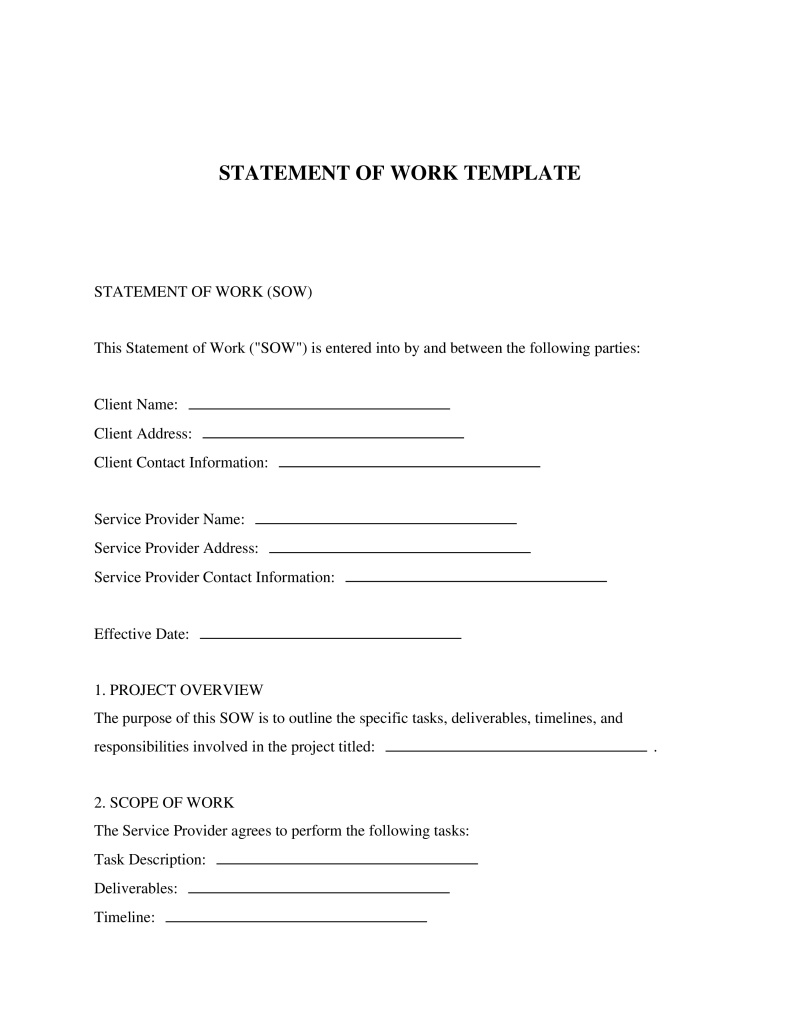
A Statement of Work Template outlines project scope, deliverables, timelines, and responsibilities, ensuring clarity and agreement between parties.
Project Type
Select the category that best fits the nature of the work. This helps tailor the SOW to industry practices.
Provide a brief description if your project does not fit the listed categories.
Table of Contents
What Is a Statement Of Work Template?
A Statement of Work (SOW) template is a structured document that formally defines the scope, deliverables, timelines, and responsibilities for a specific project or service agreement between a client and a service provider or vendor. It serves as a critical communication tool, ensuring that all parties have a clear, shared understanding of what work will be performed, what outcomes are expected, and how success will be measured. Teams utilize an SOW template to standardize their project initiation process, minimize ambiguity, prevent scope creep, and establish a foundational agreement before significant work commences, thereby reducing potential disputes and fostering smoother collaboration.
What Is Included
A comprehensive Statement of Work template typically includes several key sections designed to leave no room for misinterpretation. Each component plays a vital role in outlining the project's specifics and ensuring alignment between the client and the service provider:
- Introduction and Purpose - This section provides a high-level overview of the project, its objectives, and the parties involved. It sets the context for the entire document, explaining why the work is being undertaken and what the desired business outcomes are.
- Scope of Work - Arguably the most crucial section, it explicitly details what tasks and activities will be performed and, equally important, what will NOT be performed. This clarity is essential for preventing scope creep and managing expectations effectively.
- Deliverables - This lists all tangible outputs, products, or services that the service provider will deliver to the client. Each deliverable should be clearly defined, measurable, and have an associated due date or milestone.
- Timeline and Milestones - This section outlines the project schedule, including key start and end dates, significant milestones, and the expected duration for each phase or deliverable. It provides a roadmap for project progress tracking.
- Roles and Responsibilities - Clearly defines who is accountable for what on both the client and service provider sides. This includes identifying key contacts, project managers, and team members, along with their specific duties.
- Payment Schedule and Terms - Details the financial aspects of the agreement, including the total project cost, billing rates, payment intervals (e.g., upfront, milestone-based, monthly), and any specific invoicing requirements or late payment policies.
- Acceptance Criteria - Specifies the standards, metrics, or conditions that must be met for the client to formally approve a deliverable or the completion of a project phase. Clear acceptance criteria prevent disputes over the quality or completeness of work.
- Assumptions and Constraints - Lists any conditions that are taken for granted for the project to proceed as planned (assumptions) and any limitations or restrictions that might impact the project's execution (constraints). This helps in managing risks and setting realistic expectations.
- Change Management Process - Describes the formal procedure for requesting, reviewing, approving, or rejecting changes to the agreed-upon scope, deliverables, or timeline. A well-defined change process is vital for adapting to evolving project needs without derailing the project.
Who Should Use This Template?
The Statement of Work template is a versatile tool, but its utility shines brightest in specific scenarios and for particular types of organizations.
Best For
- Project Managers and Project Leads: To formalize project scope, deliverables, and timelines with external vendors or internal teams, ensuring everyone is aligned from the outset.
- Procurement and Contracting Teams: When engaging third-party vendors, consultants, or contractors for specific services, to clearly define the contractual obligations and expected outcomes.
- Service-Based Businesses (e.g., IT Consulting, Marketing Agencies, Development Firms): To clearly articulate the services they will provide to clients, setting expectations and protecting against scope creep.
- Clients Engaging External Vendors: To ensure that the services or products they are purchasing are precisely what they need, with clear deliverables and acceptance criteria.
- Organizations with Fixed-Price Contracts: Crucial for projects where the budget is fixed, as it precisely defines the scope to prevent cost overruns due to expanding requirements.
- Medium to Large-Scale Projects: Especially those with multiple phases, complex deliverables, or involving significant financial investment, where detailed planning and formal agreement are essential.
Not Ideal For
- Very Small, Informal Internal Tasks: For quick, ad-hoc internal assignments with low risk and clear, immediate understanding, an SOW might introduce unnecessary overhead.
- Highly Agile Development Sprints (without adaptation): Traditional SOWs define a fixed scope, which can conflict with the iterative and flexible nature of pure Agile methodologies. An Agile SOW or a very high-level SOW with subsequent detailed user stories is more appropriate.
- Exploratory or Discovery Phases: When the project's scope is inherently undefined and the goal is to explore possibilities, a rigid SOW can hinder innovation. A separate discovery phase SOW might be used instead.
- Simple, Standardized Product Purchases: For off-the-shelf products or services with pre-defined terms and conditions, a simple purchase order or standard contract might suffice.
- Extremely Early-Stage Venture Capital Pitches: Before a project or company's direction is solidified, a detailed SOW is premature.
Quick Start Guide
Effectively utilizing a Statement of Work template involves more than just filling in blanks; it requires strategic thinking and clear communication. Follow these tactical steps to get started:
- Define Core Project Objectives: Before drafting, clearly articulate the 'why' behind the project. What problem are you solving? What specific business goals will this work achieve? This foundational understanding will guide all subsequent sections and help prioritize scope.
- Detail the Scope with Precision: List all specific tasks, activities, and processes that are included in the work. Crucially, also list what is explicitly *excluded* to prevent ambiguity. Use quantifiable metrics where possible (e.g., 'develop 5 web pages' instead of 'develop web pages').
- Specify Measurable Deliverables and Milestones: For each deliverable, define what it is, its format, and its completion criteria. Break the project into logical milestones with clear dates. For example, instead of 'website,' specify 'fully functional homepage prototype,' 'beta version for user testing,' and 'final production launch.'
- Assign Clear Roles and Responsibilities: Identify the key stakeholders and their specific roles for both the client and the service provider. Define decision-making authority and communication channels. This prevents overlap or gaps in accountability.
- Establish Concrete Acceptance Criteria: Determine how each deliverable will be judged as complete and satisfactory. Will there be a review period? Specific performance tests? Sign-off by a particular person? Make these criteria objective to avoid subjective disputes later.
- Outline a Realistic Payment and Billing Schedule: Detail the total cost, payment methods, and when payments are due (e.g., upon SOW signing, at specific milestones, monthly). Include provisions for invoicing and any penalties for late payment. Consider breaking down large payments to align with major deliverable completions.
- Develop a Robust Change Management Process: Anticipate that changes may occur. Define a formal process for requesting changes, assessing their impact on scope, schedule, and cost, and obtaining formal approval from all parties before implementation. This prevents 'informal' scope creep.
- Collaborate, Review, and Iterate: Share initial drafts of the SOW with all key stakeholders (client, vendor, internal teams). Solicit feedback, address concerns, and iterate until all parties are in full agreement. A collaborative review process ensures buy-in and reduces the likelihood of misunderstandings post-signing.
Frequently Asked Questions
Not the form you're looking for?
Try our legal document generator to create a custom document
Disclaimer: The templates available on this website are provided for general informational purposes only and do not constitute legal advice. They are not intended to be, and should not be interpreted as, compliant with any specific legal, regulatory, or privacy requirements. These templates are not a replacement for professional legal guidance and should not be relied upon for any particular matter or circumstance. Users are strongly encouraged to seek advice from a qualified attorney licensed in their jurisdiction before using, modifying, or relying on any template.
All templates are provided on an "as is," "with all faults," and "as available" basis. The provider disclaims any and all warranties of any kind, whether express, implied, statutory, or otherwise, including without limitation warranties of merchantability, fitness for a particular purpose, title, or non-infringement.
LegalTemplates.com makes no guarantees or representations regarding the accuracy, completeness, expected outcomes, or reliability of the materials contained in these templates or any materials referenced or linked from them.