Trial Separation Agreement
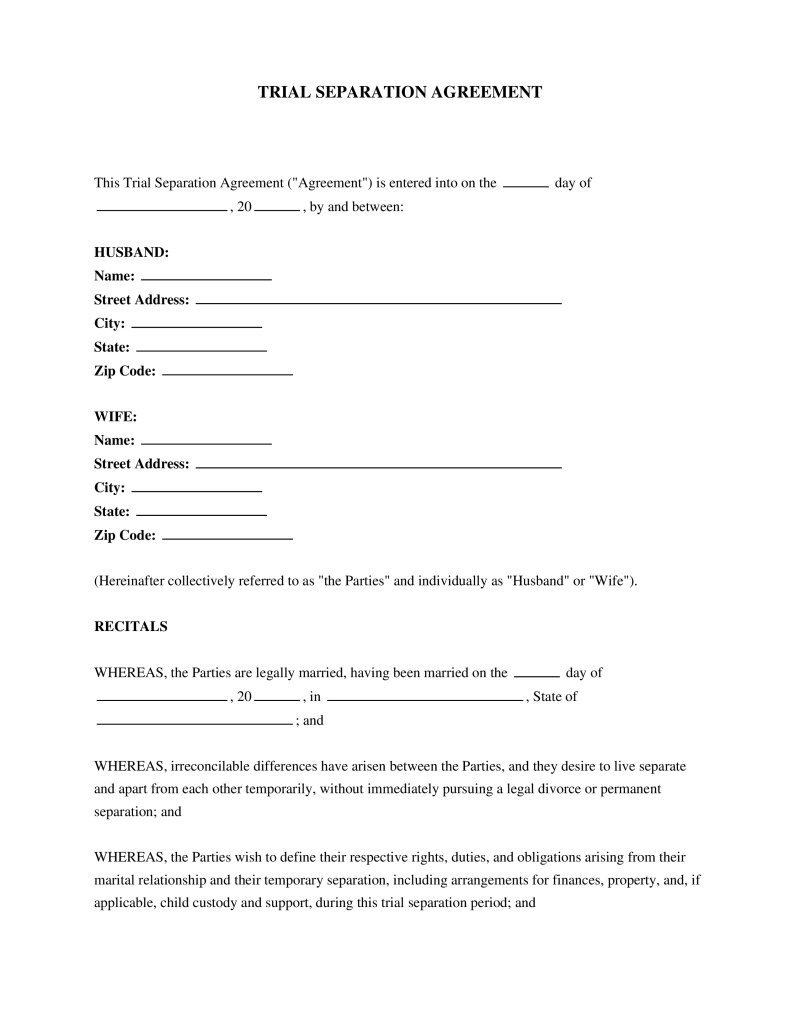
A Trial Separation Agreement is a legal document that formally outlines temporary arrangements for spouses who live apart while evaluating their marital future, addressing matters such as finances, property, and child-related issues.
Agreement Effective Date
Enter the date when the separation agreement will begin.
Table of Contents
What is a Trial Separation Agreement?
A trial separation agreement is a written document voluntarily entered into by married spouses who are contemplating divorce or permanent separation, but wish to live apart for a trial period. Its primary purpose is to establish temporary arrangements for financial support, child custody, property use, and other marital issues while the couple evaluates the future of their marriage. This agreement provides a structured framework for a temporary living arrangement, allowing both parties to experience the practicalities of living separately without immediately committing to a formal legal separation or divorce.
Legal Requirements and Validity
The legal validity of a trial separation agreement largely depends on the jurisdiction and the intent of the parties. While not a court order, it is a contract between spouses and generally enforceable if it meets basic contractual requirements. For an agreement to be considered valid and potentially binding, it typically requires:
- Mutual Assent - Both parties must voluntarily and knowingly agree to the terms without coercion or undue influence.
- Consideration - Each party must provide something of value, such as a promise to abide by certain terms in exchange for the other's promises.
- Lawful Purpose - The agreement's terms must not violate public policy or any existing laws.
- Capacity - Both parties must be of sound mind and legal age to enter into a contract.
- Written Form and Signatures - Although some verbal agreements may be recognized, a written document signed by both parties is crucial for enforceability and clarity, often requiring notarization in many jurisdictions to prevent future disputes regarding authenticity.
Some states may treat trial separation agreements as enforceable contracts, while others might view them as less formal arrangements, especially if they are not formally filed with a court. The enforceability can be strengthened if the agreement is fair and reasonable at the time of its execution and if both parties had independent legal counsel.
Key Provisions in a Trial Separation Agreement
A comprehensive trial separation agreement addresses various aspects of the couple's lives during the trial period. The specific clauses included are designed to minimize conflict and provide clarity on responsibilities while living apart. Essential provisions typically include:
- Temporary Child Custody and Visitation - Outlining the parenting schedule, including weekdays, weekends, holidays, and vacations for any minor children.
- Child Support - Specifying the amount and frequency of financial support for children, often based on state guidelines.
- Spousal Support (Alimony) - Determining if one spouse will provide financial support to the other and, if so, the amount and duration of such support during the trial period.
- Use of Marital Residence - Designating which spouse will reside in the family home and who will be responsible for mortgage/rent payments, utilities, and maintenance.
- Division of Debts - Allocating responsibility for marital debts, such as credit card balances, car loans, and student loans, incurred before or during the separation.
- Management of Bank Accounts and Financial Assets - Clarifying access to joint bank accounts, investments, and other financial resources.
- Healthcare and Other Insurance - Addressing the continuation of health, dental, vision, and life insurance coverage for both spouses and children.
- Personal Property - Providing for the temporary division or use of personal belongings, vehicles, and other assets.
- Communication Guidelines - Establishing expectations for communication between the spouses, especially regarding children's matters.
- Duration of Agreement - Stating the specific period for which the agreement will be in effect, after which the parties will reassess their marital status.
How to Draft a Trial Separation Agreement
Drafting a trial separation agreement involves careful consideration of numerous personal and financial details. While templates exist, customizing the document to reflect the unique circumstances of the couple is essential. Seeking legal counsel during this process is highly recommended to ensure all necessary provisions are included and legally sound.
- Identify Core Issues and Discuss Terms - Begin by openly discussing all major areas that require temporary arrangements, such as living situations, finances, and parenting. Both parties should clearly articulate their needs and expectations, and attempt to reach an understanding on each point before formalizing anything. This initial discussion forms the basis of the agreement's content.
- Gather Financial Information - Collect all relevant financial documents, including income statements, tax returns, bank statements, investment account summaries, and debt records. A clear picture of the marital estate and individual financial standing is critical for making equitable decisions regarding support and asset allocation during the separation.
- Draft the Agreement Document - Using the agreed-upon terms, begin writing the agreement. Clearly state the names of both parties, the date, and explicitly declare that the agreement is for a trial separation. Organize the document into distinct sections for child custody, support, property, and debt, ensuring each clause is precise and unambiguous.
- Review with Legal Counsel - Before signing, each spouse should have the agreement reviewed by their own independent attorney. Legal counsel can identify potential pitfalls, ensure the agreement is fair, explain its implications, and confirm compliance with state laws. An attorney can also advise on the enforceability of the terms and suggest necessary revisions.
- Sign and Notarize the Agreement - Once both parties and their respective attorneys are satisfied with the terms, the agreement should be signed by both spouses. It is highly advisable to have the signatures notarized, as this adds a layer of authenticity and can be crucial evidence if the agreement's validity is challenged in the future. Keep original copies for both parties.
Rights and Obligations of Parties
During a trial separation, the rights and obligations of the parties are primarily defined by the terms of their written agreement. Unlike a formal legal separation or divorce, a trial separation does not typically alter the legal status of the marriage itself; the parties remain legally married. However, the agreement dictates their practical responsibilities and entitlements while living apart.
- Parental Rights and Responsibilities - Both parents generally retain full legal and physical parental rights unless specified otherwise in the agreement. The agreement will delineate specific obligations regarding child-rearing, including decision-making authority, daily care, and financial support.
- Financial Rights and Obligations - The agreement will detail financial contributions, such as spousal support, child support, and responsibility for marital debts. While separate, spouses may still have a duty to not dissipate marital assets, and any income earned may still be considered marital property in community property states, unless explicitly addressed.
- Property Rights - The agreement typically specifies the temporary use and possession of marital property. It does not permanently divide marital assets or debts, but rather establishes who uses what during the trial period. Neither party should sell or encumber significant marital assets without the other's consent.
- Healthcare and Insurance - Spouses generally remain eligible for each other's employer-sponsored health insurance during a trial separation, as they are still legally married. The agreement should clarify who maintains coverage and who is responsible for premiums.
- Confidentiality and Privacy - While not always explicitly stated, a trial separation agreement often implies a mutual expectation of respect for privacy and a reduction in marital intimacy, though the legal bond remains.
Applicable Federal and State Laws
While no specific federal law directly governs trial separation agreements, several broader legal principles and state statutes indirectly influence their creation, content, and enforceability.
Federal Statutes
- Employee Retirement Income Security Act (ERISA) - Governs most private sector employee benefit plans, including health insurance and retirement accounts (29 U.S.C. § 1001 et seq.). This is relevant for maintaining or changing beneficiaries and understanding rights to retirement assets during a separation.
- Social Security Act - Defines eligibility for Social Security benefits, which can be affected by the duration of marriage should a divorce occur (42 U.S.C. § 301 et seq.).
- Internal Revenue Code - Dictates tax filing statuses (married filing jointly, married filing separately) and the deductibility of spousal or child support payments (26 U.S.C. § 1 et seq.).
State Laws and Requirements
State laws play a more direct role, often treating trial separation agreements as contracts subject to general contract law principles. Specific state statutes and common law doctrines that apply include:
- Contract Law Principles - The basic requirements for a valid contract, such as offer, acceptance, consideration, and mutual assent, are universally applied to these agreements (e.g., California Civil Code § 1550 et seq., New York General Obligations Law § 5-101 et seq.).
- Family Law Statutes - While not directly regulating trial separations, state family codes often provide guidelines for child custody, child support, and spousal support that can inform the terms of a trial separation agreement, even if the agreement itself isn't a court order (e.g., Texas Family Code, Florida Statutes Chapter 61).
- Statute of Frauds - In many states, agreements concerning real property or agreements that cannot be performed within one year must be in writing to be enforceable (e.g., California Civil Code § 1624, New York General Obligations Law § 5-701).
- Equitable Distribution/Community Property Laws - These laws dictate how marital assets and debts would be divided in a divorce, which can influence how parties decide to manage finances during a trial separation, particularly in states like California, Texas, and Washington.
Penalties for non-compliance with a trial separation agreement are typically contractual in nature. If one party breaches the agreement, the other party may be able to sue for breach of contract, seeking specific performance or damages. However, without court approval, enforcement mechanisms may be more limited than with a formal court order.
Impact on Future Legal Proceedings
A trial separation agreement can significantly influence future legal proceedings, particularly if the couple eventually decides to pursue a legal separation or divorce. The agreement serves as a documented record of the parties' intentions and arrangements during a period of marital uncertainty.
Courts often look to the terms of a trial separation agreement as evidence of the parties' previous agreements and conduct. If the terms were fair and reasonable, and both parties had legal representation, a court might give substantial weight to its provisions concerning child custody, support, and property division when formalizing a divorce decree. This is especially true if the agreement was successfully implemented for a significant period. However, a court retains the discretion to modify terms, particularly those related to child custody and support, if it determines that the provisions are no longer in the best interests of the children or if circumstances have materially changed. The agreement can also demonstrate a clear date of separation, which is crucial for determining marital property in many jurisdictions.
Frequently Asked Questions
Not the form you're looking for?
Try our legal document generator to create a custom document
Disclaimer: The templates available on this website are provided for general informational purposes only and do not constitute legal advice. They are not intended to be, and should not be interpreted as, compliant with any specific legal, regulatory, or privacy requirements. These templates are not a replacement for professional legal guidance and should not be relied upon for any particular matter or circumstance. Users are strongly encouraged to seek advice from a qualified attorney licensed in their jurisdiction before using, modifying, or relying on any template.
All templates are provided on an "as is," "with all faults," and "as available" basis. The provider disclaims any and all warranties of any kind, whether express, implied, statutory, or otherwise, including without limitation warranties of merchantability, fitness for a particular purpose, title, or non-infringement.
LegalTemplates.com makes no guarantees or representations regarding the accuracy, completeness, expected outcomes, or reliability of the materials contained in these templates or any materials referenced or linked from them.