Sales Agreement
A Sales Agreement is a legally binding contract between a buyer and a seller, detailing the terms and conditions for the exchange of goods or services.
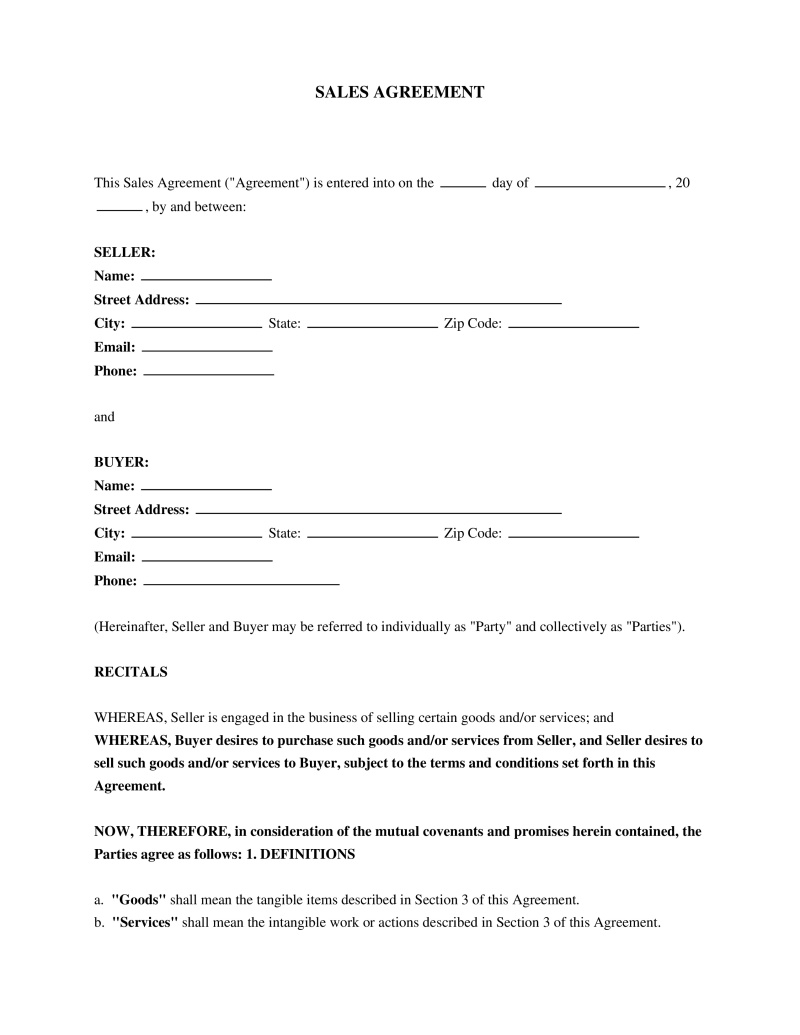
Agreement Effective Date
Enter the date on which this agreement becomes legally effective.
Table of Contents
What is a Sales Agreement?
A sales agreement is a legally binding contract between two or more parties, typically a buyer and a seller, that outlines the terms and conditions of a transaction involving the exchange of goods or services for consideration, usually money. Its primary purpose is to document the mutual understanding and commitment of the parties, ensuring clarity regarding the sale and preventing potential disputes. This foundational document is widely utilized across various industries, from simple retail purchases to complex business-to-business transactions, establishing a framework for the transfer of ownership and associated responsibilities.
Requirements
For a sales agreement to be legally valid and enforceable, it must generally satisfy several fundamental contractual elements. These elements ensure that both parties enter into the agreement knowingly and willingly, with a clear understanding of their respective roles and expectations. The absence of any one of these core components can render the agreement void or voidable, impacting its enforceability in a court of law.
- Offer and Acceptance - One party must make a clear offer to buy or sell, and the other party must unequivocally accept that offer. This establishes a "meeting of the minds" between the parties regarding the essential terms of the sale.
- Consideration - There must be something of value exchanged between the parties. In most sales agreements, this is the goods or services provided by the seller and the payment made by the buyer, representing the mutual benefit derived from the transaction.
- Legal Capacity - All parties entering into the agreement must have the legal ability to do so. This typically means they must be of legal age, possess sound mind, and not be under duress or undue influence. Entities like corporations must have proper authorization to enter contracts.
- Lawful Purpose - The subject matter and purpose of the sales agreement must be legal and not violate any public policy or statute. An agreement to sell illegal substances, for example, would be inherently unenforceable.
- Mutual Assent - Both parties must agree to the same terms and conditions, signifying a genuine intent to be bound by the contract. This is closely related to offer and acceptance, emphasizing the shared understanding of the agreement's scope.
- Statute of Frauds Compliance - For certain types of sales, particularly those involving goods valued at $500 or more, or real estate, a sales agreement may be required to be in writing to be enforceable (UCC § 2-201). This requirement aims to prevent fraudulent claims by ensuring tangible evidence of the agreement's existence and terms.
Rights and Obligations of Parties
A well-drafted sales agreement clearly delineates the rights and obligations of both the buyer and the seller, establishing a balanced framework for the transaction. Understanding these roles is crucial for ensuring smooth execution and providing a basis for resolving any disagreements that may arise. The specific rights and obligations can vary based on the nature of the goods or services, industry customs, and jurisdictional laws, but core principles generally apply.
Buyer's Rights and Obligations:
- Right to Receive Goods/Services - The buyer has the right to receive the specified goods or services as described in the agreement, delivered according to the agreed-upon schedule and condition.
- Right to Inspect - Buyers typically have the right to inspect the goods upon delivery to ensure they conform to the contract's specifications before final acceptance and payment.
- Right to Warranties - Depending on the agreement and applicable laws, buyers may have rights to implied or express warranties regarding the quality, fitness, or merchantability of the goods.
- Obligation to Pay - The buyer is obligated to pay the agreed-upon purchase price according to the terms specified in the sales agreement, including any down payments, installments, or full payments upon delivery.
- Obligation to Accept Delivery - The buyer must accept delivery of the goods or services when they are offered in accordance with the contract terms, unless there is a valid reason for rejection.
Seller's Rights and Obligations:
- Right to Receive Payment - The seller has the right to receive the full purchase price from the buyer as stipulated in the sales agreement.
- Right to Cure Defects - In certain circumstances, if non-conforming goods are delivered, the seller may have the right to "cure" the defect by replacing or repairing the goods within a reasonable timeframe.
- Obligation to Deliver Goods/Services - The seller must deliver the specific goods or perform the services as detailed in the agreement, ensuring they meet the quality, quantity, and delivery schedule specified.
- Obligation to Transfer Title - The seller is responsible for transferring clear and marketable title to the goods to the buyer, free from any undisclosed liens or encumbrances.
- Obligation to Provide Warranties - The seller must uphold any express warranties made regarding the goods or services, and may be subject to implied warranties imposed by law, such as the implied warranty of merchantability.
How to Complete a Sales Agreement
Drafting a comprehensive sales agreement involves several key steps to ensure all critical aspects of the transaction are clearly documented and legally sound. Following a structured process helps to minimize ambiguities and protect the interests of both the buyer and the seller.
- Identify the Parties and Date - Clearly state the full legal names and addresses of both the buyer and the seller at the beginning of the document. If a party is a business entity, include its legal name, type of entity (e.g., LLC, Corporation), and state of incorporation. Accurately record the effective date of the agreement, which is the date it becomes legally binding.
- Describe the Goods or Services - Provide a detailed and unambiguous description of the items being sold or services being rendered. For goods, include quantity, model numbers, serial numbers, color, condition, and any unique identifiers. For services, specify the scope of work, deliverables, timelines, and any performance metrics. Attach exhibits or schedules for extensive lists or complex specifications.
- State the Purchase Price and Payment Terms - Clearly specify the total purchase price in numerical and written form, along with the currency. Outline the payment schedule, including any down payments, installment plans, or full payment due dates. Detail the accepted methods of payment, such as bank transfer, check, or credit card, and any late payment penalties or interest charges.
- Define Delivery, Acceptance, and Transfer of Risk - Establish the terms for delivery, including the delivery location, estimated date, and who is responsible for shipping costs and arrangements. Specify the process for the buyer's inspection and acceptance of the goods, including any time limits for rejection. Clearly state when the risk of loss or damage to the goods transfers from the seller to the buyer, which is crucial for insurance purposes.
- Include Warranties and Disclaimers - Detail any express warranties provided by the seller regarding the quality, condition, or performance of the goods or services, including the duration and scope of coverage. If the sale is "as-is," explicitly state this disclaimer to limit implied warranties, ensuring it complies with applicable state laws, particularly the Uniform Commercial Code.
- Outline Governing Law and Dispute Resolution - Specify the state or jurisdiction whose laws will govern the interpretation and enforcement of the agreement. Include clauses for dispute resolution, such as mediation, arbitration, or litigation, and define the venue for any legal proceedings to avoid future jurisdictional conflicts.
- Add Signatures and Witness/Notary Information - Ensure both the buyer and seller, or their authorized representatives, sign and date the agreement. Include spaces for printed names and titles. Depending on the complexity or value of the transaction and state requirements, consider having the document witnessed or notarized to enhance its legal enforceability and authenticity.
Penalties for Non-Compliance
Failure to comply with the terms of a sales agreement or relevant laws can result in significant legal consequences. The specific penalties depend on the nature of the breach, the terms of the contract, and the applicable jurisdiction.
- Breach of Contract Remedies - If one party fails to fulfill their obligations, the non-breaching party may seek remedies such as monetary damages (compensatory, consequential, incidental), specific performance (court order to fulfill the contract), or rescission (cancellation of the contract).
- Statutory Fines and Penalties - Violations of federal or state consumer protection laws can lead to substantial fines imposed by regulatory bodies (e.g., FTC, state Attorneys General), in addition to civil liabilities to affected parties.
- Contract Invalidation - If a sales agreement fails to meet fundamental legal requirements (e.g., lack of consideration, illegal purpose), a court may declare the contract void or unenforceable, meaning it never legally existed or cannot be enforced.
- Reputational Damage - Beyond legal and financial penalties, non-compliance or a reputation for unfair practices can severely damage a business's reputation and customer trust.
Frequently Asked Questions
Not the form you're looking for?
Try our legal document generator to create a custom document
Disclaimer: The templates available on this website are provided for general informational purposes only and do not constitute legal advice. They are not intended to be, and should not be interpreted as, compliant with any specific legal, regulatory, or privacy requirements. These templates are not a replacement for professional legal guidance and should not be relied upon for any particular matter or circumstance. Users are strongly encouraged to seek advice from a qualified attorney licensed in their jurisdiction before using, modifying, or relying on any template.
All templates are provided on an "as is," "with all faults," and "as available" basis. The provider disclaims any and all warranties of any kind, whether express, implied, statutory, or otherwise, including without limitation warranties of merchantability, fitness for a particular purpose, title, or non-infringement.
LegalTemplates.com makes no guarantees or representations regarding the accuracy, completeness, expected outcomes, or reliability of the materials contained in these templates or any materials referenced or linked from them.