Property Settlement Worksheet Divorce
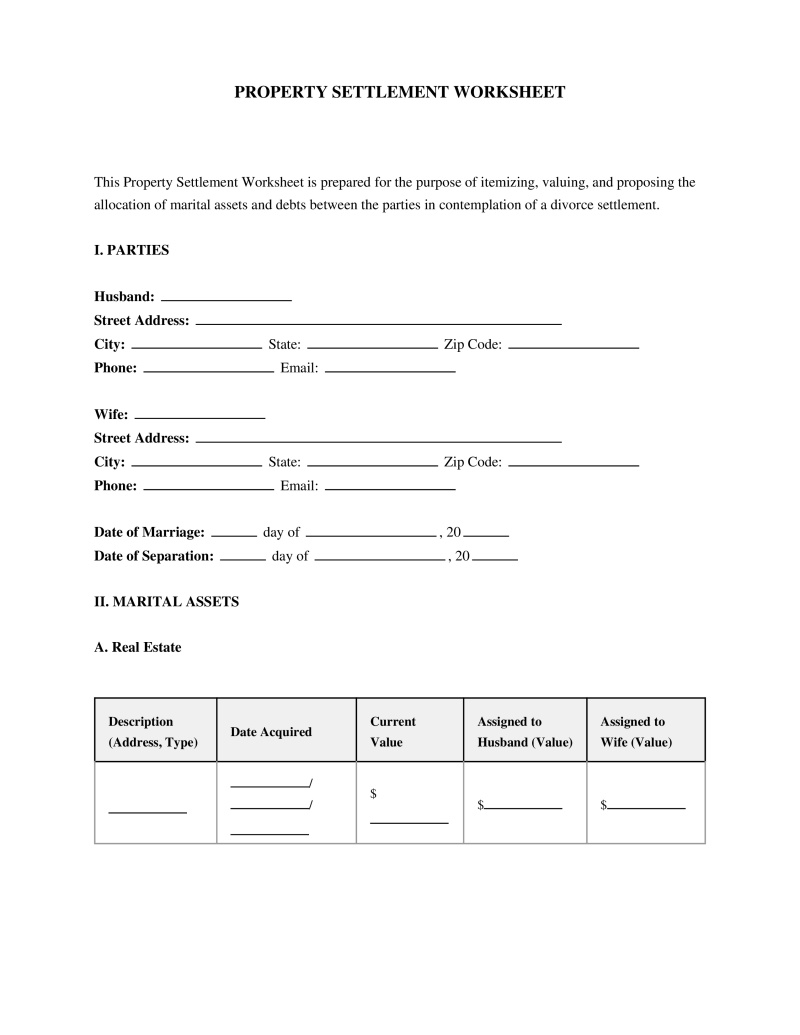
A Property Settlement Worksheet Divorce is a legal document designed to itemize and value assets, liabilities, and debts for division between divorcing parties.
Asset Liability Scope
Select 'Yes' to include both marital assets and debts. Select 'No' if you only want to list assets.
Table of Contents
What is a Property Settlement Worksheet Divorce?
A Property Settlement Worksheet in the context of a divorce is a comprehensive financial document used by divorcing parties and their legal counsel to itemize, value, and propose a division of marital assets and debts. Its primary purpose is to provide a clear, structured overview of the couple's financial landscape, facilitating negotiations and ultimately forming the basis for a legally binding Property Settlement Agreement or Marital Settlement Agreement. This document is essential for ensuring an equitable distribution of property as required by state family laws, whether through mediation, collaborative divorce, or litigation.
Purpose and Scope
The Property Settlement Worksheet serves as a foundational tool in the divorce process, particularly for cases involving significant or complex marital estates. It compels both parties to disclose all relevant financial information, promoting transparency and reducing the likelihood of hidden assets or undisclosed liabilities. The scope of such a worksheet typically extends to all forms of property and debt acquired during the marriage, irrespective of whose name is on the title, as these are generally considered marital property subject to division. This includes real estate, bank accounts, investment portfolios, retirement accounts, businesses, vehicles, personal property, and all outstanding debts.
Beyond mere listing, the worksheet requires parties to assign a fair market value to each asset and detail the full amount of each debt. This valuation process often involves appraisals for real estate, business valuations, and current statements for financial accounts. The goal is to create a comprehensive snapshot of the marital estate's net worth, which then informs the proposed distribution. It also helps identify separate property, which is generally not subject to division, though its commingling with marital property can complicate matters.
Key Components
A comprehensive Property Settlement Worksheet is designed to capture all essential financial details relevant to the marital estate. While specific forms may vary by jurisdiction or legal practice, the core elements typically include:
- Identification of Parties and Case Information - Full legal names of both spouses, the divorce case number, and the date the worksheet is prepared.
- Marital Real Estate Holdings - Detailed listing of all jointly or separately owned real properties, including addresses, current fair market value, outstanding mortgage balances, and equity.
- Bank and Investment Accounts - Information on checking, savings, money market, brokerage, and other investment accounts, including account numbers (often redacted for privacy), current balances, and account holders.
- Retirement and Pension Accounts - Identification of all 401(k)s, IRAs, pensions, defined benefit plans, and other retirement assets, including their current vested value and plan administrators.
- Vehicles and Other Titled Property - Details for cars, boats, RVs, and other assets with titles, including make, model, year, VIN, current market value, and any associated loan balances.
- Personal Property and Household Furnishings - Categories for jewelry, art, collectibles, furniture, appliances, and other significant personal belongings, often with estimated values or proposed distribution.
- Business Interests - Any ownership interests in businesses, partnerships, or professional practices, requiring valuation and details on ownership percentage.
- Life Insurance Policies - Cash value life insurance policies, detailing the insurer, policy number, and current cash surrender value.
- Outstanding Debts and Liabilities - Comprehensive list of all credit card debts, personal loans, student loans, medical bills, and other financial obligations, including creditors, account numbers (redacted), and current balances.
- Proposed Division of Assets and Debts - A section where each asset and debt is assigned to one party or designated for sale, often with columns to show the net value received by each spouse to illustrate equitable distribution.
How to Complete
Completing a Property Settlement Worksheet is a detailed process that requires careful attention to financial records and an understanding of valuation principles. It typically involves several key steps:
- Gather Financial Documents - Collect all relevant financial statements, including bank statements, investment account statements, retirement account summaries, pay stubs, tax returns, mortgage statements, credit card statements, loan documents, and appraisals. These documents provide the necessary data for accurately listing and valuing assets and debts.
- Identify and List All Assets - Systematically list every asset owned by either spouse, individually or jointly, acquired during the marriage. This includes real estate, vehicles, financial accounts, personal property, and business interests. For each asset, record its full description and relevant identifying information.
- Determine Fair Market Value of Assets - Assign a current fair market value to each asset. For liquid assets like bank accounts, this is straightforward; for real estate, vehicles, or businesses, it may require professional appraisals or market research to establish an accurate value. Indicate the date of valuation for all assets.
- Identify and List All Debts - Compile a complete list of all marital debts, including mortgages, credit card balances, personal loans, student loans, and any other outstanding liabilities. For each debt, specify the creditor, account number, and the current outstanding balance.
- Classify Property as Marital or Separate - Distinguish between marital property (subject to division) and separate property (generally not divisible). Separate property typically includes assets owned before the marriage, gifts, or inheritances received individually, though commingling can blur these lines.
- Propose a Division Plan - Based on the itemized and valued lists, propose how each asset and debt will be distributed between the parties. This often involves assigning specific items to one spouse, selling assets and dividing the proceeds, or offsetting the value of assets received by one spouse with a greater share of debt for the other.
- Calculate Net Equitable Distribution - Calculate the total value of assets and debts allocated to each spouse. The goal in most jurisdictions is an equitable, though not necessarily equal, distribution. This step helps ensure the proposed division is fair and balanced, often requiring adjustments to achieve equity.
Legal Requirements and Validity
While a Property Settlement Worksheet itself is a working document and not a legally binding agreement in its initial form, its contents are critical for the eventual creation of a valid and enforceable Property Settlement Agreement (PSA) or Marital Settlement Agreement (MSA). The validity of the underlying agreement derived from the worksheet hinges on several legal requirements:
- Full and Fair Disclosure - Both parties must provide complete and accurate financial information. Concealing assets or intentionally misrepresenting values can invalidate the final agreement.
- Voluntary and Informed Consent - The agreement must be entered into voluntarily by both parties, free from coercion, duress, or undue influence. Each party should have the opportunity to seek independent legal counsel.
- Clarity and Specificity - The terms of the property division must be clear, unambiguous, and specific enough to be enforceable. Ambiguous language can lead to future disputes and court intervention.
- Compliance with State Law - The agreement must adhere to the specific family law statutes of the state where the divorce is filed, particularly concerning equitable distribution principles.
- Court Approval - While parties can negotiate and sign a PSA/MSA outside of court, it typically needs to be presented to and approved by a family court judge to become part of the final divorce decree. The court will review the agreement to ensure it is fair and not unconscionable.
Applicable Laws and Regulations
The division of marital property in a divorce is primarily governed by state law, though some federal regulations can impact specific types of assets. The legal framework ensures an equitable distribution based on the unique circumstances of each case.
State Laws and Equitable Distribution Principles
Most states operate under an "equitable distribution" principle, which mandates a fair, but not necessarily equal, division of marital property. Factors considered by courts typically include:
- Marital Property Definition - Defines what assets and debts are considered marital and subject to division (e.g., assets acquired from the date of marriage to the date of separation or divorce filing).
- Separate Property Definition - Defines assets typically exempt from division, such as property owned prior to marriage, inheritances, or gifts received by one spouse individually.
- Factors for Equitable Division - State statutes often enumerate factors courts consider when determining a fair division, such as the length of the marriage, the age and health of each spouse, their respective incomes and earning capacities, contributions to the marital estate (monetary and non-monetary), and the dissipation of assets by either party.
- Community Property States - A minority of states (Arizona, California, Idaho, Louisiana, Nevada, New Mexico, Texas, Washington, and Wisconsin, plus Alaska by agreement) follow community property laws, where marital assets and debts are generally divided equally (50/50).
Federal Regulations Affecting Property Division
Certain federal laws and regulations come into play when specific types of assets are involved in a divorce settlement:
- Employee Retirement Income Security Act of 1974 (ERISA) - Governs most private sector employee benefit plans, including pensions and 401(k)s. ERISA requires a Qualified Domestic Relations Order (QDRO) to divide certain retirement accounts without incurring immediate tax penalties (29 U.S.C. § 1001 et seq.).
- Internal Revenue Code (IRC) - Sections of the IRC dictate the tax implications of property transfers between spouses in a divorce, generally allowing tax-free transfers between spouses or former spouses incident to a divorce (26 U.S.C. § 1041). This is crucial for avoiding unintended tax liabilities.
- Uniformed Services Former Spouses' Protection Act (USFSPA) - Authorizes state courts to treat disposable retired pay of military members as marital property and to divide it between the member and former spouse, subject to certain conditions (10 U.S.C. § 1408).
Penalties for Non-Compliance
Failure to comply with legal requirements during the property settlement process can lead to significant penalties:
- Invalidation of Agreement - If a court finds that an agreement was procured through fraud, coercion, or a lack of full disclosure, it can be set aside, forcing the parties to renegotiate or litigate the property division.
- Sanctions and Fines - Parties who intentionally hide assets or refuse to comply with discovery requests can face court-imposed sanctions, including fines, attorney's fees for the opposing party, or even adverse rulings on property division.
- Criminal Charges - In extreme cases of deliberate fraud or perjury regarding financial disclosures, criminal charges may be pursued, although this is rare in civil divorce proceedings.
- Reopening of Divorce Decree - In some instances, if significant undisclosed assets are discovered years after a divorce has been finalized, a court may reopen the decree to achieve a truly equitable distribution.
Rights and Obligations
Both spouses in a divorce proceeding have distinct rights and obligations concerning the property settlement worksheet and the broader financial division process. Understanding these is crucial for navigating the divorce effectively and ensuring a fair outcome.
Each party has the fundamental right to full and accurate financial disclosure from their spouse. This means they are entitled to receive comprehensive information about all marital and separate assets, debts, income, and expenses. They also have the right to challenge valuations, request appraisals, and seek legal and financial advice to protect their interests. Furthermore, parties have the right to negotiate the terms of their property division, either directly, through mediation, or via their attorneys, aiming for an equitable resolution that considers their individual needs and contributions to the marriage.
Concurrently, each party carries significant obligations. The primary obligation is to provide complete, honest, and timely financial disclosures. This includes submitting all requested documents, truthfully answering interrogatories, and appearing for depositions if required. Parties are obligated not to dissipate, hide, or transfer marital assets without proper accounting or agreement. They must also engage in the process in good faith, striving for a resolution rather than intentionally prolonging litigation. Finally, once a Property Settlement Agreement is reached and incorporated into a divorce decree, both parties are legally obligated to abide by its terms, including transferring titles, refinancing debts, and making any agreed-upon payments.
Frequently Asked Questions
Not the form you're looking for?
Try our legal document generator to create a custom document
Disclaimer: The templates available on this website are provided for general informational purposes only and do not constitute legal advice. They are not intended to be, and should not be interpreted as, compliant with any specific legal, regulatory, or privacy requirements. These templates are not a replacement for professional legal guidance and should not be relied upon for any particular matter or circumstance. Users are strongly encouraged to seek advice from a qualified attorney licensed in their jurisdiction before using, modifying, or relying on any template.
All templates are provided on an "as is," "with all faults," and "as available" basis. The provider disclaims any and all warranties of any kind, whether express, implied, statutory, or otherwise, including without limitation warranties of merchantability, fitness for a particular purpose, title, or non-infringement.
LegalTemplates.com makes no guarantees or representations regarding the accuracy, completeness, expected outcomes, or reliability of the materials contained in these templates or any materials referenced or linked from them.