Non Solicitation Agreement
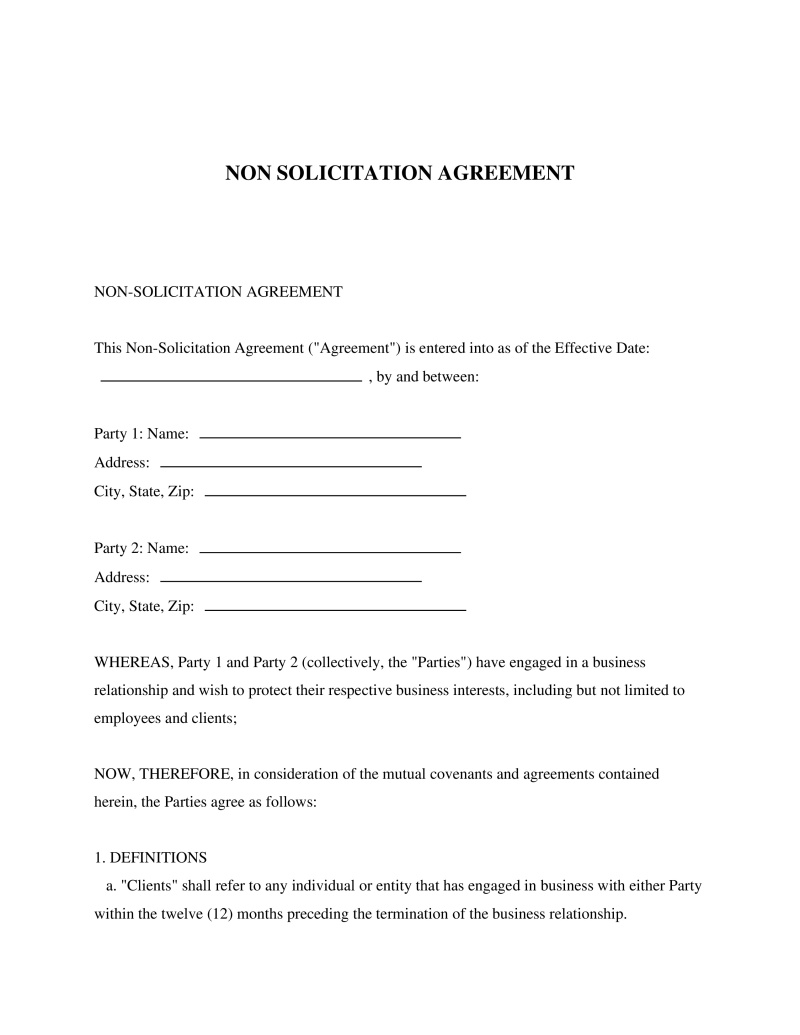
A Non Solicitation Agreement is a legal document that restricts parties from soliciting each other's employees or clients for a specified time.
Employer Name
Enter the full legal name of the employer or company.
Table of Contents
What is a Non Solicitation Agreement?
A Non Solicitation Agreement is a legal contract that prevents an individual, typically a former employee or contractor, from soliciting employees or clients of a business after leaving the company. The primary aim of this document is to protect a business's valuable relationships with its clients and employees from being exploited by individuals who have had access to them. Such agreements are crucial for companies that invest significantly in their workforce and client base and wish to safeguard these assets. Employers, contractors, and professionals across various industries find these agreements essential in maintaining competitive advantage and operational stability.
Key Features
Important Provisions
- Definition of Solicitation: Clearly outlines what actions constitute solicitation under the agreement.
- Term of Agreement: Specifies the duration for which the non-solicitation conditions apply post-termination of employment or contract.
- Penalties for Breach: Details consequences faced by the individual should they violate terms of the agreement.
- Jurisdiction and Governing Law: Establishes which state's law will govern the agreement and where disputes will be resolved.
Pros and Cons
Pros
- +Prevents the loss of valuable clients and employees by restricting solicitation activities post-employment.
- +Offers legal protection for proprietary information and trade secrets indirectly by reducing turnover.
- +Enhances stability within the company by securing critical human and client resources.
- +Serves as a clear agreement between parties, reducing potential conflicts related to post-employment activities.
- +Tailorable duration and scope clauses allow for flexibility according to specific business needs.
Cons
- -Enforceability may vary significantly between jurisdictions, potentially limiting effectiveness in certain areas.
- -Overly restrictive non solicitation agreements may be challenged in court, leading to legal uncertainty.
- -May deter potential hires if perceived as overly limiting on future employment opportunities.
Common Uses
- Used by companies during the offboarding process of employees with access to sensitive client lists or business practices.
- Incorporated into contractor agreements where independent contractors have intimate knowledge of company operations.
- Utilized in industries with high turnover rates to protect against rapid loss of clientele or skilled labor.
- Employed in merger and acquisition scenarios to ensure stability post-transition.
- Included in executive employment contracts where the risk of solicitation is deemed high.
- Applied within tech companies to safeguard against poaching among highly competitive talent pools.
Frequently Asked Questions
Not the form you're looking for?
Try our legal document generator to create a custom document
Disclaimer: The templates available on this website are provided for general informational purposes only and do not constitute legal advice. They are not intended to be, and should not be interpreted as, compliant with any specific legal, regulatory, or privacy requirements. These templates are not a replacement for professional legal guidance and should not be relied upon for any particular matter or circumstance. Users are strongly encouraged to seek advice from a qualified attorney licensed in their jurisdiction before using, modifying, or relying on any template.
All templates are provided on an "as is," "with all faults," and "as available" basis. The provider disclaims any and all warranties of any kind, whether express, implied, statutory, or otherwise, including without limitation warranties of merchantability, fitness for a particular purpose, title, or non-infringement.
LegalTemplates.com makes no guarantees or representations regarding the accuracy, completeness, expected outcomes, or reliability of the materials contained in these templates or any materials referenced or linked from them.