Motion to Withdraw
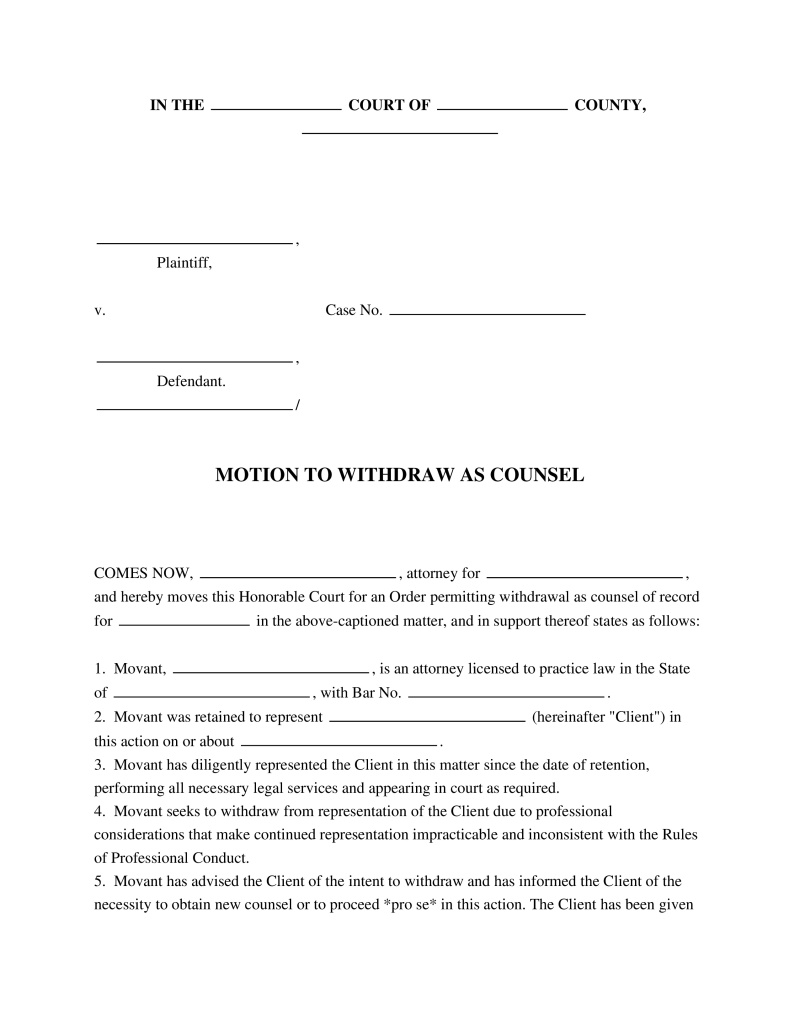
A Motion to Withdraw is a formal legal application submitted to a court, requesting permission to be relieved of a previously undertaken legal obligation or role.
Withdrawal Type
Select whether you are withdrawing from all representation in the case or only from representing certain parties or issues.
Provide details if you are only withdrawing from representing certain clients or issues.
Table of Contents
What is a Motion to Withdraw?
A motion to withdraw is a formal request submitted to a court, asking for permission to remove or discontinue something from a legal proceeding. This judicial tool serves various purposes, allowing parties or their representatives to formally disengage from certain aspects of a case or to retrieve items previously submitted. The specific nature and implications of a motion to withdraw depend heavily on its context, such as whether it pertains to an attorney seeking to withdraw from representation, a party requesting to remove funds from a court registry, or the withdrawal of a document from the court record.
Diverse Applications of the Motion to Withdraw
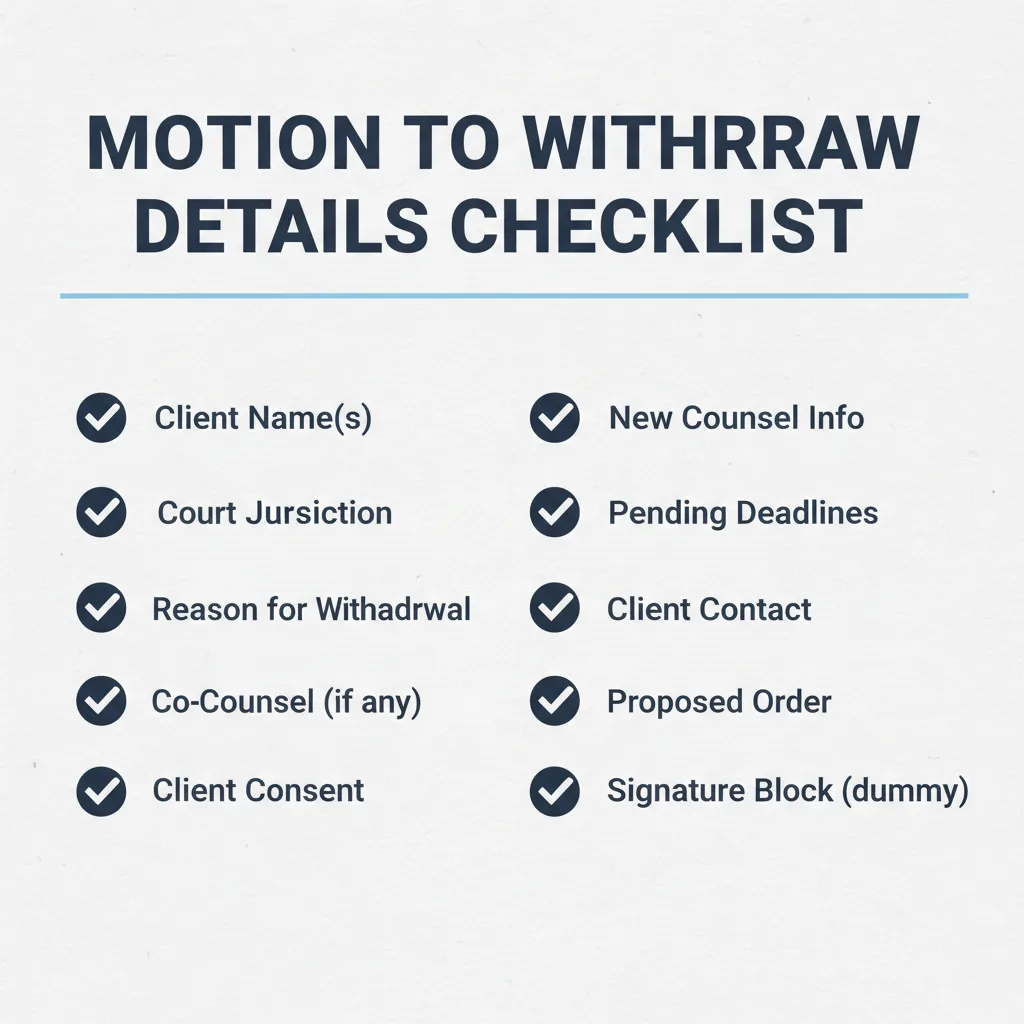
The term "motion to withdraw" encompasses several distinct legal actions, each with its own purpose and procedural requirements. While the underlying principle involves formally removing something from the court's consideration or control, the specific application dictates the relevant rules and forms. These motions are crucial for maintaining the integrity of court proceedings and ensuring that all parties adhere to established judicial protocols.
- Withdrawal of Counsel - An attorney's formal request to be relieved of their duties in representing a client in a particular case.
- Withdrawal of Funds - A party's request to retrieve money previously deposited into the court's registry.
- Withdrawal of Documents - A request to remove a document that has been filed with the court from the official record.
- Withdrawal of Reference - A specialized motion in bankruptcy proceedings, requesting that a bankruptcy case or proceeding be heard by a district court instead of a bankruptcy court.
Withdrawal of Counsel
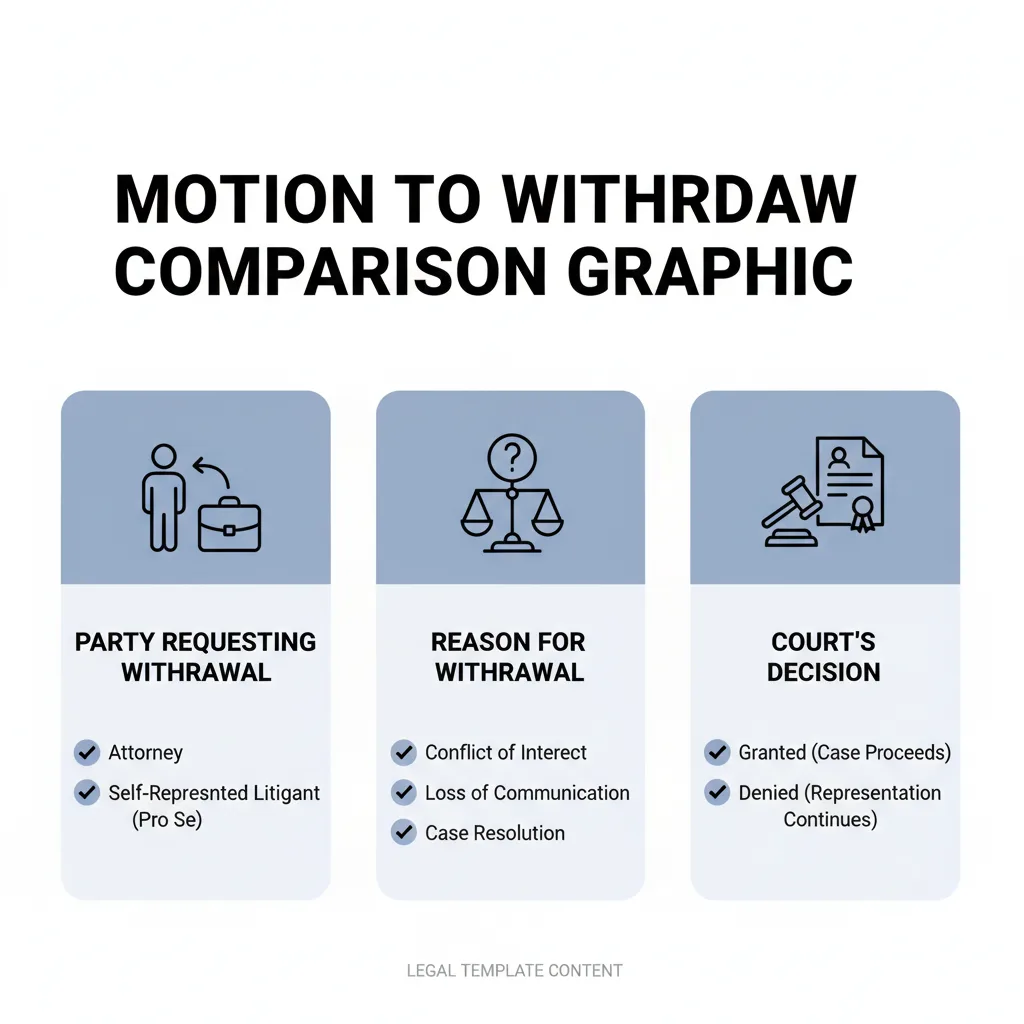
When an attorney wishes to cease representing a client in a case, they typically must file a motion to withdraw as counsel. This motion is not automatically granted and requires court approval to ensure that the client's rights are not prejudiced and that the administration of justice is not disrupted. Courts often consider several factors before granting such a request, including the stage of the litigation, the reasons for withdrawal, and the potential impact on the client and opposing parties.
Attorneys seeking to withdraw as counsel often utilize specific forms provided by the court. For instance, in some federal courts, attorneys can use a dedicated form for a motion to withdraw as counsel of record without substitution, indicating that no new attorney will immediately take over the representation (United States District Court for the District of Minnesota). Similarly, in bankruptcy cases, attorneys may file a motion to withdraw by selecting specific options within the court's electronic filing system (United States Bankruptcy Court for the District of Nebraska).
Withdrawal of Funds from the Court Registry
Courts sometimes hold funds in a registry, typically in cases where there is a dispute over ownership, or when funds are deposited as part of a settlement, judgment, or bond. When a party believes they are entitled to these funds, they must file a motion to withdraw them. This process ensures that the court maintains control over the funds until proper authorization for their release is established.
The procedure for withdrawing funds from the court registry generally involves submitting a formal motion using a court-provided form. For example, the United States District Court for the Northern District of Texas offers a specific form for parties seeking to withdraw funds from its registry. The motion typically requires detailed information to justify the withdrawal, such as the legal basis for the claim to the funds, the amount requested, and any supporting documentation or court orders.
Withdrawal of Documents from the Record
Occasionally, a party may need to withdraw a document that has already been filed with the court. This might occur due to clerical errors, the discovery of new information, or a change in legal strategy that renders the document irrelevant or inappropriate. Such motions aim to remove the document from the official court record, preventing it from being considered in future proceedings or becoming publicly accessible.
Frequently Asked Questions
Sources
- Motion to Withdraw as Counsel of Record Without Substitution - Provides a form for attorneys to withdraw as counsel without substitution.
- Motions to Withdraw the Reference of a Bankruptcy Case or Proceeding - Guidelines for filing motions to withdraw the reference in bankruptcy cases.
- Motion to Withdraw as Attorney - Instructions for attorneys to withdraw as counsel in bankruptcy cases.
- Motion to Withdraw Funds From the Registry of the Court - Form for withdrawing funds from the court registry.
- Motion to Withdraw Document - Procedure for filing a motion to withdraw a document in bankruptcy cases.
Not the form you're looking for?
Try our legal document generator to create a custom document
Disclaimer: The templates available on this website are provided for general informational purposes only and do not constitute legal advice. They are not intended to be, and should not be interpreted as, compliant with any specific legal, regulatory, or privacy requirements. These templates are not a replacement for professional legal guidance and should not be relied upon for any particular matter or circumstance. Users are strongly encouraged to seek advice from a qualified attorney licensed in their jurisdiction before using, modifying, or relying on any template.
All templates are provided on an "as is," "with all faults," and "as available" basis. The provider disclaims any and all warranties of any kind, whether express, implied, statutory, or otherwise, including without limitation warranties of merchantability, fitness for a particular purpose, title, or non-infringement.
LegalTemplates.com makes no guarantees or representations regarding the accuracy, completeness, expected outcomes, or reliability of the materials contained in these templates or any materials referenced or linked from them.