Motion to Vacate
A Motion to Vacate is a formal legal request submitted to a court, seeking the nullification or setting aside of a previously issued judgment, order, or conviction.
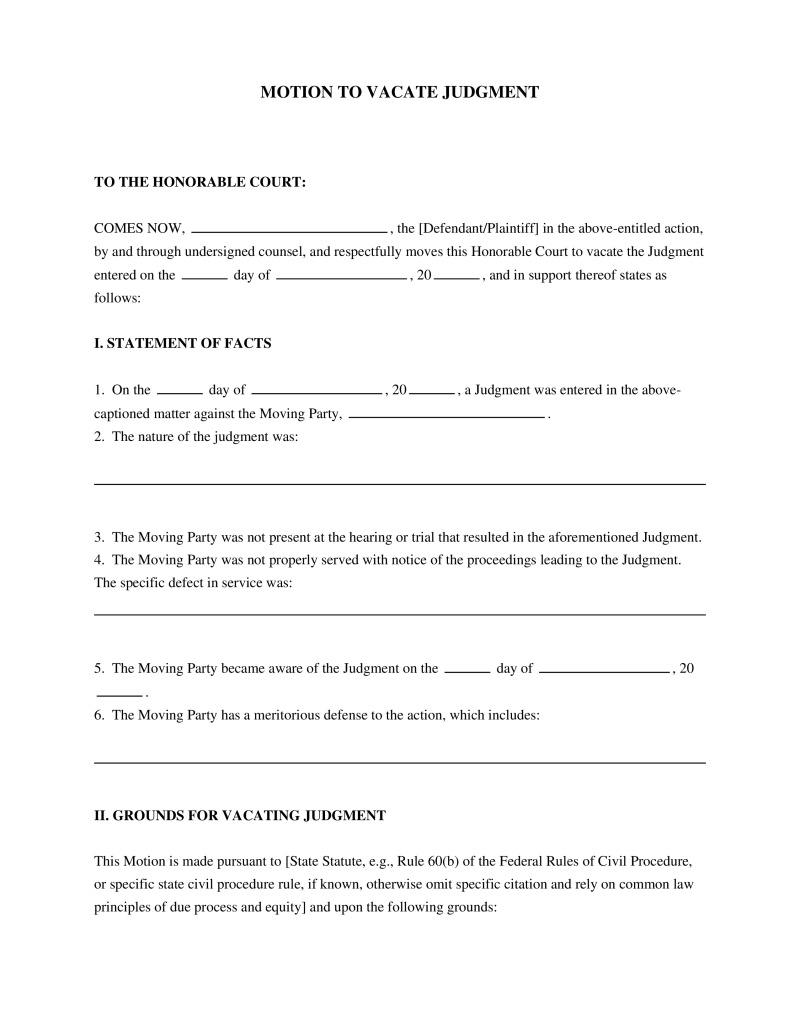
Ruling Type
Choose the closest description of the judgment, order, or ruling you want the court to set aside.
Use the court's wording if you know it.
Table of Contents
What is a Motion to Vacate?
A motion to vacate is a formal request made to a court to set aside or nullify a previous judgment, order, or conviction. This legal mechanism allows a party to challenge a court's decision, often asserting that the original ruling was made improperly, based on flawed evidence, or due to a legal error. It serves as a critical avenue for seeking relief from judicial outcomes that are believed to be unjust or procedurally unsound. While the specific rules and grounds vary by jurisdiction and the type of case, the fundamental purpose remains to undo a prior judicial action.
Grounds for Seeking to Vacate
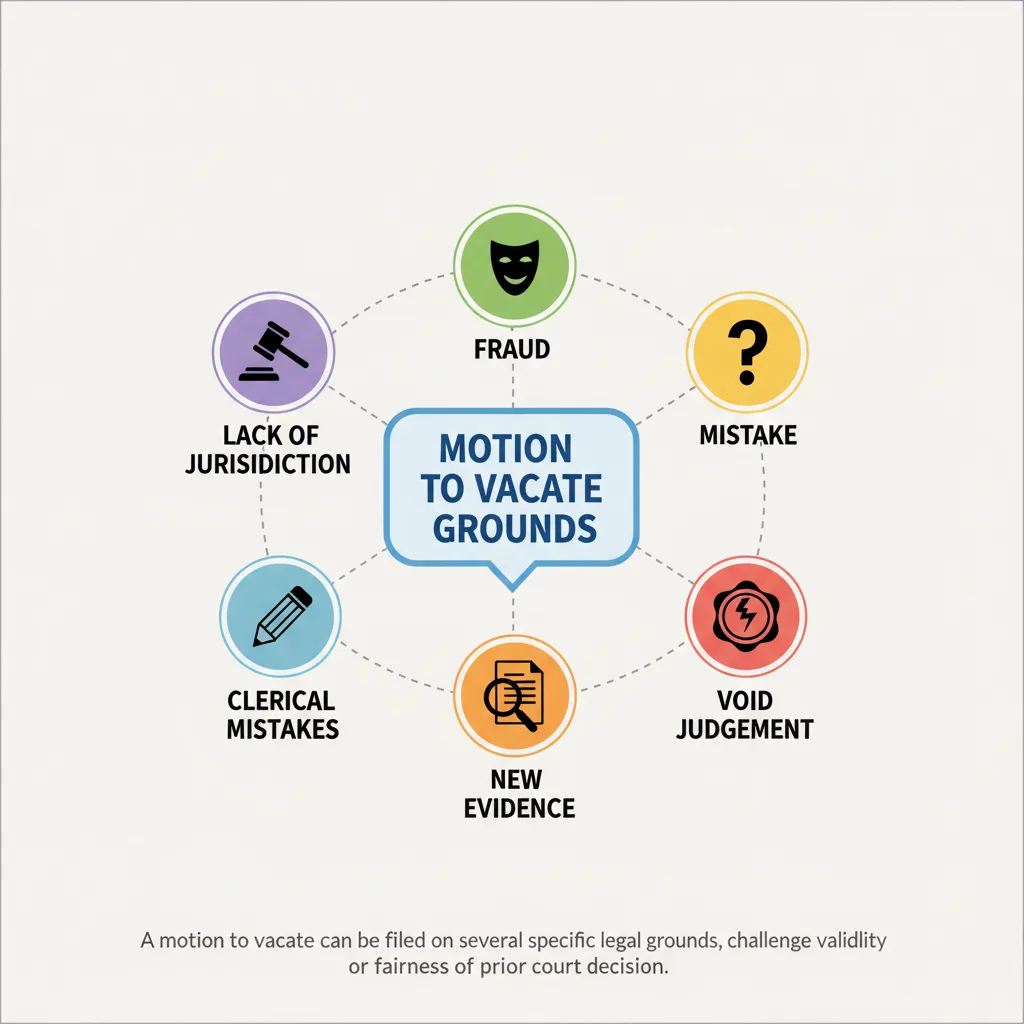
Parties typically file a motion to vacate when they believe a significant error or injustice occurred that warrants overturning a court's decision. The permissible grounds for such a motion are usually narrowly defined and must meet specific legal criteria. These grounds often reflect fundamental issues that undermine the fairness or legality of the original proceeding.
- Lack of Jurisdiction - The court that issued the original judgment or order did not have the legal authority to hear the case.
- Fraud or Misrepresentation - The judgment was obtained through deceit, false statements, or intentional misleading of the court or opposing party.
- Mistake, Inadvertence, Surprise, or Excusable Neglect - A party's failure to act in time or to present a defense was due to an understandable error or oversight, not willful disregard.
- Newly Discovered Evidence - Significant evidence has come to light since the original trial or hearing that could not have been reasonably discovered earlier and would likely change the outcome.
- Void Judgment - The judgment is legally invalid from the outset, perhaps due to a lack of proper service or a fundamental flaw in the court's authority.
- Satisfaction or Release of Judgment - The judgment has already been paid, satisfied, or discharged, making its continued enforcement inappropriate.
- Clerical Mistakes - Minor errors, omissions, or miscalculations in the judgment or record that do not affect the substantive outcome but need correction.
Federal Application: 28 U.S.C. § 2255
In the federal system, a specific type of motion to vacate is available to individuals who are in federal custody and wish to challenge their conviction or sentence. This mechanism is formally known as a "Motion to Vacate, Set Aside, or Correct a Sentence by a Person in Federal Custody" and is governed by federal statute. It provides a means for federal inmates to collaterally attack their judgments, meaning they challenge the legality of their detention or sentence based on grounds that typically could not have been raised on direct appeal or have arisen since the appeal.
The primary purpose of this federal motion is to address constitutional errors or other fundamental legal defects that occurred during the federal trial or sentencing process. While it serves a similar function to a writ of habeas corpus, it is specifically designed for federal prisoners challenging federal convictions, whereas habeas corpus is broader. The U.S. Courts provide a pro se form for federal inmates to use when filing this motion, streamlining the process for those representing themselves.
Key aspects of the federal motion under 28 U.S.C. § 2255 include:
- Eligibility - Available to a "person in federal custody" who claims the right to be released upon the ground that the sentence was imposed in violation of the Constitution or laws of the United States, or that the court was without jurisdiction to impose such sentence, or that the sentence is in excess of the maximum authorized by law, or is otherwise subject to collateral attack (28 U.S.C. § 2255).
- Exclusive Remedy - For federal prisoners, this motion is generally the exclusive remedy for challenging their convictions or sentences, superseding traditional habeas corpus petitions unless the § 2255 remedy is inadequate or ineffective.
- Form Usage - Federal inmates can use the official "Motion to Vacate, Set Aside, or Correct a Sentence by a Person in Federal Custody" form to challenge their convictions or sentences (U.S. Courts Form AO 243).
Distinction from Direct Appeals
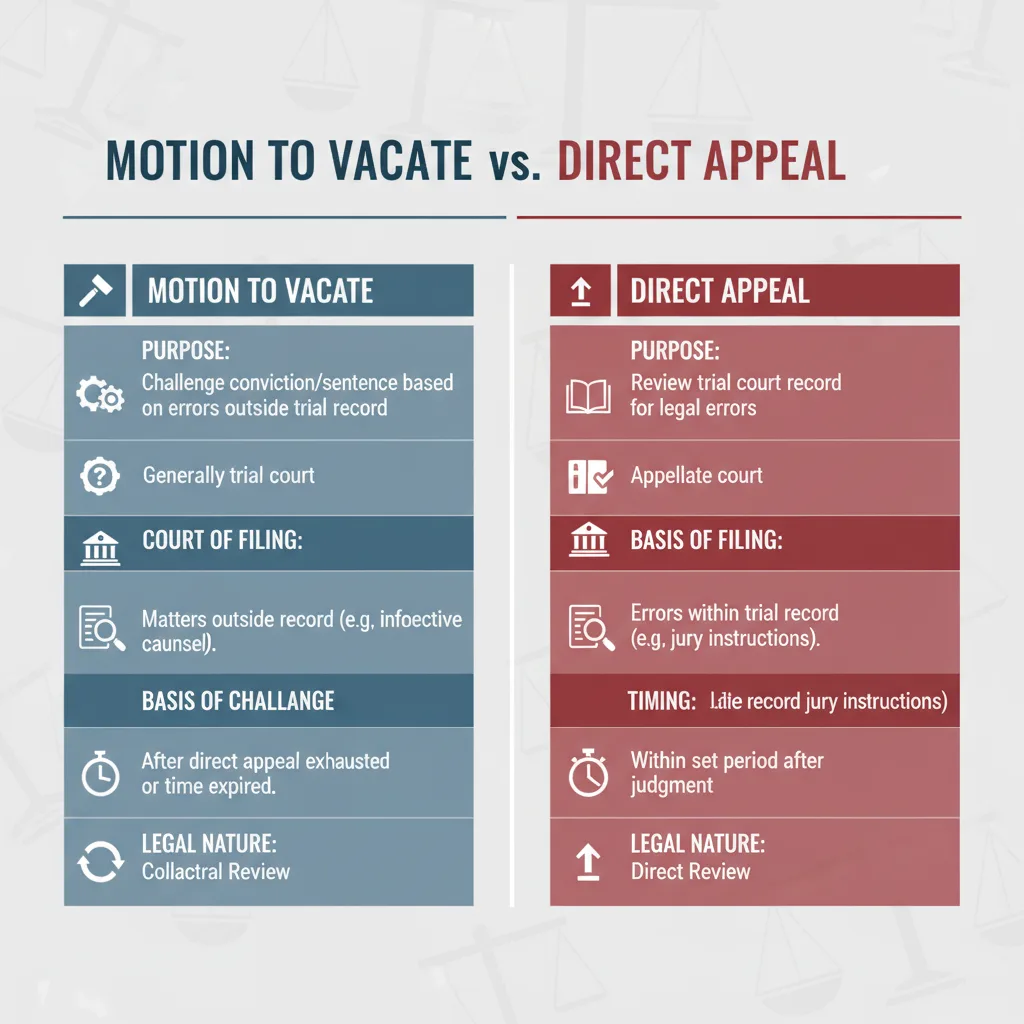
A motion to vacate is distinct from a direct appeal, although both aim to challenge a court's decision. A direct appeal is typically filed with a higher court shortly after a final judgment is entered, focusing on errors of law or procedure that appear on the face of the trial record. The appellate court reviews the trial court's proceedings to determine if legal mistakes were made that affected the outcome.
In contrast, a motion to vacate is generally filed with the same court that issued the original judgment and often relies on evidence or arguments that were not part of the original trial record. This can include claims of ineffective assistance of counsel, newly discovered evidence, or jurisdictional defects that were not fully litigated or apparent during the initial proceedings. A motion to vacate is considered a collateral attack because it challenges the underlying validity of the judgment rather than merely reviewing it for errors.
Procedural Considerations
Filing a motion to vacate involves specific procedural steps and adherence to strict timelines. The process often begins with the petitioner identifying the legal grounds for their challenge and gathering supporting evidence. Due to the serious nature of overturning a prior judgment, courts generally apply a high standard to these motions.
Key procedural aspects often include:
- Timeliness - Most jurisdictions impose strict deadlines for filing motions to vacate, often within a year after the judgment becomes final, especially in federal cases under 28 U.S.C. § 2255. Failure to meet these deadlines can result in the motion being dismissed, absent extraordinary circumstances.
- Supporting Documentation - The motion must typically be accompanied by affidavits, exhibits, and legal memoranda that clearly articulate the grounds for relief and provide factual and legal support for the claims.
- Service of Process - The moving party must properly serve the motion on all opposing parties, ensuring they have notice and an opportunity to respond.
- Hearing - Depending on the nature of the claims and the evidence presented, the court may schedule a hearing to take testimony and review evidence before making a decision.
- Leave to Amend - Courts may grant leave to amend a motion if initial filings are deemed insufficient, though this is not guaranteed and often subject to time limits.
Frequently Asked Questions
Sources
- Motion to Vacate, Set Aside, or Correct a Sentence by a Person in Federal Custody - Official form for federal inmates seeking to vacate, set aside, or correct a sentence under 28 U.S.C. § 2255
Not the form you're looking for?
Try our legal document generator to create a custom document
Disclaimer: The templates available on this website are provided for general informational purposes only and do not constitute legal advice. They are not intended to be, and should not be interpreted as, compliant with any specific legal, regulatory, or privacy requirements. These templates are not a replacement for professional legal guidance and should not be relied upon for any particular matter or circumstance. Users are strongly encouraged to seek advice from a qualified attorney licensed in their jurisdiction before using, modifying, or relying on any template.
All templates are provided on an "as is," "with all faults," and "as available" basis. The provider disclaims any and all warranties of any kind, whether express, implied, statutory, or otherwise, including without limitation warranties of merchantability, fitness for a particular purpose, title, or non-infringement.
LegalTemplates.com makes no guarantees or representations regarding the accuracy, completeness, expected outcomes, or reliability of the materials contained in these templates or any materials referenced or linked from them.