Motion to Suppress
A Motion to Suppress is a formal legal request made to a court by a party in a criminal proceeding, seeking to exclude evidence from trial that was allegedly obtained in violation of constitutional rights or statutory law.
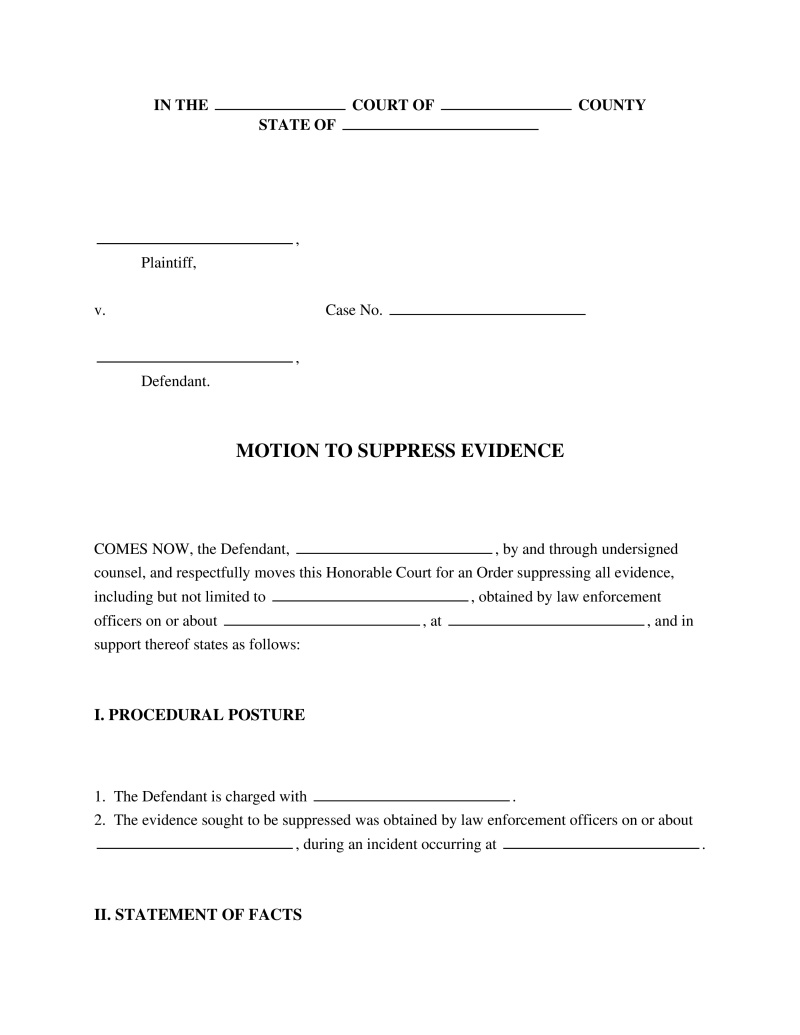
Evidence Type
Select the main category of evidence you want the court to exclude.
Provide a brief description of the evidence if you selected 'Other'.
Table of Contents
What is a Motion to Suppress?
A Motion to Suppress is a formal request made by a defendant in a criminal case, typically before trial, asking the court to exclude certain evidence from being presented by the prosecution. Its primary purpose is to prevent the use of evidence that was allegedly obtained in violation of the defendant's constitutional rights or through other unlawful means. These motions are a critical tool in criminal defense, challenging the admissibility of evidence and potentially impacting the strength of the prosecution's case.
Purpose and Legal Context
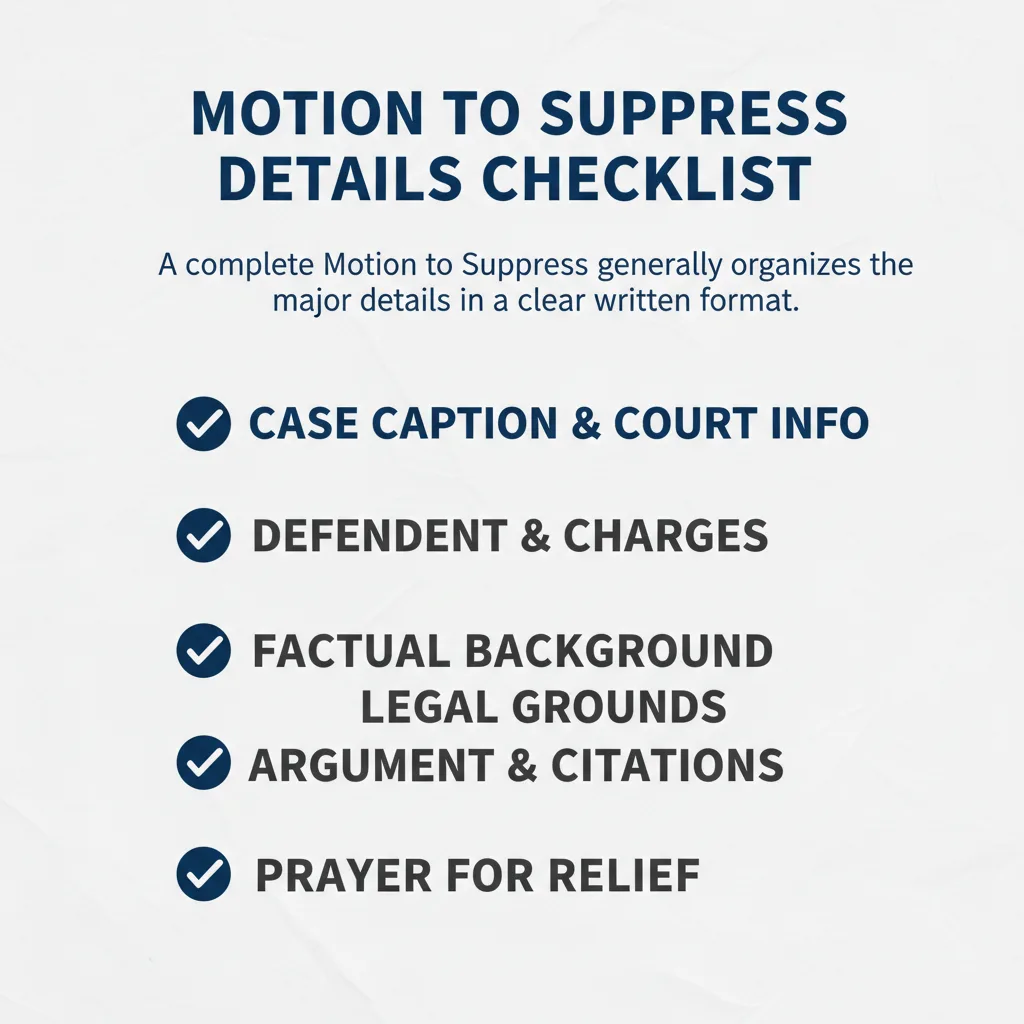
The core purpose of a Motion to Suppress is to ensure a fair trial by preventing the introduction of evidence that does not meet legal standards for admissibility. This often relates to the manner in which evidence was collected by law enforcement. If the court finds that evidence was obtained illegally, it can be excluded from trial, a principle commonly known as the exclusionary rule. This rule serves to deter unlawful police conduct and uphold constitutional protections.
Motions to Suppress are filed in federal courts across the United States. Federal courts, such as the U.S. District Courts for the Northern District of Texas, Eastern District of Virginia, Middle District of Georgia, and Western District of North Carolina, provide forms and procedures for filing various criminal motions, including those to suppress evidence. These forms facilitate the formal request by the defense to challenge evidence.
Common Grounds for Seeking Suppression
Defendants typically file a Motion to Suppress when they believe evidence against them was obtained improperly. The specific arguments for suppression generally fall into several categories:
- Unlawful Search and Seizure - Evidence obtained without a warrant, probable cause, or an applicable exception to the warrant requirement, violating protections against unreasonable searches and seizures.
- Involuntary Statements or Confessions - Statements made by a defendant that were coerced, rather than given freely and voluntarily, often due to improper interrogation tactics or lack of proper advisement of rights.
- Miranda Violations - Statements obtained from a defendant during custodial interrogation without the defendant being properly informed of their right to remain silent and right to an attorney.
- Identification Procedures - Eyewitness identifications that were conducted in an overly suggestive or unreliable manner, potentially leading to misidentification.
- Lack of Probable Cause for Arrest - Evidence discovered as a direct result of an arrest that lacked sufficient probable cause, rendering the arrest itself unlawful.
- Chain of Custody Issues - Problems with how evidence was collected, handled, or preserved, raising doubts about its authenticity or integrity.
The Process of Filing a Motion to Suppress
Filing a Motion to Suppress involves several procedural steps within the criminal justice system. The process typically begins after a defendant has been charged but before the trial commences. Adherence to court rules and deadlines is crucial for the motion to be considered.
The general steps often include:
- Investigation and Discovery - The defense attorney reviews all evidence provided by the prosecution, including police reports, witness statements, and forensic analyses, to identify potential grounds for suppression.
- Drafting the Motion - A formal written motion is prepared, detailing the specific evidence to be suppressed, the legal grounds for suppression, and supporting arguments. This document often includes a memorandum of law citing relevant legal principles.
- Filing with the Court - The motion is formally filed with the clerk of the court where the criminal case is pending. Local court rules dictate specific filing procedures and deadlines, which must be strictly observed.
- Service on the Prosecution - A copy of the filed motion is served on the prosecuting attorney, providing them with notice of the defense's challenge to the evidence.
- Hearing on the Motion - The court schedules a hearing where both the defense and prosecution present arguments and, often, testimony from witnesses (such as police officers or the defendant) regarding how the evidence was obtained.
- Court Ruling - After the hearing, the judge issues a ruling, either granting or denying the Motion to Suppress. The ruling may be issued immediately or at a later date after further deliberation.
Types of Evidence Affected
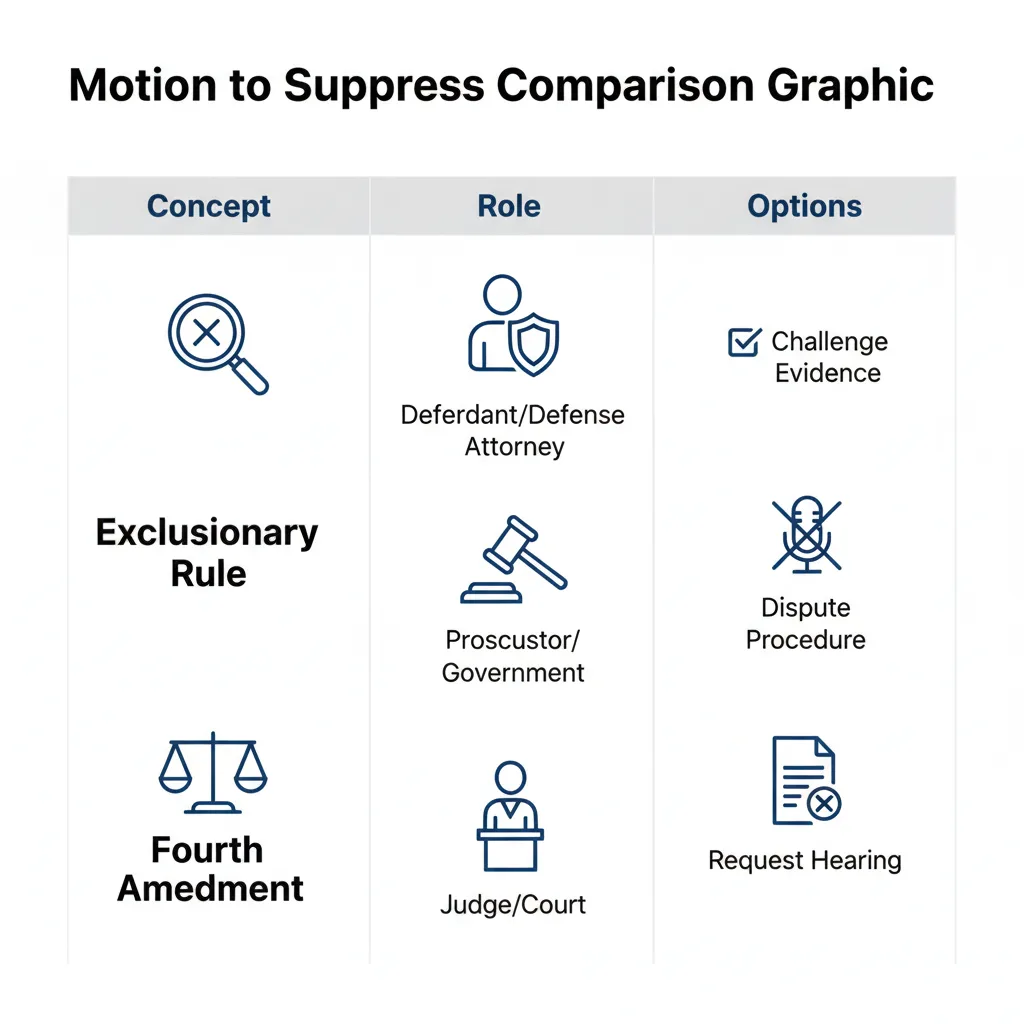
A Motion to Suppress can target a wide array of evidence that the prosecution intends to use at trial. The nature of the evidence is less important than the legality of how it was acquired. If the method of acquisition violated legal standards, the evidence, regardless of its form, may be subject to suppression.
Common types of evidence that may be challenged through this motion include:
- Physical Evidence - Items such as drugs, weapons, stolen property, or other tangible objects found during a search.
- Confessions and Statements - Oral or written statements made by the defendant to law enforcement, including full confessions or incriminating remarks.
- Eyewitness Identifications - In-court or out-of-court identifications of the defendant by witnesses, often from lineups, photo arrays, or show-ups.
- Forensic Evidence - Results of scientific tests or analyses performed on evidence, such as DNA, fingerprints, or ballistics, if the underlying samples were illegally obtained.
- Documents and Records - Papers, electronic files, or other records seized during a search.
- Observations by Law Enforcement - Testimony from officers regarding what they saw or heard, if their presence or observation was based on an unlawful entry or surveillance.
Consequences of a Granted Motion
When a court grants a Motion to Suppress, the implications for the criminal case can be substantial. The primary consequence is that the specific evidence identified in the motion is deemed inadmissible and cannot be presented by the prosecution during the trial. This can significantly alter the course and outcome of the proceedings.
The potential effects of a successful motion include:
- Weakened Prosecution Case - If crucial evidence is suppressed, the prosecution may have insufficient evidence remaining to prove guilt beyond a reasonable doubt, potentially leading to dismissal of charges.
- Plea Bargaining - A successful motion can strengthen the defendant's position in plea negotiations, leading to a more favorable plea agreement.
- Dismissal of Charges - In cases where the suppressed evidence is essential to the prosecution's case, the charges against the defendant may be dismissed entirely if the remaining evidence is too weak to proceed.
- Impact on Appeal - The granting or denial of a Motion to Suppress is often a key issue that can be raised during the appeals process, influencing subsequent legal challenges.
Frequently Asked Questions
Sources
- Criminal Forms | United States Courts - Provides a list of national federal court forms, including those related to criminal procedures.
- Criminal Forms | Northern District of Texas | United States District Court - Offers various criminal forms, including motions related to criminal cases.
- Criminal Forms | Eastern District of Virginia | United States District Court - Lists criminal forms available in PDF format, including motions to vacate or set aside sentences.
- Criminal Forms | Middle District of Georgia | United States District Court - Provides a range of criminal forms, including motions related to criminal procedures.
- Criminal Forms | Western District of North Carolina | United States District Court - Lists criminal forms, including motions to suppress evidence.
Not the form you're looking for?
Try our legal document generator to create a custom document
Disclaimer: The templates available on this website are provided for general informational purposes only and do not constitute legal advice. They are not intended to be, and should not be interpreted as, compliant with any specific legal, regulatory, or privacy requirements. These templates are not a replacement for professional legal guidance and should not be relied upon for any particular matter or circumstance. Users are strongly encouraged to seek advice from a qualified attorney licensed in their jurisdiction before using, modifying, or relying on any template.
All templates are provided on an "as is," "with all faults," and "as available" basis. The provider disclaims any and all warranties of any kind, whether express, implied, statutory, or otherwise, including without limitation warranties of merchantability, fitness for a particular purpose, title, or non-infringement.
LegalTemplates.com makes no guarantees or representations regarding the accuracy, completeness, expected outcomes, or reliability of the materials contained in these templates or any materials referenced or linked from them.