Motion to Reconsider
A Motion to Reconsider is a formal legal application submitted to a court, requesting review and potential alteration of a previously rendered judicial order or decision.
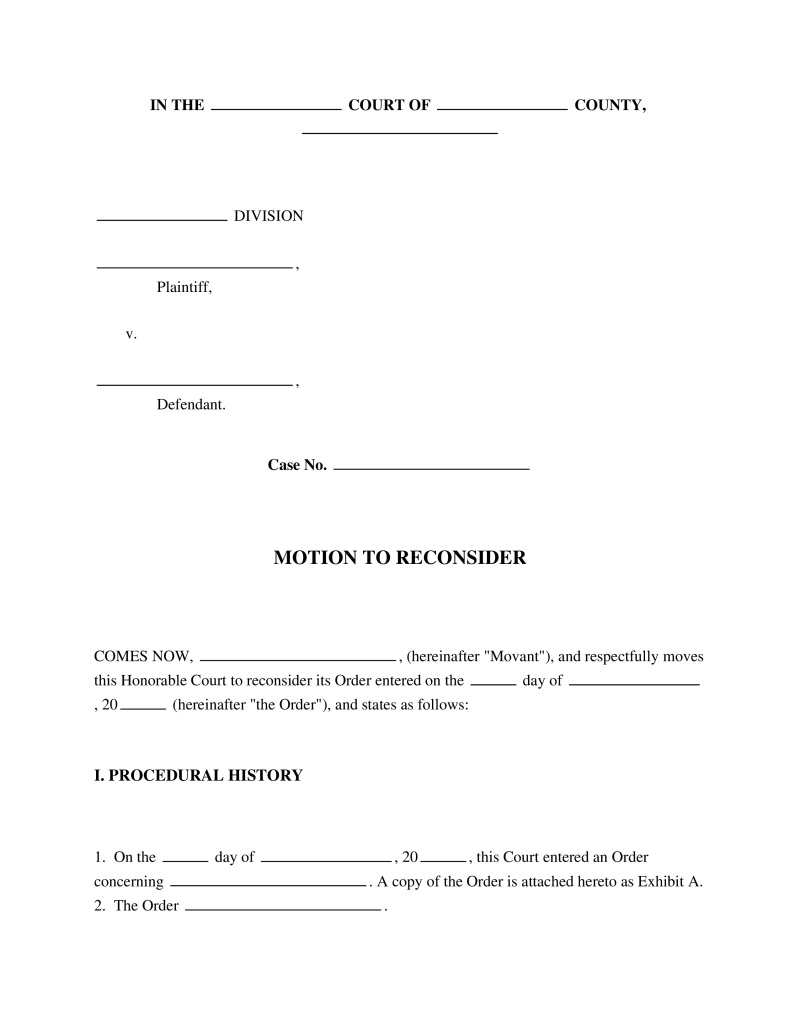
Prior Order Type
Select the type of order or ruling you are seeking to have reconsidered.
Provide a brief description if you selected 'Other'.
Table of Contents
What is a Motion to Reconsider?
A Motion to Reconsider is a formal request submitted to the governmental office or administrative body that issued an unfavorable decision, asking it to review its original ruling. The primary purpose of such a motion is to argue that the initial decision was based on an incorrect application of law or policy, or that there was an error in fact present in the record at the time the decision was made. This legal mechanism is commonly employed in administrative proceedings, particularly within immigration law, to seek a reversal or modification of a previous judgment without introducing new evidence.
Purpose and Grounds for Filing
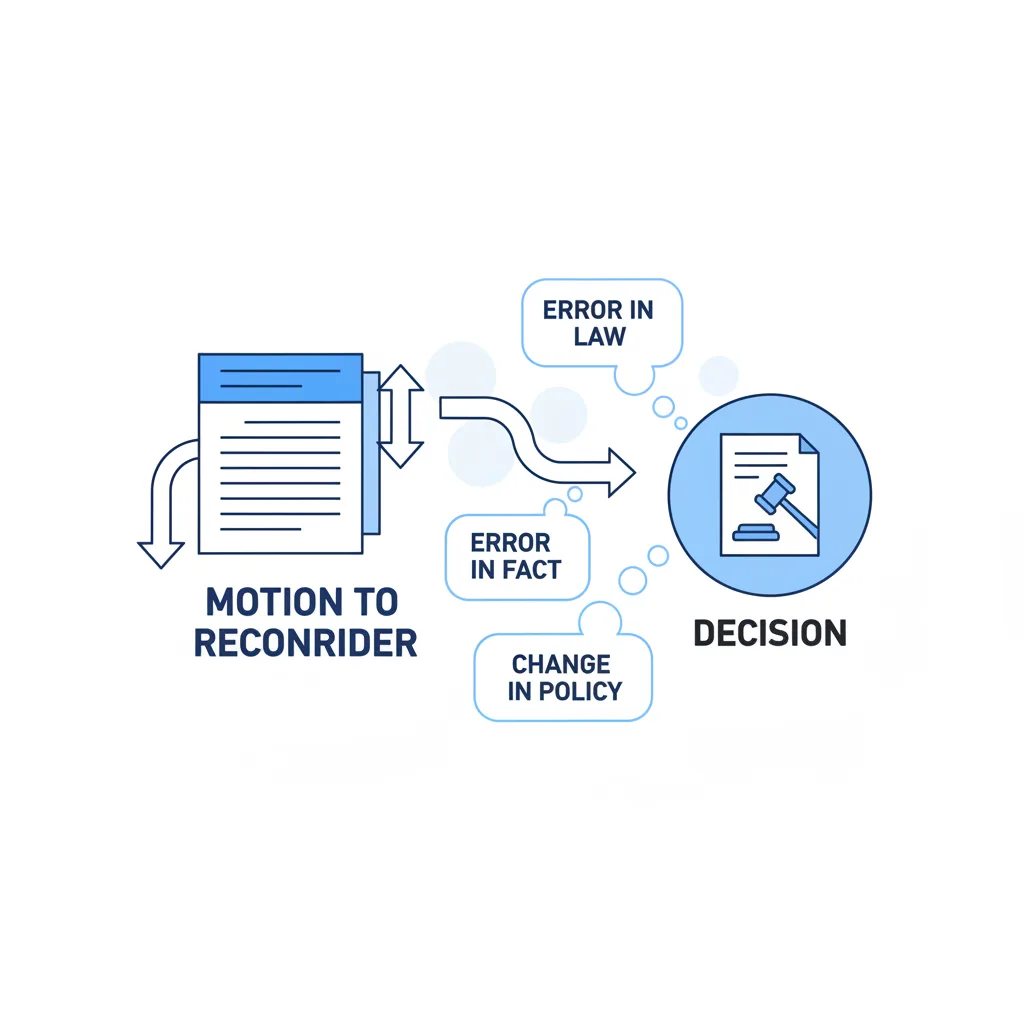
The core objective of a Motion to Reconsider is to challenge the legal or factual basis of a prior decision, urging the adjudicating body to re-examine its conclusion. It is not intended to introduce new facts or evidence but rather to highlight flaws in the original analysis of existing information or changes in applicable law.
Key grounds for filing a Motion to Reconsider include:
- Error in Law or Fact Identification - The motion must identify an error in law or fact in the Immigration Judge’s prior decision or a change in law affecting it (Executive Office for Immigration Review).
- Incorrect Application of Law or Policy - The motion asserts that the unfavorable decision resulted from an incorrect application of law or policy by the adjudicating office (USCIS, ICE).
- Evidence of Record - The motion must establish that the decision was incorrect based on the evidence of record at the time of that decision, without presenting new facts (USCIS).
Requirements for Filing
Filing a Motion to Reconsider necessitates adherence to specific procedural and content requirements to ensure it is properly considered. These requirements are designed to provide clarity on the asserted errors and facilitate efficient review by the adjudicating body.
Typical requirements for filing include:
- Cover Page Labeling - The motion must be filed with a cover page clearly labeled 'MOTION TO RECONSIDER' (Executive Office for Immigration Review).
- Supporting Citations - The motion must be supported by citations to appropriate statutes, regulations, or precedent decisions relevant to the asserted errors (ICE).
- Basis in Original Record - The arguments presented must be based on the evidence of record at the time of the original decision, without introducing new evidence (USCIS).
- Compliance with Deadlines - The motion must comply with all established deadlines for filing, which are often strict and non-negotiable (Executive Office for Immigration Review).
Deadlines and Limitations
Motions to Reconsider are subject to strict deadlines and, in some contexts, limitations on the number of motions that can be filed. These rules are crucial for maintaining the finality of decisions and the efficiency of administrative processes.
- Board of Immigration Appeals Deadline - A motion to reconsider a decision by the Board of Immigration Appeals (BIA) must be filed within 30 days of the date of the Board’s decision (Executive Office for Immigration Review).
- One-Motion Limit - Generally, a party is limited to filing only one motion to reconsider. Motions filed prior to July 31, 1996, typically do not count toward this one-motion limit (Executive Office for Immigration Review).
Distinction from Motion to Reopen
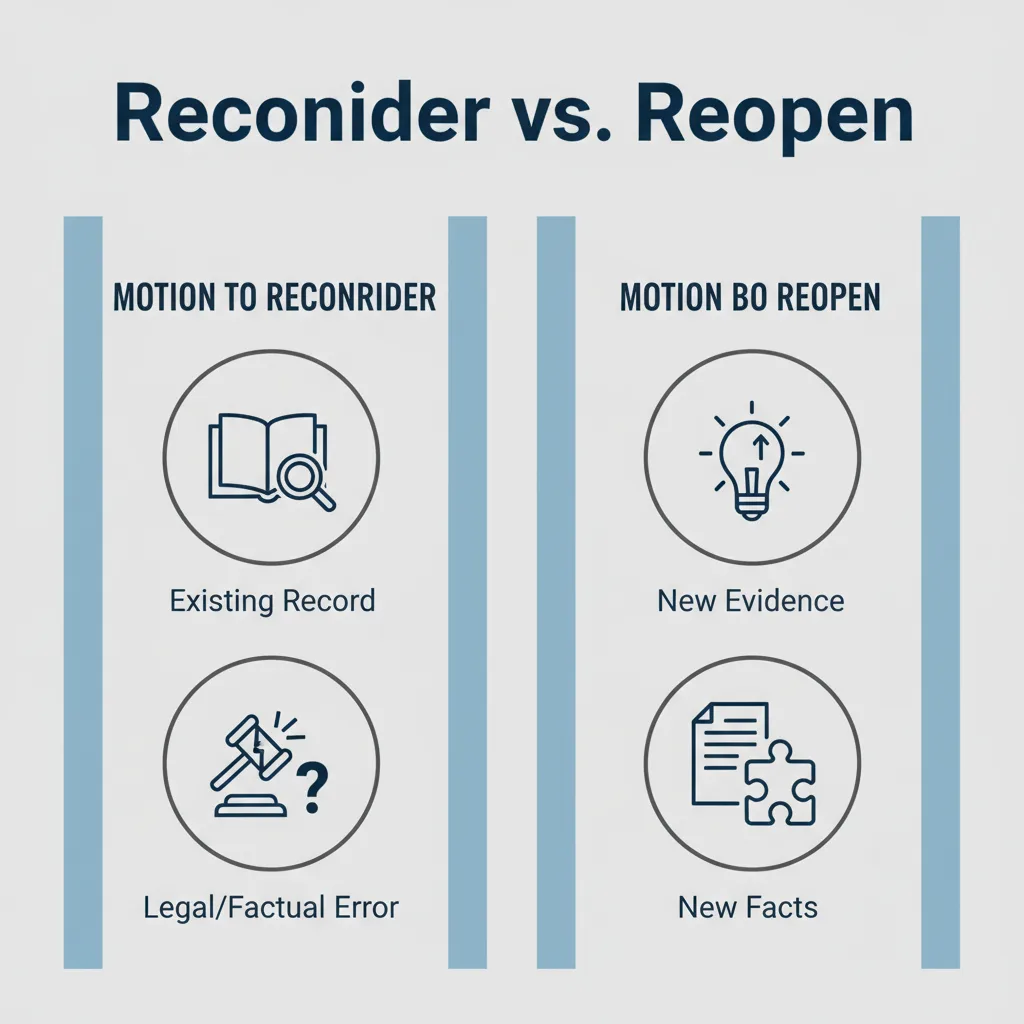
While often discussed together, a Motion to Reconsider is distinct from a Motion to Reopen, primarily in the nature of the information presented and the grounds for review. Understanding this difference is critical for selecting the appropriate legal remedy.
- Motion to Reconsider - Seeks review of a decision based on an incorrect application of law or policy, or an error in fact, using the evidence already in the record at the time of the original decision (USCIS). It focuses on errors in the initial ruling itself.
- Motion to Reopen - Typically seeks to introduce new facts or present new evidence that was not available or could not have been discovered at the time of the original decision. This type of motion argues that, with the new information, the outcome should be different (USCIS).
Frequently Asked Questions
Sources
- 4.8 - Motions to Reconsider | Executive Office for Immigration Review - Guidelines for filing motions to reconsider in immigration court proceedings.
- Questions and Answers: Appeals and Motions | USCIS - Provides information on motions to reopen and reconsider in immigration proceedings.
- How to File an Appeal or Motion | ICE - Guidance on filing appeals and motions, including motions to reconsider, in SEVP-related cases.
- 5.7 - Motions to Reconsider | Executive Office for Immigration Review - Details on motions to reconsider before the Board of Immigration Appeals.
Not the form you're looking for?
Try our legal document generator to create a custom document
Disclaimer: The templates available on this website are provided for general informational purposes only and do not constitute legal advice. They are not intended to be, and should not be interpreted as, compliant with any specific legal, regulatory, or privacy requirements. These templates are not a replacement for professional legal guidance and should not be relied upon for any particular matter or circumstance. Users are strongly encouraged to seek advice from a qualified attorney licensed in their jurisdiction before using, modifying, or relying on any template.
All templates are provided on an "as is," "with all faults," and "as available" basis. The provider disclaims any and all warranties of any kind, whether express, implied, statutory, or otherwise, including without limitation warranties of merchantability, fitness for a particular purpose, title, or non-infringement.
LegalTemplates.com makes no guarantees or representations regarding the accuracy, completeness, expected outcomes, or reliability of the materials contained in these templates or any materials referenced or linked from them.