Motion to Compel Arbitration
A Motion to Compel Arbitration is a formal legal request submitted to a court, seeking to enforce a contractual agreement that mandates disputes be resolved through arbitration rather than litigation.
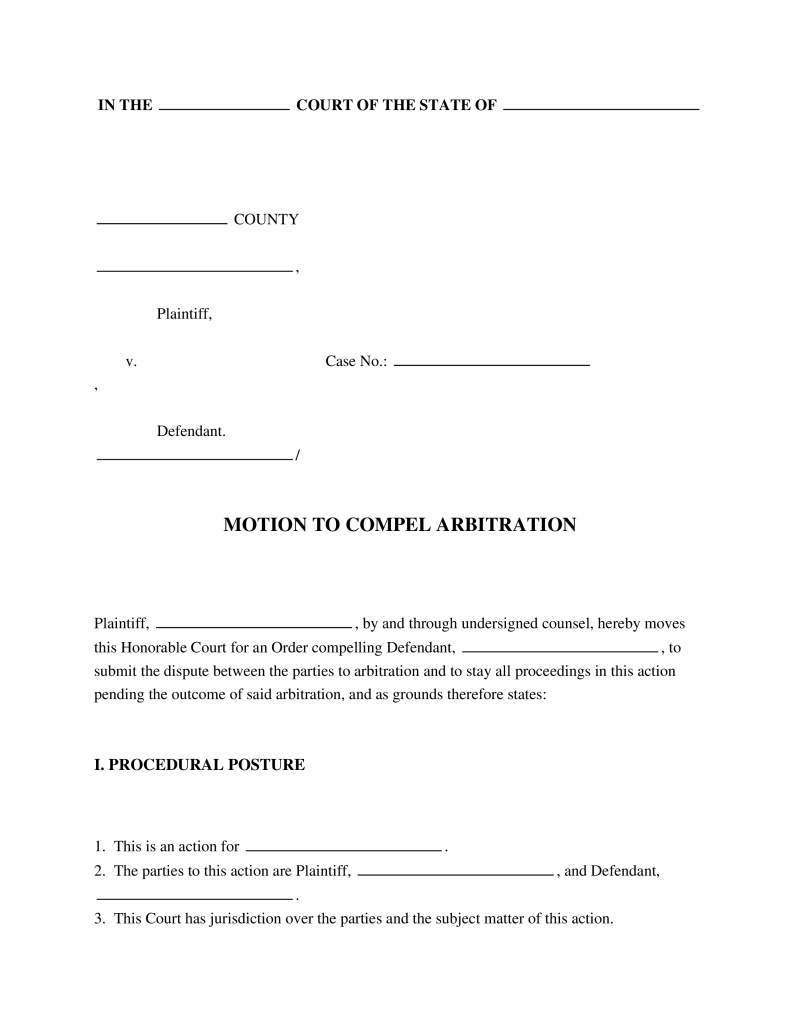
Arbitration Agreement Attached
Attaching the agreement or relevant excerpt is standard practice to support your motion.
Specify the section or page number of the arbitration clause.
Table of Contents
What is a Motion to Compel Arbitration?
A Motion to Compel Arbitration is a legal request filed with a court by one party to a dispute, asking the court to order another party to participate in arbitration rather than continue with litigation. Its primary purpose is to enforce a pre-existing agreement between the parties that mandates the resolution of disputes through arbitration. This motion is typically filed when one party initiates a lawsuit in court despite having previously agreed to arbitrate their differences, thereby seeking to uphold the terms of their contract.
Legal Framework for Arbitration
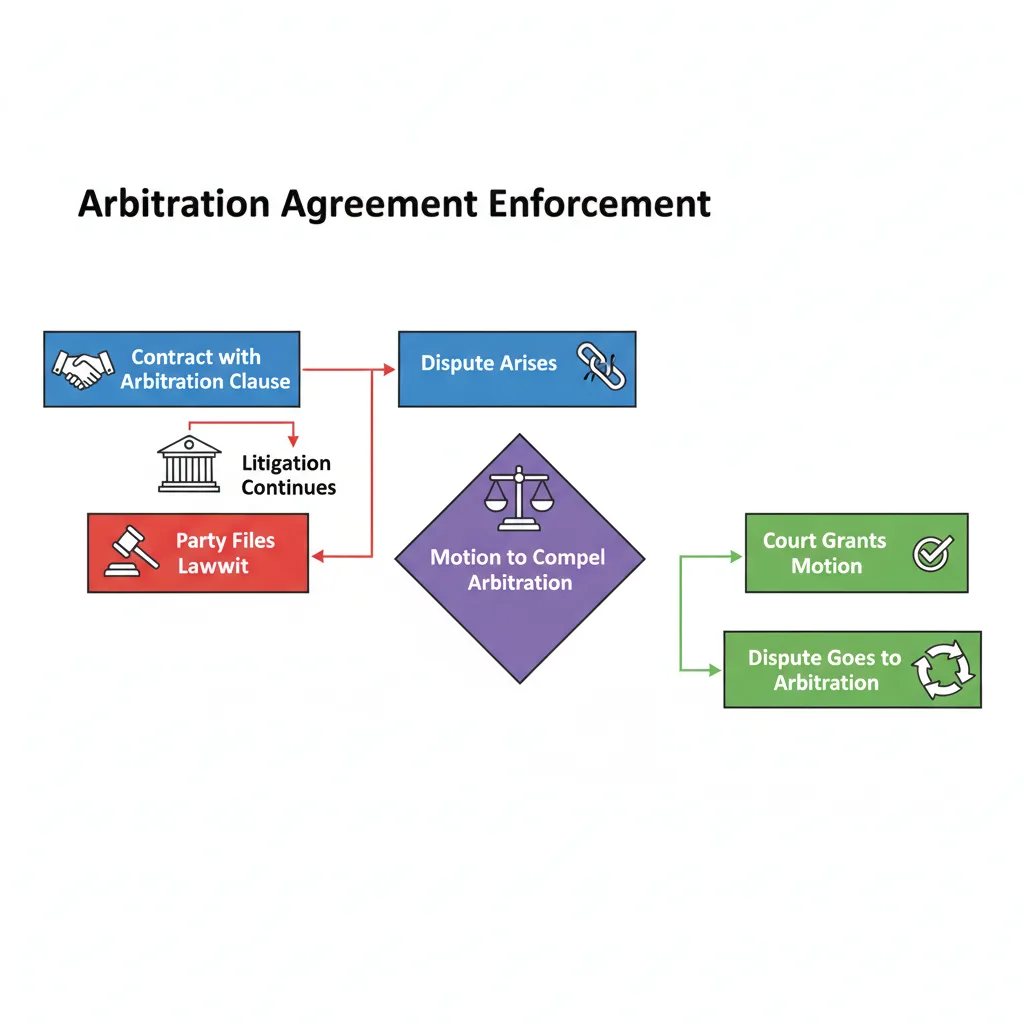
Arbitration, as an alternative dispute resolution method, is broadly supported by both federal and state law. The legal foundation for enforcing arbitration agreements in the United States is primarily established by the Federal Arbitration Act (FAA). This act expresses a strong federal policy favoring arbitration and ensures that arbitration agreements in contracts involving interstate commerce are generally valid, irrevocable, and enforceable.
Key principles underpinning the legal framework include:
- Federal Arbitration Act (FAA) - This federal statute governs the enforcement of arbitration clauses in contracts involving interstate commerce, preempting conflicting state laws that disfavor arbitration.
- State Arbitration Acts - Many states have adopted their own arbitration statutes, often modeled after the Uniform Arbitration Act (UAA), which provide similar frameworks for enforcing arbitration agreements within their respective jurisdictions.
- Contractual Basis - The enforceability of arbitration largely stems from the contractual agreement between the parties, where they voluntarily consent to resolve future disputes through arbitration.
When is a Motion to Compel Arbitration Filed?
A Motion to Compel Arbitration is typically filed early in the litigation process, often in response to a complaint or petition filed in court. The situation arises when one party believes that the dispute should be resolved through arbitration, as stipulated in a contract, but the other party has instead chosen to pursue the matter in a judicial forum.
Common scenarios for filing this motion include:
- Breach of Contract - A party files a lawsuit for breach of a contract that contains an arbitration clause.
- Employment Disputes - An employee sues their employer over a dispute covered by an employment agreement's arbitration provision.
- Consumer Agreements - A consumer initiates litigation against a business, and their agreement includes an arbitration clause.
- Construction Disputes - Parties to a construction contract with an arbitration clause end up in court over project disagreements.
Key Elements of a Motion to Compel Arbitration
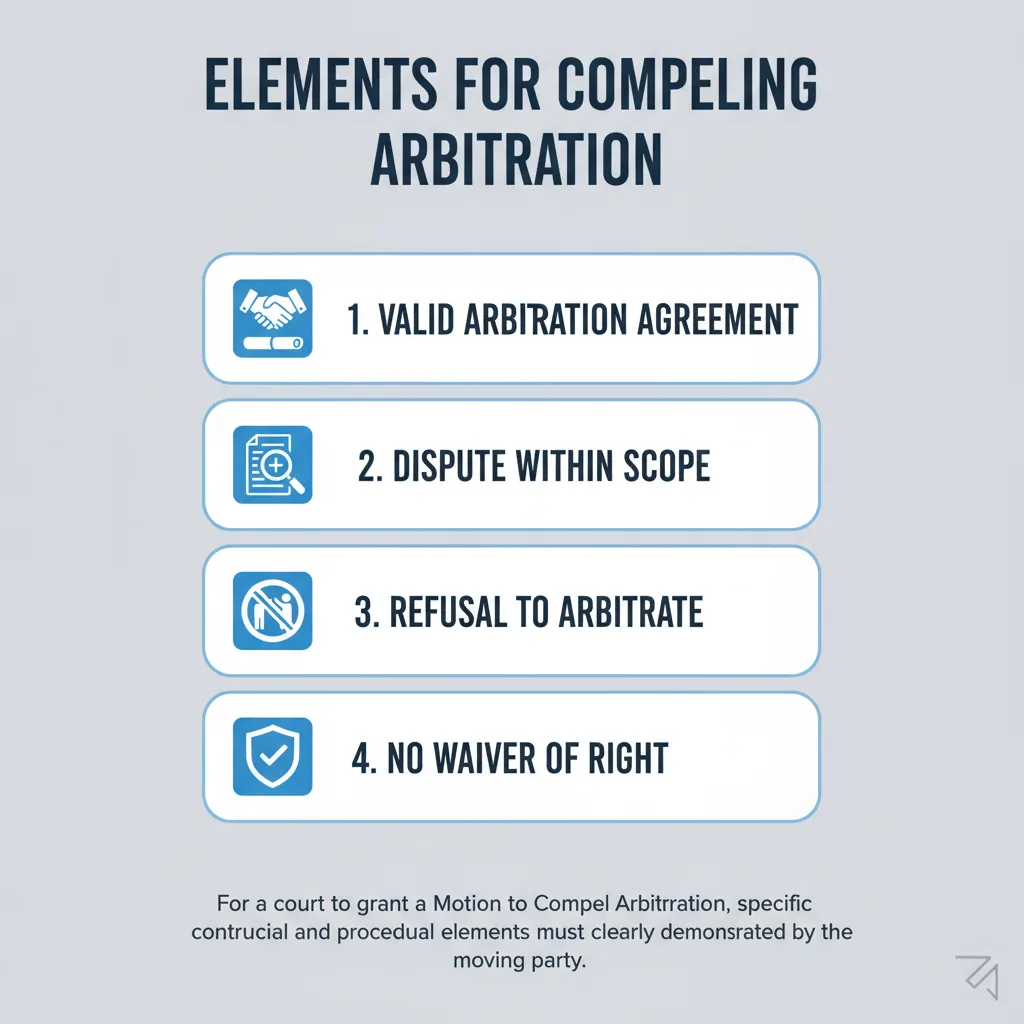
For a court to grant a Motion to Compel Arbitration, the moving party must generally demonstrate specific elements. These elements establish that a valid and enforceable arbitration agreement exists and covers the dispute in question, and that the opposing party is refusing to honor that agreement.
The moving party must typically prove:
- Existence of a Valid Arbitration Agreement - There must be a written agreement between the parties that includes a clause mandating arbitration for disputes. The agreement must be valid under general contract law principles.
- Scope of the Agreement - The dispute at hand must fall within the scope of the arbitration clause. This means the subject matter of the lawsuit must be among the types of disputes the parties agreed to arbitrate.
- Failure or Refusal to Arbitrate - The opposing party must have refused to proceed to arbitration despite the existence of the agreement, opting instead to litigate the matter in court.
- Lack of Waiver - The moving party must not have waived its right to arbitrate through its conduct, such as actively participating in litigation for an extended period before filing the motion.
Procedure for Filing the Motion
The process for filing a Motion to Compel Arbitration generally follows standard court procedures for motions. Adherence to rules of civil procedure is crucial, as is timely filing to avoid any implication of waiving the right to arbitrate.
The typical procedural steps involve:
- Drafting the Motion - The moving party prepares a formal written motion, usually accompanied by a memorandum of law explaining the legal basis and supporting arguments.
- Attaching Evidence - The motion must include supporting documentation, most importantly a copy of the contract containing the arbitration agreement.
- Filing with the Court - The motion and supporting documents are filed with the court where the lawsuit was initiated.
- Serving the Opposing Party - The motion is formally served on the opposing party in accordance with court rules.
- Response and Reply - The opposing party has an opportunity to file a response opposing the motion, to which the moving party may then file a reply.
- Hearing - The court may schedule a hearing to hear oral arguments from both sides before making a decision.
Effect of a Successful Motion
If a court grants a Motion to Compel Arbitration, the effect is significant for the ongoing legal proceedings. The court's order essentially halts the litigation and redirects the dispute to the agreed-upon arbitration process.
The common outcomes include:
- Stay of Litigation - The court will typically issue an order staying (halting) the lawsuit pending the outcome of the arbitration. This means no further court proceedings will occur until arbitration is complete.
- Order to Arbitrate - The court will order the parties to proceed with arbitration in accordance with their agreement. This often includes specifying the arbitration forum or method if not clearly defined.
- Loss of Judicial Forum - The parties lose the ability to litigate their dispute in court and must resolve it through the arbitration process, which is generally private and less formal than court.
Common Defenses Against Arbitration
Parties opposing a Motion to Compel Arbitration may raise several defenses to argue why the arbitration agreement should not be enforced. These defenses often challenge the validity of the agreement itself or its applicability to the specific dispute.
Typical defenses include:
- Invalidity of the Agreement - Arguing that the arbitration agreement is not a valid contract due to issues like lack of mutual assent, lack of consideration, or incapacity of a party.
- Unconscionability - Claiming the arbitration agreement is so one-sided or oppressive that it is fundamentally unfair and unenforceable. This often involves both procedural (how the contract was formed) and substantive (the terms themselves) unconscionability.
- Fraud or Duress - Alleging that the agreement to arbitrate was induced by fraud, misrepresentation, or under duress.
- Waiver - Asserting that the party seeking to compel arbitration has waived its right to do so by actively participating in the litigation, causing prejudice to the opposing party.
- Scope of the Clause - Contending that the specific dispute falls outside the scope of the arbitration clause, meaning the parties did not agree to arbitrate this type of claim.
Frequently Asked Questions
Not the form you're looking for?
Try our legal document generator to create a custom document
Disclaimer: The templates available on this website are provided for general informational purposes only and do not constitute legal advice. They are not intended to be, and should not be interpreted as, compliant with any specific legal, regulatory, or privacy requirements. These templates are not a replacement for professional legal guidance and should not be relied upon for any particular matter or circumstance. Users are strongly encouraged to seek advice from a qualified attorney licensed in their jurisdiction before using, modifying, or relying on any template.
All templates are provided on an "as is," "with all faults," and "as available" basis. The provider disclaims any and all warranties of any kind, whether express, implied, statutory, or otherwise, including without limitation warranties of merchantability, fitness for a particular purpose, title, or non-infringement.
LegalTemplates.com makes no guarantees or representations regarding the accuracy, completeness, expected outcomes, or reliability of the materials contained in these templates or any materials referenced or linked from them.