Medical Consent Form
Create Medical Consent Form
Medical Consent Form
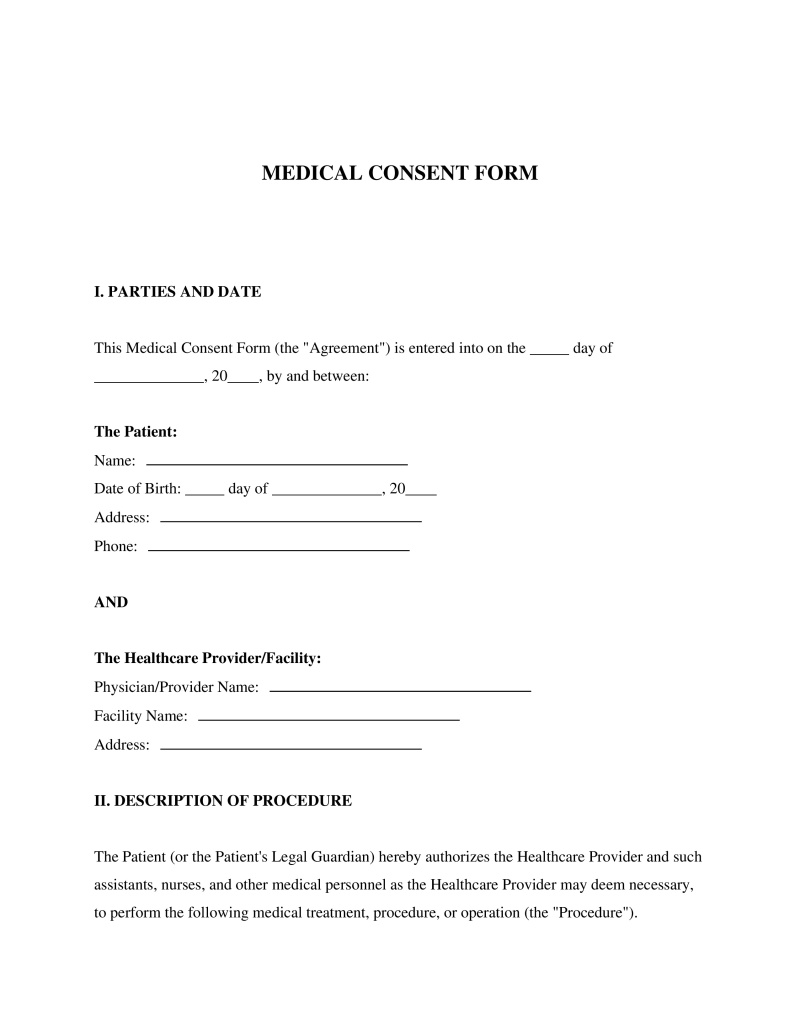
A Medical Consent Form is a legally compliant tool designed for individuals or guardians granting authorization for medical treatment or procedures.
Answer the question(s) below to create your Medical Consent Form
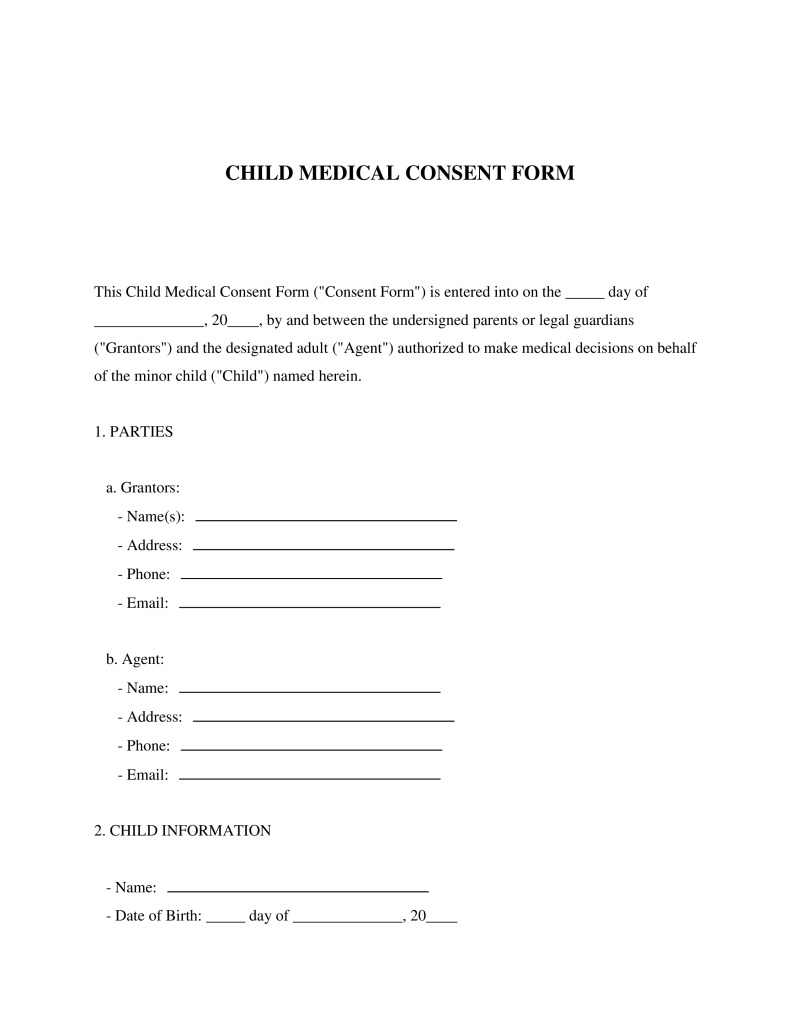
Consent For Minor
Select 'Yes' if the patient is a minor (under 18) or lacks capacity to consent. This will prompt for guardian/representative details.
Enter the full legal name of the guardian or authorized representative.
Specify the relationship (e.g., parent, legal guardian, healthcare proxy, power of attorney).
Start typing to see address suggestions
Provide the complete mailing address.
Optional. Provide a contact number for the guardian or representative.
Select 'Yes' to add another authorized person.
Enter the full legal name of the second guardian or representative.
Specify the relationship (e.g., parent, legal guardian, healthcare proxy, power of attorney).
Start typing to see address suggestions
Provide the complete mailing address.
Optional. Provide a contact number for the second guardian or representative.
Table of Contents
What is a Medical Consent Form?
A Medical Consent Form is a legal document that provides formal permission from a patient or their authorized representative to a healthcare provider for a specific medical treatment, procedure, or intervention. Its primary purpose is to ensure that patients are fully informed about their care options, potential risks, benefits, and alternatives before making a decision. This document is fundamental to the ethical and legal practice of medicine, upholding the principle of patient autonomy and informed decision-making in healthcare settings.
Legal Requirements
For a Medical Consent Form to be legally valid and enforceable, it must meet several essential criteria, ensuring that the patient's agreement is truly informed and voluntary. These requirements are designed to protect patient rights and ensure accountability from healthcare providers.
- Capacity to Consent - The patient must have the mental and legal capacity to understand the information presented and make a reasoned decision. This typically means being of legal adult age and possessing the cognitive ability to comprehend the nature and consequences of the proposed treatment.
- Voluntariness - The patient's consent must be given freely, without coercion, manipulation, or undue influence from healthcare providers, family members, or other parties.
- Disclosure of Information - Healthcare providers are obligated to disclose all material information relevant to the patient's decision. This includes the nature of the proposed treatment, its purpose, potential benefits, known risks (including common side effects and serious complications), alternative treatments (including no treatment), and the consequences of refusing treatment.
- Understanding of Information - The patient must demonstrate a reasonable understanding of the information provided. This often involves the healthcare provider answering questions and ensuring the patient grasps the implications of their choices.
- Documentation - The consent must be documented, typically in writing, signed by the patient or their authorized representative, and dated. This written record serves as proof that the informed consent process occurred.
Express Consent vs. Implied Consent
Consent in healthcare can generally be categorized into two main forms: express consent and implied consent. Understanding the distinction between these is crucial for both patients and healthcare providers.
Express consent is explicitly and unequivocally given, either verbally or in writing. It is typically required for invasive procedures, surgeries, or treatments that carry significant risks. A Medical Consent Form is the most common and legally robust method of obtaining express written consent, detailing the specifics of the proposed intervention and the patient's acknowledgment and agreement. This form ensures a clear record of the patient's decision and the information provided to them.
Implied consent, conversely, is not explicitly stated but is inferred from a patient's actions, conduct, or the surrounding circumstances. For instance, a patient extending their arm for a blood draw or opening their mouth for a dental examination implies consent for those routine, low-risk procedures. In emergency situations where a patient is unconscious or otherwise unable to provide express consent and immediate intervention is necessary to save their life or prevent serious harm, the law often presumes implied consent for essential life-saving treatments. However, implied consent is generally not sufficient for complex or high-risk medical interventions.
How to Complete
Completing a Medical Consent Form is a critical step in the patient care process, requiring careful attention to detail to ensure its validity and the patient's informed understanding.
- Review the Proposed Treatment Details - Begin by thoroughly reading the section that describes the specific medical treatment, procedure, or intervention. Ensure you understand the name of the procedure, its purpose, and what it entails. If any terms are unclear, ask the healthcare provider for clarification before proceeding.
- Understand Risks, Benefits, and Alternatives - Carefully consider the disclosed information regarding potential benefits, known risks (including common side effects and rare but serious complications), and any available alternative treatments, including the option of no treatment. This section is vital for making an informed decision, so ensure all your questions about these aspects are fully answered by your physician.
- Identify the Participating Healthcare Providers - Verify that the form correctly identifies the healthcare professionals who will be performing or assisting with the procedure. This ensures clarity regarding who is responsible for your care during the intervention.
- Confirm Your Identity and Capacity - Ensure that your full legal name, date of birth, and any other identifying information are accurately recorded on the form. By signing, you are affirming your identity and your capacity to understand and agree to the terms outlined.
- Sign and Date the Form - Once you have fully understood all aspects of the form and are comfortable with your decision, sign your legal signature in the designated area. Also, accurately record the current date. Your signature signifies your express, informed, and voluntary consent to the proposed medical intervention.
Rights and Obligations
The Medical Consent Form process delineates specific rights for patients and corresponding obligations for healthcare providers, establishing a framework for ethical and legally compliant medical care.
Patient Rights:
- Right to Information - Patients have the right to receive comprehensive information about their medical condition, proposed treatments, risks, benefits, alternatives, and prognosis in a language they understand.
- Right to Ask Questions - Patients are entitled to ask questions and receive clear, understandable answers from their healthcare providers regarding their care options.
- Right to Refuse Treatment - Competent adult patients have the right to refuse any medical treatment, even if it could lead to serious harm or death, provided they understand the consequences of their decision.
- Right to Privacy and Confidentiality - Patients have the right to expect that their medical information will be kept confidential and only shared with appropriate parties, as protected by privacy laws.
- Right to Revoke Consent - Patients can revoke consent at any time, even after signing a Medical Consent Form, as long as they retain the capacity to do so.
Healthcare Provider Obligations:
- Duty to Disclose - Providers have a legal and ethical duty to disclose all material information necessary for a patient to make an informed decision about their treatment.
- Duty to Ensure Understanding - Providers must take reasonable steps to ensure that the patient understands the information provided, which may include using plain language, visual aids, or interpreters.
- Duty to Obtain Valid Consent - Providers are obligated to obtain valid informed consent before performing any non-emergent medical procedure or treatment.
- Duty to Document Consent - Proper documentation of the informed consent process, typically through a signed Medical Consent Form, is a professional and legal requirement.
- Duty to Respect Patient Decisions - Providers must respect a competent patient's decision regarding their treatment, including the decision to refuse care, as long as it aligns with legal and ethical standards.
Applicable Federal and State Laws
The legal framework surrounding Medical Consent Forms is robust, involving both federal statutes and state-specific regulations that govern patient rights, information disclosure, and privacy.
Federal Laws Governing Medical Consent
Several federal laws significantly impact the requirements and implications of Medical Consent Forms:
- Health Insurance Portability and Accountability Act (HIPAA) - While HIPAA primarily focuses on the privacy and security of protected health information (PHI), it indirectly influences consent by establishing requirements for how patient information can be used and disclosed, often necessitating specific authorizations for non-treatment, payment, or healthcare operations disclosures (45 CFR § 164.508).
- Emergency Medical Treatment and Labor Act (EMTALA) - This act requires hospitals that participate in Medicare to provide emergency medical treatment to anyone needing it, regardless of their ability to pay. In emergency situations where a patient is unable to provide consent, EMTALA allows for necessary stabilizing treatment without formal consent (42 U.S.C. § 1395dd).
- Patient Self-Determination Act (PSDA) - This act requires healthcare providers to inform adult patients of their rights to make decisions about their medical care, including the right to accept or refuse medical or surgical treatment and the right to formulate advance directives (42 U.S.C. § 1395cc(f)).
State-Specific Regulations and Model Acts
States often build upon federal guidelines, enacting their own statutes that detail specific requirements for informed consent. Many states have adopted or adapted model legislation:
- Uniform Health-Care Decisions Act (UHCDA) - This model act, adopted in various forms by many states, provides a comprehensive framework for healthcare decision-making, including provisions for advance directives, surrogate decision-making, and the general principles of informed consent. It clarifies who can make decisions when a patient lacks capacity and the scope of those decisions (e.g., California Probate Code § 4600 et seq.).
- Medical Malpractice Statutes - State laws governing medical malpractice often define the standard of care for obtaining informed consent. Failure to obtain proper informed consent, especially if it results in patient harm, can be grounds for a medical malpractice claim (e.g., New York Civil Practice Law & Rules § 4401-a).
- Minors' Consent Laws - Most states have specific laws addressing when minors can consent to their own medical treatment, often related to specific services like reproductive health, mental health, or substance abuse treatment, or in cases of emancipation (e.g., Texas Family Code § 32.003).
Frequently Asked Questions
A competent adult patient is primarily responsible for signing their own Medical Consent Form. If the patient lacks the capacity to make medical decisions, a legally authorized representative, such as a guardian, healthcare power of attorney agent, or next of kin (in order of legal precedence), may sign on their behalf.
In emergency situations where a patient is unconscious or incapacitated and immediate medical intervention is necessary to save their life or prevent serious harm, healthcare providers can proceed with treatment under the doctrine of implied consent or emergency consent. Formal consent is obtained once the patient regains capacity or from an authorized surrogate.
Yes, a competent patient has the right to revoke their consent at any time, even after signing a Medical Consent Form and even if treatment has already begun. It is important to communicate this decision clearly to the healthcare team, ideally in writing, to ensure it is documented.
While verbal consent can be legally binding for certain routine, low-risk procedures, written consent is generally preferred and legally required for more invasive or high-risk treatments. Written consent provides clear documentation and reduces ambiguity, offering stronger legal protection for both patient and provider.
Healthcare providers must disclose the nature and purpose of the proposed treatment, its potential benefits, known risks (including side effects and complications), available alternative treatments (including no treatment), and the likely consequences of refusing treatment. This information must be presented in a way the patient can understand.
Failure to obtain proper informed consent can lead to serious legal consequences for healthcare providers. These may include medical malpractice lawsuits, professional disciplinary actions, and in some cases, allegations of battery (unconsented touching) if a procedure was performed without valid permission.
No, a Medical Consent Form is typically specific to a particular treatment, procedure, or intervention. Separate consent forms are usually required for different or subsequent treatments, especially if they are invasive, carry new risks, or involve a significant change in the care plan.
The general rule is that parents or legal guardians must provide consent for a minor's medical treatment. However, many states have laws allowing minors to consent to certain specific treatments (e.g., reproductive health, mental health) or if they are deemed emancipated or mature minors capable of understanding the decision."
Related Documents
Forms commonly used with Medical Consent Form.
Not the form you're looking for?
Try our legal document generator to create a custom document
Disclaimer: The templates available on this website are provided for general informational purposes only and do not constitute legal advice. They are not intended to be, and should not be interpreted as, compliant with any specific legal, regulatory, or privacy requirements. These templates are not a replacement for professional legal guidance and should not be relied upon for any particular matter or circumstance. Users are strongly encouraged to seek advice from a qualified attorney licensed in their jurisdiction before using, modifying, or relying on any template.
All templates are provided on an "as is," "with all faults," and "as available" basis. The provider disclaims any and all warranties of any kind, whether express, implied, statutory, or otherwise, including without limitation warranties of merchantability, fitness for a particular purpose, title, or non-infringement.
LegalTemplates.com makes no guarantees or representations regarding the accuracy, completeness, expected outcomes, or reliability of the materials contained in these templates or any materials referenced or linked from them.