Equipment Lease Agreement
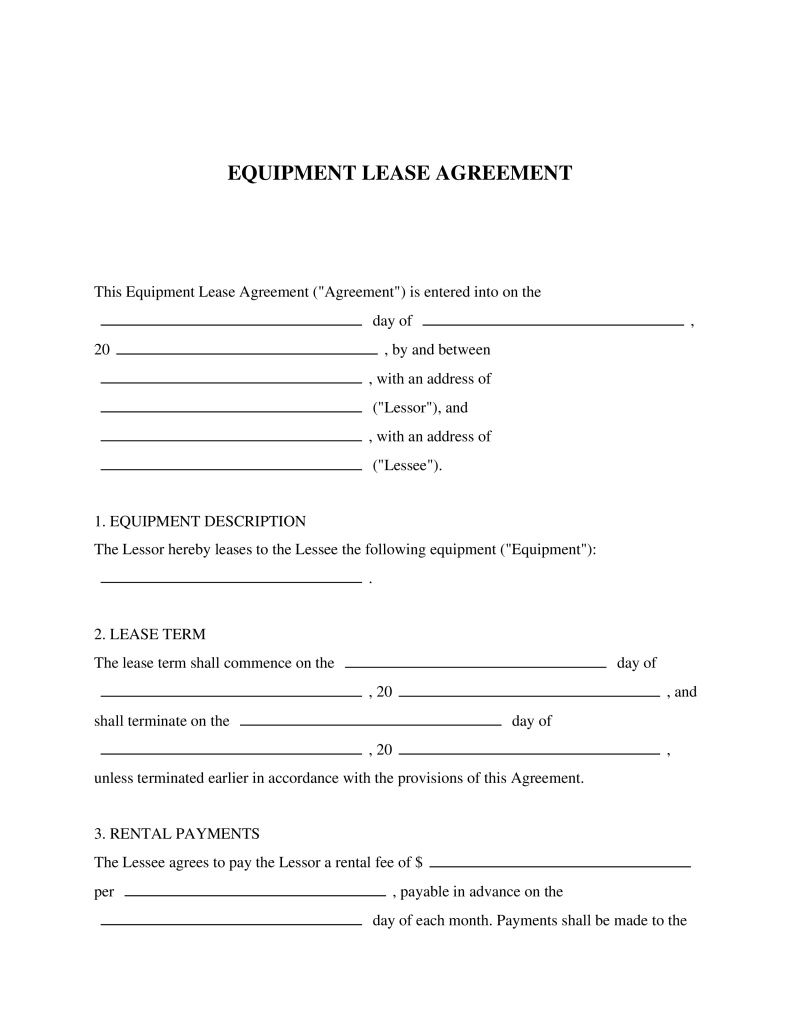
An Equipment Lease Agreement is a legal instrument that establishes the contractual terms for the temporary transfer of possession and use of specific equipment from a lessor to a lessee for an agreed-upon period and consideration.
Equipment Type
Select the primary category that best describes the equipment.
Provide a description if you selected 'Other'.
Table of Contents
What is an Equipment Lease Agreement?
An Equipment Lease Agreement is a legally binding contract outlining the terms under which one party, the lessor, agrees to rent equipment to another party, the lessee, for a specified period. This document allows businesses to acquire necessary machinery, vehicles, or technology without the significant upfront capital expenditure required for a direct purchase. It details the responsibilities of both parties, payment schedules, maintenance obligations, and conditions for the equipment's use and return, serving as a critical tool for managing assets and operational costs across various industries.
Legal Requirements
For an Equipment Lease Agreement to be legally valid and enforceable, it must satisfy several fundamental principles of contract law. These requirements ensure that both parties enter into the agreement with a clear understanding of their commitments and that the contract can withstand legal scrutiny.
- Offer and Acceptance - One party must propose specific terms for the lease, and the other party must agree to those terms without reservation.
- Consideration - Both parties must exchange something of value; typically, the lessee provides lease payments, and the lessor provides the use of the equipment.
- Legal Capacity - All parties entering the agreement must be of legal age and sound mind, and if a business entity, duly authorized to enter into contracts.
- Lawful Purpose - The purpose of the equipment lease must be legal and not violate any public policy.
- Definite Terms - The agreement must clearly specify essential terms such as the equipment description, lease term, payment schedule, and conditions for termination.
- Statute of Frauds Compliance - Leases for terms exceeding one year typically must be in writing to be enforceable, as per the Statute of Frauds (e.g., UCC § 2A-201).
Rights and Obligations of Parties Involved
The Equipment Lease Agreement meticulously defines the rights and obligations of both the lessor (owner) and the lessee (user) of the equipment. These provisions are crucial for preventing disputes and ensuring the smooth operation of the lease arrangement throughout its term.
Lessor's Rights and Obligations:
The lessor, as the legal owner of the equipment, retains certain rights and is bound by specific duties under the agreement:
- Right to Receive Payments - The lessor is entitled to receive timely lease payments as stipulated in the agreement.
- Ownership Retention - The lessor maintains legal title to the equipment throughout the lease term.
- Right to Inspect - Depending on the terms, the lessor may have the right to inspect the equipment periodically to ensure proper use and maintenance.
- Obligation to Provide Equipment - The lessor must provide the specified equipment in the condition agreed upon, often in good working order.
- Warranty Provisions - The lessor may provide warranties regarding the equipment's performance, or disclaim them, depending on the nature of the lease.
- Repossession Rights - In the event of lessee default, the lessor typically has the right to repossess the equipment.
Lessee's Rights and Obligations:
The lessee, as the party using the equipment, also has defined rights and corresponding responsibilities:
- Right to Use Equipment - The lessee has the exclusive right to use the equipment for its intended purpose during the lease term, provided all lease conditions are met.
- Obligation to Make Payments - The lessee must make all lease payments on time and in the agreed-upon amounts.
- Maintenance and Repair - The agreement typically assigns responsibility for routine maintenance, repairs, and sometimes major overhauls, often falling to the lessee for operational leases.
- Insurance Requirements - The lessee is usually responsible for insuring the equipment against loss, damage, or theft.
- Proper Use - The lessee must use the equipment in a safe and proper manner, consistent with manufacturer guidelines and the lease terms.
- Return Conditions - Upon termination, the lessee must return the equipment in the condition specified in the agreement, accounting for normal wear and tear.
How to Complete an Equipment Lease Agreement
Creating a comprehensive and legally sound Equipment Lease Agreement involves several key steps to ensure all essential terms are covered and both parties' interests are protected.
- Identify Parties and Equipment - Begin by clearly identifying the full legal names and addresses of both the lessor and the lessee. Provide a detailed and accurate description of the equipment being leased, including make, model, serial number, and any unique identifiers. This step is crucial to avoid ambiguity regarding the subject of the agreement and the identities of the contracting parties.
- Define Lease Terms and Payment Schedule - Specify the exact duration of the lease, including the start and end dates. Outline the payment structure, including the amount of each payment, the frequency (e.g., monthly, quarterly), due dates, and acceptable payment methods. Include provisions for late payment penalties and any security deposit requirements, detailing how and when the deposit will be returned or applied.
- Specify Maintenance, Insurance, and Warranties - Clearly delineate which party is responsible for routine maintenance, repairs, and major servicing of the equipment. Detail the insurance requirements, including the types of coverage (e.g., property damage, liability) and the minimum coverage amounts, usually requiring the lessee to name the lessor as an additional insured. Address any warranties provided by the lessor, or explicitly disclaim them, stating the equipment is leased "as is."
- Outline Default and Termination Conditions - Define what constitutes an event of default by either party, such as non-payment, unauthorized use, or failure to maintain insurance. Establish the remedies available to the non-defaulting party, which may include repossession, acceleration of payments, or monetary damages. Detail the procedures for early termination, including any penalties or buyout options, and the process for returning the equipment upon lease expiration or termination.
- Review and Execute - Before signing, both parties should thoroughly review the entire agreement, preferably with legal counsel, to ensure all terms are understood and acceptable. Any amendments or special conditions should be incorporated in writing. Once all parties are satisfied, the agreement must be signed by authorized representatives and dated. It is good practice to have the signatures witnessed or notarized, especially for high-value equipment or lengthy lease terms, and each party should retain an original signed copy.
Legal Framework and Applicable Laws
Equipment Lease Agreements are primarily governed by a combination of state and, indirectly, federal laws, particularly those related to commercial transactions and contracts. Understanding the legal landscape is essential for compliance and enforcement.
Federal Statutes and Model Laws
While no single overarching federal statute directly governs all equipment leases, several federal principles and model laws significantly influence their structure and enforcement:
- Uniform Commercial Code (UCC) Article 2A, Leases - This model law, widely adopted by states, provides a comprehensive legal framework for the creation, validity, and enforcement of equipment leases. It addresses issues such as formation, construction, effect, and performance of lease contracts, as well as default and remedies (UCC § 2A-101 et seq.).
- Internal Revenue Code (IRC) - Federal tax laws dictate how leases are classified for tax purposes (e.g., true lease vs. conditional sale), which impacts depreciation, deductibility of lease payments, and other tax implications for both lessor and lessee (26 U.S.C. § 1 et seq.).
- Federal Arbitration Act (FAA) - If the lease agreement includes an arbitration clause, this federal law governs the enforceability of such clauses in contracts involving interstate commerce (9 U.S.C. § 1 et seq.).
State Laws and Requirements
State laws play a predominant role in the specific enforcement and interpretation of Equipment Lease Agreements, building upon the framework provided by model laws like the UCC:
- State Adoption of UCC Article 2A - Nearly all states have adopted some version of UCC Article 2A, which means the general principles governing equipment leases are largely consistent across jurisdictions, though minor variations may exist (e.g., California Commercial Code § 10101 et seq.).
- General Contract Law - Principles of offer, acceptance, consideration, capacity, and legality, which are foundational to all contracts, are defined by individual state common law and statutes.
- Usury Laws - If the lease incorporates financing elements or interest charges, state usury laws may limit the maximum permissible interest rates (e.g., New York General Obligations Law § 5-501).
- Statute of Frauds - State versions of the Statute of Frauds dictate that leases exceeding a certain term (typically one year) must be in writing to be enforceable (e.g., Texas Business and Commerce Code § 2.201).
- Consumer Protection Laws - While primarily commercial, if the lease involves a consumer rather than a business entity, state consumer protection statutes might apply, offering additional safeguards (e.g., Magnuson-Moss Warranty Act, 15 U.S.C. § 2301 et seq. for product warranties, though less direct for leases).
Penalties for Non-Compliance
Breaching the terms of an Equipment Lease Agreement can lead to significant legal and financial consequences for the defaulting party. Remedies are typically outlined within the agreement itself and reinforced by state law.
- Monetary Damages - The non-defaulting party can sue for financial losses incurred due to the breach, which may include unpaid lease payments, costs of repossession, remarketing expenses, and the difference between the agreed lease payments and the fair market value of the lease.
- Repossession - For a lessee's default, the lessor typically has the right to repossess the equipment, often without judicial process if it can be done peacefully, as permitted by UCC Article 2A.
- Specific Performance - In rare cases where monetary damages are insufficient, a court might order specific performance, compelling the defaulting party to fulfill their contractual obligations.
- Acceleration Clauses - Many agreements include an acceleration clause, allowing the lessor to demand immediate payment of all remaining lease payments upon default.
- Legal Fees and Costs - The defaulting party may be responsible for the legal fees and court costs incurred by the non-defaulting party in enforcing the agreement.
Frequently Asked Questions
Not the form you're looking for?
Try our legal document generator to create a custom document
Disclaimer: The templates available on this website are provided for general informational purposes only and do not constitute legal advice. They are not intended to be, and should not be interpreted as, compliant with any specific legal, regulatory, or privacy requirements. These templates are not a replacement for professional legal guidance and should not be relied upon for any particular matter or circumstance. Users are strongly encouraged to seek advice from a qualified attorney licensed in their jurisdiction before using, modifying, or relying on any template.
All templates are provided on an "as is," "with all faults," and "as available" basis. The provider disclaims any and all warranties of any kind, whether express, implied, statutory, or otherwise, including without limitation warranties of merchantability, fitness for a particular purpose, title, or non-infringement.
LegalTemplates.com makes no guarantees or representations regarding the accuracy, completeness, expected outcomes, or reliability of the materials contained in these templates or any materials referenced or linked from them.