End User License Agreement
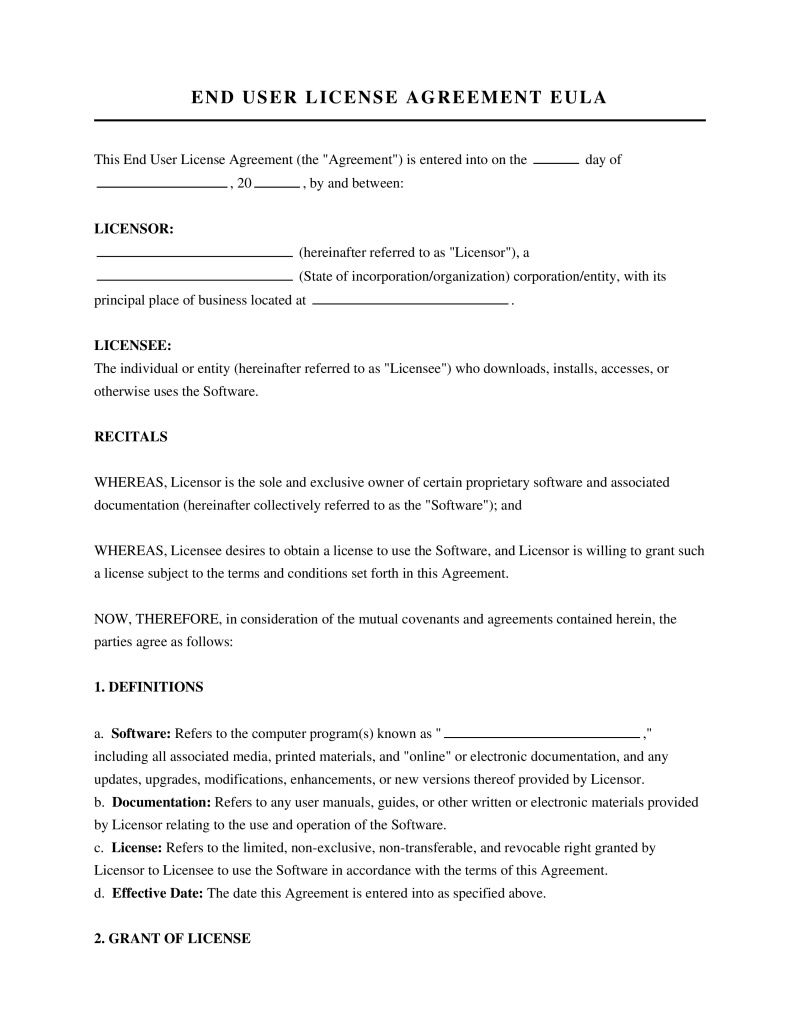
An End User License Agreement is a legal contract that outlines the rights and restrictions for software usage by the end user.
Licensee Type
Select whether the end user is an individual or an organization/business.
Enter the individual’s or organization’s full legal name.
Enter the mailing address for the end user.
Provide an email for license-related communications.
Select Yes to add another individual or organization as a licensee.
Enter the second individual’s or organization’s full legal name.
Enter the mailing address for the second end user.
Select Yes to add a third individual or organization as a licensee.
Enter the third individual’s or organization’s full legal name.
Enter the mailing address for the third end user.
Table of Contents
What is a End User License Agreement?
An End User License Agreement (EULA) is a legal contract established between a software developer or publisher and the end user of their software. It defines the terms under which the user is granted the right to use the software, rather than outright ownership of the software itself. This agreement typically specifies the scope of the license, restrictions on use, disclaimers of warranty, and limitations of liability. EULAs are ubiquitous in the digital landscape, accompanying most proprietary software applications, operating systems, and even some open-source projects.
Legal Requirements
The validity and enforceability of an End User License Agreement are generally determined by contract law principles. For an EULA to be legally binding, it must meet the fundamental requirements for contract formation, including offer, acceptance, and consideration. The manner in which a user accepts the terms, often through clickwrap or browsewrap agreements, is a critical factor in its enforceability.
Key considerations for the legal validity of an EULA include:
- Offer and Acceptance - The EULA must be presented to the user as an offer, and the user must clearly manifest their assent to its terms. This often occurs by clicking an "I Agree" button (clickwrap) or by simply using the software after being notified of the terms (browsewrap).
- Mutuality of Assent - Both parties must agree to the same terms and conditions. Ambiguous or overly complex language can sometimes challenge this element.
- Consideration - The exchange of promises or value between the parties. For a EULA, this typically involves the grant of a license to use the software in exchange for the user's agreement to abide by the terms.
- Legality - The terms of the EULA must comply with applicable laws and cannot promote illegal activities or contain unconscionable clauses.
- Capacity - Both parties must have the legal capacity to enter into a contract, meaning they must be of legal age and sound mind.
Courts have generally upheld EULAs, particularly clickwrap agreements, where the user has an unambiguous opportunity to review the terms before indicating acceptance. Browsewrap agreements, where acceptance is inferred from use, face greater scrutiny regarding whether the user had adequate notice of the terms.
Rights and Obligations of Parties Involved
An End User License Agreement delineates the specific rights and responsibilities of both the licensor (software developer/publisher) and the licensee (end user).
Licensor's Rights and Obligations:
- Grant of License - The licensor grants a non-exclusive, non-transferable license to the user to install and use the software in accordance with the EULA's terms.
- Intellectual Property Retention - The licensor retains all ownership rights, title, and interest in and to the software, including all intellectual property rights. The user is typically only granted a limited right to use.
- Warranty Disclaimers - Most EULAs include disclaimers of warranties, often stating the software is provided "as is" without guarantees of performance or fitness for a particular purpose.
- Limitation of Liability - EULAs frequently limit the licensor's liability for damages arising from the use or inability to use the software, often to the amount paid for the license.
- Support and Maintenance - While not always included, some EULAs may outline the licensor's obligation to provide technical support, updates, or maintenance services, often for an additional fee or for a limited period.
Licensee's Rights and Obligations:
- Permitted Use - The user is granted the right to install and use the software as specified in the EULA, typically on a certain number of devices or for specific purposes (e.g., personal, non-commercial).
- Restrictions on Use - Users are generally prohibited from reverse engineering, decompiling, disassembling, modifying, adapting, translating, or creating derivative works from the software. Reselling, sublicensing, or distributing the software is also commonly forbidden.
- Compliance with Terms - The user is obligated to adhere to all terms and conditions of the EULA, including any restrictions on copying, sharing, or network usage.
- Payment of Fees - If the software is not freeware, the user is obligated to pay the license fees as agreed upon.
- Termination of License - The user's license to use the software can typically be terminated by the licensor if the user breaches any of the EULA's terms.
Key Provisions of an End User License Agreement
A comprehensive End User License Agreement typically includes several standard provisions designed to protect the intellectual property of the software developer and define the boundaries of use. These elements are crucial for clarity and enforceability:
- Grant of License - Specifies the scope of the license granted to the end user (e.g., non-exclusive, non-transferable, revocable, limited).
- Restrictions on Use - Outlines prohibited actions, such as reverse engineering, modification, redistribution, or use beyond the licensed scope.
- Intellectual Property Rights - States that the licensor retains all ownership, title, and intellectual property rights to the software.
- Disclaimer of Warranties - Limits the licensor's liability by stating the software is provided "as is" and disclaiming implied warranties (e.g., merchantability, fitness for a particular purpose).
- Limitation of Liability - Caps the financial liability of the licensor for any damages arising from the use or inability to use the software.
- Governing Law - Designates the jurisdiction whose laws will govern the interpretation and enforcement of the EULA.
- Termination Clause - Describes conditions under which the EULA can be terminated by either party, often upon breach by the user.
- Updates and Upgrades - May address how software updates, patches, and new versions will be handled, and whether they are included in the initial license.
- Privacy Policy Reference - Often includes a reference to or incorporates the software's privacy policy, detailing data collection and usage practices.
- Export Controls - Notifies users that the software may be subject to international export laws and regulations.
Applicable Laws and Legal Framework
End User License Agreements operate within a complex legal framework encompassing federal and state laws, primarily focusing on intellectual property and contract law. The enforceability and interpretation of EULAs are largely shaped by these legal principles.
Federal Statutes and Legal Principles:
- Copyright Act of 1976 - Protects original works of authorship, including software code, providing the licensor with exclusive rights to reproduce, distribute, and create derivative works (17 U.S.C. § 101 et seq.). EULAs derive their authority from the licensor's copyright.
- Digital Millennium Copyright Act (DMCA) - Prohibits circumvention of technological measures that control access to copyrighted works, which can reinforce EULA clauses against reverse engineering or unauthorized access (17 U.S.C. § 1201 et seq.).
- Federal Trade Commission Act (FTC Act) - Prohibits unfair or deceptive acts or practices in commerce, which can apply to misleading EULA terms or practices (15 U.S.C. § 45).
- Export Administration Regulations (EAR) - Governs the export of certain technologies, including software, requiring compliance with U.S. export controls (15 CFR § 730 et seq.).
State Laws and Model Acts:
- Uniform Commercial Code (UCC) Article 2 (Sales) - While primarily for goods, some courts have applied UCC principles to software transactions, particularly when the software is treated as a good. However, many EULAs explicitly state they are not a sale.
- Uniform Computer Information Transactions Act (UCITA) - A controversial model law specifically drafted to govern contracts for computer information transactions, including software licenses. While adopted by only a few states (e.g., Virginia, Maryland), it represents an attempt to standardize EULA law.
- State Contract Law - General principles of contract formation, interpretation, and enforceability, including doctrines like unconscionability, fraud, and misrepresentation, are applied by state courts when evaluating EULAs.
- Consumer Protection Laws - Many states have consumer protection statutes that may limit certain clauses in EULAs, particularly those deemed unfair or deceptive towards consumers.
Penalties for Non-Compliance:
Breach of an End User License Agreement can lead to several legal consequences for the licensee:
- Termination of License - The most common penalty, resulting in the immediate revocation of the user's right to use the software.
- Injunctive Relief - The licensor may seek a court order to prevent the user from continuing to breach the EULA, such as stopping unauthorized distribution or reverse engineering.
- Damages - The licensor can sue for monetary damages incurred due to the breach, which may include lost profits or the cost of the unauthorized use.
- Copyright Infringement Claims - If the breach involves unauthorized copying, distribution, or creation of derivative works, the licensor may pursue claims under federal copyright law, which can carry significant statutory damages and attorney's fees.
- Civil and Criminal Penalties - In cases involving severe breaches, such as large-scale piracy or circumvention of copy protection, criminal charges and substantial fines may be pursued under laws like the DMCA.
Enforceability Challenges and Common Disputes
Despite their widespread use, End User License Agreements frequently face challenges regarding their enforceability, leading to common disputes between licensors and licensees. These challenges often stem from the nature of digital contract formation and the sometimes-onerous terms contained within.
Key areas of contention and enforceability challenges include:
- Notice and Assent - The primary challenge for EULAs is proving that the user had adequate notice of the terms and affirmatively assented to them.
- Clickwrap Agreements - Generally considered enforceable because they require the user to click an "I Agree" button, indicating clear assent.
- Browsewrap Agreements - Often face greater scrutiny. Courts assess whether a reasonably prudent user would have known about the terms and understood that their actions constituted acceptance. Factors include the prominence of the link to the EULA and the clarity of the notice.
- Unconscionability - A court may refuse to enforce an EULA, or a specific clause within it, if the terms are deemed so one-sided or oppressive as to be fundamentally unfair. This often involves a combination of procedural unconscionability (lack of meaningful choice) and substantive unconscionability (overly harsh terms).
- Ambiguity - Vague or unclear language in an EULA can lead to disputes over interpretation. Courts typically interpret ambiguous terms against the drafter (the licensor).
- Lack of Consideration - In some cases, users may argue that there was no valid consideration for the EULA, especially if the software is free or if the terms are presented after purchase or download.
- Scope of License Restrictions - Disputes frequently arise over whether a user's specific actions (e.g., transferring software, using it in a virtual environment, reverse engineering for interoperability) fall within the prohibited restrictions of the EULA.
- Forum Selection and Arbitration Clauses - EULAs often include clauses requiring disputes to be resolved in a specific jurisdiction or through binding arbitration. While generally upheld, these can be challenged on grounds of fundamental fairness or public policy.
The evolving nature of software distribution and consumption continually brings new challenges to EULA enforceability, requiring courts to adapt traditional contract principles to the digital realm.
Frequently Asked Questions
End User License Agreement Sample
Not the form you're looking for?
Try our legal document generator to create a custom document
Disclaimer: The templates available on this website are provided for general informational purposes only and do not constitute legal advice. They are not intended to be, and should not be interpreted as, compliant with any specific legal, regulatory, or privacy requirements. These templates are not a replacement for professional legal guidance and should not be relied upon for any particular matter or circumstance. Users are strongly encouraged to seek advice from a qualified attorney licensed in their jurisdiction before using, modifying, or relying on any template.
All templates are provided on an "as is," "with all faults," and "as available" basis. The provider disclaims any and all warranties of any kind, whether express, implied, statutory, or otherwise, including without limitation warranties of merchantability, fitness for a particular purpose, title, or non-infringement.
LegalTemplates.com makes no guarantees or representations regarding the accuracy, completeness, expected outcomes, or reliability of the materials contained in these templates or any materials referenced or linked from them.