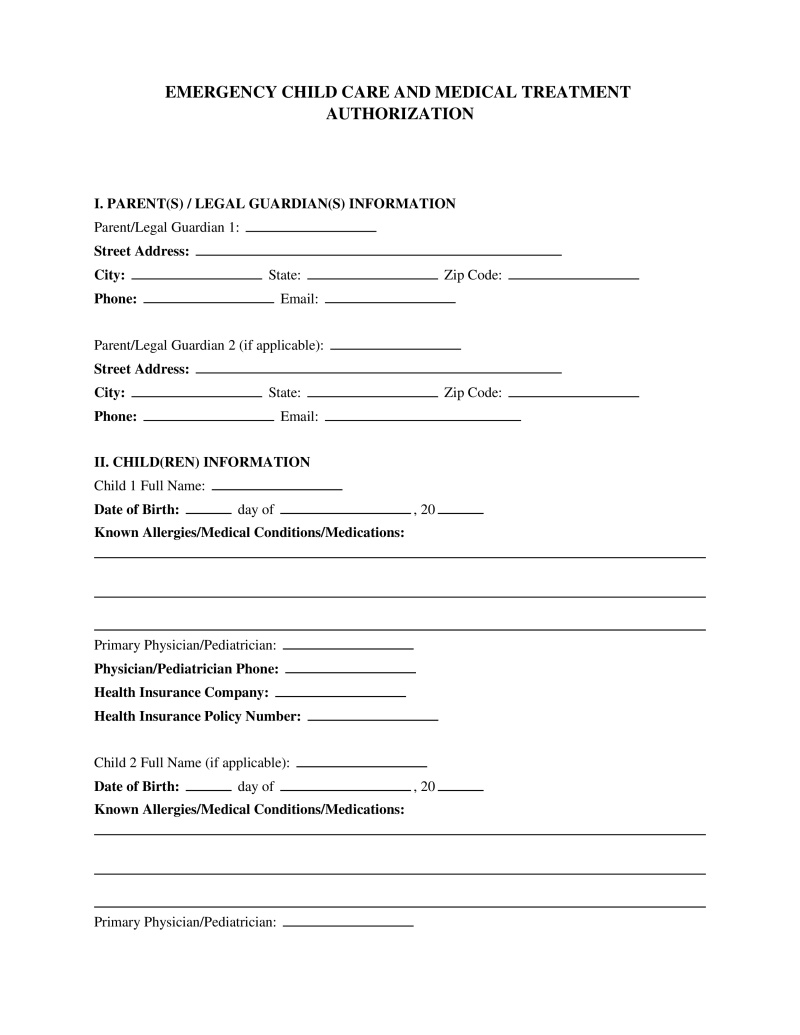
Emergency Child Care Authorization Form
An Emergency Child Care Authorization Form is a legal instrument that designates a temporary caregiver for a minor child in the event of a parent's or guardian's unforeseen unavailability.
Authorization Scope
Select all that apply. These are the types of decisions the designated caregiver may make in your absence.
Describe any additional types of decisions not listed above.
Table of Contents
What is an Emergency Child Care Authorization Form?
An Emergency Child Care Authorization Form is a crucial legal document that delegates temporary authority from a parent or legal guardian to another trusted adult, such as a caregiver, teacher, or relative, for making immediate decisions concerning a minor child's well-being. This form is specifically designed to address situations where the parent or guardian is unreachable or unavailable during an emergency, particularly those requiring urgent medical attention. Its primary purpose is to ensure that a child receives necessary care without delay, thereby safeguarding their health and safety when their primary guardians cannot be present.
Purpose and Scope of the Authorization
The Emergency Child Care Authorization Form serves as a vital instrument for ensuring continuity of care and prompt decision-making in unforeseen circumstances. It bridges the gap created by a parent's temporary absence or unavailability, empowering an authorized caregiver to act swiftly in the child's best interest. This document is commonly required by schools, daycares, camps, and other organizations that care for children, providing them with clear legal guidance on who can make decisions in a crisis.
The scope of authority granted by such a form typically encompasses several critical areas. It often includes consent for emergency medical treatment, permission to administer prescribed medications, and instructions regarding specific medical conditions or allergies. Beyond medical decisions, the form may also designate individuals authorized to pick up the child, outline emergency contact procedures, and specify preferences for communication during an incident. This comprehensive delegation helps prevent delays that could otherwise jeopardize a child's health or safety.
Required Elements of a Valid Emergency Child Care Authorization Form
For an Emergency Child Care Authorization Form to be legally sound and effective, it must contain several key pieces of information and adhere to specific structural requirements. These elements ensure clarity, prevent ambiguity, and provide essential details to all parties involved:
- Child's Full Identifying Information - Includes the child's full legal name, date of birth, current address, and any unique identifying characteristics.
- Parent/Legal Guardian Information - Full names, contact phone numbers (home, work, cell), email addresses, and current address of all custodial parents or legal guardians.
- Authorized Caregiver(s) Details - Full names, relationships to the child, contact phone numbers, and addresses of all individuals empowered to make decisions or act on the parents' behalf. This section often includes a clear statement of the scope of their authority.
- Emergency Contact Persons - Names and contact information for at least two additional emergency contacts who can be reached if parents and authorized caregivers are unavailable.
- Medical Consent and Instructions - Explicit consent for emergency medical treatment, including hospitalization, surgery, and administration of necessary medications. This section should also list any known allergies (food, medication, environmental), chronic medical conditions (e.g., asthma, diabetes, epilepsy), and current medications with dosage instructions.
- Healthcare Provider and Insurance Information - Name and contact information for the child's primary physician, dentist, and any specialists, along with health insurance policy details (company name, policy number, group number).
- Specific Limitations or Directives - Any specific restrictions on treatment, religious objections to certain medical procedures, or preferences regarding healthcare facilities.
- Date of Authorization and Expiration Date - The date the form is signed and an explicit expiration date to ensure the information remains current and valid.
- Parent/Legal Guardian Signatures - Signatures of all custodial parents or legal guardians, affirming their consent and understanding of the document's contents.
- Witness Signatures and/or Notarization - Depending on state law or organizational requirements, the form may need to be witnessed or notarized to enhance its legal enforceability and authenticate the signatures.
Rights and Obligations of Parties Involved
The establishment of an Emergency Child Care Authorization Form creates a framework of specific rights and obligations for all parties involved, ensuring accountability and clarity in a child's care during emergencies.
- Parents/Legal Guardians - Have the right to specify the exact scope of authority delegated to the caregiver, including any limitations on medical treatment or specific instructions regarding the child's care. They are obligated to provide accurate, up-to-date information on the form, including medical history, allergies, and contact details, and to promptly update the form if any information changes.
- Authorized Caregiver(s) - Are granted the right to make decisions regarding the child's care, including seeking emergency medical attention, within the parameters set forth in the authorization form. They are obligated to act in the child's best interest, follow the parents' instructions as outlined in the form, and make reasonable efforts to contact the parents or guardians before taking significant actions, unless immediate action is required to prevent harm.
- Medical Providers and Facilities - Have the right to rely on the authorization form as valid consent for treatment, allowing them to provide necessary medical care without delay in an emergency. They are obligated to adhere to the instructions and limitations specified in the form, to protect the child's privacy under applicable laws like HIPAA, and to make reasonable attempts to contact the parents or guardians for significant medical decisions, if time permits.
- Schools and Childcare Facilities - Have the right to require such a form from parents to ensure they have legal authority to act or seek care for a child in an emergency. They are obligated to keep the form confidential and readily accessible to authorized personnel, to follow the instructions within the form, and to notify parents or guardians as soon as possible after an emergency event.
How to Complete an Emergency Child Care Authorization Form
Completing an Emergency Child Care Authorization Form requires careful attention to detail to ensure it is comprehensive and legally effective. The following steps outline the process:
- Gather Essential Information - Begin by compiling all necessary personal and medical details for the child, including their full legal name, date of birth, any known allergies, current medications, existing medical conditions, and health insurance policy information. Ensure all contact details for parents, guardians, and emergency contacts are current and accurate.
- Identify and Designate Authorized Caregivers - Select one or more trusted individuals who will be granted the authority to make decisions in your absence. Obtain their full names, contact information, and their relationship to the child. Confirm that these individuals are willing and able to assume this responsibility, and understand the scope of their delegated authority.
- Specify Medical Directives and Preferences - Clearly state your consent for emergency medical treatment, including potential hospitalization or surgical procedures. Detail any specific medical instructions, such as religious objections to certain treatments, preferences for particular hospitals or doctors, or limitations on the types of care that can be provided. This section is critical for guiding medical professionals.
- List Comprehensive Emergency Contacts - Provide a robust list of emergency contacts, including phone numbers for home, work, and mobile devices for each person. These contacts should be individuals who can be reached if the parents or primary authorized caregivers are unavailable, ensuring multiple layers of communication in a crisis.
- Review, Sign, and Notarize the Document - Carefully review the entire form to ensure all information is correct and complete. Sign the document in the presence of any required witnesses or a notary public. Notarization adds an extra layer of legal validity by verifying the identity of the signatories and the authenticity of their signatures, making the document more difficult to challenge.
- Distribute Copies to Relevant Parties - Once completed and signed, provide copies of the form to all authorized caregivers, the child's school or daycare, and any other relevant institutions (e.g., sports clubs, summer camps). Keep the original document in a secure, accessible location, and inform all parties of its existence and where it can be quickly retrieved.
Applicable Laws and Regulations
The legal framework surrounding Emergency Child Care Authorization Forms is influenced by both federal and state statutes, designed to protect children's welfare and ensure proper delegation of authority.
Federal Statutes
Several federal laws impact how information on these forms is handled and how medical decisions are made:
- Health Insurance Portability and Accountability Act (HIPAA) - Governs the privacy and security of protected health information (PHI). While parents generally have access to their minor child's PHI, an Emergency Child Care Authorization Form can facilitate the sharing of necessary medical information with authorized caregivers and medical providers in an emergency, often bypassing standard authorization requirements for immediate care (45 CFR § 164.508).
- Family Educational Rights and Privacy Act (FERPA) - Protects the privacy of student education records. While primarily focused on schools, information shared on an authorization form with educational institutions must comply with FERPA's provisions regarding who can access student information, including medical details provided by parents (20 U.S.C. § 1232g; 34 CFR Part 99).
State Laws and Requirements
State laws play a significant role in defining the scope and validity of temporary delegation of parental authority:
- Temporary Delegation of Parental Authority Statutes - Many states have specific statutes that outline the legal requirements for temporarily delegating parental rights and responsibilities, which includes medical decision-making authority, to another adult (e.g., refer to specific state statutes if applicable, otherwise use general phrasing). These statutes often dictate the duration of such delegation, the necessity of notarization, and specific content requirements for the authorization form.
- Child Abuse and Neglect Reporting Laws - All states have mandatory reporting laws that require certain professionals, including caregivers, teachers, and medical personnel, to report suspected child abuse or neglect. An authorization form does not absolve a caregiver of this legal duty.
- Notary Public Acts - Govern the official acts of notaries public, including the acknowledgment of signatures on legal documents. Notarization, when required or recommended for an authorization form, must comply with the specific state's Notary Public Act to ensure its legal validity.
Penalties for Non-Compliance
Failure to comply with the legal requirements related to Emergency Child Care Authorization Forms, or acting outside the scope of authority granted, can lead to serious legal consequences:
- Medical Negligence or Battery - An authorized caregiver who provides or consents to medical treatment beyond the scope of the authorization, or without proper consent when the parent is available, could face claims of medical negligence or even battery.
- Unauthorized Disclosure of Information - Healthcare providers or institutions that disclose a child's protected health information to unauthorized individuals may face penalties under HIPAA. Similarly, educational institutions could face penalties under FERPA for improper disclosure of student records.
- Child Endangerment or Neglect - Parents who fail to provide adequate authorization for emergency care, leading to harm or delay in treatment, could potentially face accusations of child endangerment or neglect, depending on the severity of the outcome and state laws.
- Liability Issues - Caregivers or institutions acting without proper authorization in a medical emergency may incur civil liability if their actions are deemed inappropriate or harmful to the child.
Frequently Asked Questions
Not the form you're looking for?
Try our legal document generator to create a custom document
Disclaimer: The templates available on this website are provided for general informational purposes only and do not constitute legal advice. They are not intended to be, and should not be interpreted as, compliant with any specific legal, regulatory, or privacy requirements. These templates are not a replacement for professional legal guidance and should not be relied upon for any particular matter or circumstance. Users are strongly encouraged to seek advice from a qualified attorney licensed in their jurisdiction before using, modifying, or relying on any template.
All templates are provided on an "as is," "with all faults," and "as available" basis. The provider disclaims any and all warranties of any kind, whether express, implied, statutory, or otherwise, including without limitation warranties of merchantability, fitness for a particular purpose, title, or non-infringement.
LegalTemplates.com makes no guarantees or representations regarding the accuracy, completeness, expected outcomes, or reliability of the materials contained in these templates or any materials referenced or linked from them.