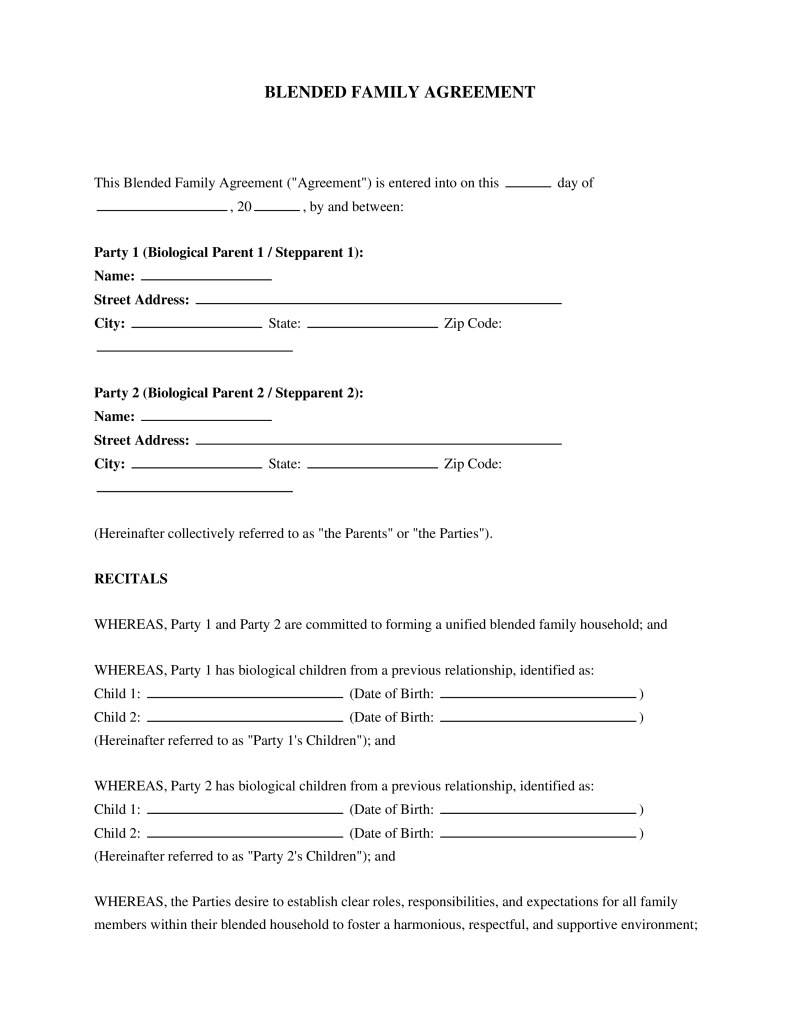
Blended Family Agreement
A Blended Family Agreement is a legal document that specifies the understandings and expectations between partners in a stepfamily concerning financial, property, and child-related matters.
Agreement Effective Date
Enter the date when this agreement will begin to apply.
Table of Contents
What is a Blended Family Agreement?
A Blended Family Agreement is a formal, written document designed to address and clarify expectations, responsibilities, and arrangements within a family composed of a couple and children from previous relationships, and potentially children from their current union. Its primary purpose is to foster harmony and prevent potential disputes by establishing clear guidelines regarding financial contributions, parenting roles, property management, and estate planning. This agreement is utilized by couples entering or currently in a blended family structure who seek to proactively define their shared future and manage the complexities inherent in merging two distinct family units.
Purpose and Scope of a Blended Family Agreement
The establishment of a blended family inherently introduces intricate dynamics concerning finances, child-rearing philosophies, and property distribution. A Blended Family Agreement serves as a foundational document to proactively navigate these complexities. It aims to minimize misunderstandings and emotional distress that can arise from differing expectations regarding roles, responsibilities, and resource allocation. By outlining these matters in advance, the agreement provides a framework for decision-making and conflict resolution, promoting stability and predictability for all family members.
The scope of such an agreement can be extensive, often encompassing a wide array of personal and financial considerations. It can detail how household expenses will be shared, how children's educational and healthcare costs will be managed, and the extent of stepparent involvement in day-to-day parenting decisions. Furthermore, it frequently addresses estate planning matters, ensuring that both biological children and stepchildren are provided for according to the parents' wishes, and clarifies property rights and inheritances, which can be particularly sensitive in blended family structures.
How to Create a Blended Family Agreement
The process of creating a Blended Family Agreement requires open communication, careful consideration, and legal guidance to ensure it is comprehensive and enforceable.
- Initiate Open Discussions - Begin by engaging in candid conversations with your partner about your individual expectations, concerns, and goals for the blended family. Discuss finances, parenting styles, discipline, education, healthcare, and future aspirations. It is crucial to identify areas of agreement and potential disagreement early in the process to address them constructively.
- Identify Key Areas for Agreement - Systematically list all the specific aspects of family life you wish to cover in the agreement. This might include living arrangements, financial contributions to household expenses, college savings, inheritance for all children, roles of stepparents, and decision-making authority regarding children's upbringing. Prioritize the most critical areas to ensure they are thoroughly addressed.
- Gather Relevant Financial and Legal Documents - Collect all necessary financial statements, such as income records, bank account details, investment portfolios, and existing wills or trust documents. Also, compile any relevant legal documents, including divorce decrees, child custody orders, or prenuptial agreements. This information will provide a clear picture of each party's assets, liabilities, and existing obligations.
- Draft the Agreement with Legal Counsel - Engage an attorney specializing in family law or estate planning to draft the agreement. Legal counsel can ensure the document is legally sound, covers all necessary provisions, and complies with applicable state laws. The attorney will help translate your discussions and intentions into precise legal language, avoiding ambiguities that could lead to future disputes.
- Review and Negotiate Terms - Both parties should independently review the drafted agreement with their own legal counsel. This step ensures that each individual understands the terms and implications of the document and has an opportunity to negotiate any clauses they find unfavorable or unclear. Negotiation is a crucial part of reaching a mutually acceptable and fair agreement.
- Execute the Agreement - Once all terms are agreed upon, the Blended Family Agreement must be formally signed by both parties in the presence of witnesses and/or a notary public, as required by state law. Proper execution is essential for the document's legal validity and enforceability. Ensure all parties receive a signed copy for their records.
- Periodic Review and Amendment - A Blended Family Agreement is not static. Life circumstances change, children grow, and financial situations evolve. It is advisable to review the agreement periodically, perhaps every few years or upon significant life events like a new child, a change in employment, or a major inheritance. Amendments can be made through a formal written addendum, also executed with legal counsel.
Key Considerations in Drafting an Agreement
When drafting a Blended Family Agreement, several critical areas require careful attention to ensure the document effectively addresses the unique needs and potential challenges of the family structure. These considerations help to lay a robust foundation for family harmony and financial security.
- Financial Contributions and Expenses - Clearly define how household expenses, mortgage or rent payments, utilities, and other joint financial responsibilities will be shared. This includes outlining contributions to children's expenses such as education, healthcare, extracurricular activities, and college savings for all children in the household.
- Parenting Roles and Responsibilities - Establish the respective roles of biological parents and stepparents in children's upbringing, discipline, and daily care. Clarify decision-making authority regarding education, medical treatment, and religious upbringing, ensuring these provisions align with existing custody orders.
- Property Ownership and Management - Delineate ownership of pre-existing assets and property brought into the marriage by each partner, as well as how jointly acquired property will be owned and managed. This section may address real estate, vehicles, investments, and personal belongings.
- Estate Planning and Inheritance - Detail how assets will be distributed upon the death of either partner, considering the needs of biological children, stepchildren, and the surviving spouse. This often involves coordinating the Blended Family Agreement with wills, trusts, and beneficiary designations for life insurance policies and retirement accounts.
- Dispute Resolution Mechanisms - Include provisions for resolving future disagreements that may arise concerning the agreement's terms. This can specify mediation or arbitration as preferred methods for dispute resolution, offering a structured approach to conflict rather than litigation.
- Future Amendments and Review - Outline the process for reviewing and amending the agreement as family circumstances evolve. This ensures the document remains relevant and adaptable to changes in financial situations, family composition, or children's needs over time.
Legal Requirements and Validity
For a Blended Family Agreement to be legally enforceable, it must generally adhere to fundamental principles of contract law and, in some jurisdictions, specific family law statutes. The validity of such an agreement typically depends on several core requirements:
- Written Form - The agreement must be in writing to be enforceable, as oral agreements are often difficult to prove and enforce in court.
- Mutual Assent - Both parties must voluntarily and knowingly agree to the terms of the agreement, demonstrating a "meeting of the minds."
- Consideration - There must be an exchange of promises or something of value between the parties. In a marital or cohabitation context, mutual promises regarding financial support, property rights, or family responsibilities typically suffice.
- Legal Capacity - Both parties must be of sound mind and legal age (typically 18) to enter into a contract.
- Absence of Duress or Undue Influence - The agreement must be entered into freely, without coercion, threats, or improper persuasion from one party over the other.
- Full Disclosure - In many jurisdictions, particularly when financial matters are involved, parties must provide full and frank disclosure of all assets, liabilities, and income. Failure to do so can render the agreement unenforceable.
- Not Against Public Policy - The terms of the agreement cannot violate existing laws or public policy, such as attempting to waive child support obligations that are legally mandated.
- Independent Legal Counsel - While not always strictly required by law, it is highly recommended and often a factor in enforceability that each party has the opportunity to consult with and be represented by their own independent legal counsel before signing the agreement.
Applicable Federal and State Laws
While no single federal statute directly governs Blended Family Agreements, their enforceability and specific provisions are influenced by broader legal frameworks at both federal and state levels. The primary legal underpinnings derive from state contract, family, and estate planning laws.
Federal Laws
Several federal laws may indirectly impact aspects covered within a Blended Family Agreement:
- Employee Retirement Income Security Act (ERISA) - This act governs most private-sector employee benefit plans, including retirement plans like 401(k)s and pension plans (29 U.S.C. § 1001 et seq.). If a Blended Family Agreement seeks to allocate retirement assets or designate beneficiaries, it must comply with ERISA's requirements, particularly for qualified domestic relations orders (QDROs) if a divorce is involved, or spousal consent rules for beneficiary changes.
- Internal Revenue Code (IRC) - Various provisions of the IRC relate to the tax implications of financial arrangements made within a Blended Family Agreement (26 U.S.C. § 1 et seq.). This includes tax treatment of property transfers, child support payments (which are generally not tax-deductible for the payer or taxable for the recipient), and dependency exemptions, all of which should be considered during drafting.
- Health Insurance Portability and Accountability Act (HIPAA) - While primarily focused on health information privacy, if a Blended Family Agreement addresses a stepparent's access to a child's medical records or health decisions, it must acknowledge the privacy protections under HIPAA (45 CFR Parts 160, 164). Generally, only biological parents or legal guardians have direct access, and specific authorizations may be needed for others.
State Laws and Requirements
State laws are the primary legal authority for Blended Family Agreements, drawing upon principles of contract law, family law, and probate law:
- General Contract Law - Every state has statutes and common law principles governing the formation, interpretation, and enforceability of contracts. A Blended Family Agreement is fundamentally a contract, requiring elements like offer, acceptance, consideration, and legal capacity.
- Uniform Premarital Agreement Act (UPAA) / Uniform Marital Property Act (UMPA) - While Blended Family Agreements are distinct from prenuptial or postnuptial agreements, the legal principles established by the UPAA (adopted in various forms by many states, e.g., Cal. Fam. Code § 1600 et seq.) and UMPA (adopted in Wisconsin, Wis. Stat. Ann. § 766.001 et seq.) often inform the requirements for financial disclosure, independent counsel, and enforceability of agreements made in contemplation of or during marriage.
- Family Law Statutes - State family codes address issues such as child custody, visitation, and child support. A Blended Family Agreement cannot override existing court orders for child support or custody but can clarify how parents intend to manage responsibilities within the framework of those orders.
- Probate Codes and Estate Planning Laws - State probate laws govern the distribution of assets upon death (e.g., N.Y. Est. Powers & Trusts Law § 4-1.1). Blended Family Agreements often integrate with or inform wills, trusts, and beneficiary designations to ensure that both biological children and stepchildren are provided for according to the parties' wishes, potentially establishing trusts for specific beneficiaries.
Penalties for Non-Compliance
Failure to comply with the legal requirements for a valid Blended Family Agreement, or a party's non-adherence to its terms, can lead to significant legal consequences. The primary "penalty" is often the unenforceability of the agreement in whole or in part. If a court finds the agreement invalid due to lack of disclosure, duress, or violation of public policy, it may refuse to uphold its provisions, leading to:
- Litigation and Legal Costs - Disagreements over financial contributions, parenting roles, or inheritance can escalate into costly and emotionally draining court battles, requiring parties to expend significant resources on legal fees.
- Court-Imposed Solutions - Without a valid agreement, a court may impose its own resolutions for property division, child support, or custody disputes, which may not align with the original intentions of the parties.
- Unintended Inheritance Outcomes - If estate planning provisions in the agreement are found invalid or not properly integrated with wills and trusts, assets may be distributed according to state intestacy laws, potentially disinheriting stepchildren or other intended beneficiaries.
- Ongoing Family Conflict - The absence of clear, enforceable guidelines can perpetuate conflict and uncertainty within the blended family, harming relationships and the overall family environment.
Rights and Obligations of Parties Involved
A Blended Family Agreement delineates the specific rights and obligations of the individuals who are part of the blended family structure. These documents aim to clarify roles and responsibilities, which can differ significantly from traditional nuclear family dynamics, ensuring all parties understand their commitments and entitlements.
For the **biological parents**, the agreement typically reaffirms their primary legal and moral obligations to their biological children, including financial support, decision-making authority regarding education and health, and ensuring their children's well-being. The agreement may also detail their obligations to their new partner, such as contributing to shared household expenses and respecting the agreed-upon parenting roles of the stepparent.
The **stepparent** gains specific rights and assumes obligations as defined in the agreement. These may include responsibilities for daily care, discipline, and participation in educational or medical decisions, often within limits set by the biological parent's legal rights. Financially, a stepparent might agree to contribute to household expenses, children's activities, or even college funds, depending on the terms. The agreement clarifies that these roles are often supplementary to, rather than overriding of, the biological parent's legal responsibilities.
While **children** are not typically direct signatories to these agreements, their welfare and interests are central to the document's provisions. The agreement aims to provide a stable environment, ensure financial security for all children, and clarify the expectations of parental figures. It indirectly grants children the right to consistent care and support as outlined by the adults, and it obligates parents and stepparents to uphold the agreed-upon standards for their upbringing.
The agreement also defines the **rights and obligations between the partners** themselves. This includes financial responsibilities, property ownership, and mutual support. It can detail how assets acquired during the relationship will be treated, how debts will be managed, and what happens to property upon separation or death. This clarifies the financial and relational framework for the couple, providing a roadmap for their shared future.
Frequently Asked Questions
Not the form you're looking for?
Try our legal document generator to create a custom document
Disclaimer: The templates available on this website are provided for general informational purposes only and do not constitute legal advice. They are not intended to be, and should not be interpreted as, compliant with any specific legal, regulatory, or privacy requirements. These templates are not a replacement for professional legal guidance and should not be relied upon for any particular matter or circumstance. Users are strongly encouraged to seek advice from a qualified attorney licensed in their jurisdiction before using, modifying, or relying on any template.
All templates are provided on an "as is," "with all faults," and "as available" basis. The provider disclaims any and all warranties of any kind, whether express, implied, statutory, or otherwise, including without limitation warranties of merchantability, fitness for a particular purpose, title, or non-infringement.
LegalTemplates.com makes no guarantees or representations regarding the accuracy, completeness, expected outcomes, or reliability of the materials contained in these templates or any materials referenced or linked from them.