Babysitter Authorization Form
A Babysitter Authorization Form is a legal instrument that grants temporary authority to a designated caregiver to make decisions regarding a minor child's well-being and medical care in the absence of their parents or legal guardians.
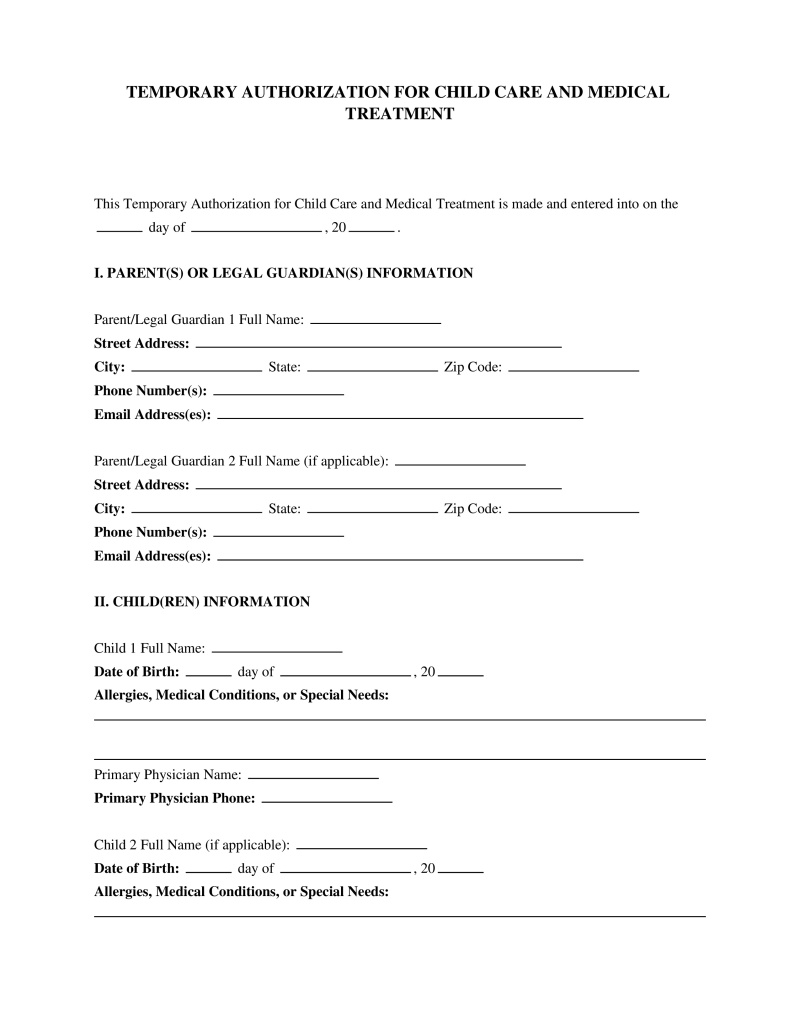
Authorization Duration Type
Choose whether the authorization is for a specific date range, a single occasion, or ongoing until revoked.
Enter the date when the babysitter's authorization begins.
Enter the date when the babysitter's authorization ends. Leave blank if ongoing.
Table of Contents
What is a Babysitter Authorization Form?
A Babysitter Authorization Form is a legal document that grants temporary authority to a designated caregiver, such as a babysitter, nanny, or other guardian, to make specific decisions on behalf of a minor child in the absence of the child's parents or legal guardians. This critical document typically outlines permissions for medical treatment, emergency contacts, specific instructions for the child's care, and any necessary restrictions. Its primary purpose is to ensure that caregivers can act swiftly and legally in unforeseen circumstances, particularly medical emergencies, thereby providing peace of mind for parents and clarity for the caregiver.
Legal Requirements and Validity
The legal validity of a Babysitter Authorization Form hinges on several key elements, ensuring that the delegated authority is clear, specific, and enforceable. While not universally mandated by a single federal statute, its effectiveness is derived from principles of parental consent and delegated authority recognized across jurisdictions. For a form to be considered robust and legally sound, it typically requires:
- Clear Identification of Parties - The full legal names and contact information for the parents or legal guardians, the minor child, and the authorized caregiver must be explicitly stated.
- Specific Scope of Authority - The document must clearly delineate the types of decisions the caregiver is authorized to make, particularly regarding medical treatment, travel, and educational matters. Broad, ambiguous language can undermine its enforceability.
- Duration of Authority - A precise start and end date for the authorization period must be included. This ensures the temporary nature of the delegation and prevents any misunderstanding about when the caregiver's authority begins and ceases.
- Parental Consent and Signature - The form must be signed and dated by at least one parent or legal guardian, affirming their informed consent to delegate authority. In some jurisdictions, notarization may add an additional layer of legal certainty, though it is not always a strict requirement.
- Emergency Contact Information - Comprehensive contact details for parents, emergency contacts, the child's physician, and preferred medical facilities are essential for immediate action in critical situations.
Without these components, the form may be challenged in situations requiring urgent action, potentially delaying necessary care or interventions. It serves as a testament to the parents' intent and a guide for medical professionals or other authorities who might need to verify the caregiver's standing.
How to Complete a Babysitter Authorization Form
Completing a Babysitter Authorization Form requires careful attention to detail to ensure all necessary information is present and accurately reflects the parents' wishes and the child's needs. This systematic approach helps create a comprehensive and legally sound document.
- Gather Essential Information - Begin by collecting all pertinent personal details for everyone involved. This includes the full legal names, dates of birth, and current contact information for the child, each parent or legal guardian, and the designated babysitter. Ensure all phone numbers, including cell and work numbers, are up-to-date and clearly legible.
- Specify Medical Authorization - This is often the most critical section. Clearly state whether the caregiver is authorized to consent to medical treatment, including routine care, emergency medical procedures, and the administration of medication. Detail any existing medical conditions, allergies, current medications (with dosage instructions), and the child's primary healthcare provider's name and contact information. Consider including insurance policy details for quick access.
- Outline Emergency Contacts and Procedures - Provide a tiered list of emergency contacts, starting with the parents' direct lines, followed by alternate family members or trusted friends who can be reached if the parents are unavailable. Detail instructions for various emergency scenarios, such as fire, natural disaster, or medical crisis, including where to go and who to call.
- Include Activity Restrictions and Special Instructions - Document any limitations or specific rules the child must follow, such as screen time limits, dietary restrictions, bedtimes, or forbidden activities. Also, include any unique preferences or routines for the child, like comfort items, specific disciplinary approaches, or favorite activities, to help the caregiver maintain consistency.
- Execute and Distribute - Once all sections are thoroughly completed, the form must be signed and dated by the parent(s) or legal guardian(s). While not always legally required, having the signatures notarized can add an extra layer of legal validity. Provide the original signed form to the babysitter and keep copies for the parents and potentially a trusted emergency contact.
Rights and Obligations of Parties Involved
The Babysitter Authorization Form establishes a framework of rights and obligations for all parties, ensuring clarity and accountability during the period of delegated care. Understanding these roles is crucial for effective and responsible childcare.
- Parents/Legal Guardians
- Right to Delegate Authority - Parents have the inherent right to delegate temporary care and decision-making authority for their minor children to a trusted individual.
- Obligation to Provide Accurate Information - Parents are obliged to furnish the caregiver with comprehensive and accurate information about the child's health, routines, and emergency contacts.
- Obligation to Provide Clear Instructions - They must provide explicit instructions regarding the scope of the caregiver's authority, particularly concerning medical consent and emergency protocols.
- Obligation to Compensate - Parents typically have a contractual or implied obligation to compensate the babysitter for their services as agreed upon.
- Babysitter/Authorized Caregiver
- Right to Act on Behalf of Parents - The caregiver gains the right to make decisions within the specified scope of authority, particularly in medical emergencies, as authorized by the parents.
- Obligation to Prioritize Child's Safety and Well-being - The primary obligation is to ensure the safety, health, and well-being of the child in their care, acting as a prudent and responsible caregiver.
- Obligation to Adhere to Instructions - Caregivers must follow all instructions and restrictions outlined in the authorization form and communicated by the parents.
- Obligation to Maintain Confidentiality - They are expected to maintain the confidentiality of the child's personal and medical information, especially if sensitive details are disclosed.
- Obligation to Report Incidents - Any significant incidents, accidents, or concerns regarding the child must be promptly reported to the parents.
- Medical Providers (Hospitals, Doctors, Paramedics)
- Right to Rely on Authorization - Medical providers have the right to rely on a properly executed Babysitter Authorization Form as valid consent for treatment, especially in emergencies, when parents are unreachable.
- Obligation to Provide Necessary Care - They are ethically and often legally obligated to provide necessary medical care to a child, regardless of immediate parental presence, particularly under the Emergency Medical Treatment and Labor Act (EMTALA).
- Obligation to Attempt Parental Contact - Despite the authorization, medical providers generally attempt to contact the parents or legal guardians for direct consent whenever feasible.
- Obligation to Act Within Scope - Treatment must be within the scope of what is medically necessary and, if possible, consistent with the authorization provided.
Applicable Federal and State Laws
While no single federal law specifically mandates or governs a Babysitter Authorization Form, several federal and state statutes influence its necessity, content, and application, particularly concerning medical consent and privacy.
Federal Laws
- Health Insurance Portability and Accountability Act (HIPAA) - While HIPAA primarily governs how healthcare providers and health plans protect patient information, it indirectly affects authorization forms. Parents typically have the right to access their minor child's medical records. An authorization form can clarify who else, beyond the parents, is permitted to receive information or make decisions for the child, though HIPAA authorization requirements (45 CFR § 164.508) would still apply for broader disclosures.
- Emergency Medical Treatment and Labor Act (EMTALA) - This federal law requires hospitals that accept Medicare funds to provide emergency medical care to anyone who comes to the emergency department, regardless of their ability to pay or consent. This means that in a true medical emergency, a minor child will receive necessary treatment even without a Babysitter Authorization Form or immediate parental consent (42 U.S.C. § 1395dd). The authorization form, however, facilitates non-emergency or elective treatment decisions.
State Laws and Principles
State laws play a more direct role in the enforceability and specifics of a Babysitter Authorization Form, primarily through statutes related to parental rights, minor consent, and medical decision-making:
- Minor Consent Laws - Most states have laws defining when a minor can consent to their own medical treatment, typically varying by age (e.g., "mature minor" doctrines) or type of treatment (e.g., reproductive health, mental health). A Babysitter Authorization Form operates within these state-specific frameworks, clarifying parental intent to delegate authority when the minor cannot consent independently.
- Medical Proxy/Power of Attorney for Minors - Many states have specific statutes allowing parents to delegate medical decision-making authority for a minor child to another adult, often through a medical power of attorney or similar proxy document. While a Babysitter Authorization Form may not always be as formal as a statutory power of attorney, it serves a similar function for temporary, specific delegations.
- Negligence Standards - State common law and statutes establish standards for negligence. A babysitter, as a caregiver, owes a duty of care to the child. The authorization form helps define the scope of expected care and decision-making, which can be relevant in assessing whether a caregiver met their duty in an incident.
- Child Protection Laws - All states have laws regarding child abuse and neglect. Caregivers, including babysitters, are often considered mandatory reporters if they suspect abuse or neglect. The authorization form does not supersede these obligations.
Penalties for non-compliance with the terms of an authorization form primarily relate to civil liability. A caregiver acting outside the scope of authorization could be liable for damages if their actions cause harm. Similarly, a medical provider who knowingly disregards a valid authorization might face legal repercussions, though the immediate need for emergency care often takes precedence.
Frequently Asked Questions
Not the form you're looking for?
Try our legal document generator to create a custom document
Disclaimer: The templates available on this website are provided for general informational purposes only and do not constitute legal advice. They are not intended to be, and should not be interpreted as, compliant with any specific legal, regulatory, or privacy requirements. These templates are not a replacement for professional legal guidance and should not be relied upon for any particular matter or circumstance. Users are strongly encouraged to seek advice from a qualified attorney licensed in their jurisdiction before using, modifying, or relying on any template.
All templates are provided on an "as is," "with all faults," and "as available" basis. The provider disclaims any and all warranties of any kind, whether express, implied, statutory, or otherwise, including without limitation warranties of merchantability, fitness for a particular purpose, title, or non-infringement.
LegalTemplates.com makes no guarantees or representations regarding the accuracy, completeness, expected outcomes, or reliability of the materials contained in these templates or any materials referenced or linked from them.