Warrant
Create Warrant
Warrant
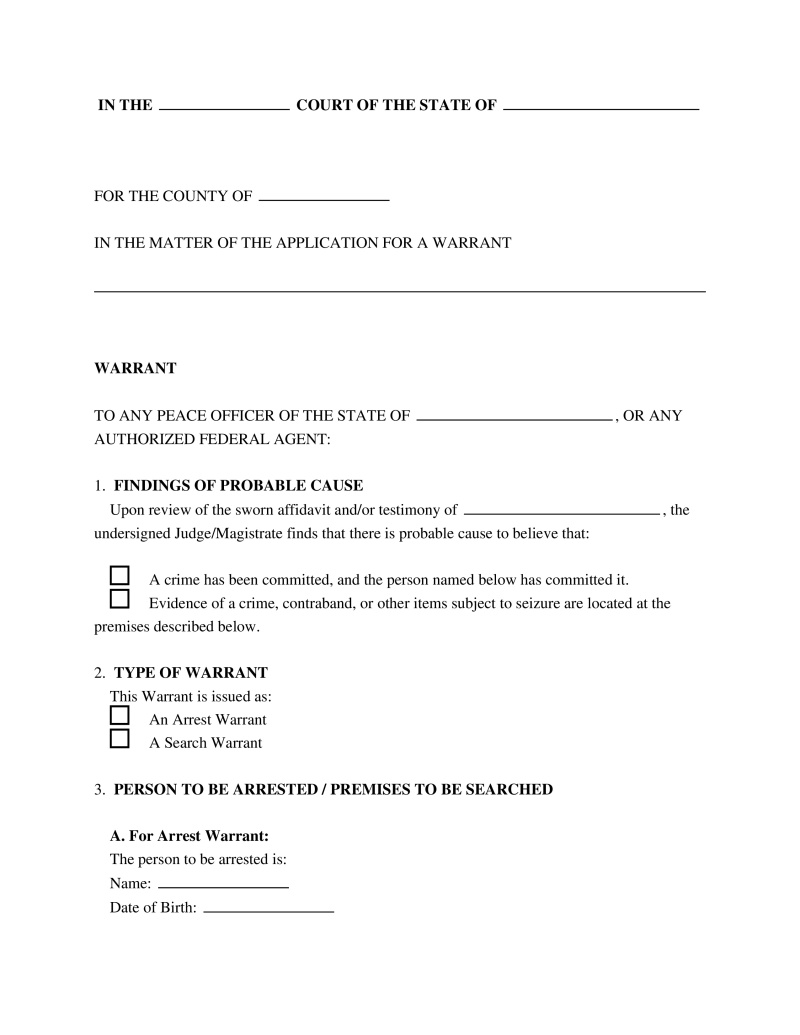
A Warrant is a legal document issued by a competent authority, typically a judge or magistrate, authorizing an officer to perform a specified act, such as an arrest, search, or seizure of property, based on probable cause.
Answer the question(s) below to create your Warrant
Action Type
Select the primary action the warrant will authorize.
Describe the specific action if 'Other' was selected.
Table of Contents
What is a Warrant?
A warrant is an official legal document issued by a court or magistrate that authorizes law enforcement to carry out a specific action, such as an arrest or a search. These documents serve as a judicial check on police power, ensuring that such actions are based on legal grounds rather than arbitrary discretion. Warrants are typically issued only after a finding of probable cause, meaning there is sufficient credible evidence to believe that a crime has been committed or that evidence of a crime exists in a specific location.
Types of Warrants
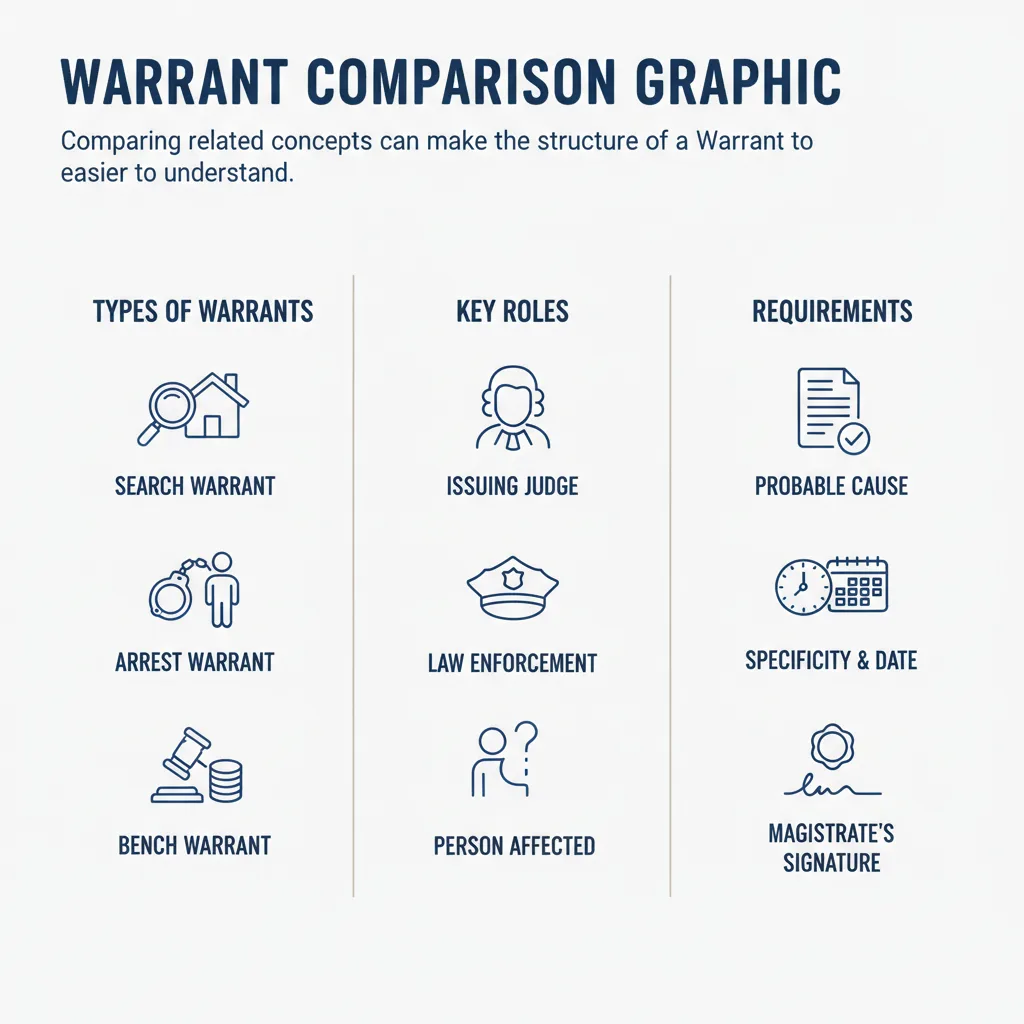
Warrants are categorized based on the specific action they authorize. The most common types include arrest warrants and search warrants, each serving a distinct purpose within the criminal justice system.
- Arrest Warrant - A court order directing law enforcement to take a person into custody. This warrant is issued when there is probable cause to believe that the individual has committed a crime. In Texas, an arrest warrant is defined as a written order from a magistrate, directed to a peace officer or other person, commanding them to take the body of the person accused of an offense, to be dealt with according to law (Code of Criminal Procedure Chapter 15). The United States Courts provide an official arrest warrant form (AO 442) for use in federal courts.
- Search Warrant - A court order authorizing law enforcement to search a specific location, vehicle, or person for designated items. This type of warrant is issued when there is probable cause to believe that evidence of a crime will be found at the specified location. In North Carolina, a search warrant is defined as a court order directing law enforcement to search designated premises, vehicles, or persons for the purpose of seizing designated items (Chapter 15A - Article 11). The United States Courts offer official forms for search and seizure warrants, such as AO 93, AO 93A, and AO 93B.
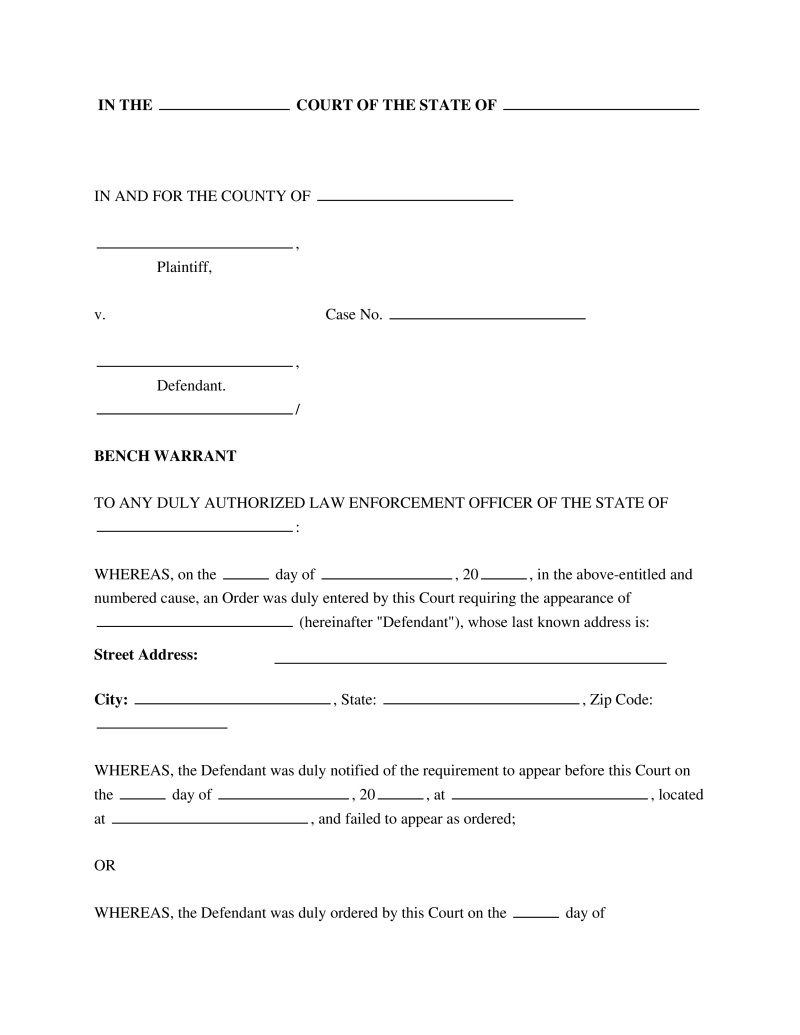
- Bench Warrant - Issued by a judge directly from the bench, typically for failure to appear in court, contempt of court, or failure to pay a fine.
- Capias Warrant - Similar to a bench warrant, a capias often commands the arrest of a person who has failed to comply with a court order, such as a subpoena or a condition of probation.
Issuance and Probable Cause
The issuance of a warrant is a critical step that ensures constitutional protections are upheld, primarily requiring a showing of probable cause. This legal standard means there must be a reasonable basis for believing that a crime has been committed or that evidence relevant to a crime exists in a particular place.
Judges or magistrates are responsible for reviewing applications for warrants. They must independently assess the information presented by law enforcement, often in the form of an affidavit, to determine if probable cause is met. This judicial oversight prevents arbitrary government intrusion and protects individuals' rights against unreasonable searches and seizures.
For instance, in Maryland, a circuit court judge or District Court judge may issue a search warrant when there is probable cause to believe that a misdemeanor or felony is being committed, or that property subject to seizure under the criminal laws of the state is present (Criminal Procedure §1–203).
Requisites of a Warrant
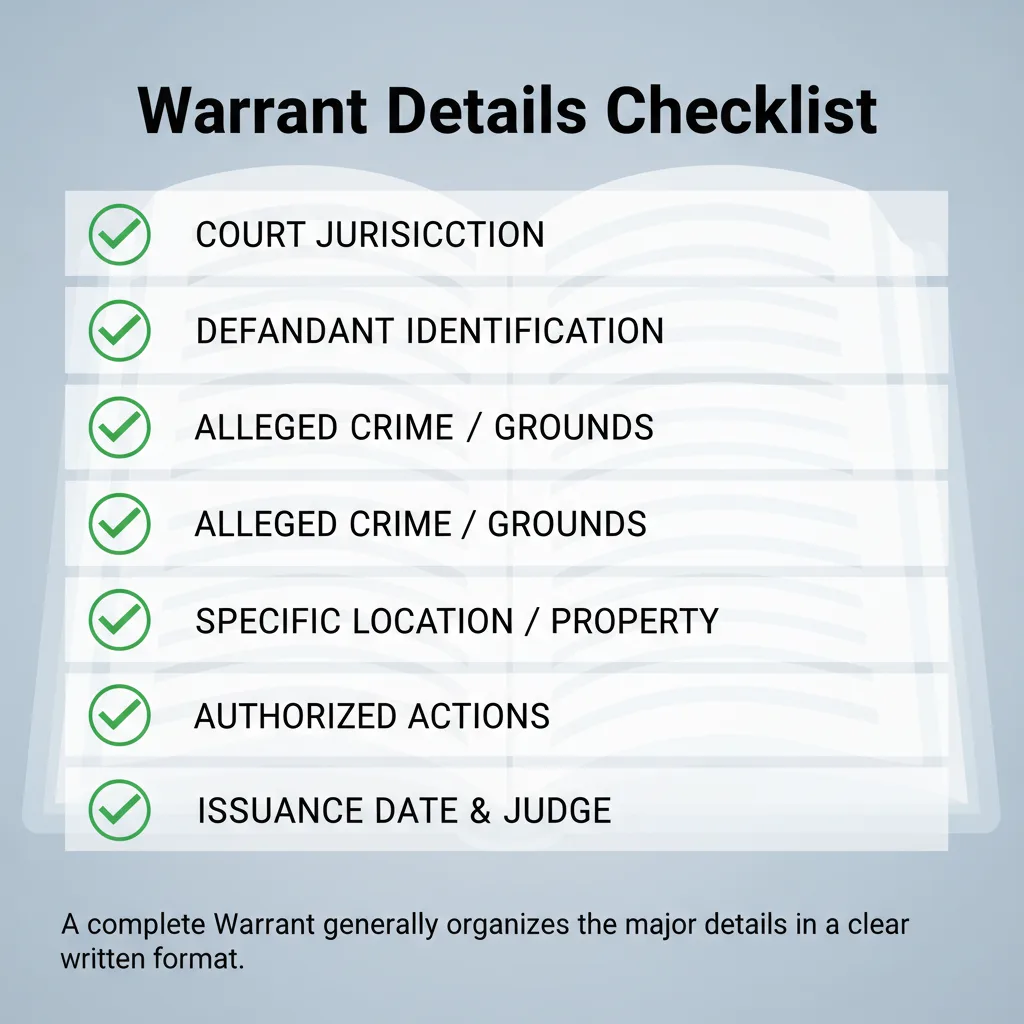
To be legally valid, a warrant must contain specific information that clearly defines its scope and authority. These requisites ensure that law enforcement acts within the bounds of judicial authorization and that individuals' rights are protected.
Common requisites for both arrest and search warrants include:
- Issuing Authority - Must be issued by a neutral and detached magistrate or judge.
- Probable Cause Finding - A clear statement or finding that probable cause exists for the authorized action.
- Specific Person/Place - For an arrest warrant, it must name or describe the person to be arrested with sufficient particularity. For a search warrant, it must describe the place to be searched with sufficient particularity to prevent searching unintended locations.
- Specific Items to be Seized - For a search warrant, it must particularly describe the items or property to be seized, preventing general or exploratory searches.
- Command to Law Enforcement - A clear directive to a peace officer or other authorized person to execute the warrant. In Texas, an arrest warrant must command the peace officer to take the body of the person accused (Code of Criminal Procedure Chapter 15).
- Signature of Judicial Officer - The warrant must be signed by the issuing judge or magistrate.
- Date of Issuance - The date the warrant was issued.
- Return Date/Time Limit - Many jurisdictions require search warrants to be executed and returned within a specific timeframe, such as ten days in North Carolina (Chapter 15A - Article 11).
Execution of Warrants
Once issued, a warrant authorizes law enforcement officers to carry out the specified action. The execution of a warrant must adhere to legal procedures and constitutional safeguards to remain valid.
For an arrest warrant, officers are authorized to take the named individual into custody. For a search warrant, officers may enter the designated location, conduct a search for the specified items, and seize any items listed in the warrant. During a search, officers generally must limit their search to areas where the items described in the warrant could reasonably be found. Any items seized must be documented, and often an inventory is provided to the property owner or occupant.
Federal and State Warrants
Warrants can be issued at both the federal and state levels, depending on the jurisdiction of the alleged crime. While the fundamental principles of probable cause and judicial oversight remain consistent, specific procedures and forms can vary.
- Federal Warrants - Issued by federal judges or magistrates for violations of federal law. The United States Courts provide standardized forms for federal warrants, such as the official arrest warrant form (AO 442) and various search and seizure warrant forms (AO 93, AO 93A, AO 93B).
- State Warrants - Issued by state judges or magistrates for violations of state law. Each state has its own statutes governing the issuance and execution of warrants. For example, North Carolina statutes define search warrants and outline procedures (Chapter 15A - Article 11), while Texas statutes detail the requisites for arrest warrants (Code of Criminal Procedure Chapter 15). Maryland law also specifies conditions for issuing search warrants (Criminal Procedure §1–203).
Frequently Asked Questions
The primary purpose of a warrant is to ensure that law enforcement actions, such as arrests or searches, are justified by probable cause and authorized by a neutral judicial officer. This protects individuals from arbitrary government intrusion.
Warrants are typically issued by a judge or magistrate after reviewing evidence presented by law enforcement. This judicial officer determines if there is sufficient probable cause to justify the warrant's issuance.
An arrest warrant authorizes law enforcement to take a specific person into custody, while a search warrant authorizes officers to search a particular location or person for specific evidence or contraband.
Probable cause is a legal standard requiring sufficient credible evidence to lead a reasonable person to believe that a crime has been committed or that evidence of a crime exists in a specific location. It is a prerequisite for most warrant issuances.
Yes, warrants can expire. Search warrants, for example, often have a specific time limit within which they must be executed and returned, such as ten days in some jurisdictions.
If a warrant is improperly issued or executed, any evidence obtained as a result may be deemed inadmissible in court under the exclusionary rule. This legal principle aims to deter illegal police conduct.
Sources
- Law Enforcement, Grand Jury, and Prosecution Forms - Provides official forms related to warrants, including search and seizure warrants.
- Arrest Warrant Form - Provides the official arrest warrant form (AO 442) used in federal courts.
- Chapter 15A - Article 11: Search Warrants - Defines search warrants and outlines procedures in North Carolina.
- CODE OF CRIMINAL PROCEDURE CHAPTER 15. ARREST UNDER WARRANT - Defines arrest warrants and their requisites in Texas.
- Article - Criminal Procedure §1–203: Search Warrants - Outlines the issuance and requisites of search warrants in Maryland.
Related Documents
Forms commonly used with Warrant.
Not the form you're looking for?
Try our legal document generator to create a custom document
Disclaimer: The templates available on this website are provided for general informational purposes only and do not constitute legal advice. They are not intended to be, and should not be interpreted as, compliant with any specific legal, regulatory, or privacy requirements. These templates are not a replacement for professional legal guidance and should not be relied upon for any particular matter or circumstance. Users are strongly encouraged to seek advice from a qualified attorney licensed in their jurisdiction before using, modifying, or relying on any template.
All templates are provided on an "as is," "with all faults," and "as available" basis. The provider disclaims any and all warranties of any kind, whether express, implied, statutory, or otherwise, including without limitation warranties of merchantability, fitness for a particular purpose, title, or non-infringement.
LegalTemplates.com makes no guarantees or representations regarding the accuracy, completeness, expected outcomes, or reliability of the materials contained in these templates or any materials referenced or linked from them.