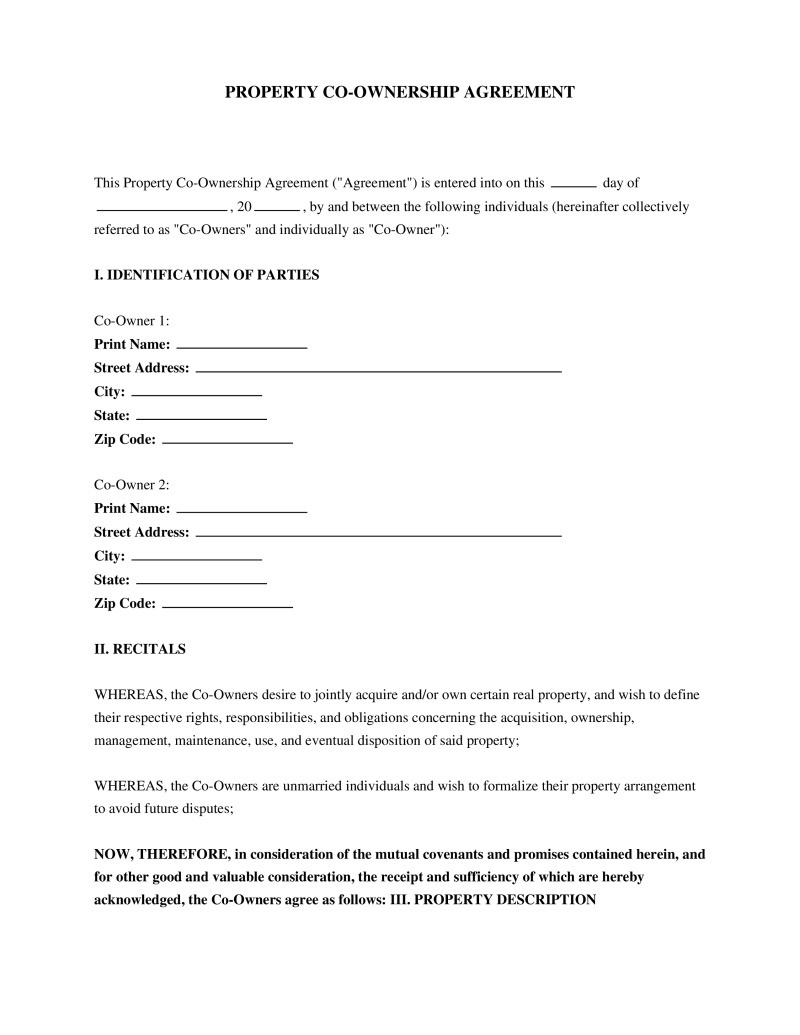
Unmarried Couple Property Agreement Template
An Unmarried Couple Property Agreement is a legal document delineating the respective rights and responsibilities of individuals in a non-marital relationship concerning shared property and financial obligations.
Agreement Status
Select whether this agreement covers property you already own or property you intend to purchase.
Table of Contents
What is a Unmarried Couple Property Agreement Template?
An Unmarried Couple Property Agreement Template is a legally binding document designed for individuals in a committed, non-marital relationship to define their respective rights and responsibilities regarding property, assets, and financial obligations. Its primary purpose is to establish clear terms for how property acquired before and during the relationship will be owned, managed, and divided should the couple separate or one partner pass away. This document is typically utilized by cohabiting partners, domestic partners, or individuals in long-term relationships who wish to avoid potential disputes over shared and individual assets without entering into a formal marriage.
Legal Framework and Validity
The legal enforceability of an unmarried couple property agreement largely relies on general principles of contract law, as it operates outside the scope of marital property laws. For such an agreement to be considered valid and enforceable, it typically must satisfy several fundamental contractual requirements:
- Offer and Acceptance - Both parties must clearly express their willingness to enter into the agreement and accept its terms.
- Consideration - There must be an exchange of value or promises between the parties, such as mutual promises to contribute to household expenses or to define property ownership.
- Legal Capacity - Both individuals must be of legal age and possess the mental capacity to understand and agree to the terms of the contract.
- Legal Purpose - The agreement's objectives must be lawful and not violate public policy.
- In Writing and Signed - To be enforceable, especially when dealing with real estate, the agreement must be in writing and signed by both parties. Many states also require notarization or witness signatures for agreements affecting real property.
While an attorney's involvement is not always a strict legal requirement for execution, it is highly recommended. Independent legal counsel for each partner helps ensure that both parties fully understand their rights and obligations and that the agreement is drafted equitably and in compliance with state-specific contract and property laws. The absence of legal advice can sometimes lead to challenges regarding enforceability, particularly if one party later claims they did not understand the terms or felt coerced.
Rights and Obligations of Parties
An unmarried couple property agreement clearly delineates the rights and obligations of each partner, which helps prevent misunderstandings and disputes. The specific provisions can vary widely depending on the couple's needs and assets, but commonly address the following areas:
- Real Property Ownership - The agreement can specify how shared residences or other real estate will be owned (e.g., as joint tenants with rights of survivorship, tenants in common, or as separate property of one partner). It can also detail contributions to mortgage payments, property taxes, insurance, and maintenance.
- Personal Property Division - This includes provisions for tangible assets such as vehicles, furniture, artwork, and electronics, clarifying whether they are jointly owned or belong to one individual.
- Financial Contributions - The document typically outlines each partner's responsibilities for household expenses, including rent or mortgage payments, utilities, groceries, and other shared living costs. It may also define how joint bank accounts are managed.
- Debt Responsibility - The agreement can specify how joint debts (e.g., credit cards, loans) will be managed and which partner is responsible for individual debts incurred during the relationship.
- Asset Division Upon Separation - A crucial component is the establishment of clear procedures and terms for dividing jointly owned assets and settling financial accounts if the relationship ends. This can include provisions for selling shared property and distributing the proceeds.
- Support Provisions - While generally not enforceable in the same way as alimony in a marriage, some agreements may include provisions for financial support for one partner after separation, though their enforceability can vary significantly by state law and judicial interpretation.
- Dispute Resolution - Many agreements include clauses for mediation or arbitration to resolve disagreements regarding the interpretation or enforcement of the agreement, aiming to avoid costly and lengthy litigation.
By clearly articulating these rights and obligations, the agreement serves as a roadmap for the couple's financial and property relationship, providing a framework for managing their affairs both during their cohabitation and in the event of a separation.
How to Complete an Unmarried Couple Property Agreement Template
Completing an unmarried couple property agreement template involves several crucial steps to ensure it accurately reflects the parties' intentions and is legally sound:
- Initial Discussion and Agreement on Principles - Before drafting, both partners should engage in open and honest discussions about their expectations for financial contributions, property ownership, and how assets would be divided upon separation. This foundational step helps align their understanding and identify potential areas of disagreement that need resolution.
- Gathering Comprehensive Financial Information - Compile a detailed list of all individual and jointly owned assets, including real estate, bank accounts, investments, vehicles, and significant personal property. Similarly, list all debts, whether individual or joint, to establish a clear financial picture. This information forms the basis for defining ownership and responsibility within the agreement.
- Drafting Property Ownership Provisions - Clearly specify how both real and personal property will be owned. For real estate, decide on tenancy in common, joint tenancy, or if it will remain separate property. For personal assets, determine if they are individually owned or shared, documenting contributions made by each party towards their acquisition.
- Outlining Financial Contributions and Responsibilities - Detail each partner's contribution to shared expenses such as rent or mortgage payments, utilities, groceries, insurance premiums, and other household costs. The agreement should clearly state how these expenses will be divided, whether equally, proportionally to income, or by other agreed-upon methods.
- Including Dispute Resolution and Separation Clauses - Incorporate provisions that outline how disagreements regarding the agreement will be resolved, such as through mediation or arbitration, before resorting to litigation. Also, include specific terms for how assets and debts will be divided and how shared property will be handled (e.g., sale, buy-out) if the couple separates.
- Seeking Independent Legal Counsel - It is strongly advised that each partner consults with their own independent attorney to review the draft agreement. Attorneys can provide objective advice, ensure the agreement is fair and enforceable under state law, and clarify any complex legal terminology or implications.
- Execution and Safekeeping of the Document - Once both parties and their respective legal counsel are satisfied with the terms, the agreement should be formally executed. This typically involves signing the document in the presence of a notary public, and sometimes witnesses, depending on state requirements, especially for agreements involving real estate. Each party should retain an original signed copy for their records.
Key Considerations Before Drafting
Before an unmarried couple proceeds with drafting a property agreement, several critical factors should be thoroughly considered to ensure the document is comprehensive, fair, and effective:
- Clarity on Individual vs. Shared Assets - A clear understanding and documentation of which assets were brought into the relationship by each partner individually and which will be considered jointly acquired or owned during the cohabitation period is essential.
- Understanding of State Contract Law - Knowledge of the specific contract laws in the state where the couple resides is crucial, as enforceability and specific requirements for validity can vary significantly.
- Fairness and Equity of Terms - While the agreement is a contract, it should aim for fairness and equity in its provisions to avoid potential challenges based on unconscionability or duress, which could undermine its enforceability.
- Potential for Future Changes - The couple should consider how future life events, such as having children, significant career changes, or major financial windfalls, might impact the agreement and whether provisions for amendment or review should be included.
- Impact on Estate Planning - The property agreement can significantly impact how assets are distributed upon the death of one partner. It should be consistent with existing or future wills and estate plans, and couples should consult with an estate planning attorney.
- Need for Independent Legal Advice - Both parties should be strongly encouraged to seek independent legal counsel. An attorney can ensure each partner fully understands the legal implications of the agreement, that their interests are protected, and that the document is legally sound.
- Tax Implications - Transfers of property or financial support outlined in the agreement may have tax consequences, which should be explored with a tax professional or attorney.
Distinguishing from Other Agreements
Unmarried Couple Property Agreement vs. Prenuptial Agreement
While both an unmarried couple property agreement and a prenuptial agreement serve to define property rights and financial responsibilities, they are distinct legal instruments designed for different relationship statuses and governed by different legal frameworks.
An unmarried couple property agreement, sometimes referred to as a cohabitation agreement or domestic partnership agreement, is created by individuals who are not married and do not intend to marry in the immediate future. This agreement is primarily governed by state contract law principles. It addresses the financial and property arrangements of the couple during their cohabitation and, critically, outlines the division of assets and debts if the relationship ends. The agreement's enforceability relies on meeting the standard requirements for a valid contract, such as offer, acceptance, and consideration.
Conversely, a prenuptial agreement, or premarital agreement, is entered into by prospective spouses in contemplation of marriage. Its effectiveness is contingent upon the marriage actually taking place. These agreements are largely governed by state family law statutes, often incorporating principles from the Uniform Premarital Agreement Act (UPAA), which has been adopted in various forms by many states. A prenuptial agreement typically defines how assets and debts will be treated upon divorce or the death of a spouse, often deviating from default marital property laws. Key differences include the marital status of the parties, the specific legal framework that governs the agreement's validity and enforceability, and the types of legal remedies available should the agreement be challenged.
Applicable Federal and State Laws
While no single federal statute directly governs unmarried couple property agreements, various federal and state laws indirectly influence their creation, content, and enforceability:
Federal Statutes
- Fair Housing Act - Although not directly regulating property agreements, this act prohibits discrimination in housing based on certain protected characteristics, which can indirectly affect cohabiting couples seeking housing or jointly owning property (42 U.S.C. § 3601 et seq.).
- Internal Revenue Code - This comprehensive body of law dictates the tax implications of property ownership, transfers between partners, and income earned from shared assets. It is relevant when considering how property divisions or support payments outlined in an agreement might affect individual tax liabilities (26 U.S.C. § 1 et seq.).
State Laws and Requirements
State laws are the primary legal framework governing these agreements, focusing on contract and property law principles:
- Contract Law Principles - All states require an unmarried couple property agreement to adhere to fundamental contract law requirements, including mutual assent (offer and acceptance), consideration, legal capacity of the parties, and a lawful purpose. Failure to meet these can render the agreement unenforceable (varies by state common law and statutes).
- Statute of Frauds - Most states have a Statute of Frauds, which mandates that certain types of contracts, including those involving the transfer or ownership of real estate or agreements that cannot be performed within one year, must be in writing and signed to be enforceable (e.g., Cal. Civ. Code § 1624; N.Y. Gen. Oblig. Law § 5-701).
- Property Law (Tenancy in Common, Joint Tenancy) - State property laws dictate the forms of co-ownership available for real and personal property, such as tenancy in common or joint tenancy with rights of survivorship. The agreement must clearly specify the chosen form of ownership to ensure proper legal classification and division (varies by state statute).
- Palimony and Non-Marital Cohabitation Law - Some states, through common law development or specific statutes, have recognized certain rights for unmarried cohabiting partners, sometimes referred to as "palimony" claims. These often arise in the absence of a written agreement and are typically based on implied contracts or theories of unjust enrichment (e.g., *Marvin v. Marvin*, 18 Cal. 3d 660 (1976), though the specific legal landscape for such claims varies widely across states).
- Uniform Probate Code - For states that have adopted parts of the UPC, it governs intestate succession and estate administration. A property agreement can influence how a deceased partner's assets are distributed, potentially overriding default intestate succession laws if properly integrated into an estate plan (e.g., Uniform Probate Code § 2-101 et seq.).
Penalties for Non-Compliance
The primary "penalty" for non-compliance with the legal requirements for an unmarried couple property agreement is that the agreement may be deemed unenforceable by a court. Specific consequences include:
- Unenforceability of Terms - If the agreement fails to meet contract law requirements, a court may refuse to uphold its provisions, leaving property division and financial responsibilities to default state laws or judicial discretion.
- Costly Litigation - Without a valid and enforceable agreement, disputes over property and finances upon separation can lead to expensive and time-consuming litigation, where outcomes are uncertain and potentially unfavorable to one or both parties.
- Breach of Contract Claims - If a valid agreement exists and one party fails to adhere to its terms, the other party may file a breach of contract lawsuit, seeking damages or specific performance, which can compel the breaching party to fulfill their obligations.
- Default Property Division Rules - In the absence of a clear agreement, courts may apply general property law principles, such as tenancy in common rules for jointly titled property, or may entertain claims based on equitable theories like unjust enrichment or implied partnership, which may not align with the parties' original intentions.
Frequently Asked Questions
Not the form you're looking for?
Try our legal document generator to create a custom document
Disclaimer: The templates available on this website are provided for general informational purposes only and do not constitute legal advice. They are not intended to be, and should not be interpreted as, compliant with any specific legal, regulatory, or privacy requirements. These templates are not a replacement for professional legal guidance and should not be relied upon for any particular matter or circumstance. Users are strongly encouraged to seek advice from a qualified attorney licensed in their jurisdiction before using, modifying, or relying on any template.
All templates are provided on an "as is," "with all faults," and "as available" basis. The provider disclaims any and all warranties of any kind, whether express, implied, statutory, or otherwise, including without limitation warranties of merchantability, fitness for a particular purpose, title, or non-infringement.
LegalTemplates.com makes no guarantees or representations regarding the accuracy, completeness, expected outcomes, or reliability of the materials contained in these templates or any materials referenced or linked from them.