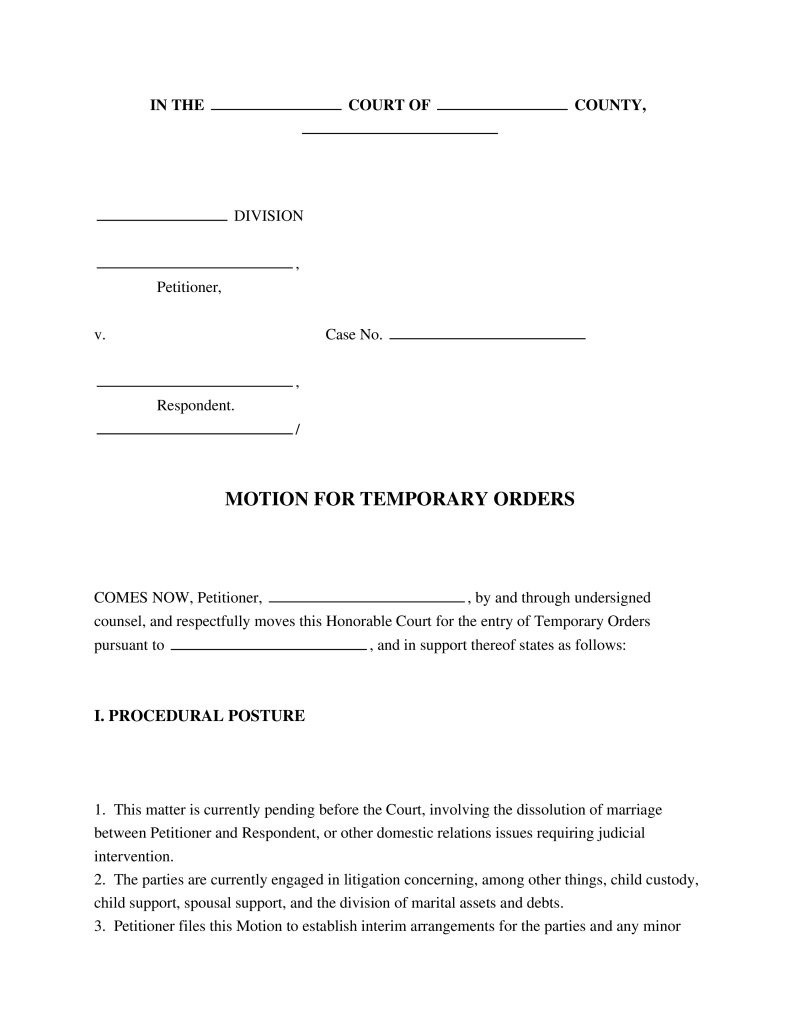
Motion for Temporary Orders
A Motion for Temporary Orders is a formal legal pleading filed with a court to request interim relief or specific directives that remain in effect during the pendency of a case, prior to a final judgment.
Temporary Orders Requested
Select all that apply. These are the main categories of relief commonly sought in a Motion for Temporary Orders.
Describe any additional temporary relief you are seeking.
Table of Contents
What is a Motion for Temporary Orders?
A Motion for Temporary Orders is a formal request submitted to a court, typically in civil litigation, asking for immediate relief or directives that will remain in effect for a limited period, usually until a final judgment or further court order. These motions are crucial for addressing urgent issues that cannot wait for the full litigation process to conclude. They are commonly used to preserve the status quo, prevent irreparable harm, or ensure the well-being of parties or property while a case is pending.
Purpose and Scope of Temporary Orders
The primary purpose of a motion for temporary orders is to obtain interim relief that addresses immediate concerns arising during litigation. These orders aim to prevent a party from taking actions that could undermine the court's ability to render an effective final judgment or to mitigate ongoing harm. Courts grant temporary orders when there is a demonstrated need for prompt intervention to protect rights or property.
The scope of temporary orders can be broad, encompassing various types of directives depending on the nature of the case. They are frequently encountered in family law cases, such as those involving child custody, support, or spousal maintenance, where immediate arrangements are often necessary. In other civil disputes, they might involve preventing the sale of property, halting a business practice, or requiring specific actions to be taken.
Required Elements of the Motion
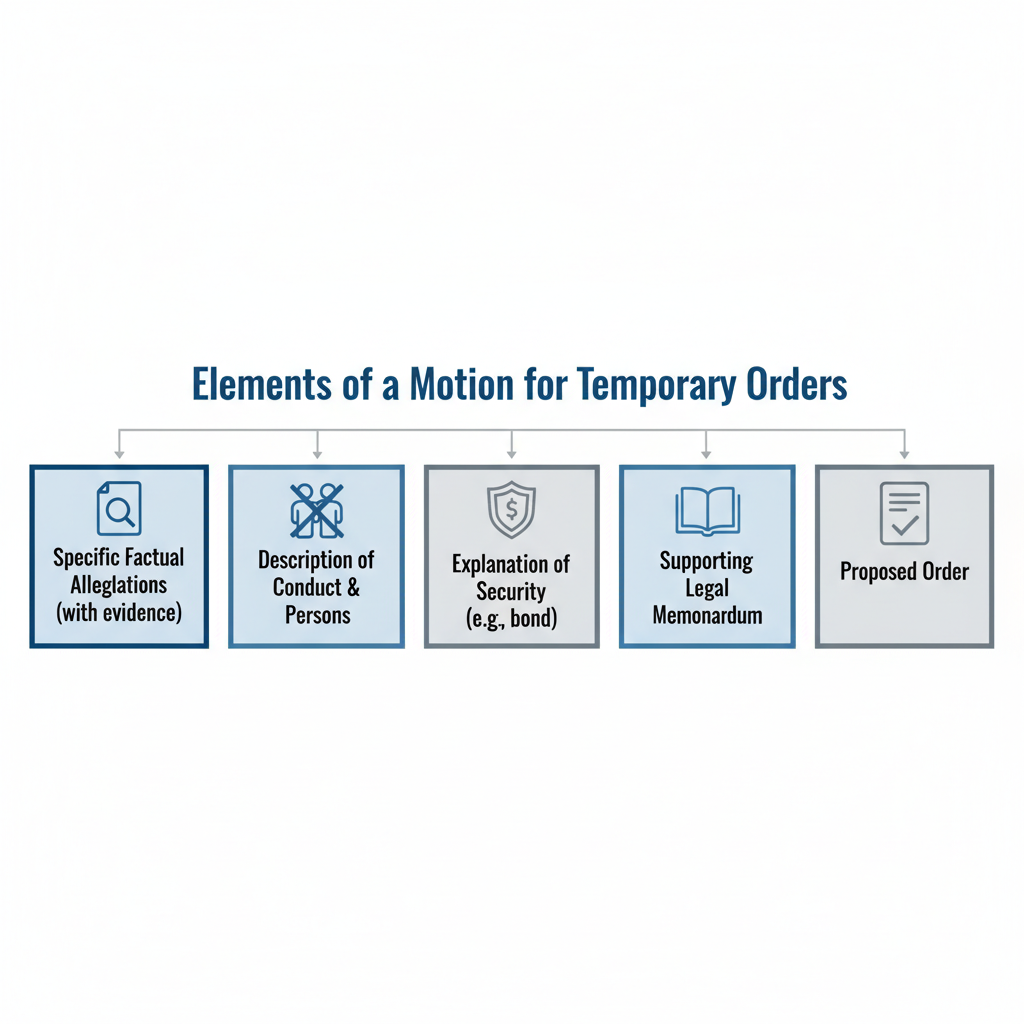
A motion for temporary orders, particularly one seeking a temporary restraining order or preliminary injunction, must adhere to specific procedural and evidentiary requirements to be considered by the court. These requirements ensure that the court has sufficient information to make a well-reasoned decision regarding urgent relief.
Key elements typically required in such a motion include:
- Specific Factual Allegations - The motion must present specific facts that demonstrate the moving party's entitlement to the requested relief. These facts must be supported by a verified complaint, affidavit, or other admissible evidence (M.D. Fla. L.R. 6.01; E.D. Mich. L.R. 65.1).
- Description of Conduct and Persons - The motion must clearly describe the specific conduct and the persons or entities that would be subject to the requested restraint or order (M.D. Fla. L.R. 6.01). This clarity is essential for the order to be enforceable.
- Explanation of Security - If the court requires security (such as a bond), the motion must explain the amount and form of the required security (M.D. Fla. L.R. 6.01). This provision protects the enjoined party if the order is later found to have been wrongly issued.
- Supporting Legal Memorandum - A memorandum of law must accompany the motion, outlining the legal basis and arguments for why the temporary order should be granted (M.D. Fla. L.R. 6.01).
- Proposed Order - The moving party must submit a proposed order that complies with the court's procedures for submitting proposed documents (M.D. Fla. L.R. 6.01; N.D. Okla. L.CvR 65). This proposed order should clearly state the terms of the requested temporary relief.
Temporary Restraining Orders vs. Preliminary Injunctions
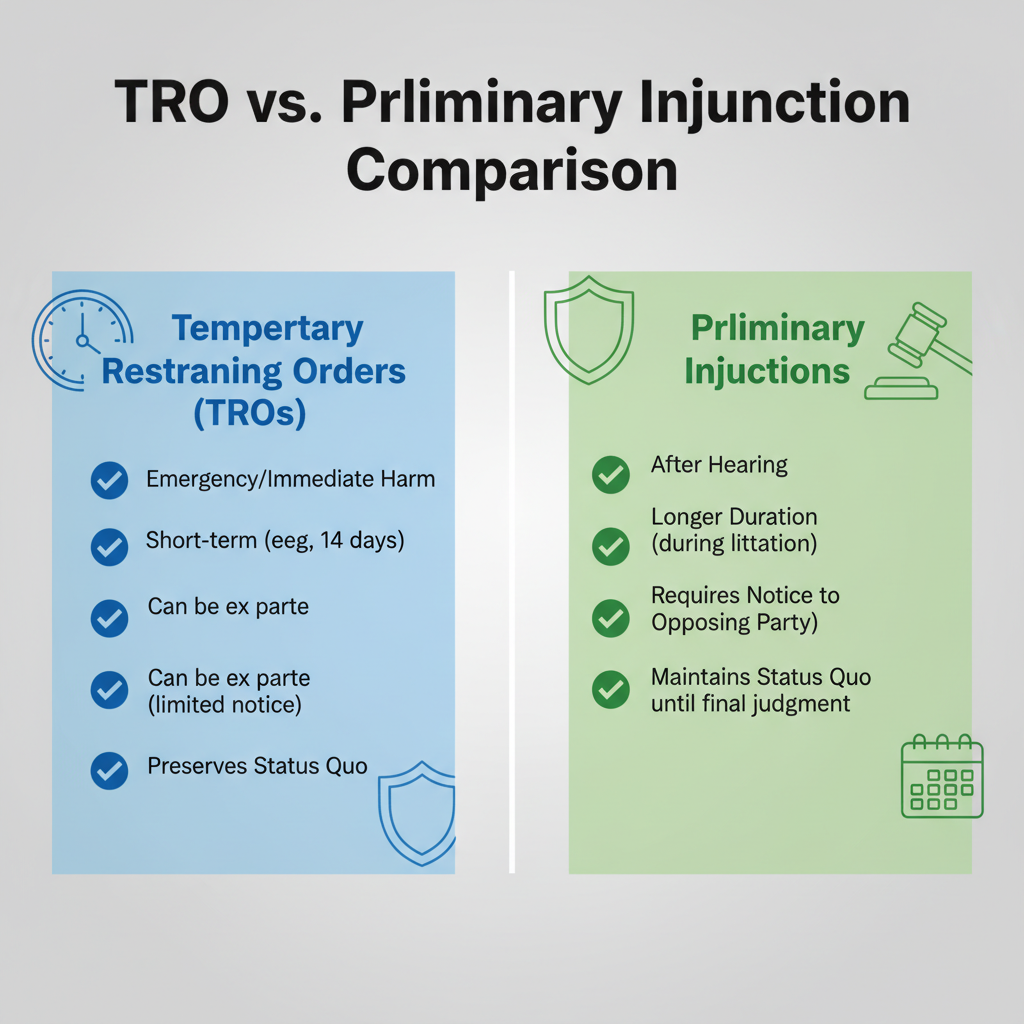
Motions for temporary orders often seek two distinct, though related, forms of relief: temporary restraining orders (TROs) and preliminary injunctions. While both aim to provide interim relief, they differ in their duration, procedural requirements, and the immediacy of the threat they address.
- Temporary Restraining Order (TRO) - A TRO is an emergency measure designed to prevent immediate and irreparable harm that would occur before the opposing party could be heard. TROs are typically short-term, often lasting no more than 14 days, though they can sometimes be extended. They may be issued without formal notice to the opposing party in extraordinary circumstances, provided the moving party can demonstrate good cause for lack of notice and the likelihood of immediate, irreparable injury (E.D. Mich. L.R. 65.1; N.D. Okla. L.CvR 65; E.D. Mich. Judge's Guide). Even in ex parte situations, courts generally require some attempt at notice or a showing of why notice is impossible or would be detrimental.
- Preliminary Injunction - A preliminary injunction is a more substantial form of interim relief, typically granted after a hearing where both parties have an opportunity to present arguments and evidence. It remains in effect throughout the pendency of the litigation, or until a specific event occurs, or until further order of the court. A preliminary injunction requires the moving party to demonstrate a likelihood of success on the merits, a threat of irreparable harm, that the balance of hardships favors the moving party, and that the injunction is in the public interest.
Procedural Considerations
The process for filing and adjudicating a motion for temporary orders involves specific procedural steps designed to ensure fairness and efficiency. Courts often establish expedited schedules for these motions due to their urgent nature.
Key procedural requirements include:
- Separate Motion Requirement - Requests for temporary restraining orders and preliminary injunctions must be made by a separate motion, distinct from the initial complaint (E.D. Mich. L.R. 65.1; N.D. Okla. L.CvR 65). This ensures the urgency and specific nature of the request are clearly identified.
- Briefing Schedules - Courts will typically set a time schedule for motion and briefing requirements (E.D. Mich. L.R. 65.1; E.D. Mich. Judge's Guide). These schedules are often shorter than those prescribed for other motions, reflecting the need for prompt resolution.
- Notification to Opposing Party - While TROs can sometimes be issued ex parte, courts generally require some form of notice to the opposing party and an opportunity for both sides to be heard (E.D. Mich. Judge's Guide). The moving party must demonstrate good cause if they fail to give notice.
- TRO Information Sheet - Some courts require the submission of a completed TRO Information Sheet (Form CV-14) along with the proposed order to facilitate the court's review (N.D. Okla. L.CvR 65).
Security Requirements
A crucial aspect of many temporary orders, particularly temporary restraining orders and preliminary injunctions, is the requirement for the moving party to post security. This security, often in the form of a bond, serves to protect the party against whom the order is issued.
The purpose of requiring security is to compensate the enjoined party for any costs and damages they may incur if the court later determines that the temporary order was wrongfully issued. The specific amount and form of the security are determined by the court, based on the potential harm that could result from the injunction. The motion itself must explain the amount and form of required security, aiding the court in its determination (M.D. Fla. L.R. 6.01).
Frequently Asked Questions
Sources
- Rule 6.01 - Temporary Restraining Order - Provides detailed requirements for filing a motion for a temporary restraining order, including necessary documentation and procedures.
- LR 65.1: Motions for Temporary Restraining Orders and for Preliminary Injunctions - Outlines procedures for filing motions for temporary restraining orders and preliminary injunctions, including motion requirements and briefing schedules.
- LCvR65 – Injunctions and Restraining Orders - Details the procedures for requesting temporary restraining orders and preliminary injunctions, including motion requirements and necessary documentation.
- Temporary Restraining Orders and Injunctions - Provides guidance on the court's procedures for motions for temporary restraining orders and preliminary injunctions, including notification requirements and scheduling.
Not the form you're looking for?
Try our legal document generator to create a custom document
Ask about a Motion for Temporary Orders
Example questions:
Disclaimer: The templates available on this website are provided for general informational purposes only and do not constitute legal advice. They are not intended to be, and should not be interpreted as, compliant with any specific legal, regulatory, or privacy requirements. These templates are not a replacement for professional legal guidance and should not be relied upon for any particular matter or circumstance. Users are strongly encouraged to seek advice from a qualified attorney licensed in their jurisdiction before using, modifying, or relying on any template.
All templates are provided on an "as is," "with all faults," and "as available" basis. The provider disclaims any and all warranties of any kind, whether express, implied, statutory, or otherwise, including without limitation warranties of merchantability, fitness for a particular purpose, title, or non-infringement.
LegalTemplates.com makes no guarantees or representations regarding the accuracy, completeness, expected outcomes, or reliability of the materials contained in these templates or any materials referenced or linked from them.