Stepparent Consent Letter
A Stepparent Consent Letter is a formal legal document by which a biological parent grants specific authority to a stepparent regarding a minor child's care, travel, or medical treatment.
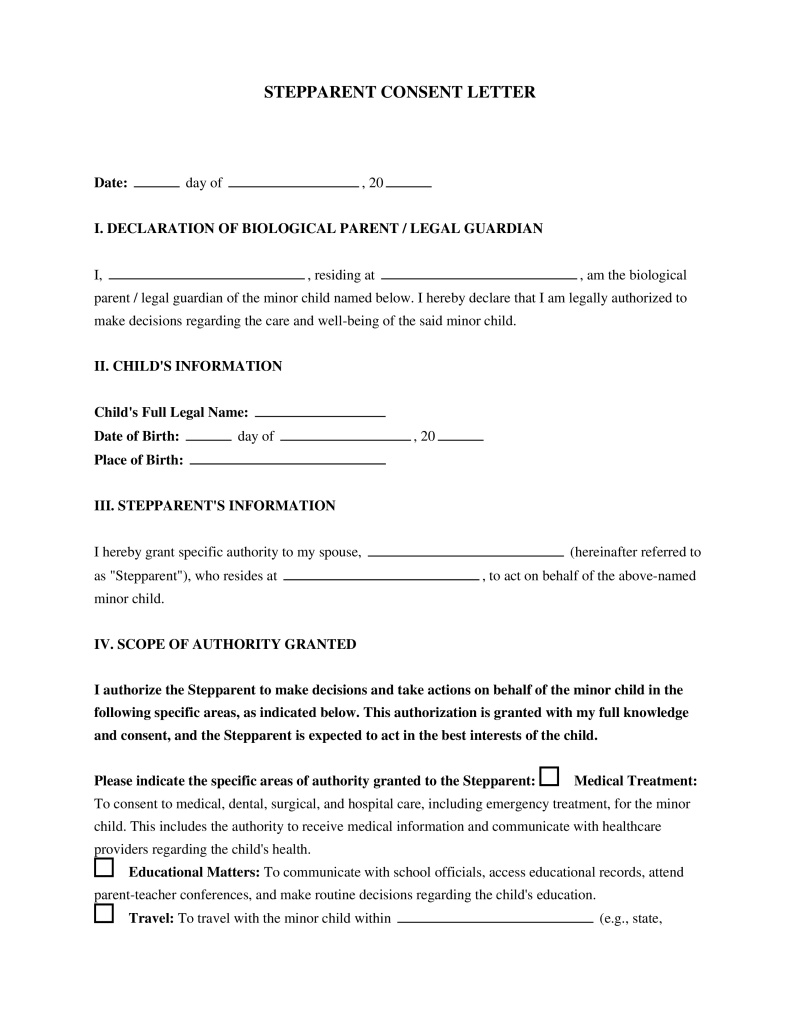
Consent Scope
Select all areas in which the stepparent should have authority. You may specify additional details in later steps.
Provide details about any other authority not listed above.
Table of Contents
What is a Stepparent Consent Letter?
A Stepparent Consent Letter is a formal legal document used to grant a stepparent temporary authority to make decisions or act on behalf of a minor child, particularly in situations where a biological or adoptive parent is unavailable. This letter is crucial for empowering a stepparent to handle various matters such as medical emergencies, school-related activities, or travel. It serves as a written delegation of parental authority, ensuring the child receives necessary care and support when the primary parent cannot be present. The document aims to prevent delays or complications that might arise from the stepparent lacking legal standing.
Legal Framework and Purpose
The legal framework surrounding a stepparent consent letter is rooted in the concept of delegated parental authority. While stepparents generally do not possess inherent legal rights over their stepchildren, this document allows a biological or adoptive parent to temporarily transfer specific decision-making powers. Its primary purpose is to provide legal clarity and authorization for a stepparent to act in the child's best interest during defined circumstances. Without such a letter, institutions like hospitals, schools, or airlines may refuse a stepparent's requests due to concerns about legal liability and the absence of formal parental consent.
The letter is particularly important in situations requiring immediate action, such as medical treatment, where delays could be detrimental to the child's health. It can also facilitate routine activities, enabling a stepparent to sign permission slips for school trips, discuss academic progress with teachers, or enroll the child in extracurricular activities. For travel, especially international travel, a consent letter from a non-traveling parent is often a prerequisite, and a stepparent consent letter can supplement this by clarifying the stepparent's authority to travel with the child.
Required Elements of a Valid Stepparent Consent Letter
For a stepparent consent letter to be legally effective and widely accepted, it must contain several key components:
- Full Legal Names and Relationships - The complete legal names of the biological/adoptive parent, the stepparent, and the minor child, along with their respective relationships.
- Child's Identifying Information - The child's date of birth and, if applicable, their passport number or other relevant identification.
- Scope of Authority Granted - A clear and specific description of the powers being delegated to the stepparent (e.g., medical treatment, school decisions, travel authorization).
- Duration of Authority - The specific dates or conditions for which the delegated authority is valid, including a clear start and end date or event.
- Limitations or Exclusions - Any specific actions the stepparent is NOT authorized to take, or conditions under which the authority is revoked.
- Contact Information - Current contact details for the biological/adoptive parent, including phone numbers and email addresses, for verification purposes.
- Parent's Signature and Date - The notarized signature of the biological or adoptive parent granting consent, along with the date of signing.
- Witness Signatures (Optional but Recommended) - Signatures of disinterested witnesses, enhancing the document's credibility.
- Notary Public Seal and Signature - Official acknowledgment by a notary public, verifying the identity of the signatory parent.
How to Complete a Stepparent Consent Letter
Drafting and executing a stepparent consent letter involves several important steps to ensure its validity and effectiveness.
- Gather Essential Information - Collect the full legal names, dates of birth, and contact information for the child, the biological/adoptive parent, and the stepparent. Include any relevant identification numbers such as passport numbers if the letter involves travel. Clearly define the specific areas where the stepparent needs authority, such as medical care, school matters, or travel.
- Draft the Letter with Specificity - Clearly state the purpose of the letter and the exact scope of authority being granted. Use precise language to avoid ambiguity, specifying what actions the stepparent is permitted to take. Include the start and end dates for the delegated authority. If there are any limitations, explicitly state them within the document.
- Include Emergency Contact Details - Provide comprehensive emergency contact information for the biological/adoptive parent, including multiple phone numbers and email addresses. This allows third parties to verify the consent quickly and directly if needed, especially in urgent situations.
- Review and Finalize the Content - Carefully read through the entire letter to check for accuracy, completeness, and clarity. Ensure all names are spelled correctly and dates are accurate. Any errors or omissions could potentially invalidate the document or cause confusion when presented to third parties.
- Sign Before a Notary Public - The biological or adoptive parent granting consent must sign the letter in the presence of a notary public. The notary will verify the identity of the signatory and affix their official seal and signature. Notarization adds a layer of legal authentication, making the document more credible and widely accepted by institutions.
- Provide Copies to Relevant Parties - Ensure the stepparent has an original or certified copy of the letter. It is also advisable to provide copies to the child's school, healthcare providers, and any other relevant institutions that may require it. Keep a copy for the biological/adoptive parent's records.
Rights, Scope, and Limitations
A stepparent consent letter grants specific rights to the stepparent, allowing them to act on behalf of the minor child within the defined scope of the document. These rights typically include making routine decisions regarding the child's welfare, consenting to medical treatment, or interacting with educational institutions. The scope of authority is entirely determined by the biological or adoptive parent who drafts and signs the letter; it can be broad or highly restricted to particular situations.
Despite the delegated authority, there are inherent limitations. A stepparent consent letter does not confer legal custody, adoption, or permanent parental rights. It is a temporary delegation of specific powers and does not alter the fundamental legal relationship between the child and their biological or adoptive parents. The biological/adoptive parent retains the ultimate authority and can revoke the consent at any time. Furthermore, the letter cannot override existing court orders regarding custody or parental rights, nor can it authorize actions that are illegal or contrary to the child's best interests as determined by law.
Applicable Federal and State Laws
Several federal and state laws influence the creation and acceptance of a stepparent consent letter, primarily concerning minor children's rights, healthcare, and parental authority.
Federal Statutes
- Health Insurance Portability and Accountability Act (HIPAA) - Governs the privacy and security of protected health information (PHI) (45 CFR § 164.508). A stepparent consent letter, when specifically authorizing medical decision-making, can serve as a form of authorization for healthcare providers to share information with or accept decisions from the stepparent.
- Uniform Child Custody Jurisdiction and Enforcement Act (UCCJEA) - While primarily addressing jurisdiction in child custody matters, its principles reinforce the need for clear legal authority when one parent delegates care (adopted by all states except Massachusetts).
- Passport Requirements for Minors - The U.S. Department of State requires consent from both parents for a minor's passport application, and for international travel with one parent or a non-parent, a consent letter from the absent parent(s) is often needed (22 U.S.C. § 211a et seq.).
State Laws and Requirements
State laws play a significant role in defining parental rights, the ability to delegate authority, and the requirements for legal documents. Specific state statutes often address:
- Minor Consent to Medical Treatment - Many states have laws specifying when a minor can consent to their own medical treatment and when parental consent is required (e.g., State Health Code § 41-41-1 et seq.). A stepparent consent letter clarifies who can provide this consent when a biological parent is absent.
- Parental Rights and Responsibilities - State family codes outline the rights and responsibilities of parents, including the ability to delegate certain aspects of care to a third party (e.g., State Family Code § 153.001 et seq.).
- Notary Public Act - Each state has statutes governing the duties and powers of notaries public, including the requirements for acknowledging signatures on legal documents like a consent letter (e.g., State Notary Public Act § 406.001 et seq.).
- Temporary Delegation of Parental Authority - Some states have specific statutes or common law principles allowing for the temporary delegation of parental authority, which directly supports the validity of a stepparent consent letter (e.g., State Probate Code § 2911).
Penalties for Non-Compliance
Operating without proper authorization or misrepresenting one's authority can lead to serious legal consequences. If a stepparent acts on behalf of a child without a valid consent letter or beyond its scope, they may face accusations of interference with parental rights, kidnapping, or other civil and criminal charges depending on the severity of the action. Healthcare providers or schools that act on invalid or fraudulent consent may also face legal liabilities, including HIPAA violations if protected health information is improperly disclosed. Forging a consent letter is a criminal offense, typically considered fraud or forgery, carrying penalties that include fines and imprisonment. These potential repercussions underscore the importance of ensuring a stepparent consent letter is accurately prepared, legally sound, and properly executed.
Frequently Asked Questions
Not the form you're looking for?
Try our legal document generator to create a custom document
Disclaimer: The templates available on this website are provided for general informational purposes only and do not constitute legal advice. They are not intended to be, and should not be interpreted as, compliant with any specific legal, regulatory, or privacy requirements. These templates are not a replacement for professional legal guidance and should not be relied upon for any particular matter or circumstance. Users are strongly encouraged to seek advice from a qualified attorney licensed in their jurisdiction before using, modifying, or relying on any template.
All templates are provided on an "as is," "with all faults," and "as available" basis. The provider disclaims any and all warranties of any kind, whether express, implied, statutory, or otherwise, including without limitation warranties of merchantability, fitness for a particular purpose, title, or non-infringement.
LegalTemplates.com makes no guarantees or representations regarding the accuracy, completeness, expected outcomes, or reliability of the materials contained in these templates or any materials referenced or linked from them.