Sibling Loan Agreement Template
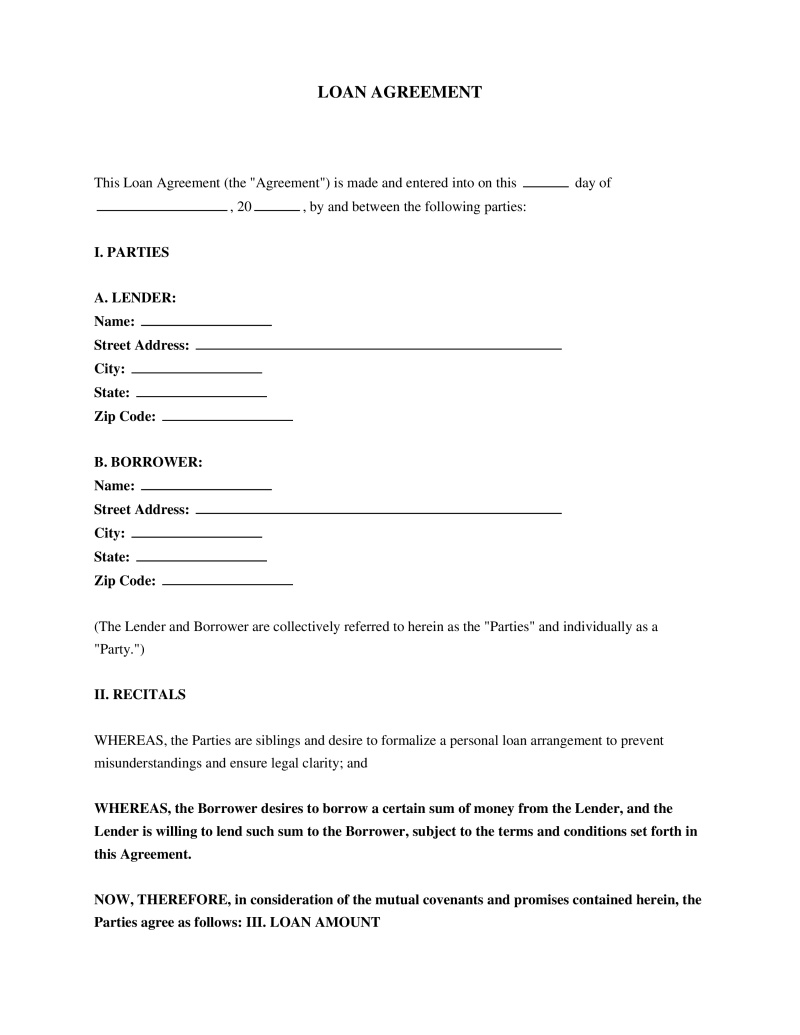
A Sibling Loan Agreement Template is a standardized legal document designed to facilitate the formalization of financial arrangements between siblings, outlining terms and conditions for a loan.
Loan Purpose
Select the main reason for the loan. This helps clarify intent and may affect tax or legal considerations.
Provide details if you selected 'Other'.
Table of Contents
What is a Sibling Loan Agreement Template?
A Sibling Loan Agreement Template is a formal, legally binding contract that outlines the terms and conditions of a financial loan between two siblings. Its primary purpose is to clearly define the responsibilities of both the lender (the sibling providing the money) and the borrower (the sibling receiving the money), thereby preventing misunderstandings and potential family disputes. This document ensures that the loan is treated as a legitimate financial transaction, with specified repayment schedules, interest rates, and consequences for default, rather than an informal family gift. It is used by siblings who wish to formalize a loan arrangement, ensuring legal enforceability and clarity for all parties involved.
Legal Requirements and Validity
For a sibling loan agreement to be legally valid and enforceable, it must meet several fundamental contractual requirements. These requirements ensure that the agreement represents a true meeting of the minds and a legitimate transaction, rather than an unenforceable promise. Failure to meet these criteria can render the agreement void or difficult to enforce in a court of law.
- Offer and Acceptance - One sibling must make a clear offer to lend or borrow money under specific terms, and the other sibling must unequivocally accept those terms.
- Consideration - There must be an exchange of value between the parties. In a loan agreement, the consideration is typically the principal loan amount provided by the lender and the promise of repayment (often with interest) by the borrower.
- Legal Capacity - Both siblings entering into the agreement must be of sound mind and legal age (typically 18 years old in most jurisdictions) to understand and agree to the terms of the contract.
- Lawful Purpose - The purpose of the loan and the terms of the agreement must not violate any laws or public policy. Loans for illegal activities would be unenforceable.
- Mutuality of Obligation - Both parties must be bound to perform certain duties under the agreement. The lender is obligated to disburse the funds, and the borrower is obligated to repay them according to the agreed schedule.
- Definite and Certain Terms - The essential terms of the loan, such as the principal amount, interest rate, repayment schedule, and any collateral, must be clearly and unambiguously stated. Vague or incomplete terms can lead to enforceability issues.
- Written Form - While some oral agreements can be legally binding, a written sibling loan agreement is highly advisable for enforceability, especially for significant sums or if the repayment period extends beyond one year, due to the Statute of Frauds in most states.
Rights and Obligations of Parties Involved
A well-drafted sibling loan agreement clearly delineates the rights and obligations of both the lending and borrowing parties, fostering transparency and reducing potential for conflict. Understanding these roles is crucial for both siblings to ensure compliance and protect their respective interests throughout the loan term.
- Lender's Rights - The sibling providing the loan holds specific rights designed to ensure the return of their funds and any agreed-upon interest. These rights typically include the right to receive timely payments according to the agreed-upon schedule, the right to charge and collect interest as specified in the agreement, and the right to pursue legal remedies in the event of default, which may include accelerating the loan or claiming collateral if pledged.
- Lender's Obligations - The lender also has responsibilities under the agreement. Their primary obligation is to disburse the full agreed-upon loan amount to the borrower as specified. They must also adhere to all terms of the agreement, such as not demanding repayment before it is due or altering interest rates without mutual consent, and provide accurate records of payments received and outstanding balances upon reasonable request.
- Borrower's Rights - The sibling receiving the loan has the right to receive the full agreed-upon principal amount from the lender. They also have the right to repay the loan according to the established terms and schedule, and in cases where collateral is involved, the right to clear title to that collateral once the loan has been fully repaid.
- Borrower's Obligations - The borrower's main obligation is to repay the principal loan amount along with any accrued interest by the due dates specified in the agreement. They are also obligated to adhere to all other terms, such as maintaining any pledged collateral in good condition and notifying the lender of significant changes that might affect their ability to repay the loan.
How to Complete a Sibling Loan Agreement Template
Completing a sibling loan agreement template requires careful attention to detail to ensure all necessary financial and legal aspects are covered. Each step contributes to creating a robust and enforceable document that protects both the lender and the borrower.
- Identify Parties and Loan Amount - Begin by accurately listing the full legal names and current addresses of both the lending sibling and the borrowing sibling. Clearly state the exact principal amount of the loan in both numerical and written form to avoid any ambiguity regarding the sum being transferred. This foundational information ensures that the correct individuals are bound by the agreement and the precise financial commitment is established.
- Define Repayment Terms - Specify the interest rate that will apply to the loan, ensuring it meets or exceeds the Applicable Federal Rate (AFR) if tax implications are a concern, and detail how interest will be calculated (e.g., simple interest, compounded annually). Outline the complete repayment schedule, indicating whether payments will be made in regular installments (monthly, quarterly), as a lump sum, or a combination, along with the precise due dates for each payment. This section is critical for setting clear expectations and preventing disputes over repayment timing and amounts.
- Outline Default and Remedies - Clearly define what constitutes an event of default (e.g., missing a payment, failing to pay interest, bankruptcy). Establish any grace periods allowed before a default is officially declared and detail the specific remedies available to the lender upon default, such as the right to demand immediate repayment of the entire outstanding balance (acceleration clause) or the right to take possession of any collateral pledged. This protects the lender's investment and provides a clear pathway for resolution if the borrower fails to meet their obligations.
- Include Governing Law and Dispute Resolution - Designate the specific state whose laws will govern the interpretation and enforcement of the agreement, as contract laws can vary significantly by jurisdiction. Consider including clauses for dispute resolution, such as requiring mediation or arbitration before resorting to litigation, which can help preserve family relationships by providing a less adversarial method for resolving disagreements. This ensures clarity on the legal framework and offers a structured approach to conflict resolution.
- Signatures and Witnessing - Ensure that both the lending sibling and the borrowing sibling sign and date the completed agreement. For added legal weight and to prevent claims of duress or forgery, it is highly recommended to have the document signed in the presence of one or more disinterested witnesses, and ideally, notarized by a public notary. Each party should receive a signed original copy of the agreement for their records, providing tangible proof of the mutual understanding and commitment.
Applicable Federal and State Laws
Sibling loan agreements, while often informal in their inception, are subject to various federal and state laws that govern contracts, lending, and taxation. Adhering to these legal frameworks is essential for ensuring the agreement's enforceability and avoiding unintended legal or financial consequences, particularly regarding tax implications.
Federal Laws
Several federal laws may indirectly influence or directly apply to sibling loan agreements, especially concerning tax implications or if the loan structure becomes more complex:
- Internal Revenue Code (IRC) Section 7872 - This section addresses below-market interest rate loans, requiring that if a loan between family members has an interest rate below the Applicable Federal Rate (AFR), the difference may be treated as a taxable gift from the lender to the borrower (26 U.S.C. § 7872). Charging at least the AFR helps avoid these gift tax implications.
- Truth in Lending Act (TILA) - While primarily applicable to commercial creditors regularly extending credit to consumers, TILA (15 U.S.C. § 1601 et seq.) generally does not apply to private, informal loans between family members unless the lender is regularly engaged in the business of lending money. However, if the loan is secured by a dwelling and involves more than four installments, certain disclosure requirements might be triggered, though this is rare for typical sibling loans.
- Federal Trade Commission (FTC) Act - This act broadly prohibits unfair and deceptive acts or practices in commerce (15 U.S.C. § 45). While typically applied to businesses, it serves as a general principle against fraudulent conduct in any financial transaction, including those between family members.
State Laws and Requirements
State-specific regulations play a significant role in the validity and enforcement of sibling loan agreements, particularly regarding contract formation, interest rates, and collection practices:
- Statute of Frauds - Most states have a Statute of Frauds that requires certain types of contracts, including agreements that cannot be performed within one year, to be in writing to be enforceable (e.g., Cal. Civ. Code § 1624). A sibling loan agreement with a repayment period longer than one year would fall under this requirement.
- Usury Laws - All states have usury laws that set a maximum legal interest rate that can be charged on loans (e.g., N.Y. Gen. Oblig. Law § 5-501). Charging an interest rate above this legal limit can render the interest portion of the loan, or even the entire loan, unenforceable, depending on the state's specific statutes.
- Contract Law Principles - General contract law principles, largely derived from common law but often codified in state statutes, govern the formation, interpretation, and enforcement of the sibling loan agreement. These principles cover elements such as offer, acceptance, consideration, legal capacity, and lawful purpose.
- Uniform Commercial Code (UCC) Article 9 - If the sibling loan is secured by personal property (e.g., a vehicle, valuable assets), UCC Article 9 (e.g., N.Y. U.C.C. Law § 9-101 et seq.) governs secured transactions. This article outlines the process for creating, perfecting (making public), and enforcing a security interest in collateral, which is crucial for the lender to protect their interest in the event of default.
- Statutes of Limitations - Each state has statutes of limitations that set a time limit within which legal action must be initiated to enforce a contract (e.g., 4 to 6 years for written contracts in many states). Failure to file a lawsuit within this period can permanently bar the lender from seeking repayment through the courts.
Frequently Asked Questions
Not the form you're looking for?
Try our legal document generator to create a custom document
Disclaimer: The templates available on this website are provided for general informational purposes only and do not constitute legal advice. They are not intended to be, and should not be interpreted as, compliant with any specific legal, regulatory, or privacy requirements. These templates are not a replacement for professional legal guidance and should not be relied upon for any particular matter or circumstance. Users are strongly encouraged to seek advice from a qualified attorney licensed in their jurisdiction before using, modifying, or relying on any template.
All templates are provided on an "as is," "with all faults," and "as available" basis. The provider disclaims any and all warranties of any kind, whether express, implied, statutory, or otherwise, including without limitation warranties of merchantability, fitness for a particular purpose, title, or non-infringement.
LegalTemplates.com makes no guarantees or representations regarding the accuracy, completeness, expected outcomes, or reliability of the materials contained in these templates or any materials referenced or linked from them.