Quiet Title Action
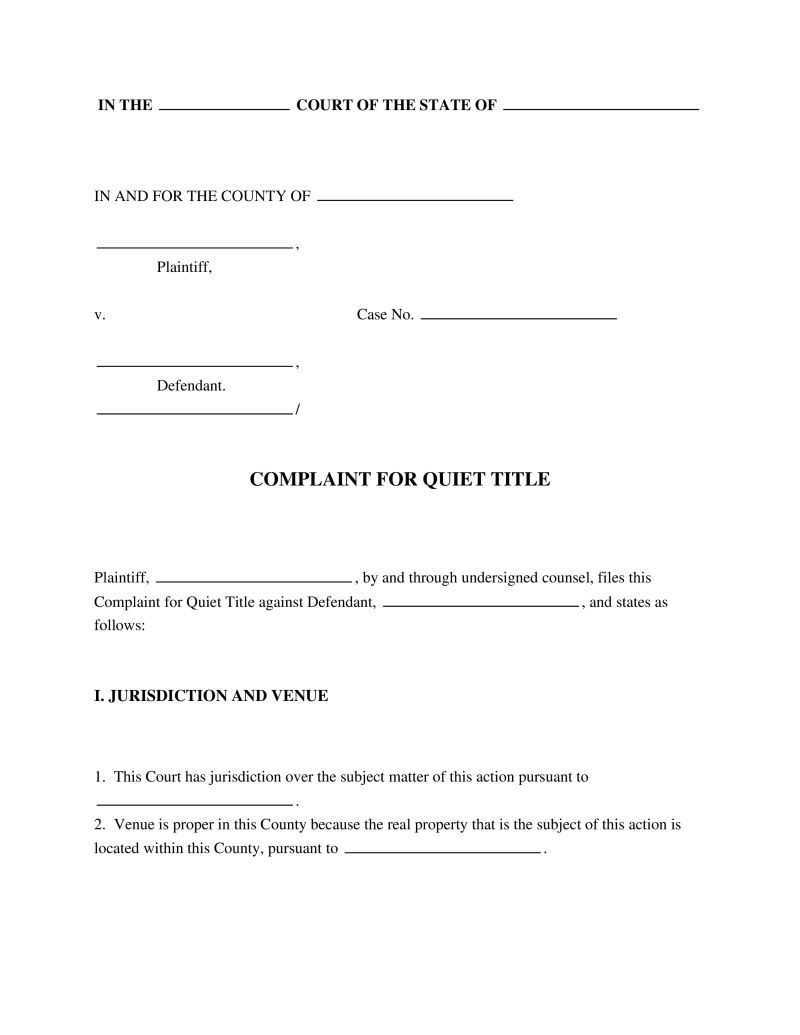
A Quiet Title Action is a legal proceeding initiated to establish clear ownership of real property and resolve any competing claims or encumbrances against the title.
Property Type
Select the property type most closely matching the real estate involved.
Provide a brief description of the property if you selected 'Other'.
Table of Contents
What is a Quiet Title Action?
A quiet title action is a specialized legal proceeding initiated to establish an individual's or entity's ownership of real property against any adverse claims. Its primary purpose is to "quiet" or remove any uncertainty, disputes, or "clouds" on the title, thereby confirming a clear and marketable ownership interest. This judicial process is essential for resolving ambiguities and ensuring that the property owner holds an indisputable legal title.
Common Grounds for Action
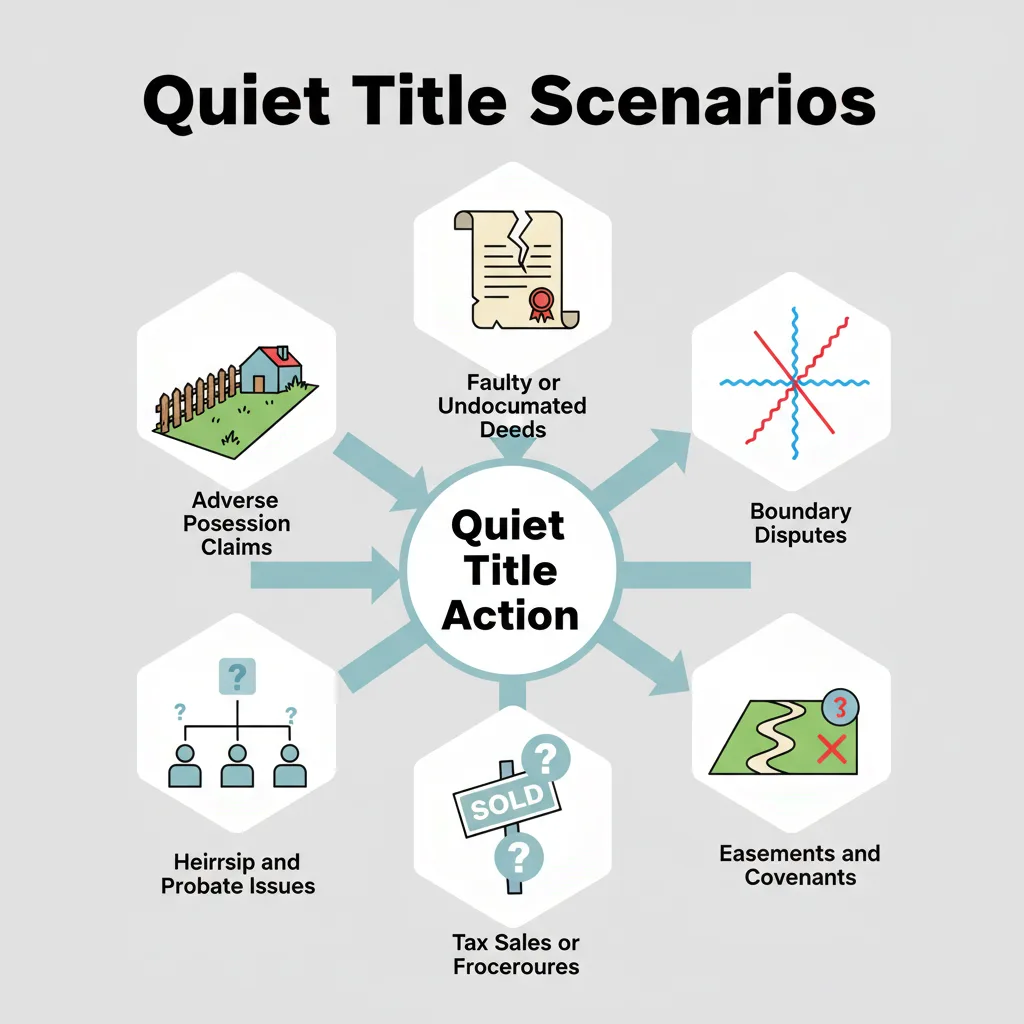
Quiet title actions are typically pursued when there are specific issues or competing claims that create uncertainty about who rightfully owns a property. These actions address a wide range of defects or disputes that can cloud a title:
- Adverse Possession Claims - When an individual has occupied a property openly, notoriously, continuously, exclusively, and hostilely for a statutory period, they may seek to formalize their ownership through a quiet title action.
- Faulty or Undocumented Deeds - Issues such as improperly executed deeds, missing signatures, incorrect legal descriptions, or unrecorded conveyances can create title ambiguities that require judicial resolution.
- Boundary Disputes - Conflicts over property lines, often arising from old surveys, unclear descriptions, or encroachment, can necessitate a quiet title action to establish definitive boundaries.
- Heirship and Probate Issues - When property passes through inheritance, particularly without a clear will or proper probate proceedings, disputes among heirs or claims from unknown parties can cloud the title.
- Tax Sales or Foreclosures - Properties acquired through tax sales or foreclosure often come with potential claims from prior owners or lienholders, making a quiet title action necessary to validate the new ownership.
- Easements and Covenants - Disputes over the existence, validity, or scope of easements, restrictive covenants, or other encumbrances on a property's use can be resolved to clarify the property rights.
Parties and Procedure
A quiet title action typically involves a plaintiff, who is the party asserting ownership and seeking to clear the title, and one or more defendants, who are individuals or entities believed to have a competing claim or interest in the property. The plaintiff must identify all known and ascertainable parties who might have an interest and serve them with notice of the lawsuit. In some cases, unknown claimants may be notified through public notices.
The legal procedure generally begins with the filing of a complaint in the appropriate court, outlining the plaintiff's claim to the property and identifying the alleged defects or adverse claims. The court then hears evidence regarding the various claims and renders a judgment. A successful quiet title judgment legally declares the plaintiff as the rightful owner and nullifies any competing claims, effectively removing the cloud from the title.
Historical and Legislative Context
While quiet title actions are common law remedies, specific legislative acts have historically been passed to address particular title disputes, especially those involving federal lands or complex historical claims. These legislative measures underscore the importance of clear property ownership, even at a national level.
- Rocky Mountain Arsenal Land - Congress enacted legislation to quiet title and possession with respect to certain real property adjacent to the Rocky Mountain Arsenal in Denver, Colorado, resolving specific land claims (Public Law No. 86-318, 1959).
- Nez Perce Indian Reservation Lands - An Act was passed to quiet title to certain lands within the Nez Perce Indian Reservation in Idaho, demonstrating legislative intervention for specific tribal land issues (Public Law No. 86-690, 1960).
- Louisiana Land Claim - Legislation was introduced to quiet title and possession to an unconfirmed and located private land claim in the State of Louisiana, addressing historical private land claims (Public Law No. 87-468, 1962).
- Pensacola, Florida Property - Congress enacted a bill to quiet title and possession with respect to certain real property in the city of Pensacola, Florida, indicating federal involvement in local land disputes (Public Law No. 84-499, 1956).
- General Quiet Title Actions against the U.S. - A broader act was passed to permit suits to adjudicate certain real property quiet title actions where the United States is a defendant, providing a mechanism for private parties to sue the federal government over land title disputes (Public Law No. 92-562, 1972).
Effect of a Judgment
The ultimate outcome of a successful quiet title action is a court order, or judgment, that definitively establishes the plaintiff's ownership of the property. This judgment effectively removes any clouds, liens, or adverse claims that previously encumbered the title. The result is a clear and marketable title, which is essential for any future transactions involving the property.
The judgment serves as a permanent record, legally binding all parties involved in the suit and often those who could have claimed an interest but failed to do so after proper notice. This clarity protects the owner from future challenges and enhances the property's value and liquidity. It provides peace of mind and legal certainty for the property owner.
Frequently Asked Questions
Sources
- An Act to permit suits to adjudicate certain real property quiet title actions - Provides legislative history and official titles for a bill related to quiet title actions.
- An Act to quiet title and possession with respect to certain real property adjacent to the Rocky Mountain Arsenal, Denver, Colo. - Details legislative actions for a bill concerning quiet title and possession in Denver, Colorado.
- An Act to quiet title and possession to an unconfirmed and located private land claim in the State of Louisiana - Provides legislative history for a bill related to quiet title and possession in Louisiana.
- An Act to quiet title to certain lands within the Nez Perce Indian Reservation, Idaho, and for other purposes. - Details legislative actions for a bill concerning quiet title to lands within the Nez Perce Indian Reservation.
- An Act to quiet title and possession with respect to certain real property in the city of Pensacola, Fla - Provides legislative history for a bill related to quiet title and possession in Pensacola, Florida.
Not the form you're looking for?
Try our legal document generator to create a custom document
Disclaimer: The templates available on this website are provided for general informational purposes only and do not constitute legal advice. They are not intended to be, and should not be interpreted as, compliant with any specific legal, regulatory, or privacy requirements. These templates are not a replacement for professional legal guidance and should not be relied upon for any particular matter or circumstance. Users are strongly encouraged to seek advice from a qualified attorney licensed in their jurisdiction before using, modifying, or relying on any template.
All templates are provided on an "as is," "with all faults," and "as available" basis. The provider disclaims any and all warranties of any kind, whether express, implied, statutory, or otherwise, including without limitation warranties of merchantability, fitness for a particular purpose, title, or non-infringement.
LegalTemplates.com makes no guarantees or representations regarding the accuracy, completeness, expected outcomes, or reliability of the materials contained in these templates or any materials referenced or linked from them.