Lease Termination Letter
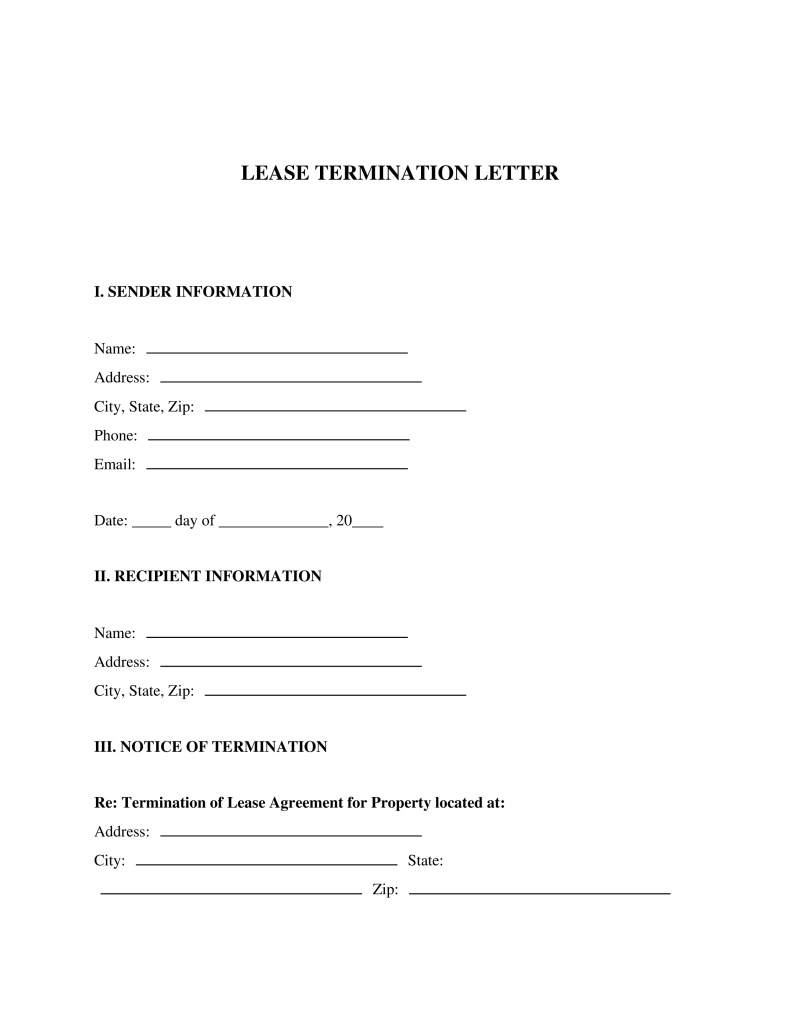
A Lease Termination Letter is a legal document that formally notifies the termination of a lease agreement between a landlord and tenant.
Property Type
Select the category that best describes the leased property.
Provide details if the property type is not listed above.
Table of Contents
What is a Lease Termination Letter?
A Lease Termination Letter is a formal written notice provided by either a landlord or a tenant to signify the intent to end a lease agreement. This crucial document serves to legally conclude the contractual relationship between the parties, outlining the effective date of termination and often specifying the reasons, if required by the lease or local law. Its primary purpose is to ensure that both the landlord and tenant are fully aware of the impending end of the tenancy, facilitating a smooth transition and adherence to the terms stipulated in the original lease agreement and relevant statutory provisions.
Legal Requirements and Validity
The legal validity of a Lease Termination Letter hinges on its compliance with both the original lease agreement and applicable federal, state, and local laws. A properly executed letter ensures that the termination is recognized by law, preventing potential disputes or penalties for early or improper termination. Key considerations for its legal standing include adequate notice periods, adherence to specified delivery methods, and the inclusion of necessary information.
For a Lease Termination Letter to be legally binding, several requirements are often mandated:
- Written Format - Most jurisdictions and lease agreements require termination notices to be in writing, precluding oral agreements for such significant actions.
- Adequate Notice Period - The letter must be delivered within the timeframe specified by the lease or state law, typically 30, 60, or 90 days prior to the desired termination date.
- Valid Reason (for early termination) - If terminating a fixed-term lease early, a legally recognized reason (e.g., military deployment, landlord breach of habitability, domestic violence) or a mutual agreement with the landlord is usually necessary.
- Proper Delivery Method - Methods often include certified mail with a return receipt, personal delivery with a signed acknowledgment, or other methods explicitly permitted by the lease or statute.
- Accurate Information - The letter must correctly identify the parties involved, the property address, and the precise effective date of termination.
Failure to meet these requirements can render the Lease Termination Letter invalid, potentially obligating the tenant to continue paying rent or the landlord to continue providing services beyond the intended termination date.
Rights and Obligations of Parties Involved
Upon the issuance and receipt of a Lease Termination Letter, both landlords and tenants acquire specific rights and assume certain obligations designed to ensure a fair and orderly conclusion to the tenancy. These responsibilities are typically outlined in the original lease agreement and reinforced by state and local landlord-tenant laws.
Key rights and obligations for tenants include:
- Continued Rent Payment - Tenants are generally obligated to pay rent through the effective termination date, even if they vacate the premises earlier.
- Property Condition - Tenants must return the property in the condition it was received, ordinary wear and tear excepted, often requiring cleaning and minor repairs.
- Security Deposit Return - Tenants have the right to the return of their security deposit, minus any legitimate deductions for damages beyond normal wear and tear or unpaid rent.
- Timely Vacating - Tenants must vacate the premises by the specified termination date, removing all personal belongings.
- Forwarding Address Provision - Providing a forwarding address is crucial for the landlord to return the security deposit and any other correspondence.
Key rights and obligations for landlords include:
- Security Deposit Accounting - Landlords are obligated to return the security deposit or provide an itemized list of deductions within a state-mandated timeframe, typically 14 to 60 days.
- Property Inspection - Landlords typically have the right to inspect the property after the tenant vacates to assess damages and determine security deposit deductions.
- Mitigation of Damages - In cases of early termination by a tenant, landlords often have an obligation to make reasonable efforts to re-rent the property to mitigate the tenant's financial liability.
- Providing Access for Showings - Landlords typically have the right to show the property to prospective new tenants during the notice period, provided reasonable notice is given to the current tenant.
- Adherence to Notice Periods - Landlords must respect the notice period provided by the tenant and cannot demand earlier vacation unless mutually agreed upon.
How to Complete a Lease Termination Letter
Drafting a comprehensive and legally sound Lease Termination Letter requires careful attention to detail to ensure all necessary information is included and properly communicated. The process involves several distinct steps to guarantee clarity and compliance.
- Identify Parties and Property - Begin by clearly stating the full legal names of both the landlord and the tenant(s), along with the complete address of the leased property. This ensures there is no ambiguity about whose lease is being terminated and which property is involved. Include the date the letter is being written.
- Reference the Lease Agreement - Explicitly state the date the original lease agreement was signed and the duration of the lease term. This links the termination notice directly to the existing contract, reinforcing its legal basis. Mentioning the lease's start date helps contextualize the termination.
- State Intent and Termination Date - Clearly and unequivocally state the intention to terminate the lease. Specify the exact date on which the tenancy will officially end. This date must comply with the notice period requirements outlined in the lease or by state law.
- Provide Reason (if applicable) - If the lease is being terminated early due to a specific clause in the agreement (e.g., military transfer, landlord's failure to maintain habitability) or mutual agreement, briefly state the reason. For standard end-of-term terminations, a reason is often not required.
- Include Moving Out Instructions and Deposit Details - Outline expectations for the move-out process, such as property cleaning, key return, and final inspection scheduling. Request instructions for the return of the security deposit and provide a forwarding address for its remittance.
- Sign and Date the Letter - The tenant(s) sending the letter must sign and date it. If there are multiple tenants on the lease, all adult tenants should sign to demonstrate collective agreement. The landlord or their authorized agent must sign if it is a mutual termination agreement or a landlord-initiated termination.
- Choose a Delivery Method - Select a delivery method that provides proof of delivery, such as certified mail with a return receipt requested, or personal delivery with a signed acknowledgment from the recipient. Retain copies of the letter and proof of delivery for personal records.
Required Elements of a Valid Lease Termination Letter
For a Lease Termination Letter to be legally effective and withstand potential scrutiny, it must contain several essential components. These elements ensure clarity, proper identification, and compliance with contractual and statutory requirements.
- Date of Letter - The specific date the termination letter is written and sent, which is crucial for calculating notice periods.
- Landlord's Full Name and Address - Complete and accurate identification of the landlord or property management company.
- Tenant's Full Name(s) and Current Address - Full legal names of all tenants on the lease and the address of the property being vacated.
- Lease Agreement Date - The date on which the original lease agreement commenced, providing a clear reference to the active contract.
- Clear Statement of Intent to Terminate - An unambiguous declaration that the sender intends to terminate the lease agreement.
- Desired Termination Date - The exact date on which the tenancy will officially end, calculated to meet the required notice period.
- Reference to Applicable Lease Clause or Statute (if early termination) - If terminating a fixed-term lease early, citing the specific clause in the lease or legal statute that permits such early termination.
- Request for Security Deposit Return Instructions - A clear request for information on how and when the security deposit will be returned.
- Forwarding Address - The new address where the security deposit and any future correspondence should be sent.
- Tenant's Signature(s) - The signature of all tenants listed on the lease, confirming their agreement to the termination.
- Landlord's Signature (if mutual agreement or landlord-initiated) - The signature of the landlord or their authorized agent, particularly for mutual termination agreements.
Federal Statutes
While many aspects of lease termination are governed by state law, several federal statutes can significantly impact the rights and obligations of parties involved in a lease agreement, particularly regarding early termination or the conditions under which a lease can be terminated.
- Servicemembers Civil Relief Act (SCRA) - Provides protections for military members, allowing them to terminate a residential lease agreement without penalty if they receive military orders for a permanent change of station or deployment for a period of 90 days or more (50 U.S.C. § 3955).
- Fair Housing Act - Prohibits discrimination in housing based on race, color, religion, sex, national origin, familial status, or disability. While not directly governing termination notices, it ensures that termination actions are not discriminatory (42 U.S.C. § 3601 et seq.).
- Residential Lead-Based Paint Hazard Reduction Act - Requires landlords of properties built before 1978 to disclose known lead-based paint hazards to tenants. A failure to disclose could potentially provide grounds for a tenant to terminate a lease, though this is often adjudicated under state consumer protection laws (42 U.S.C. § 4852d).
State Laws and Requirements
State laws provide the primary framework for residential landlord-tenant relationships, including the specific requirements for Lease Termination Letters. These statutes often vary significantly from state to state, making it crucial to consult local regulations.
- Uniform Residential Landlord and Tenant Act (URLTA) - A model act that many states have adopted, in whole or in part, to standardize landlord-tenant laws. It addresses notice periods for termination, security deposit handling, and conditions for early termination (e.g., Alaska Stat. § 34.03.010 et seq., Iowa Code Ann. § 562A.1 et seq.).
- Notice Periods for Termination - Most states mandate specific notice periods for terminating month-to-month leases or for landlords to issue non-renewal notices for fixed-term leases. These periods commonly range from 30 to 90 days, depending on the state and type of tenancy (e.g., California Civil Code § 1946, New York Real Property Law § 232-a, § 232-b).
- Security Deposit Regulations - State laws dictate the maximum amount a landlord can charge for a security deposit, the conditions under which it can be withheld, and the timeline for its return after lease termination. Itemized statements for deductions are often required (e.g., Fla. Stat. Ann. § 83.49, Tex. Prop. Code Ann. § 92.103).
- Landlord's Duty to Mitigate Damages - Many states require landlords to make reasonable efforts to re-rent a property if a tenant breaks a lease early, thereby reducing the tenant's financial liability for remaining rent (e.g., Arizona Rev. Stat. § 33-1370, Oregon Rev. Stat. § 90.300).
- Early Termination Clauses and Penalties - State laws often govern the enforceability of early termination clauses in leases and may limit the penalties landlords can charge for breaking a lease without a legally recognized reason.
Not the form you're looking for?
Try our legal document generator to create a custom document
Disclaimer: The templates available on this website are provided for general informational purposes only and do not constitute legal advice. They are not intended to be, and should not be interpreted as, compliant with any specific legal, regulatory, or privacy requirements. These templates are not a replacement for professional legal guidance and should not be relied upon for any particular matter or circumstance. Users are strongly encouraged to seek advice from a qualified attorney licensed in their jurisdiction before using, modifying, or relying on any template.
All templates are provided on an "as is," "with all faults," and "as available" basis. The provider disclaims any and all warranties of any kind, whether express, implied, statutory, or otherwise, including without limitation warranties of merchantability, fitness for a particular purpose, title, or non-infringement.
LegalTemplates.com makes no guarantees or representations regarding the accuracy, completeness, expected outcomes, or reliability of the materials contained in these templates or any materials referenced or linked from them.