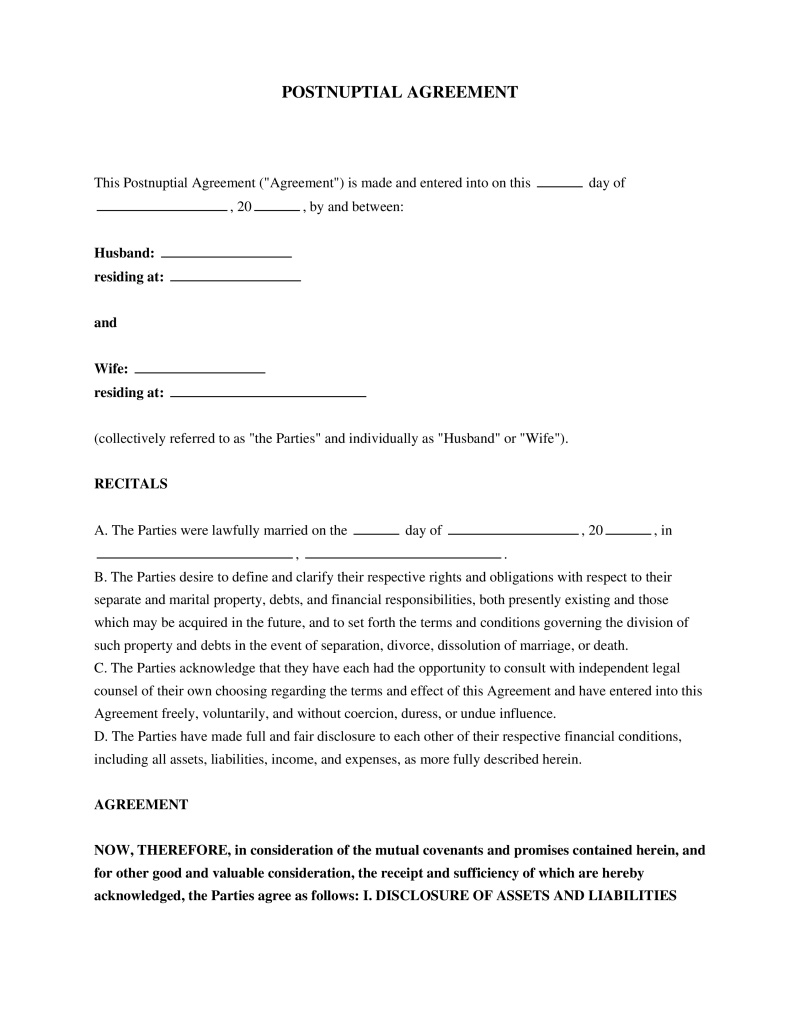
Postnuptial Agreement
A Postnuptial Agreement is a legal contract executed by spouses after marriage to establish the division of assets, debts, and spousal support in the event of separation or divorce.
Agreement Effective Event
Select the event that triggers the agreement's effectiveness.
Provide details if you selected 'Other'.
Table of Contents
What is a Postnuptial Agreement?
A postnuptial agreement is a legally binding contract entered into by spouses after they have married. Its primary purpose is to define and formalize the division of assets, liabilities, and spousal support in the event of a divorce, legal separation, or death. Couples typically use this document to clarify financial expectations, protect individual property, or address changes in circumstances that have arisen during their marriage. It serves as a proactive measure to avoid potential disputes and provide clarity regarding financial matters should the marriage dissolve.
Legal Requirements and Validity
For a postnuptial agreement to be considered legally valid and enforceable, it must meet several stringent requirements, which can vary by state but generally include:
- Writing Requirement - The agreement must be in writing and signed by both parties. This requirement is typically governed by the Statute of Frauds, which mandates written documentation for certain types of contracts, including those related to marriage or property division.
- Full and Fair Disclosure - Each spouse must provide a complete and accurate disclosure of all their assets, debts, income, and financial obligations. Failure to disclose material financial information can lead to the agreement being deemed unenforceable due to fraud or misrepresentation.
- Independent Legal Representation - While not always strictly mandated, it is highly recommended and often a factor in enforceability that both parties have the opportunity to consult with and be represented by their own independent legal counsel. A knowing and voluntary waiver of this right may be permitted in some jurisdictions.
- Voluntary Execution - Both parties must sign the agreement voluntarily, free from duress, coercion, fraud, or undue influence. The circumstances surrounding the signing are closely scrutinized to ensure genuine consent.
- Fairness and Consionability - The terms of the agreement must be fair and reasonable both at the time of execution and, in some jurisdictions, at the time of enforcement. An agreement that is excessively one-sided or leaves one spouse in a position of destitution may be challenged and potentially invalidated by a court.
- Proper Execution - The agreement must be executed with the appropriate formalities, which may include notarization or witnesses, depending on state law.
Rights and Obligations of Parties
A postnuptial agreement delineates specific rights and obligations for each spouse, tailoring the financial landscape of their marriage and potential dissolution. These provisions aim to create a predictable framework for their financial future. Key areas typically addressed include:
- Property Division - The agreement can classify assets and debts as either separate property (belonging solely to one spouse) or marital property (to be divided between spouses). It can also specify how marital property will be divided upon divorce or death, potentially deviating from default state community property or equitable distribution laws.
- Spousal Support (Alimony) - Parties can agree on the amount, duration, and conditions of spousal support payments in the event of a divorce. This may include waiving alimony entirely, setting a specific amount, or establishing a formula for its calculation.
- Debt Allocation - The agreement can assign responsibility for existing and future debts, ensuring clarity on who is accountable for specific financial obligations during the marriage and after a separation.
- Business Interests - For spouses with business ownership, the agreement can outline how business assets, profits, and valuations will be handled in a divorce, potentially protecting one spouse's business from being divided as marital property.
- Inheritance Rights - Spouses can modify or waive their statutory inheritance rights in a postnuptial agreement, particularly concerning the elective share or community property rights upon the death of a spouse.
- Child-Related Matters - While postnuptial agreements can address financial support for children, provisions related to child custody, visitation, or child support are generally not binding on a court and are subject to judicial review based on the child's best interests.
How to Complete a Postnuptial Agreement
The process of creating and finalizing a postnuptial agreement involves several crucial steps to ensure its legality and enforceability:
- Initial Discussion and Goal Setting - Both spouses should openly discuss their reasons for wanting a postnuptial agreement and what specific issues they wish to address. This initial conversation helps clarify objectives, such as protecting pre-marital assets, defining responsibilities for new debts, or addressing potential inheritances, setting the foundation for the agreement's content.
- Engage Independent Legal Counsel - Each spouse should retain their own independent attorney specializing in family law. Independent representation ensures that each party's interests are advocated for, that they fully understand the legal implications of the agreement, and that they are not unduly influenced by the other spouse or their attorney.
- Comprehensive Financial Disclosure - A thorough and honest exchange of all financial information is paramount. This involves providing detailed statements of all assets (e.g., real estate, bank accounts, investments, retirement funds, business interests), debts (e.g., mortgages, loans, credit card balances), income, and liabilities. Full disclosure prevents future claims of fraud or misrepresentation.
- Drafting the Agreement - One of the attorneys, typically the one representing the spouse who initiated the agreement, will prepare an initial draft based on the discussions and financial disclosures. This draft will include clauses addressing property division, spousal support, debt allocation, and any other agreed-upon terms, ensuring it complies with state law.
- Negotiation and Review - Both attorneys will review the draft agreement with their respective clients, explaining all provisions and their potential impact. Negotiations may occur to modify terms until both parties are satisfied and believe the agreement is fair and equitable. Revisions continue until a mutually acceptable version is reached.
- Execution and Notarization - Once the final terms are agreed upon, both spouses, with their attorneys present, will formally sign the postnuptial agreement. In most jurisdictions, the signatures must be notarized, and some states may require witnesses, to attest to the authenticity of the signatures and the voluntary nature of the signing.
Comparison: Postnuptial vs. Prenuptial Agreement
While both postnuptial and prenuptial agreements serve to define financial arrangements between spouses, they differ primarily in their timing and the legal context in which they are created and reviewed by courts.
A prenuptial agreement is executed before marriage, in anticipation of the union. Its purpose is to establish financial rights and responsibilities from the outset of the marriage, often protecting pre-marital assets or defining spousal support terms before any marital property is acquired. The consideration for a prenuptial agreement is typically the marriage itself, and parties are generally viewed as having equal bargaining power at the time of execution. Courts tend to scrutinize prenuptial agreements for voluntariness, full disclosure, and conscionability at the time of signing.
In contrast, a postnuptial agreement is entered into after the marriage has already occurred. The consideration for a postnuptial agreement is not the impending marriage but rather mutual promises, the exchange of property, or other benefits exchanged between the spouses during the marriage. Postnuptial agreements often arise due to changing circumstances within the marriage, such as one spouse starting a business, receiving an inheritance, or a desire to reconcile after marital difficulties. Due to the existing marital relationship, courts often apply a higher level of scrutiny to postnuptial agreements, ensuring there was no undue influence, coercion, or overreaching by one spouse over the other, given the fiduciary duty spouses owe to each other.
Applicable Federal and State Laws
The enforceability and specific provisions of a postnuptial agreement are primarily governed by state law, although certain federal statutes may influence specific aspects, particularly concerning retirement assets.
Federal Statutes
While most aspects of postnuptial agreements fall under state jurisdiction, some federal laws can impact their scope:
- Employee Retirement Income Security Act (ERISA) - This federal law governs most private sector employee benefit plans, including qualified retirement plans (29 U.S.C. § 1001 et seq.). ERISA provides specific spousal rights to these plans, such as the right to a Qualified Joint and Survivor Annuity (QJSA) and a Qualified Preretirement Survivor Annuity (QPSA). A postnuptial agreement cannot unilaterally waive these federal spousal rights unless the spouse provides a valid, written, and notarized consent within specific ERISA guidelines, often requiring the plan administrator's acknowledgment.
- Full Faith and Credit Clause - This clause of the U.S. Constitution requires states to respect the "public acts, records, and judicial proceedings of every other state" (U.S. Constitution, Article IV, Section 1). This means a valid postnuptial agreement executed in one state should generally be recognized and enforced in other states, though enforcement may still be subject to local procedural rules.
State Laws and Requirements
State laws provide the most comprehensive framework for postnuptial agreements:
- Uniform Premarital and Marital Agreements Act (UPMAA) - This model act, or its predecessor the Uniform Premarital Agreement Act (UPAA) which some states have expanded to include postnuptial agreements, provides a statutory framework for the creation and enforcement of both premarital and marital agreements. States that have adopted the UPMAA (or a similar statute) typically outline specific requirements for validity, such as the need for a written agreement, full financial disclosure, and voluntary execution.
- State Family Law Statutes - Each state has its own body of family law that governs marriage, divorce, property division, and spousal support. These statutes dictate the default rules for how assets and debts are divided in a divorce, and a postnuptial agreement essentially allows spouses to contract around these default provisions. For example, states like California have specific provisions in their Family Code (e.g., Cal. Family Code § 1620 et seq.) addressing the validity and enforceability of postnuptial agreements, often requiring independent legal counsel for each party.
- Statute of Frauds - All states have a Statute of Frauds, which generally requires certain types of contracts, including agreements made in consideration of marriage or agreements that cannot be performed within one year, to be in writing to be enforceable (e.g., New York General Obligations Law § 5-701). Postnuptial agreements fall under this requirement.
- Contract Law Principles - Beyond specific family law statutes, general principles of contract law apply to postnuptial agreements. This includes requirements for offer, acceptance, consideration (mutual promises, property exchange, or other benefits), legality of purpose, and the legal capacity of the parties to enter into a contract.
Consequences of Non-Compliance
If a postnuptial agreement fails to meet the legal requirements for validity and enforceability, a court may deem it invalid, either in whole or in part. The primary consequence of an invalidated agreement is that the state's default laws regarding property division, spousal support, and other marital rights will apply in the event of a divorce or death. This means the court will divide assets and determine alimony based on statutory guidelines, which may be significantly different from what the spouses had intended in their agreement. Furthermore, challenging and defending an agreement's validity can lead to extensive and costly litigation.
Frequently Asked Questions
Not the form you're looking for?
Try our legal document generator to create a custom document
Disclaimer: The templates available on this website are provided for general informational purposes only and do not constitute legal advice. They are not intended to be, and should not be interpreted as, compliant with any specific legal, regulatory, or privacy requirements. These templates are not a replacement for professional legal guidance and should not be relied upon for any particular matter or circumstance. Users are strongly encouraged to seek advice from a qualified attorney licensed in their jurisdiction before using, modifying, or relying on any template.
All templates are provided on an "as is," "with all faults," and "as available" basis. The provider disclaims any and all warranties of any kind, whether express, implied, statutory, or otherwise, including without limitation warranties of merchantability, fitness for a particular purpose, title, or non-infringement.
LegalTemplates.com makes no guarantees or representations regarding the accuracy, completeness, expected outcomes, or reliability of the materials contained in these templates or any materials referenced or linked from them.