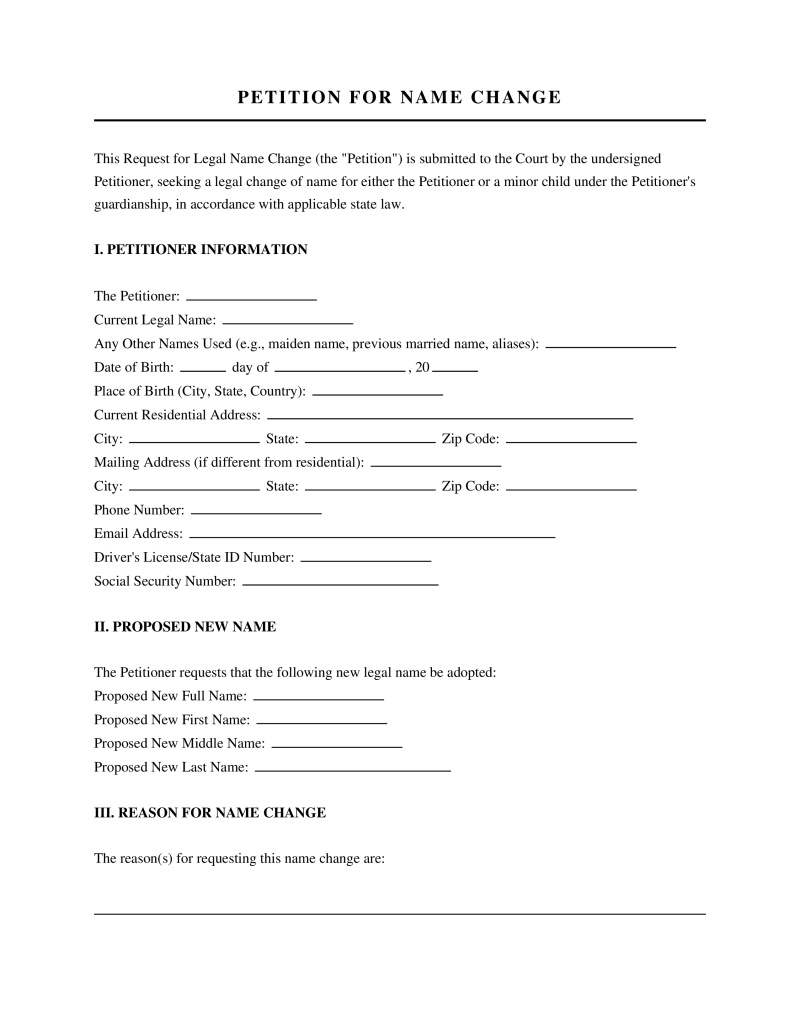
Petition for Name Change
A Petition for Name Change is a formal legal document submitted to a court requesting judicial authorization to legally alter an individual's given name.
Petitioner Type
Select whether you are requesting a name change for yourself (adult) or for a minor child under your guardianship.
Table of Contents
What is a Petition for Name Change?
A Petition for Name Change is a formal legal document filed with a court to request a legal alteration of an individual's name. This judicial process is typically required for adults seeking to change their name for personal reasons, or for parents seeking to change the name of their minor child. The petition serves as the official request, initiating a court proceeding to review the proposed name change and ensure it is not sought for fraudulent purposes or to evade legal obligations. Upon approval, the court issues an order that legally establishes the new name, allowing the individual to update their identity across various official records and documents.
Legal Framework
The legal authority for name changes primarily resides at the state level, governed by specific statutes and rules of civil procedure. Each state establishes its own requirements for filing, notice, and judicial review, ensuring that the process is orderly and transparent. Jurisdiction typically rests with the court in the county where the petitioner resides, reflecting the local nature of personal identity records.
Key aspects of the legal framework include:
- State Statutes - Most states have dedicated sections within their civil or family law codes outlining the procedures and requirements for an adult or minor's name change (e.g., [State] Civil Code § XXXX).
- Rules of Civil Procedure - These rules dictate the format, filing, and service requirements for petitions, ensuring due process is followed in all court proceedings (e.g., [State] Rules of Civil Procedure Rule XX).
- Court Discretion - Judges retain discretion to deny a name change petition if they find it is intended for fraudulent purposes, to avoid creditors, or to engage in criminal activity.
- Public Notice Requirements - Many jurisdictions mandate that the proposed name change be published in a local newspaper to inform the public and allow for potential objections.
Eligibility and Grounds for Name Change
Eligibility for a name change is generally broad, allowing individuals to seek a new name for a variety of legitimate reasons. Courts typically consider the petitioner's intent and ensure the change will not harm others or be used for illicit purposes. Specific grounds and associated considerations include:
- Personal Preference - The most common reason, reflecting a desire for a name that better suits one's identity or simply a preference for a different name.
- Marriage or Divorce - Individuals often change their names upon marriage to adopt a spouse's surname or revert to a maiden name after divorce. While these changes can sometimes be facilitated directly through marriage or divorce decrees, a separate petition may be necessary for other changes or if the decree does not cover the desired change.
- Gender Affirmation - Many individuals undergoing gender transition seek to change their legal name to align with their affirmed gender identity.
- Safety or Protection - In cases of domestic violence, harassment, or witness protection, a name change may be sought to protect the individual's safety and privacy.
- Correction of Errors - Rectifying misspellings or inaccuracies on birth certificates or other official documents.
- Minor Child Name Changes - When changing a minor's name, courts prioritize the child's best interests, often requiring consent from both parents or a judicial determination in cases of dispute.
How to Complete a Petition for Name Change
The process of legally changing one's name through a court petition involves several sequential steps designed to ensure thorough review and public notice.
- Prepare the Petition - This initial step involves drafting the formal document that will be submitted to the court. The petition typically requires the petitioner's current full legal name, the desired new name, the date and place of birth, current address, and a clear statement of the reasons for the name change. It is crucial to be truthful and comprehensive in providing all requested information, as any misrepresentation can lead to denial or future legal complications.
- File the Petition with the Court - Once completed, the petition must be filed with the clerk of the appropriate court, usually in the county of the petitioner's residence. This step involves submitting the original petition, any required supporting documents, and paying the applicable court filing fees. Some courts may also require additional forms, such as a civil cover sheet or a proposed order for the judge to sign upon approval.
- Provide Public Notice - Many jurisdictions mandate that petitioners publish notice of their intended name change in a local newspaper for a specified period, typically several weeks. This requirement is designed to inform the public of the proposed change and provide an opportunity for any interested parties to object. Proof of publication, such as an affidavit from the newspaper, must usually be filed with the court before a hearing can proceed.
- Attend the Court Hearing - After the filing and publication requirements are met, the court will schedule a hearing. The petitioner must attend this hearing, where the judge will review the petition, ask questions about the reasons for the name change, and confirm that all legal requirements have been satisfied. In some cases, if no objections are filed and the petition is straightforward, the judge may approve the change without extensive questioning.
- Obtain the Court Order - If the judge grants the petition, a formal Order for Name Change will be issued. This document is the legal proof of the name change and is essential for updating all personal records. It is advisable to obtain several certified copies of this order, as various agencies will require an official copy to process the name change on their records.
- Update Official Records - With the certified court order, the final step involves notifying and updating all relevant government agencies and private entities. This includes the Social Security Administration, Department of Motor Vehicles, Passport Agency, banks, employers, educational institutions, and any professional licensing boards. Prompt updating of records ensures that the new legal name is consistently reflected across all aspects of one's identity.
Rights and Obligations of Petitioners
Individuals seeking a name change through a petition have specific rights and corresponding obligations throughout the legal process. Understanding these is crucial for a successful outcome and to avoid potential legal issues.
The petitioner's rights include:
- Right to Due Process - Petitioners have the right to a fair and impartial hearing before a judge, where their request will be considered based on established legal criteria.
- Right to Privacy - While the process involves public notice, petitioners generally have a right to privacy regarding the specific personal reasons for their name change, unless those reasons are relevant to the court's determination of legitimate intent.
- Right to Legal Representation - Petitioners may engage legal counsel to assist them through the process, ensuring all legal requirements are met and their interests are properly represented.
The petitioner's obligations include:
- Truthfulness and Full Disclosure - Petitioners are obligated to provide accurate and complete information in their petition, including their reasons for the name change and any relevant criminal history or outstanding legal obligations.
- Compliance with Notice Requirements - It is the petitioner's responsibility to ensure that all mandated public notice requirements, such as newspaper publication, are fulfilled and proper proof is submitted to the court.
- Payment of Fees - Petitioners are responsible for paying all court filing fees, publication costs, and any other associated administrative expenses, unless a fee waiver is granted based on financial hardship.
- Appearance at Hearing - Petitioners are generally required to appear in court for their scheduled hearing, unless explicitly excused by the court.
- No Fraudulent Intent - Petitioners have a fundamental obligation to seek a name change for legitimate purposes and not to defraud creditors, evade criminal prosecution, or escape other legal responsibilities.
Applicable Laws and Regulations
The legal process for a Petition for Name Change is primarily governed by state law, but federal regulations become relevant when updating identity documents and records after a court order is issued. Non-compliance, particularly concerning fraudulent intent, carries significant penalties.
State Laws and Requirements
State statutes and procedural rules lay out the specific steps for changing a name:
- Name Change Statutes - These laws define who can petition for a name change (adults, minors), what information must be included in the petition, and the specific grounds for approval or denial (e.g., [State] Code of Civil Procedure § XXXX).
- Rules of Court - State court rules often detail the specific forms to be used, filing procedures, fee schedules, and requirements for serving notice on interested parties or publishing notice in a newspaper (e.g., [State] Rules of Court Rule XX).
- Family Law Codes - For name changes involving minors, state family law codes often dictate requirements regarding parental consent, notice to non-petitioning parents, and the "best interests of the child" standard for judicial review (e.g., [State] Family Law Code § XXXX).
- Criminal Background Checks - Some states require petitioners to undergo a criminal background check to ensure the name change is not sought to evade law enforcement or criminal obligations.
Federal Laws and Agencies
While federal law does not govern the petition process itself, several federal agencies have specific requirements for updating records following a state-issued name change order:
- Social Security Act - Requires individuals to report name changes to the Social Security Administration to ensure accurate records for benefits and identification purposes (42 U.S.C. § 405(c)(2)).
- Passport Act of 1926 - Governs the issuance of U.S. passports, requiring individuals to submit proof of a legal name change (e.g., court order) when applying for a new passport or updating an existing one (22 U.S.C. § 211a et seq.).
- Immigration and Nationality Act - Pertains to name changes for non-citizens, requiring updates to immigration documents and potentially affecting naturalization processes (8 U.S.C. § 1101 et seq.).
- Internal Revenue Code - Mandates individuals to inform the Internal Revenue Service of name changes to ensure accurate tax filings and prevent delays in processing refunds or other tax-related matters (26 U.S.C. § 6109).
Penalties for Non-Compliance
Failure to comply with the legal requirements for a name change or seeking a name change with fraudulent intent can lead to severe consequences. If a court discovers that a petitioner misrepresented facts or sought a name change to avoid legal obligations (e.g., debt, criminal prosecution), the petition will be denied. Furthermore, using a new name obtained fraudulently can lead to charges of perjury, identity fraud, or other criminal offenses, depending on the jurisdiction and the nature of the deception. Any name change obtained through fraud can be retroactively invalidated by the court.
Frequently Asked Questions
Petition for Name Change Sample
Not the form you're looking for?
Try our legal document generator to create a custom document
Disclaimer: The templates available on this website are provided for general informational purposes only and do not constitute legal advice. They are not intended to be, and should not be interpreted as, compliant with any specific legal, regulatory, or privacy requirements. These templates are not a replacement for professional legal guidance and should not be relied upon for any particular matter or circumstance. Users are strongly encouraged to seek advice from a qualified attorney licensed in their jurisdiction before using, modifying, or relying on any template.
All templates are provided on an "as is," "with all faults," and "as available" basis. The provider disclaims any and all warranties of any kind, whether express, implied, statutory, or otherwise, including without limitation warranties of merchantability, fitness for a particular purpose, title, or non-infringement.
LegalTemplates.com makes no guarantees or representations regarding the accuracy, completeness, expected outcomes, or reliability of the materials contained in these templates or any materials referenced or linked from them.