Pet Custody Agreement Template
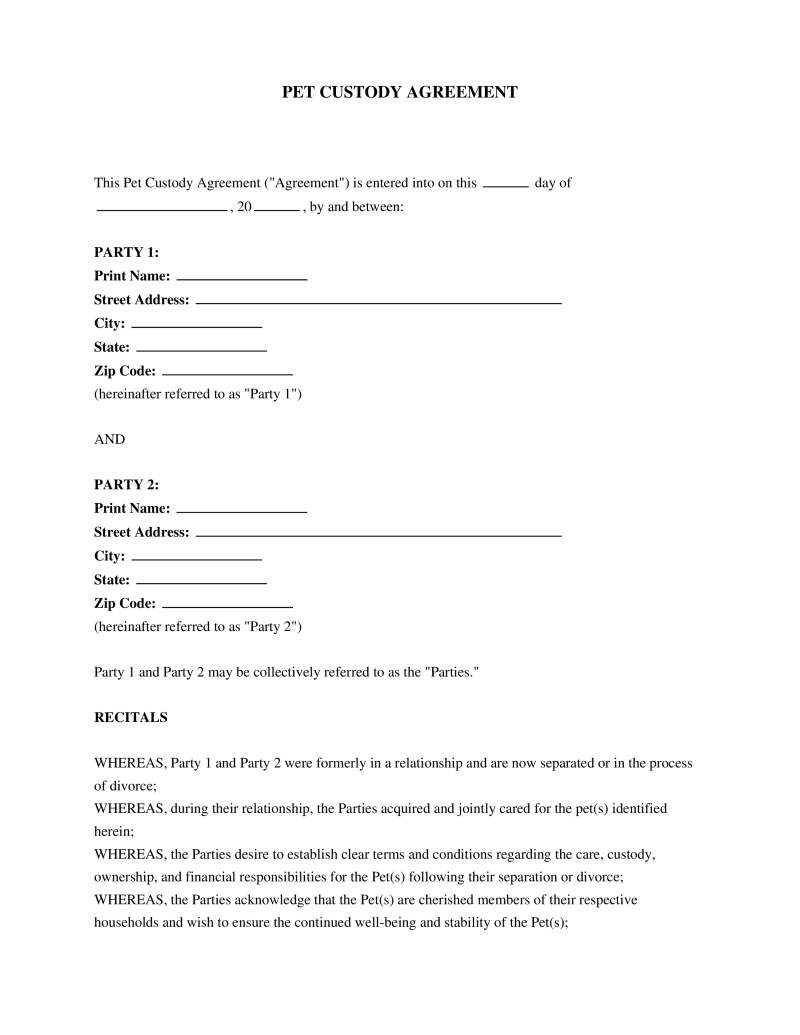
A Pet Custody Agreement is a legal document outlining the terms and conditions for the care, visitation, and division of ownership rights concerning an animal companion following separation or divorce.
Pet Type
Select the primary type of pet for this agreement. If you have multiple pets, you can add details later.
Provide a description if your pet type is not listed above.
Table of Contents
What is a Pet Custody Agreement Template?
A pet custody agreement template is a structured legal document designed for individuals who co-own a pet to outline the responsibilities, care, and visitation arrangements for their animal companion. This agreement is particularly relevant for separating or divorcing couples, cohabiting partners, or even friends who jointly own a pet, providing a clear framework for decision-making and preventing future disputes. Its primary purpose is to establish clear terms regarding the pet's living situation, financial support, and access, treating the pet's welfare as a central consideration while navigating its legal status as personal property in most jurisdictions. By utilizing a template, parties can ensure all essential aspects of pet care and shared ownership are addressed comprehensively.
Legal Requirements and Validity
For a pet custody agreement to be legally valid and enforceable, it must generally adhere to the fundamental principles of contract law applicable in the relevant jurisdiction. While pets are often treated as personal property under the law, courts are increasingly acknowledging their unique status within families, which can influence how these agreements are interpreted. Key elements that contribute to the legal validity of such an agreement include:
- Offer and Acceptance - Both parties must clearly express their intent to enter into the agreement and agree to its terms.
- Consideration - Each party must provide something of value to the other, which could be the promise of care, financial contribution, or relinquishment of certain rights.
- Legal Capacity - All parties involved must be of legal age and sound mind to enter into a contract.
- Lawful Purpose - The agreement's objective must be legal and not against public policy.
- Clarity and Specificity - The terms and conditions regarding pet care, visitation, and financial responsibilities must be clear, unambiguous, and detailed enough to be enforceable.
- Voluntary Agreement - The agreement must be entered into freely, without coercion, duress, or undue influence.
Failure to meet these requirements may render the agreement unenforceable in a court of law. Parties are encouraged to draft these agreements with precision, anticipating potential future scenarios to avoid ambiguity.
Applicable State Laws and Legal Principles
The legal framework governing pet custody agreements is primarily state-specific, often relying on general contract law principles, though some states have begun to enact specific statutes addressing pet welfare in separation or divorce proceedings. While federal laws like HIPAA or the Uniform Commercial Code (UCC) are not applicable to pet custody agreements, state statutes and common law doctrines form the basis of their enforceability. The legal landscape continues to evolve, reflecting a growing societal recognition of pets as more than mere chattel.
- Contract Law Principles - Most states treat pet custody agreements as standard contracts, enforceable under the general principles of offer, acceptance, consideration, and mutual assent. Remedies for breach of contract, such as specific performance or monetary damages, may apply.
- Property Law Classification - In the majority of states, pets are legally classified as personal property. This classification means that disputes over pet ownership or custody are often resolved using the same legal principles applied to other possessions like furniture or vehicles.
- "Best Interest of the Animal" Statutes - A growing number of states have enacted legislation that allows courts to consider the "best interest of the animal" when determining pet custody in divorce or separation cases.
- Alaska Statutes - Alaska was an early adopter, with statutes specifically allowing courts to consider the well-being of the animal, including its habitual companionship, in divorce proceedings (Alaska Stat. § 25.24.160(a)(7)).
- California Family Code - California allows courts to assign sole or joint custody of a pet, taking into consideration the care of the pet (Cal. Fam. Code § 2605.5).
- Illinois Marriage and Dissolution of Marriage Act - Illinois permits courts to allocate the sole or joint possession of a companion animal, considering factors such as the well-being of the animal (750 ILCS 5/503(n)).
- Common Law Doctrines - In states without specific pet custody statutes, courts may still apply common law principles, such as equitable distribution of property in divorce cases, or consider factors related to the pet's welfare if doing so aligns with the broader goals of fairness and justice.
- Penalties for Non-Compliance - If one party violates the terms of a legally binding pet custody agreement, the non-breaching party may seek legal recourse. Potential remedies include a court order for specific performance (requiring the breaching party to fulfill their obligations, such as returning the pet or adhering to a visitation schedule) or monetary damages (to cover costs like veterinary bills, rehoming expenses, or the cost of replacing the pet, though the latter is rare given the emotional value of pets).
Rights and Obligations of Parties Involved
A comprehensive pet custody agreement template clearly delineates the rights and obligations of each party, ensuring that the pet's well-being is prioritized and that both owners understand their responsibilities. These provisions aim to mitigate potential conflicts and provide a stable environment for the animal. Common aspects addressed within such an agreement include:
- Primary Residence and Caretaker - Designating which party will serve as the primary caregiver and where the pet will primarily reside. This includes detailing daily care routines, feeding schedules, and general supervision.
- Visitation Schedule - Establishing a clear and specific schedule for the non-primary caretaker to have access to and spend time with the pet. This might include specific days, weekends, holidays, and vacation periods, along with pick-up and drop-off arrangements.
- Financial Responsibilities - Outlining how expenses related to the pet will be divided. This typically covers veterinary care (routine check-ups, emergency treatments, medications), food, grooming, training, pet insurance, and any other recurring costs.
- Decision-Making Authority - Specifying how major decisions regarding the pet's life will be made. This includes choices about significant medical procedures, euthanasia, diet changes, training programs, travel, and breeding. Agreements may require mutual consent or designate one party as the ultimate decision-maker in certain areas.
- Emergency Protocols - Defining procedures in case of a medical emergency, including who to contact, who bears the initial costs, and how to make critical decisions if one party is unavailable.
- Rehoming or Transfer of Ownership - Restricting the ability of either party to rehome, sell, or transfer ownership of the pet without the express written consent of the other party. This ensures both parties have a say in the pet's future.
- Dispute Resolution - Including clauses for resolving disagreements that may arise, such as mandatory mediation or arbitration, before resorting to litigation.
- Communication Protocol - Establishing how parties will communicate regarding the pet's health, well-being, and any changes to schedules or care needs.
How to Complete a Pet Custody Agreement Template
Completing a pet custody agreement template involves a systematic approach to ensure all critical details are accurately captured and agreed upon by all parties. This process typically requires open communication and a clear understanding of each owner's responsibilities and expectations.
- Identify Parties and Pet Details - Begin by clearly identifying all parties involved with their full legal names and contact information. Provide comprehensive details about the pet, including its name, breed, species, age, microchip number, and any distinguishing features. Attaching recent photographs of the pet can also be helpful for identification purposes.
- Define Primary Caretaker and Living Arrangements - Determine which party will serve as the primary caretaker and where the pet will primarily reside. Clearly outline the responsibilities of the primary caretaker, such as daily feeding, exercise, and general supervision. Specify the pet's living environment and any conditions related to its housing.
- Establish a Visitation Schedule - Create a detailed and practical visitation schedule for the non-primary caretaker. This should include specific dates, times, durations, and locations for pick-up and drop-off. Consider special occasions, holidays, and extended vacations, ensuring the schedule minimizes disruption to the pet and accommodates both parties' needs.
- Allocate Financial Responsibilities - Detail how all pet-related expenses will be divided between the parties. This includes regular costs such as food, toys, grooming, and pet insurance, as well as anticipated medical expenses like vaccinations, annual check-ups, and emergency vet visits. Specify payment methods and timelines for reimbursements.
- Outline Decision-Making Authority - Clearly define how major decisions concerning the pet will be made. This encompasses critical choices regarding veterinary care, euthanasia, diet, training, and potential relocation. Specify whether decisions require mutual agreement, or if one party has final authority in certain areas, particularly in emergencies.
- Plan for Dispute Resolution - Incorporate a clause that outlines the process for resolving any future disagreements. Common approaches include mandatory mediation with a neutral third party or binding arbitration, which can help avoid costly and time-consuming litigation. Clearly state the steps to be taken if a dispute arises.
- Execution and Notarization - Once all terms are agreed upon and documented, ensure all parties sign and date the agreement. While not always legally required for validity, having the document notarized can add an extra layer of authenticity and enforceability, as it verifies the identities of the signatories. Each party should receive an original signed copy of the agreement.
Frequently Asked Questions
Not the form you're looking for?
Try our legal document generator to create a custom document
Disclaimer: The templates available on this website are provided for general informational purposes only and do not constitute legal advice. They are not intended to be, and should not be interpreted as, compliant with any specific legal, regulatory, or privacy requirements. These templates are not a replacement for professional legal guidance and should not be relied upon for any particular matter or circumstance. Users are strongly encouraged to seek advice from a qualified attorney licensed in their jurisdiction before using, modifying, or relying on any template.
All templates are provided on an "as is," "with all faults," and "as available" basis. The provider disclaims any and all warranties of any kind, whether express, implied, statutory, or otherwise, including without limitation warranties of merchantability, fitness for a particular purpose, title, or non-infringement.
LegalTemplates.com makes no guarantees or representations regarding the accuracy, completeness, expected outcomes, or reliability of the materials contained in these templates or any materials referenced or linked from them.