Summer Visitation Schedule Template
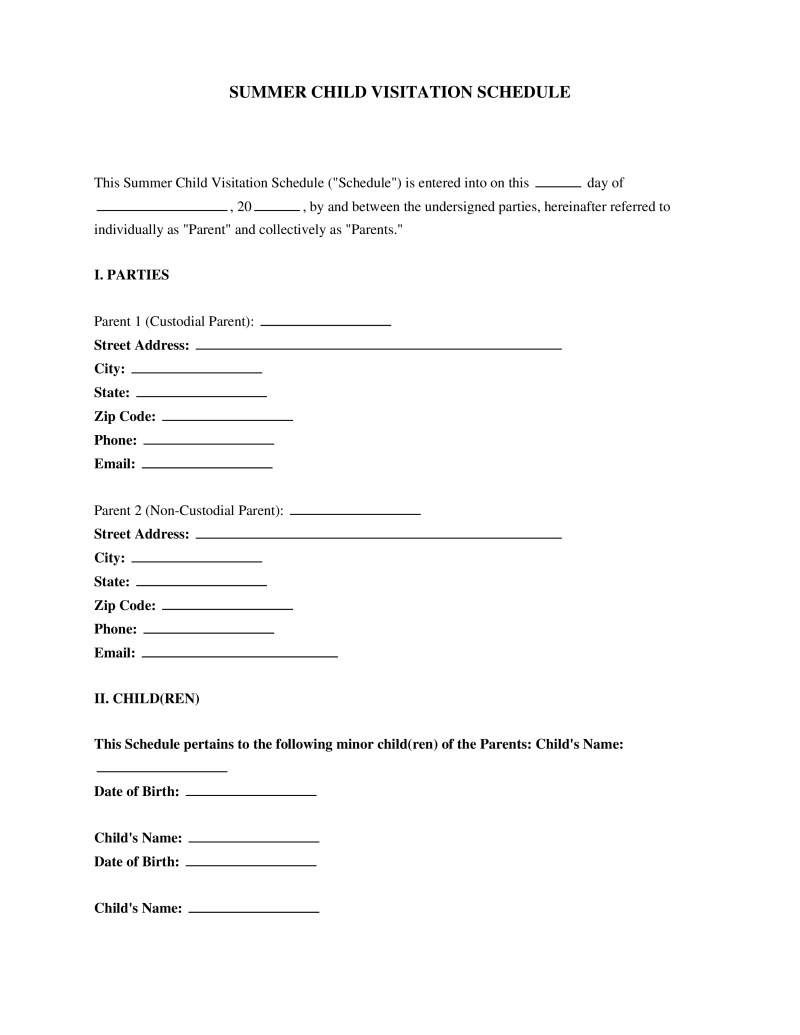
A Summer Visitation Schedule Template is a legal document that outlines the specific arrangement for parental custody and visitation during the summer period.
Visitation Structure
Select the main arrangement for summer visitation. You can add details or exceptions later.
Provide a detailed explanation of the custom or other structure for summer visitation.
Table of Contents
What is a Summer Visitation Schedule Template?
A summer visitation schedule template is a structured document designed to outline the specific periods of time each parent will spend with their children during the summer months. It serves as a practical tool for co-parents to establish a clear and predictable routine for child custody and visitation when children are out of school. This template is particularly valuable in minimizing disputes and providing stability for children by detailing pickup/drop-off times, locations, and communication protocols. It is typically utilized by divorced or separated parents who have existing child custody orders and seek to formalize their arrangements for the summer period.
Legal Requirements and Validity
While a summer visitation schedule template itself is a planning document, its legal enforceability hinges on its integration into a legally binding court order. A template alone, even if agreed upon by both parents, does not carry the weight of law without judicial approval. Courts generally require that any modifications or specific schedules, including those for summer, be formally submitted and approved to become part of the official custody order.
- Judicial Approval - Any summer visitation schedule, whether created from a template or custom-drafted, must be approved by the court to become legally binding and enforceable.
- Clarity and Specificity - Schedules must be clear, unambiguous, and highly specific regarding dates, times, locations, and responsibilities to prevent misunderstandings and future disputes.
- Best Interests of the Child - All visitation schedules, including summer arrangements, must prioritize and reflect the best interests of the child, considering factors such as age, stability, and parental capacity.
- Compliance with Existing Orders - A summer schedule must not contradict or undermine fundamental provisions of the standing child custody order without proper modification procedures.
How to Complete a Summer Visitation Schedule Template
Completing a summer visitation schedule template involves careful consideration of the child's needs and the parents' capacities, aiming for a detailed and workable plan.
- Review Existing Court Orders - Begin by thoroughly reviewing the current child custody order. Understand the existing provisions for holidays, regular visitation, and any specific clauses related to extended breaks from school. This ensures the summer schedule aligns with or appropriately modifies the foundational legal framework.
- Define the Summer Period - Clearly establish the start and end dates of the summer visitation period. This typically aligns with the academic calendar of the child's school district, from the day after the last day of school to the day before the first day of the new school year. Explicitly state these dates to avoid ambiguity.
- Allocate Weeks or Blocks of Time - Determine how the summer weeks will be divided between parents. Common arrangements include alternating weeks, splitting the summer into two large blocks, or allocating specific consecutive weeks to each parent. Consider the child's age and ability to adapt to longer periods away from one parent.
- Address Holidays and Special Events - Integrate any specific summer holidays (e.g., Memorial Day, Fourth of July, Labor Day) or special family events (e.g., family reunions, birthdays) into the schedule. Specify which parent will have the children for these occasions, ensuring these provisions do not conflict with the primary summer allocation.
- Specify Transportation Logistics - Detail how the children will be transported between parents, including who is responsible for pickup and drop-off, the exact times, and the designated locations. Consider long-distance travel arrangements if applicable, and allocate travel costs if not already defined in the existing order.
- Include Communication Protocols - Establish clear guidelines for parent-child communication when the child is with the other parent. This can include specific phone call times, video calls, or other methods, ensuring both parents respect the child's time with the other and facilitate regular contact.
- Seek Legal Review and Court Approval - Once the template is completed and agreed upon by both parents, it is crucial to have it reviewed by legal counsel. The final, agreed-upon schedule should then be submitted to the court for approval to be incorporated into the official child custody order, making it legally enforceable.
Rights and Obligations of Parties Involved
Parents involved in a summer visitation schedule have distinct rights and obligations that are typically derived from the underlying child custody order and state family law statutes. These ensure the child's well-being and the orderly execution of the visitation plan.
- Parental Right to Visitation - Each parent generally has the right to spend time with their child as outlined in the court order, which includes specific summer visitation periods. This right is fundamental to fostering a relationship between parent and child.
- Obligation to Adhere to Schedule - Both parents are legally obligated to follow the summer visitation schedule precisely as ordered by the court. Deviations, particularly without mutual agreement, can lead to legal consequences.
- Obligation to Facilitate Communication - The custodial parent during a visitation period has an obligation to facilitate reasonable communication between the child and the other parent, as specified in the order.
- Right to Information - Both parents typically have the right to access the child's educational and medical records, regardless of whose physical custody the child is in during the summer.
- Obligation for Child's Welfare - Each parent is responsible for the child's health, safety, and general welfare while the child is in their care, including providing adequate supervision, food, shelter, and medical attention.
- Obligation to Inform of Travel - Parents may have an obligation to inform the other parent of significant travel plans with the child, especially if it involves leaving the state or country, often requiring specific notice periods.
Dispute Resolution Mechanisms
Even with a clear summer visitation schedule, disagreements can arise. Various mechanisms exist to resolve these disputes outside of immediate judicial intervention, which can be costly and time-consuming.
- Direct Communication - The initial and often most effective method is direct, respectful communication between parents to clarify misunderstandings or negotiate minor adjustments.
- Mediation - A neutral third-party mediator can assist parents in reaching a mutually agreeable solution. Mediation is non-binding unless the agreement is formalized into a court order and is often a prerequisite before court action.
- Parenting Coordinator - In high-conflict cases, a court may appoint a parenting coordinator to help parents implement court orders, resolve disputes, and make decisions regarding the children.
- Arbitration - Parents can agree to submit their dispute to an arbitrator, who hears both sides and renders a binding decision. This is less formal than court but more structured than mediation.
- Judicial Intervention - If other methods fail, parents may file a motion with the court to enforce or clarify the existing order, or to request a modification of the summer visitation schedule.
Applicable Federal and State Laws
The legal framework governing summer visitation schedules primarily exists at the state level, though certain federal principles and model acts influence interstate custody matters.
Federal Principles and Model Acts
- Uniform Child Custody Jurisdiction and Enforcement Act (UCCJEA) - This model act, adopted by nearly all U.S. states, determines which state has jurisdiction to make or modify child custody and visitation orders, crucial for parents residing in different states (e.g., 28 U.S.C. § 1738A for PKPA, which the UCCJEA aligns with).
- Parental Kidnapping Prevention Act (PKPA) - A federal statute that requires states to give full faith and credit to custody determinations made by other states, preventing interstate parental kidnapping and promoting uniformity in enforcement (28 U.S.C. § 1738A).
State Laws and Requirements
State statutes universally govern the specifics of child custody and visitation, including summer schedules:
- Best Interest of the Child Standard - All state family courts base custody and visitation decisions, including summer schedules, on what is deemed to be in the child's best interest (e.g., Cal. Fam. Code § 3011, N.Y. Dom. Rel. Law § 70).
- Custody and Visitation Statutes - Each state has specific statutes outlining the process for establishing, modifying, and enforcing child custody and visitation orders (e.g., Tex. Fam. Code Ann. § 153.001 et seq., Fla. Stat. § 61.13).
- Modification of Orders - State laws dictate the legal standards and procedures for modifying an existing custody or visitation order, typically requiring a significant change in circumstances and that the modification is in the child's best interest (e.g., 750 Ill. Comp. Stat. 5/610.5).
- Relocation Laws - Many states have specific laws requiring a parent to provide notice to the other parent and/or the court before relocating with a child, especially if the move impacts the visitation schedule (e.g., N.J. Stat. Ann. § 9:2-2).
Penalties for Non-Compliance
Failure to adhere to a court-ordered summer visitation schedule can result in serious legal consequences:
- Contempt of Court - A parent who willfully violates a court order may be found in contempt of court, which can result in fines, make-up visitation time, or even jail time in severe cases.
- Modification of Custody/Visitation - Repeated or egregious violations could lead to the court modifying the existing custody or visitation order, potentially reducing the offending parent's visitation time or changing primary custody.
- Attorney Fees and Costs - The non-compliant parent may be ordered to pay the other parent's attorney fees and court costs incurred in enforcing the order.
- Enforcement Orders - Courts can issue enforcement orders compelling compliance, which may include specific directives for future behavior or supervision of visitation exchanges.
Frequently Asked Questions
Not the form you're looking for?
Try our legal document generator to create a custom document
Disclaimer: The templates available on this website are provided for general informational purposes only and do not constitute legal advice. They are not intended to be, and should not be interpreted as, compliant with any specific legal, regulatory, or privacy requirements. These templates are not a replacement for professional legal guidance and should not be relied upon for any particular matter or circumstance. Users are strongly encouraged to seek advice from a qualified attorney licensed in their jurisdiction before using, modifying, or relying on any template.
All templates are provided on an "as is," "with all faults," and "as available" basis. The provider disclaims any and all warranties of any kind, whether express, implied, statutory, or otherwise, including without limitation warranties of merchantability, fitness for a particular purpose, title, or non-infringement.
LegalTemplates.com makes no guarantees or representations regarding the accuracy, completeness, expected outcomes, or reliability of the materials contained in these templates or any materials referenced or linked from them.