Right of First Refusal Agreement Parenting
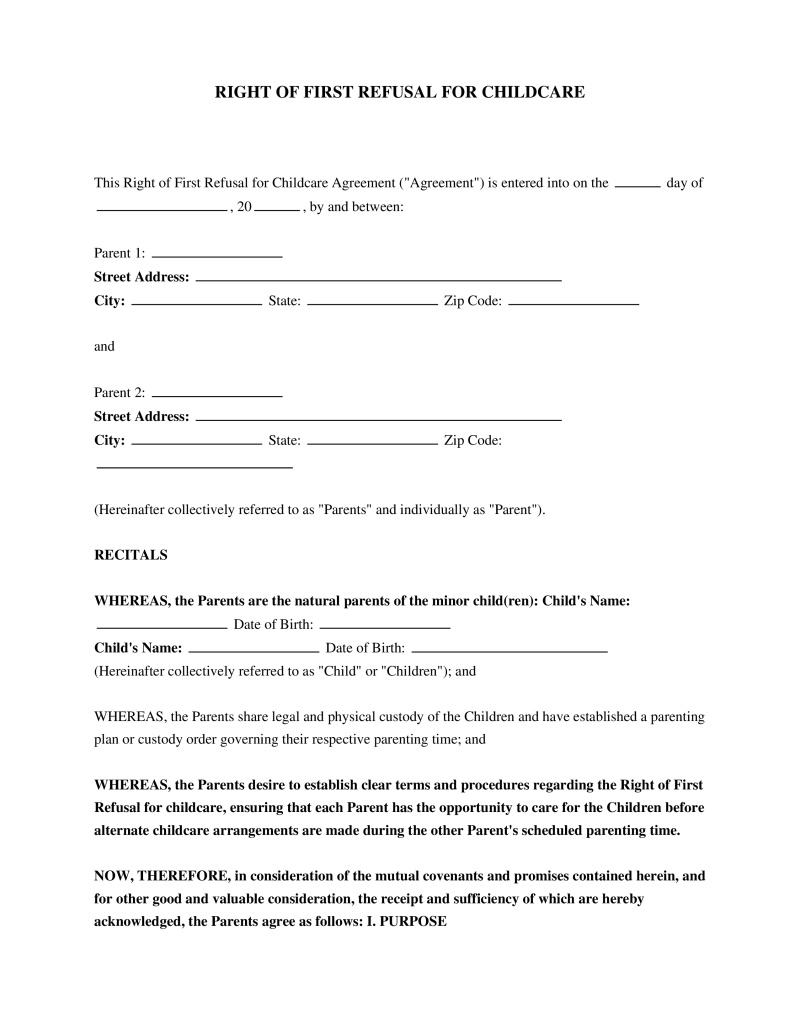
The Right of First Refusal Agreement Parenting document template is a comprehensive legal tool that outlines the terms and conditions for granting a parent the first opportunity to care for their child before seeking alternative arrangements. This document is essential for parents involved in custody or co-parenting situations, ensuring clarity and fairness in decision-making processes regarding childcare responsibilities. By establishing this agreement, parents can maintain a structured and cooperative approach to parenting, minimizing potential conflicts and promoting the best interests of the child. Trusted by 318+ users.
First Refusal Threshold Type
Select the minimum period a parent must be unavailable before the right of first refusal applies.
Provide a clear description of the custom threshold for triggering the right of first refusal.
Table of Contents
What is a Right of First Refusal Agreement Parenting?
A Right of First Refusal Agreement Parenting is a contractual provision, typically integrated into a child custody order or parenting plan, that requires one parent to offer the other parent the opportunity to care for their child before seeking alternative childcare from a third party. This agreement is designed to maximize each parent's time with the child and promote consistent parental involvement when the primary custodial parent is unavailable. It is commonly utilized by divorced or separated parents to ensure that, whenever possible, the child remains under the care of a parent rather than a babysitter, relative, or other non-parental caregiver. The primary purpose is to prioritize parental care and involvement, reinforcing the bond between both parents and the child.
Legal Framework and Validity
The legal enforceability and specific requirements for a Right of First Refusal Agreement Parenting are primarily governed by state family law statutes and judicial precedents. For an agreement to be valid and enforceable, it must typically be clearly articulated in a written document, signed by both parents, and subsequently incorporated into a court-ordered parenting plan or custody decree. Without judicial approval and incorporation, such an agreement may be considered a mere informal understanding between parents, lacking the full weight of legal enforceability.
Courts generally evaluate these agreements based on the overarching standard of the child's best interests. Provisions that are overly burdensome, impractical, or likely to cause significant conflict between parents may be disfavored. Key elements contributing to the validity and effectiveness of such an agreement include:
- Clarity of Terms - The agreement must precisely define the circumstances under which the right of first refusal is triggered, such as specific durations of unavailability (e.g., four hours, overnight stays).
- Notification Procedures - Clear methods and timelines for offering the right of first refusal must be established, including how notice is given (e.g., email, text message) and the required response time from the non-unavailable parent.
- Logistical Considerations - The agreement should address practical aspects like transportation arrangements and who bears the costs associated with exercising the right.
- Emergency Provisions - Specific clauses detailing exceptions for genuine emergencies or situations where immediate childcare is required may be included.
- Integration into Court Order - For full legal standing, the agreement must be formally adopted and made part of the official custody or parenting order by a court.
Rights and Obligations of Parties Involved
A Right of First Refusal Agreement Parenting establishes distinct rights and obligations for both the parent who is temporarily unavailable (the 'offering parent') and the parent who is offered the opportunity to care for the child (the 'refusing parent'). Adherence to these defined roles is crucial for the agreement's effective operation and for minimizing potential disputes.
The offering parent holds the obligation to notify the other parent when they anticipate being unavailable for a specified period and require childcare. This notification must be timely, allowing the refusing parent adequate time to respond and make arrangements. The offering parent must also provide accurate information regarding the duration of their unavailability and any relevant details about the child's needs during that time. Their right is to expect a timely response and, if the offer is declined, to then seek alternative third-party care without further obligation to the other parent for that specific instance.
The refusing parent has the right to accept or decline the offer of childcare within the stipulated timeframe. If they accept, they assume the responsibility for the child's care for the specified period, adhering to the terms of the parenting plan regarding supervision, activities, and general well-being. If they decline the offer or fail to respond within the agreed-upon period, they waive their right to care for the child during that particular unavailability. The refusing parent's obligation is to communicate their decision clearly and promptly, preventing delays for the offering parent in securing alternative arrangements.
How to Complete a Right of First Refusal Agreement Parenting
Creating a comprehensive and effective Right of First Refusal Agreement Parenting involves several key steps to ensure clarity, enforceability, and applicability to the specific family's circumstances.
- Define the Triggering Conditions and Duration - Clearly specify the exact circumstances that activate the right of first refusal. This includes establishing a minimum duration of unavailability (e.g., four hours, six hours, or overnight stays) that would require the offering parent to contact the other parent. Consider scenarios like school closures, vacation periods, or simple errands to determine when the provision should apply.
- Establish a Clear Notification Process - Determine the method and timeframe for communication. Parents should agree on how notice will be given (e.g., email, text message, phone call) and how much advance notice is required before the unavailability (e.g., 24 hours, 48 hours). The agreement should also specify what information must be included in the notice, such as the exact start and end times of unavailability.
- Set Response Timelines for the Refusing Parent - Outline how long the refusing parent has to accept or decline the offer after receiving notification. A typical response window might be 12-24 hours, depending on the urgency and duration of the proposed childcare. Clearly state that failure to respond within this timeframe constitutes a refusal of the offer.
- Address Logistical Details and Transportation - Plan for practical aspects such as who is responsible for transporting the child to and from each parent's home if the right is exercised. Consider who bears the cost of transportation and how hand-offs will occur. This helps prevent conflicts over minor but frequent logistical challenges.
- Include Specific Exceptions and Exclusions - Identify situations where the right of first refusal might not apply. Common exceptions include care provided by immediate family members (e.g., grandparents, aunts/uncles) for short periods, emergency situations where immediate care is needed, or when a parent is unavailable for a very brief duration that falls below the agreed-upon trigger threshold.
- Integrate into the Official Parenting Plan - Once drafted, the agreement must be formally presented to the court and incorporated into the existing or new child custody order or parenting plan. This step is crucial for the agreement to become legally binding and enforceable, allowing for judicial intervention if either parent fails to comply with its terms.
Federal and State Laws Governing Parenting Agreements
While no single federal statute directly governs the specific mechanics of a Right of First Refusal Agreement Parenting, the broader legal framework for child custody and parenting plans falls under state jurisdiction. Federal laws may indirectly influence certain aspects of family life, but the direct authority for these agreements resides with individual states.
- Uniform Child Custody Jurisdiction and Enforcement Act (UCCJEA) - This model act, adopted in some form by nearly all U.S. states, establishes clear rules for determining which state has jurisdiction to make or modify child custody orders. It ensures that custody orders are recognized and enforced across state lines, providing a framework within which parenting agreements, including right of first refusal clauses, can operate consistently (e.g., Cal. Fam. Code § 3400 et seq.; N.Y. Dom. Rel. Law § 75-a et seq.).
- State Domestic Relations Statutes - Each state has comprehensive statutes governing divorce, child custody, and support. These laws empower courts to create parenting plans that prioritize the child's best interests, and it is within these statutes that provisions for a right of first refusal are typically authorized and enforced. These statutes often outline factors courts consider when determining custody and visitation, which implicitly supports agreements that maximize parental involvement (e.g., Fla. Stat. § 61.13; Tex. Fam. Code Ann. § 153.001 et seq.).
- Best Interest of the Child Standard - This fundamental legal principle is paramount in all child custody and visitation decisions across every state. Courts will only approve or enforce a Right of First Refusal Agreement Parenting if it aligns with and promotes the child's overall well-being, stability, and relationship with both parents. Provisions that create unnecessary conflict or instability for the child are generally disfavored.
Penalties for non-compliance with a court-ordered Right of First Refusal Agreement Parenting can vary depending on state law and the specific terms of the order. Generally, a parent who violates such an agreement may face legal consequences, which could include:
- Contempt of Court - A parent who willfully disregards a court order can be found in contempt, potentially leading to fines, orders to pay the other parent's attorney fees, or even, in rare and extreme cases, incarceration.
- Modification of Parenting Plan - Repeated or egregious violations could lead the court to modify the existing parenting plan, potentially altering custody schedules or other provisions to ensure future compliance and protect the child's best interests.
- Loss of Future Opportunities - While not a direct legal penalty, a pattern of non-compliance by one parent might lead the court to view that parent as less cooperative or reliable in co-parenting matters, which could influence future judicial decisions.
Frequently Asked Questions
Not the form you're looking for?
Try our legal document generator to create a custom document
Disclaimer: The templates available on this website are provided for general informational purposes only and do not constitute legal advice. They are not intended to be, and should not be interpreted as, compliant with any specific legal, regulatory, or privacy requirements. These templates are not a replacement for professional legal guidance and should not be relied upon for any particular matter or circumstance. Users are strongly encouraged to seek advice from a qualified attorney licensed in their jurisdiction before using, modifying, or relying on any template.
All templates are provided on an "as is," "with all faults," and "as available" basis. The provider disclaims any and all warranties of any kind, whether express, implied, statutory, or otherwise, including without limitation warranties of merchantability, fitness for a particular purpose, title, or non-infringement.
LegalTemplates.com makes no guarantees or representations regarding the accuracy, completeness, expected outcomes, or reliability of the materials contained in these templates or any materials referenced or linked from them.