Nesting Agreement Template
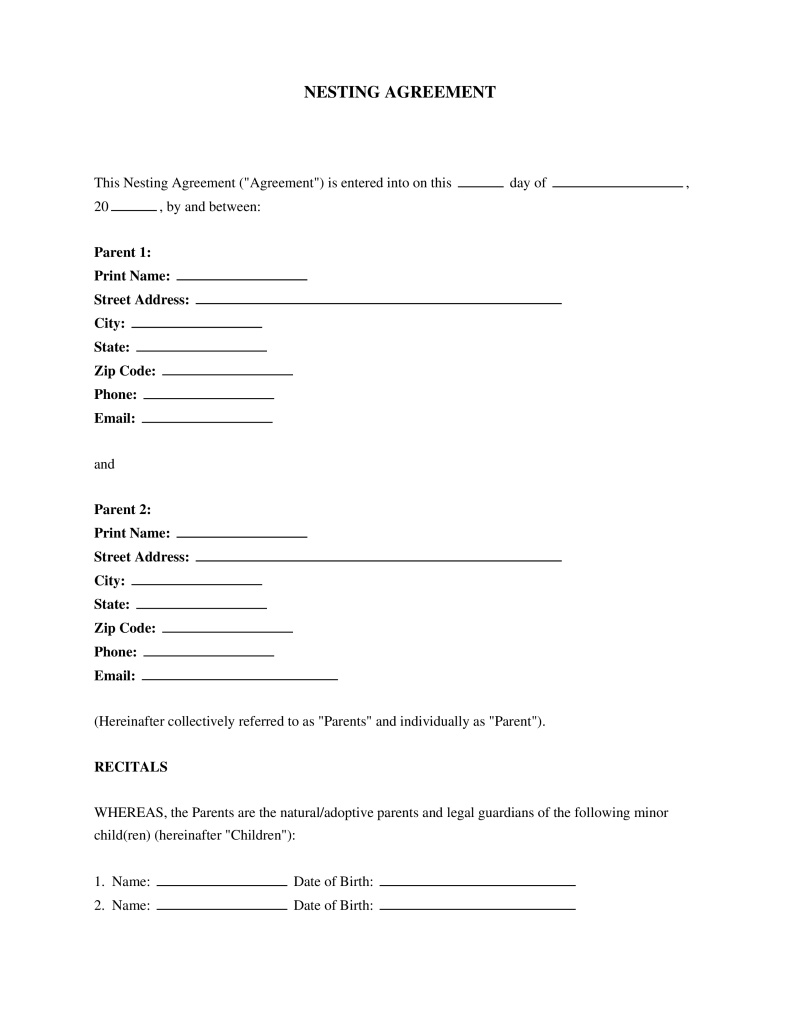
A Nesting Agreement is a legal document outlining arrangements for co-parenting where children remain in the family home while parents alternate residency.
Nesting Arrangement Start Date
Enter the date when the nesting arrangement will begin.
Table of Contents
What is a Nesting Agreement Template?
A nesting agreement template is a standardized legal document used by divorcing or separated parents to establish a co-parenting arrangement where children remain in the family home, and the parents rotate in and out of the residence. This unique custody model, often referred to as "bird-nesting," aims to minimize disruption for children by maintaining their stability within a single home environment. The template provides a structured framework for outlining parental responsibilities, financial contributions, scheduling, and conflict resolution, helping to formalize the terms of this unconventional living arrangement.
Purpose and Benefits of Nesting
The primary purpose of a nesting agreement is to prioritize the children's well-being during and after parental separation. By allowing children to remain in the familiar family home, it mitigates some of the common stressors associated with divorce, such as moving between two different households, changing schools, or leaving established social networks. This approach can provide a sense of continuity and stability during a tumultuous period in their lives.
Beyond child-centric benefits, nesting can also offer advantages for parents. It may reduce the immediate financial burden of establishing two separate fully-equipped households, as parents might share the costs of maintaining the primary residence. It can also serve as a transitional arrangement, allowing parents time to adjust to their new co-parenting dynamic before committing to more permanent housing solutions. The structured nature of a nesting agreement template helps ensure that all aspects of this complex arrangement are clearly defined and agreed upon.
Key Provisions of a Nesting Agreement Template
A comprehensive nesting agreement template typically addresses various practical and legal aspects to ensure the arrangement functions smoothly. These provisions are crucial for preventing misunderstandings and providing a clear roadmap for co-parenting within the nesting model. Key elements often include:
- Parental Schedule and Rotation - Defines the specific days, weeks, or periods each parent will reside in the family home with the children, including provisions for holidays, vacations, and special events.
- Financial Responsibilities - Outlines how household expenses, such as mortgage/rent, utilities, groceries, maintenance, and children's activity costs, will be divided and paid by each parent.
- Maintenance and Upkeep of the Home - Specifies responsibilities for cleaning, repairs, yard work, and general upkeep of the family residence, ensuring it remains a suitable living environment for the children.
- Child Rearing Decisions - Establishes how major decisions regarding the children's education, healthcare, religious upbringing, and extracurricular activities will be made, often requiring joint consultation.
- Rules for Parental Time Outside the Nest - Addresses where parents will reside when not in the family home, including expectations regarding visitors, romantic partners, and personal belongings.
- Communication Protocols - Sets forth guidelines for how parents will communicate about the children and household matters, promoting effective and respectful interaction.
- Conflict Resolution Mechanisms - Specifies procedures for resolving disputes that may arise, such as mediation or arbitration, to avoid litigation and maintain a cooperative co-parenting relationship.
- Duration and Review - Defines the intended length of the nesting arrangement and includes provisions for periodic review or modification as the children's needs or parental circumstances change.
- Exit Strategy - Outlines the conditions or timeline under which the nesting arrangement will terminate and how the family home will be handled (e.g., sold, one parent buys out the other).
How to Complete a Nesting Agreement Template
Completing a nesting agreement template requires careful consideration and open communication between parents. While a template provides structure, the specific details must be tailored to the unique circumstances of each family. The process generally involves several key steps:
- Review and Understand the Template - Begin by thoroughly reading the entire nesting agreement template to familiarize yourself with its sections and standard clauses. Identify areas that require specific information, such as names, dates, and financial figures, and note any provisions that may need modification or additional detail to suit your family's particular situation.
- Gather Necessary Information - Collect all relevant financial documents, including income statements, household bills, and children's expense records. Have a clear understanding of your current custody schedule, if one is already in place, and consider the children's school and activity schedules to inform the nesting rotation.
- Negotiate Key Terms with Co-Parent - Engage in open and honest discussions with your co-parent regarding each provision of the agreement. This includes defining the exact nesting schedule, allocating financial responsibilities for the home and children, establishing rules for household maintenance, and agreeing on communication methods. Consider seeking professional guidance from a mediator or family therapist to facilitate these discussions, especially if disagreements arise.
- Draft Specific Clauses - Populate the template with the agreed-upon details. Be precise in defining schedules, monetary contributions, and responsibilities. For example, specify exact dates for parent rotations, precise percentages or fixed amounts for expense sharing, and clear guidelines for household chores. Ambiguity can lead to future disputes, so clarity is paramount.
- Address Contingencies and Future Changes - Include provisions for unforeseen circumstances, such as a parent needing to travel unexpectedly, a child's illness, or significant changes in a parent's financial situation. Also, establish a clear process for reviewing and modifying the agreement as children grow or parental circumstances evolve, perhaps on an annual basis or at specific milestones.
- Seek Legal Review and Signature - Once the template is filled out and both parents agree on all terms, it is highly recommended to have the document reviewed by independent legal counsel for each parent. Attorneys can ensure the agreement is legally sound, enforceable, and protects the rights and interests of both parties. After legal review, both parents must sign the agreement, typically in the presence of a notary public, to formalize it.
Legal Considerations and Validity
A nesting agreement, while a private contract between parents, operates within the broader framework of family law. Its legal validity and enforceability are often contingent upon its alignment with state statutes concerning child custody, support, and property division. Courts typically review such agreements to ensure they are in the best interests of the children involved.
While a nesting agreement template itself is not a court order, it can be incorporated into a formal parenting plan or divorce decree, making its terms legally binding. Without court approval, it primarily serves as a contractual agreement between the parents, enforceable like other private contracts, but potentially subject to modification if a court determines it is not serving the children's best interests.
Applicable Laws and Regulations
Nesting agreements are primarily governed by state family law, which varies significantly from one jurisdiction to another. While no specific federal law directly mandates or prohibits nesting arrangements, certain federal principles related to child welfare and parental rights may indirectly apply. State laws, however, are directly relevant:
Federal Considerations
- Full Faith and Credit Clause - Requires states to respect the public acts, records, and judicial proceedings of every other state, meaning a custody order incorporating a nesting agreement from one state is generally recognized in others (U.S. Constitution, Article IV, Section 1).
- Parental Kidnapping Prevention Act (PKPA) - Establishes uniform standards for determining jurisdiction in interstate child custody disputes, helping to prevent parents from crossing state lines to obtain a more favorable custody order (28 U.S.C. § 1738A).
State Laws and Requirements
State statutes primarily dictate the legal landscape for nesting agreements:
- Child Custody Statutes - Most states have comprehensive laws outlining factors for determining legal and physical custody, which would apply when a court reviews or incorporates a nesting agreement (e.g., California Family Code § 3040 et seq.; New York Domestic Relations Law § 240).
- Child Support Guidelines - State laws provide formulas and guidelines for calculating child support, which must be considered even in nesting arrangements where parents share expenses (e.g., Uniform Marriage and Divorce Act, adopted in various forms by many states).
- Best Interests of the Child Standard - All custody and parenting plan decisions, including those involving nesting, must ultimately serve the best interests of the child, a paramount legal principle in every state (e.g., Florida Statute § 61.13).
- Mediation Requirements - Many states encourage or mandate mediation for divorcing parents to reach agreements on custody and parenting plans, which can be particularly useful for complex arrangements like nesting (e.g., Texas Family Code § 153.0071).
Penalties for Non-Compliance
If a nesting agreement has been incorporated into a court order, failure to comply with its terms can lead to significant legal consequences. These can include:
- Contempt of Court - A parent who violates a court-ordered nesting agreement may be found in contempt of court, potentially resulting in fines, make-up parenting time, or even jail time in severe or repeated cases.
- Modification of Custody Order - Persistent non-compliance or a demonstration that the nesting arrangement is no longer in the children's best interests can lead to a court modifying the entire custody order, potentially changing the physical or legal custody arrangement.
- Sanctions and Attorney Fees - Courts may impose monetary sanctions on a non-compliant parent or order them to pay the other parent's attorney fees incurred in enforcing the agreement.
Even if not formally ordered by a court, a breach of a private nesting agreement could be pursued as a breach of contract, though remedies might be more limited than those for violating a court order.
Frequently Asked Questions
Not the form you're looking for?
Try our legal document generator to create a custom document
Disclaimer: The templates available on this website are provided for general informational purposes only and do not constitute legal advice. They are not intended to be, and should not be interpreted as, compliant with any specific legal, regulatory, or privacy requirements. These templates are not a replacement for professional legal guidance and should not be relied upon for any particular matter or circumstance. Users are strongly encouraged to seek advice from a qualified attorney licensed in their jurisdiction before using, modifying, or relying on any template.
All templates are provided on an "as is," "with all faults," and "as available" basis. The provider disclaims any and all warranties of any kind, whether express, implied, statutory, or otherwise, including without limitation warranties of merchantability, fitness for a particular purpose, title, or non-infringement.
LegalTemplates.com makes no guarantees or representations regarding the accuracy, completeness, expected outcomes, or reliability of the materials contained in these templates or any materials referenced or linked from them.