Long Distance Parenting Plan Template
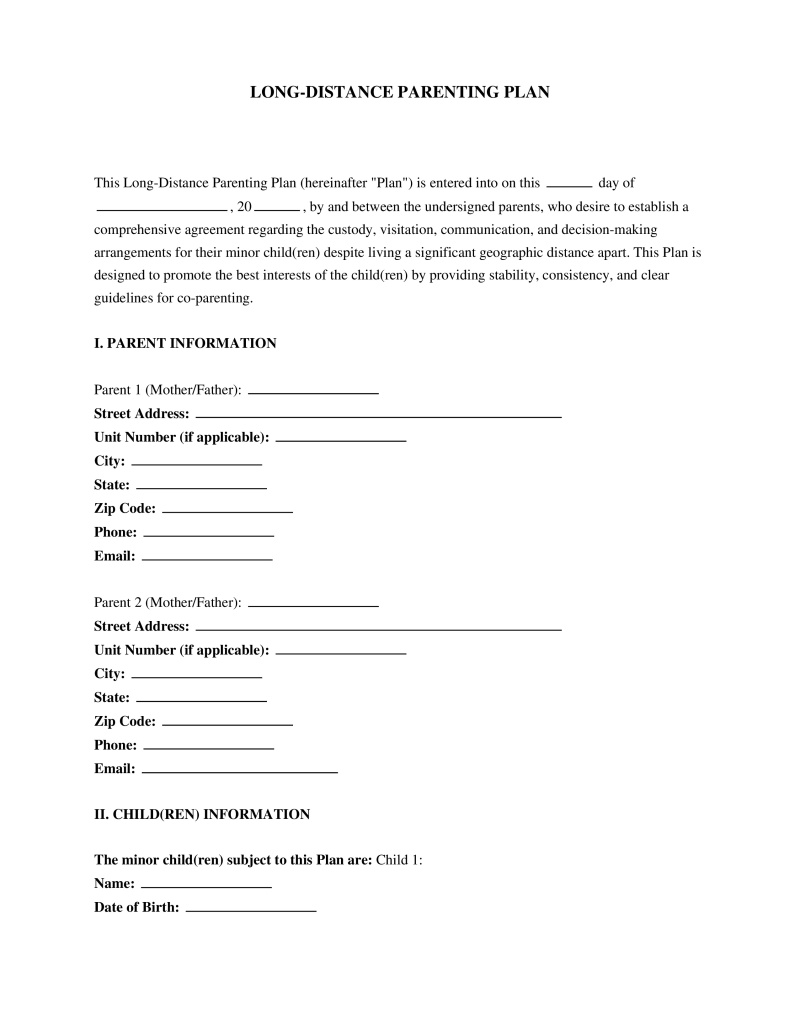
A Long Distance Parenting Plan Template is a legal document that outlines co-parenting arrangements for children when parents reside in different geographical locations, addressing custody, visitation, and communication protocols.
Parenting Plan Type
Select the arrangement that best describes your intended custody structure.
Provide details if your arrangement does not fit the listed options.
Table of Contents
What is a Long Distance Parenting Plan Template?
A long distance parenting plan template is a structured legal document designed to outline the responsibilities and arrangements for co-parenting when parents reside a significant geographical distance from each other. Its primary purpose is to establish clear guidelines for child custody, visitation schedules, communication protocols, and decision-making processes, ensuring the child's well-being and consistent parental involvement despite the physical separation. This template serves as a foundational framework for parents, often in conjunction with legal counsel, to create a customized and legally enforceable agreement that addresses the unique challenges of long-distance co-parenting.
How to Complete a Long Distance Parenting Plan Template
Completing a long distance parenting plan template requires careful consideration of various factors to ensure it effectively addresses the unique needs of the children and parents involved. The following steps provide a structured approach to filling out such a template:
- Gather Essential Information - Begin by collecting all necessary personal details for both parents and all children, including full legal names, dates of birth, current addresses, and contact information. It is also crucial to identify any existing court orders related to custody or child support, as the new plan must align with or supersede these. Consider the child's age, school schedule, extracurricular activities, and any special needs, as these will heavily influence scheduling decisions.
- Outline the Custody and Visitation Schedule - Detail the specific times and dates when each parent will have the children. For long-distance plans, this typically involves extended visits during school breaks, holidays, and summer vacation. Clearly define the start and end dates for each visitation period, specifying whether exchanges occur on a weekday or weekend, and how holidays will be rotated in odd and even years.
- Address Transportation Arrangements - Clearly define who is responsible for transporting the children to and from visits, including the specific mode of transportation (e.g., car, plane, train). The plan should specify how the costs of transportation will be shared between parents, whether equally or proportionally based on income, and detail who will accompany the child if air travel is involved, especially for younger children.
- Establish Communication Protocols - Outline how and when each parent will communicate with the children during the other parent's custody time. Specify preferred methods (e.g., phone calls, video calls, email) and the frequency and duration of these communications. It is important to establish rules that prevent one parent from interfering with the other parent's communication with the children.
- Define Decision-Making Responsibilities - Determine how major decisions regarding the children's education, healthcare, religious upbringing, and extracurricular activities will be made. The plan should specify whether parents will have joint legal custody, requiring mutual agreement, or if one parent will have sole decision-making authority in certain areas. Include provisions for emergency medical decisions.
- Address Financial Responsibilities - While child support is often determined by separate court orders, the parenting plan can specify how additional costs related to the children's needs, such as medical expenses not covered by insurance, educational fees, or extracurricular activities, will be shared. This section ensures clarity beyond basic child support obligations.
- Include Dispute Resolution Mechanisms - Incorporate a clause outlining how disagreements between parents regarding the parenting plan will be resolved. Common methods include mediation, arbitration, or seeking court intervention as a last resort. Specifying this process can help prevent future conflicts from escalating.
- Review and Seek Legal Counsel - Before finalizing, thoroughly review the entire document to ensure clarity, completeness, and enforceability. It is highly recommended to seek legal advice from an attorney specializing in family law. A lawyer can ensure the plan complies with state laws, protects parental rights, and is in the best interests of the children.
Legal Requirements and Validity of a Long Distance Parenting Plan Template
For a long distance parenting plan template to be legally valid and enforceable, it must meet specific criteria, which often vary by jurisdiction but share common principles rooted in family law. The overarching standard applied by courts is the "best interests of the child," meaning all provisions within the plan must prioritize the child's welfare, safety, and development. Courts typically scrutinize these plans to ensure they provide stability, support healthy parent-child relationships, and address practical logistics effectively.
Key legal requirements typically include:
- Court Approval - A parenting plan, whether for long-distance or local arrangements, generally requires approval by a family court to become a legally binding order. This involves filing the completed plan with the court and, in many jurisdictions, attending a hearing where a judge reviews its contents. The court's stamp of approval makes the plan enforceable by law.
- Clarity and Specificity - The plan must be written in clear, unambiguous language, leaving no room for misinterpretation. Vague terms or general statements can lead to disputes and make enforcement difficult. Specific details regarding dates, times, locations, and responsibilities are crucial.
- Signatures and Notarization - Both parents must sign the parenting plan. In many states, these signatures must be notarized, attesting to the authenticity of the signatures and confirming that the parties signed voluntarily. This adds a layer of legal formality to the document.
- Compliance with State Law - The content of the parenting plan must adhere to the specific family law statutes of the state where the child's primary residence is established or where the divorce/custody case originated. This includes provisions on child support, relocation, and parental rights and responsibilities.
- Best Interests of the Child Standard - Every aspect of the plan must demonstrably serve the child's best interests. This includes considerations such as the child's emotional and physical needs, their relationship with each parent, their preference (if age-appropriate), stability, and continuity of care.
Rights and Obligations of Parties Involved
A long distance parenting plan delineates the specific rights and obligations of both parents and, indirectly, the rights of the child, ensuring a structured approach to co-parenting across geographical divides. Adherence to these provisions is crucial for the plan's success and for maintaining stability for the children involved.
The rights and obligations include:
- Parental Rights - Each parent typically retains rights to access information concerning the child's health, education, and welfare, regardless of who has physical custody at a given time. This includes the right to attend school events, medical appointments, and extracurricular activities. Parents also have the right to regular communication with their child during the other parent's custodial time, as outlined in the plan.
- Parental Obligations - Both parents are obligated to adhere strictly to the established visitation schedule, including ensuring the child is ready for exchanges and facilitating transportation as agreed. Parents must communicate effectively and respectfully about the child's needs, health, and academic progress. They are also obligated to financially support the child, often through formal child support payments, and to share other agreed-upon expenses.
- Child's Rights - Children have the fundamental right to maintain a relationship with both parents, a right that a long distance parenting plan aims to protect and facilitate. They have the right to stability, safety, and an environment conducive to their development, free from parental conflict. The plan ensures they receive adequate care, education, and emotional support from both parents.
- Obligations Regarding Communication - Parents are obligated to facilitate communication between the child and the non-custodial parent, ensuring that scheduled calls or video chats occur without interference. They must also inform each other of significant events or emergencies involving the child in a timely manner.
- Decision-Making Obligations - When joint legal custody is established, both parents are obligated to consult and agree on major decisions affecting the child's life, such as medical treatments, educational choices, and religious upbringing. Failure to consult or unilateral decision-making can be a violation of the parenting plan.
Applicable Federal and State Laws
The enforceability and structure of a long distance parenting plan are heavily influenced by a combination of federal and state laws, particularly those designed to address interstate custody matters and ensure the best interests of the child. Understanding these legal frameworks is essential for creating a robust and legally sound plan.
Several federal laws govern this document type and related custody matters:
- Parental Kidnapping Prevention Act (PKPA) - This federal law gives full faith and credit to child custody determinations made by courts of other states, preventing parents from taking children across state lines to seek a more favorable custody order (28 U.S.C. § 1738A). It aims to deter parental abduction and ensure judicial economy in interstate custody disputes.
- Uniform Child Custody Jurisdiction and Enforcement Act (UCCJEA) - While not a federal law, the UCCJEA is a uniform act adopted by nearly all U.S. states. It establishes clear rules for determining which state has jurisdiction to make or modify child custody orders, preventing jurisdictional conflicts and promoting the enforceability of orders across state lines. The UCCJEA prevents forum shopping by parents (e.g., Uniform Child Custody Jurisdiction and Enforcement Act (UCCJEA) § 201 et seq., as adopted by individual states).
State-specific regulations typically address:
- Best Interests of the Child Statutes - All states have statutes that mandate courts prioritize the child's best interests when making custody and visitation decisions. These statutes often list factors for judges to consider, such as the child's wishes, parental capacity, and the child's adjustment to their home, school, and community (e.g., [State] Family Code § [Number] or [State] Statutes § [Number]).
- Parenting Plan Requirements - Many states specify mandatory elements that must be included in any parenting plan, whether long-distance or local. These often cover schedules, decision-making, dispute resolution, and communication. Some states may require specific language or forms (e.g., [State] Rules of Civil Procedure Rule [Number]).
- Relocation Laws - When one parent seeks to move a significant distance, state laws often require notice to the other parent and, in some cases, court approval, especially if the move impacts the existing parenting plan. These laws aim to protect the non-relocating parent's visitation rights (e.g., [State] Statutes on Parental Relocation § [Number]).
- Enforcement and Penalties for Non-Compliance - Courts have mechanisms to enforce parenting plans. If a parent fails to comply with a court-ordered long distance parenting plan, they may face various penalties, including contempt of court charges, fines, orders to pay the other parent's attorney fees, or even modifications to the custody order (e.g., [State] Civil Procedure Code § [Number]). Repeated or egregious violations can lead to changes in custody arrangements, potentially reducing the non-compliant parent's visitation time or decision-making authority.
Frequently Asked Questions
Not the form you're looking for?
Try our legal document generator to create a custom document
Disclaimer: The templates available on this website are provided for general informational purposes only and do not constitute legal advice. They are not intended to be, and should not be interpreted as, compliant with any specific legal, regulatory, or privacy requirements. These templates are not a replacement for professional legal guidance and should not be relied upon for any particular matter or circumstance. Users are strongly encouraged to seek advice from a qualified attorney licensed in their jurisdiction before using, modifying, or relying on any template.
All templates are provided on an "as is," "with all faults," and "as available" basis. The provider disclaims any and all warranties of any kind, whether express, implied, statutory, or otherwise, including without limitation warranties of merchantability, fitness for a particular purpose, title, or non-infringement.
LegalTemplates.com makes no guarantees or representations regarding the accuracy, completeness, expected outcomes, or reliability of the materials contained in these templates or any materials referenced or linked from them.