Holiday Parenting Schedule Template
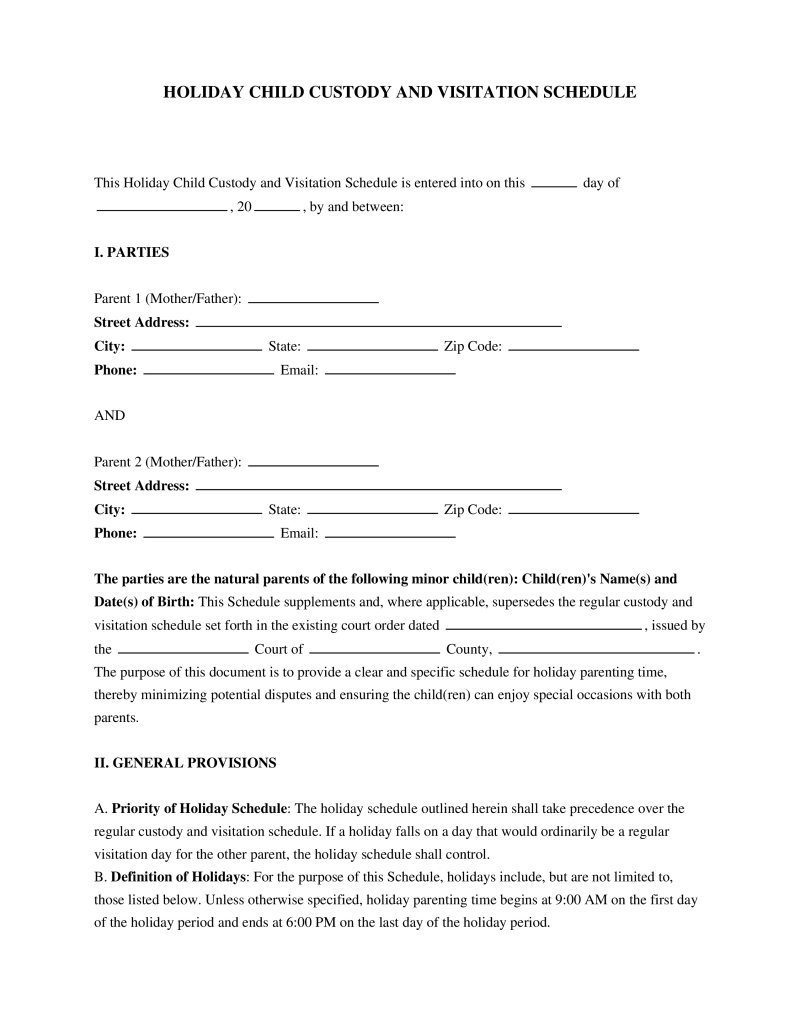
A Holiday Parenting Schedule Template is a legal document that outlines specific arrangements for child custody and visitation during designated holidays and special occasions.
Schedule Type
Choose whether you want to create a recurring annual holiday schedule, a one-time holiday schedule, or a combination.
Table of Contents
What is a Holiday Parenting Schedule Template?
A holiday parenting schedule template is a structured document designed to outline the specific arrangements for children's time with each parent during holidays, school breaks, and special occasions following a divorce or separation. Its primary purpose is to provide clarity and predictability, minimizing potential conflicts and ensuring that both parents and children understand the expectations for these significant periods. This template is typically used by co-parents, often as an attachment to a broader parenting plan or custody order, to formalize agreed-upon holiday visitation schedules and reduce ambiguity.
Legal Framework and Purpose
The creation and implementation of a holiday parenting schedule template are firmly rooted in family law, serving as a critical component of a comprehensive parenting plan. These schedules are often incorporated into legally binding court orders, making adherence mandatory for both parents. The primary objective is to ensure the children's best interests are served by providing stability, routine, and meaningful time with both parents during culturally significant and celebratory times.
Rights and Obligations of Parties Involved
Both parents and the children themselves possess distinct rights and obligations within the framework of a holiday parenting schedule. Understanding these roles is crucial for successful co-parenting and compliance with legal mandates.
- Parental Right to Time - Each parent generally has a legal right to spend time with their children, including during holidays, as specified in a court order. This right is balanced by the children's needs and the specifics of the parenting plan.
- Obligation to Adhere to Orders - Parents are legally obligated to follow the holiday parenting schedule as outlined in the court order. Deviation without mutual agreement or court approval can lead to legal consequences.
- Obligation to Facilitate Visitation - The custodial parent is typically responsible for facilitating the child's transfer and ensuring they are prepared for time with the other parent according to the schedule.
- Right to Stability for Children - Children have a fundamental right to stability and predictability in their living arrangements, especially during holidays, which a clear schedule aims to provide.
- Right to Safety and Well-being - Both parents have an obligation to ensure the child's safety and well-being during their scheduled time, regardless of the holiday.
- Communication Obligation - Parents are often obligated to communicate effectively and respectfully regarding schedule changes, transportation, and other logistical details to ensure smooth transitions for the children.
How to Complete a Holiday Parenting Schedule Template
Developing a comprehensive holiday parenting schedule requires careful consideration and detailed planning. The following steps outline a common process for completing such a template, aiming to create a clear and enforceable document.
- Gather Existing Orders and Information - Begin by reviewing any existing custody orders, parenting plans, or divorce decrees. Note down current residential schedules, transportation agreements, and any specific clauses related to holidays or school breaks. It is also important to consider the children's school calendar and any fixed family traditions.
- Identify Key Holidays and School Breaks - Create a comprehensive list of all relevant holidays, including federal holidays, religious observances, cultural celebrations, and school breaks such as winter, spring, and summer vacations. This initial list ensures no important dates are overlooked and provides a foundation for allocation.
- Determine Allocation Method for Each Holiday - Decide how each holiday will be divided or rotated. Common methods include alternating holidays year to year, assigning specific holidays to one parent annually, or dividing longer breaks (e.g., splitting summer vacation). Consider the children's ages and the distance between parents when making these decisions.
- Specify Exchange Times and Locations - For each scheduled holiday period, clearly define the exact date, time, and location for the children's exchange. These details should be precise to prevent misunderstandings and reduce potential conflicts. Public, neutral locations or specific residential addresses can be designated.
- Address Transportation Responsibilities - Clearly outline which parent is responsible for transportation for each exchange, or if responsibilities will be shared. Specify who picks up and who drops off, and if there are any provisions for long-distance travel, such as flight arrangements or costs. Detail how travel expenses will be divided, if applicable.
- Include Communication Protocols - Establish clear guidelines for communication during holiday periods when children are with the other parent. This may include rules about phone calls, video chats, and emergency contact procedures, ensuring both parents can maintain contact and address urgent matters.
- Outline Provisions for Unforeseen Circumstances and Flexibility - While a schedule aims for certainty, life events can necessitate changes. Include clauses for how unforeseen circumstances (e.g., illness, travel delays) will be handled. Specify how and when parents can mutually agree to deviate from the schedule and the process for documenting such agreements.
- Review, Finalize, and Formalize - Once all details are drafted, review the entire schedule for clarity, completeness, and fairness with the other parent, or through mediation if necessary. Ensure all dates, times, and responsibilities are unambiguous. This finalized document should then be incorporated into a legal parenting plan or court order to become legally binding.
Key Considerations for Effective Schedules
An effective holiday parenting schedule is one that is not only legally sound but also practical and adaptable to the evolving needs of the children and parents. Several factors contribute to the long-term success of such a plan.
- Children's Age and Developmental Stage - The needs of an infant differ significantly from those of a teenager. Schedules should consider whether frequent transitions are appropriate for younger children or if older children have input on holiday plans.
- Geographic Distance Between Parents - When parents live far apart, frequent exchanges may be impractical. Schedules for long-distance parenting often involve longer blocks of time during major holidays and school breaks, potentially with fewer, but extended, visits.
- Religious and Cultural Observances - The schedule should respectfully accommodate the religious and cultural traditions of both parents and the children. This may involve specific arrangements for holidays like Christmas, Hanukkah, Eid, Diwali, or other significant cultural events.
- Flexibility Versus Strict Adherence - While a clear schedule is vital, an overly rigid plan can be counterproductive. The most successful co-parenting relationships often allow for some flexibility, provided both parents communicate effectively and agree on changes in advance.
- Future Review and Modification Clauses - Children's needs change over time. An effective schedule includes provisions for periodic review or modification, allowing parents to revisit and adjust the plan as children grow older, circumstances change, or new traditions emerge.
- School and Extracurricular Activities - Holiday schedules should account for children's academic calendars, including school breaks, and any important extracurricular activities or commitments that may overlap with scheduled parenting time.
Applicable Laws and Enforcement
Holiday parenting schedules, as components of broader custody orders, are subject to various federal and state laws that govern family relations, judicial authority, and interstate recognition.
Federal Considerations
While specific federal statutes directly dictating holiday parenting schedules are limited, overarching constitutional principles and uniform acts adopted by states provide a framework for their enforcement, especially across state lines.
- Full Faith and Credit Clause - This constitutional provision requires states to respect the "public acts, records, and judicial proceedings of every other state" (U.S. Constitution, Article IV, Section 1). This means a custody order, including its holiday schedule, legally issued in one state must generally be recognized and enforced by courts in other states.
- Uniform Child Custody Jurisdiction and Enforcement Act (UCCJEA) - Adopted by nearly all U.S. states, the UCCJEA is a uniform act designed to prevent jurisdictional conflicts in interstate child custody disputes. It establishes rules for determining which state has jurisdiction to make or modify custody orders, including holiday schedules, and facilitates the enforcement of custody orders across state lines.
State Laws and Requirements
State laws primarily govern the creation, content, and enforcement of holiday parenting schedules, typically falling under the umbrella of family law statutes.
- State Family Codes/Statutes - Each state has comprehensive family codes or statutes that outline the legal framework for child custody, visitation, and parenting plans (e.g., California Family Code § 3000 et seq. or Texas Family Code § 153.001 et seq.). These statutes empower courts to issue orders, including detailed holiday schedules, based on the child's best interests.
- Best Interest of the Child Standard - All decisions regarding child custody and visitation, including holiday schedules, are made by courts based on the "best interest of the child" standard. This paramount legal principle guides judges in creating arrangements that promote the child's welfare, safety, and development.
- Mediation and Alternative Dispute Resolution - Many states require or encourage parents to attempt mediation or other forms of alternative dispute resolution to reach agreements on parenting plans, including holiday schedules, before or during litigation (e.g., Florida Statute § 61.183).
- Modification of Orders - State laws dictate the grounds and procedures for modifying existing custody orders, including holiday schedules. Generally, a significant change in circumstances since the last order must be demonstrated to warrant a modification.
Penalties for Non-Compliance
Failure to adhere to a court-ordered holiday parenting schedule can lead to serious legal consequences, as it constitutes a violation of a judicial order.
- Contempt of Court - A parent who willfully violates a court-ordered holiday schedule may be found in contempt of court. Penalties can include fines, attorney's fees incurred by the other parent, make-up parenting time, or even incarceration in severe and repeated cases.
- Modification of Orders - Persistent non-compliance can be a factor considered by the court when evaluating whether to modify the existing custody order or parenting plan, potentially resulting in a change of custody or visitation arrangements.
- Make-Up Parenting Time - Courts often order make-up parenting time to compensate the aggrieved parent for time lost due to the other parent's non-compliance.
- Supervised Visitation - In cases of severe or repeated violations, especially if there are concerns about the child's safety or well-being, a court might order that future visitation be supervised.
- Attorney's Fees and Court Costs - The non-compliant parent may be ordered to pay the attorney's fees and court costs incurred by the other parent in seeking enforcement of the order.
Frequently Asked Questions
Not the form you're looking for?
Try our legal document generator to create a custom document
Disclaimer: The templates available on this website are provided for general informational purposes only and do not constitute legal advice. They are not intended to be, and should not be interpreted as, compliant with any specific legal, regulatory, or privacy requirements. These templates are not a replacement for professional legal guidance and should not be relied upon for any particular matter or circumstance. Users are strongly encouraged to seek advice from a qualified attorney licensed in their jurisdiction before using, modifying, or relying on any template.
All templates are provided on an "as is," "with all faults," and "as available" basis. The provider disclaims any and all warranties of any kind, whether express, implied, statutory, or otherwise, including without limitation warranties of merchantability, fitness for a particular purpose, title, or non-infringement.
LegalTemplates.com makes no guarantees or representations regarding the accuracy, completeness, expected outcomes, or reliability of the materials contained in these templates or any materials referenced or linked from them.