Co Parenting Plan Agreement
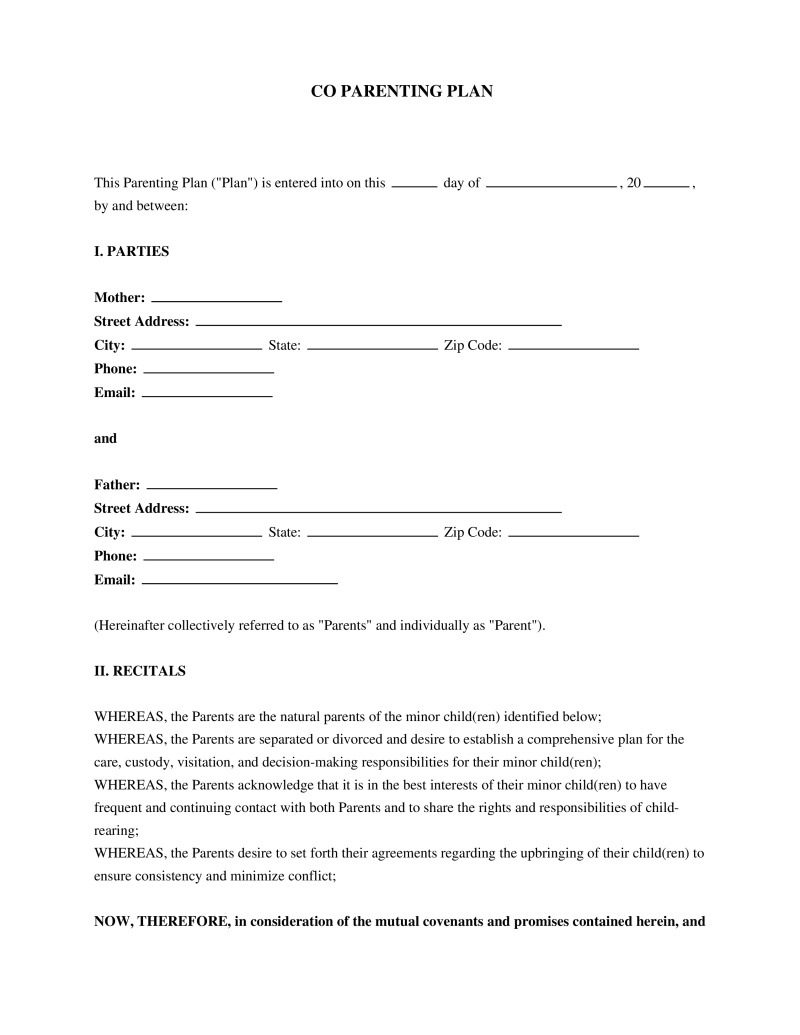
A Co Parenting Plan Agreement is a legal document outlining parental rights and responsibilities for co-parenting children after separation or divorce.
Parenting Plan Type
Select the arrangement that most closely matches your intended parenting structure.
Provide details if your arrangement does not fit the standard options.
Table of Contents
What is a Co Parenting Plan Agreement?
A Co Parenting Plan Agreement is a comprehensive legal document developed by parents who are separated or divorced, outlining the specific terms and conditions for raising their children. Its primary purpose is to establish a clear framework for parental responsibilities, decision-making authority, and the children's daily care and schedule, thereby minimizing conflict and providing stability for the children. This agreement is typically submitted to a court for approval and incorporation into a final divorce decree or custody order, making it legally binding for both parents.
Legal Requirements
For a Co Parenting Plan Agreement to be legally valid and enforceable, it must meet several crucial requirements. These requirements ensure the agreement is fair, comprehensive, and ultimately serves the best interests of the child, which is the paramount standard in all custody matters. Generally, the agreement must be:
- In Writing - All terms and conditions must be clearly documented in a written format, leaving no room for verbal misinterpretations.
- Signed by Both Parents - Both parties must voluntarily sign the agreement, indicating their consent and understanding of its provisions.
- Notarized - In many jurisdictions, the signatures must be notarized to confirm the identities of the signers and the authenticity of their consent.
- Approved by a Court - A family court judge must review the Co Parenting Plan Agreement to ensure it is in the children's best interests before issuing a court order. The judge retains the authority to modify or reject any provisions deemed detrimental to the children.
- Comprehensive - The agreement should address all significant aspects of co-parenting, including physical custody, legal custody, visitation schedules, holiday arrangements, and financial support.
- Clear and Specific - Ambiguous language can lead to disputes. The agreement must use precise terms to define responsibilities, schedules, and decision-making processes.
Failure to meet these requirements may render the agreement unenforceable or subject to legal challenge. Courts prioritize the well-being of children, and any agreement that does not adequately protect their interests will likely be modified or rejected.
How to Complete a Co Parenting Plan Agreement
Developing a comprehensive Co Parenting Plan Agreement involves careful consideration of numerous factors to ensure it addresses all aspects of the children's lives and fosters effective parental cooperation. The process typically unfolds through several key steps:
- Understand the Child's Needs - Begin by focusing on the unique needs, routines, and preferences of each child involved, considering their age, developmental stage, school schedule, extracurricular activities, and any special requirements. This foundational step helps create a plan that genuinely supports their well-being and stability.
- Outline Custody and Visitation Schedules - Detail the physical custody arrangements, specifying where the children will reside on weekdays, weekends, holidays, and during school breaks. Include precise pickup and drop-off times and locations, and consider provisions for special occasions like birthdays or extended family events.
- Define Decision-Making Authority - Clearly delineate legal custody, which determines how parents will make significant decisions regarding the children's education, healthcare, religious upbringing, and extracurricular activities. Specify whether decisions will be made jointly, by one parent with consultation, or by one parent independently for certain matters.
- Address Financial Responsibilities - Incorporate child support obligations, including the base amount, payment schedule, and responsibility for uninsured medical expenses, childcare costs, and extracurricular activity fees. Outline how these expenses will be shared or allocated between the parents, often adhering to state guidelines.
- Establish Communication Protocols - Set forth clear guidelines for parental communication, including preferred methods (e.g., email, co-parenting apps), frequency, and topics of discussion. This section should also address how parents will share information about the children's health, academic progress, and social lives.
- Include Dispute Resolution Mechanisms - Anticipate potential disagreements and establish a process for resolving conflicts without court intervention, such as mediation or arbitration. This proactive approach can help parents manage future disputes constructively and maintain a cooperative relationship.
- Seek Legal Review and Court Approval - After drafting the Co Parenting Plan Agreement, it is crucial for both parents to have independent legal counsel review the document to ensure it protects their rights and is legally sound. Once both parties agree, the document must be submitted to the appropriate family court for review and formal approval, making it a legally enforceable order.
Rights and Obligations of Parties Involved
Parents entering into a Co Parenting Plan Agreement assume specific rights and obligations, which are legally binding once the agreement is approved by a court. These provisions are designed to ensure both parents remain actively involved in their children's lives while adhering to a structured framework.
Key rights commonly afforded to parents include:
- Access to Information - Both parents typically have the right to access their children's medical, educational, and dental records, regardless of physical custody arrangements.
- Decision-Making Authority - Unless otherwise specified, parents often share joint legal custody, meaning they have an equal right to participate in major decisions concerning their children's upbringing, health, and education.
- Parenting Time - Each parent has the right to spend time with their children according to the established visitation schedule, including regular visits, holidays, and vacations.
- Communication with Children - Parents generally have the right to communicate with their children when the children are with the other parent, subject to reasonable restrictions outlined in the agreement.
Corresponding obligations require parents to:
- Adhere to the Schedule - Both parents are obligated to follow the agreed-upon physical custody and visitation schedule precisely, ensuring consistency for the children.
- Provide Financial Support - The parent designated to pay child support must do so as specified in the agreement and in accordance with state guidelines.
- Cooperate on Decisions - When joint legal custody is established, parents are obliged to communicate and cooperate in making significant decisions for their children, prioritizing the children's best interests.
- Maintain a Safe Environment - Each parent is responsible for providing a safe, stable, and nurturing environment for the children during their parenting time.
- Facilitate Communication - Parents are expected to facilitate reasonable communication between the children and the other parent, even during their own parenting time.
Failure to uphold these obligations can lead to legal consequences, including enforcement actions or modifications to the Co Parenting Plan Agreement.
Legal Framework and Enforcement
Federal Context
While most direct regulation of family law occurs at the state level, federal laws provide a crucial backdrop, particularly for interstate enforcement:
- Full Faith and Credit Clause - This constitutional provision requires states to respect and enforce the public acts, records, and judicial proceedings of every other state (U.S. Const. Art. IV, § 1). This is vital for ensuring that a custody order, which includes a Co Parenting Plan Agreement, issued in one state is recognized and enforced in another.
- Uniform Child Custody Jurisdiction and Enforcement Act (UCCJEA) - Adopted by nearly all U.S. states, the UCCJEA provides a uniform framework for determining which state has jurisdiction to make or modify child custody orders and for enforcing custody orders across state lines. It prevents jurisdictional conflicts and ensures that custody disputes are resolved in the child's home state (e.g., California Family Code § 3400 et seq.).
- Violence Against Women Act (VAWA) - This act includes provisions that can impact co-parenting plans, particularly in cases involving domestic violence. It allows for the enforcement of protection orders across state lines, which may influence custody and visitation arrangements to ensure the safety of a parent or child (42 U.S.C. § 13925).
State Statutes and Requirements
State laws primarily govern the specifics of Co Parenting Plan Agreements, dictating how they are created, approved, and enforced. Each state has a family code or similar body of law that addresses these matters:
- Child Custody and Visitation Statutes - States outline the legal standards for determining child custody and visitation, with the paramount consideration always being the best interests of the child. These statutes define physical and legal custody and provide factors courts consider when approving co-parenting plans (e.g., Texas Family Code § 153.001 et seq.).
- Child Support Guidelines - State laws establish formulas and guidelines for calculating child support payments, which are typically incorporated into the Co Parenting Plan Agreement (e.g., New York Domestic Relations Law § 240).
- Mediation Requirements - Many states encourage or mandate mediation for divorcing or separating parents to resolve custody and visitation disputes before litigation, often leading to a mutually agreed-upon co-parenting plan (e.g., Florida Statute § 61.183).
- Modification of Orders - State statutes set forth the legal criteria for modifying an existing Co Parenting Plan Agreement, typically requiring a showing of a significant change in circumstances that warrants a revision in the child's best interests (e.g., Illinois Compiled Statutes, 750 ILCS 5/610.5).
Penalties for Non-Compliance
Once a Co Parenting Plan Agreement is incorporated into a court order, failure to comply with its terms can lead to significant legal penalties. Courts take violations seriously, as they disrupt the stability of the children and undermine judicial authority:
- Contempt of Court - A parent who intentionally violates a court-ordered co-parenting plan can be found in contempt of court, which may result in fines, make-up parenting time for the aggrieved parent, or even jail time in severe cases.
- Enforcement Orders - The non-offending parent can petition the court for an enforcement order, compelling the other parent to comply with the terms. This may involve specific orders for visitation, access to records, or payment of child support arrears.
- Modification of Custody/Visitation - Repeated or egregious violations of the agreement, particularly those detrimental to the child's welfare, can lead to a court modifying the existing custody or visitation schedule, potentially reducing the non-compliant parent's parenting time or decision-making authority.
- Attorney's Fees and Costs - Courts may order the non-compliant parent to pay the other parent's attorney's fees and court costs incurred in seeking enforcement of the agreement.
Frequently Asked Questions
Not the form you're looking for?
Try our legal document generator to create a custom document
Disclaimer: The templates available on this website are provided for general informational purposes only and do not constitute legal advice. They are not intended to be, and should not be interpreted as, compliant with any specific legal, regulatory, or privacy requirements. These templates are not a replacement for professional legal guidance and should not be relied upon for any particular matter or circumstance. Users are strongly encouraged to seek advice from a qualified attorney licensed in their jurisdiction before using, modifying, or relying on any template.
All templates are provided on an "as is," "with all faults," and "as available" basis. The provider disclaims any and all warranties of any kind, whether express, implied, statutory, or otherwise, including without limitation warranties of merchantability, fitness for a particular purpose, title, or non-infringement.
LegalTemplates.com makes no guarantees or representations regarding the accuracy, completeness, expected outcomes, or reliability of the materials contained in these templates or any materials referenced or linked from them.