50 50 Custody Schedule Template
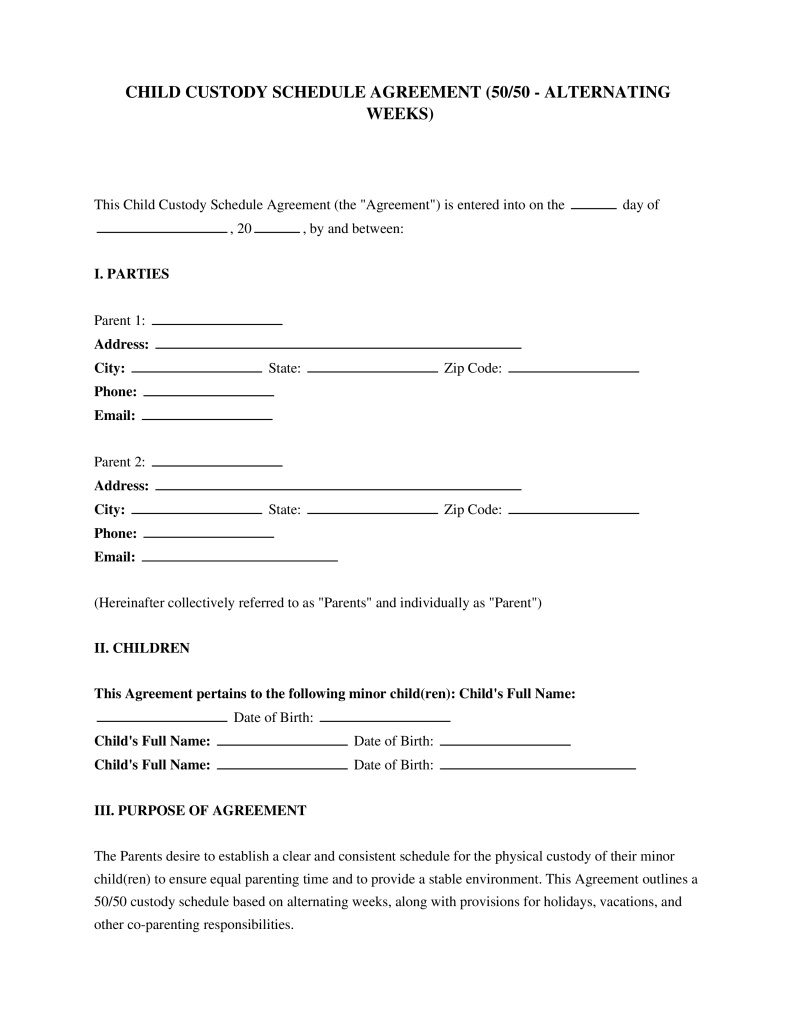
A 50 50 custody schedule template is a legal document outlining an arrangement where both parents share equal parenting time with their children.
Schedule Structure Type
Select the primary schedule structure for equal parenting time. Common options are listed below.
If you selected 'Custom Schedule', describe the specific rotation and exchange details.
Table of Contents
What is a 50 50 Custody Schedule Template?
A 50 50 custody schedule template is a structured plan outlining how parents will equally share physical custody and parenting time with their children after separation or divorce. Its primary purpose is to provide clarity, predictability, and consistency for both parents and children regarding daily routines, transitions, and special events. This template serves as a foundational document for co-parenting agreements, helping to ensure that each parent spends an equivalent amount of time with the children, fostering stable relationships with both guardians. It is typically utilized by parents, often with legal counsel, to formalize arrangements that prioritize the children's best interests.
Legal Framework and Best Interests of the Child
The establishment of any child custody arrangement, including a 50 50 custody schedule template, is fundamentally guided by the legal principle of the "best interests of the child." Courts consistently prioritize the child's physical health, safety, and emotional well-being when making custody determinations. This standard is universally applied across jurisdictions, although specific factors considered may vary. The goal is to create an environment that supports the child's stability, development, and access to both parents.
When evaluating a proposed 50 50 custody schedule, courts often consider a range of factors to ensure it aligns with the child's best interests. These considerations help determine if an equal parenting time arrangement is suitable for a particular family:
- Child's Wishes - The child's preference may be considered, depending on their age and maturity.
- Emotional Ties - The strength of the child's emotional ties to each parent and other family members.
- Parental Capacity - Each parent's ability to provide for the child's needs, including food, clothing, shelter, medical care, and education.
- Child's Adjustment - The child's adjustment to their home, school, and community.
- Parental Cooperation - The capacity and willingness of each parent to cooperate and facilitate a close and continuing relationship between the child and the other parent.
- History of Abuse or Neglect - Any history of domestic violence, substance abuse, or child abuse by either parent.
- Geographic Proximity - The distance between the parents' residences and its impact on the child's schooling and social life.
Common 50 50 Custody Schedule Patterns
While the term '50 50 custody schedule template' refers to equal parenting time, the specific arrangement of that time can vary significantly based on family needs, children's ages, and parental work schedules. These patterns are not "types" of the document itself but rather common methods for distributing parenting time equally. Each pattern aims to achieve a 50/50 split over a two-week or monthly cycle, providing different levels of consistency and transition frequency for the children.
Several common patterns are widely utilized to achieve an equal division of parenting time:
- Alternating Weeks (7-7 Schedule) - Children spend one full week with one parent, then the next full week with the other parent. This schedule minimizes transitions, making it suitable for older children who benefit from longer periods in one home.
- 2-2-3 Schedule - Children spend two days with one parent, two days with the other, and then three days with the first parent. The following week, the pattern reverses. This provides frequent contact with both parents but involves more transitions.
- 2-2-5-5 Schedule - Children spend two days with parent A, two days with parent B, then five days with parent A, followed by five days with parent B. This schedule ensures children see both parents regularly and have extended time with each.
- 3-4-4-3 Schedule - Children spend three days with parent A, four days with parent B, then four days with parent A, and three days with parent B. This pattern allows for longer blocks of time with each parent while still ensuring frequent contact.
- Every Other Week with Mid-Week Visit - This variation of the alternating week schedule includes a brief mid-week visit or dinner with the non-custodial parent, offering additional contact without a full overnight transition.
How to Create
Creating an effective 50 50 custody schedule template involves careful consideration of family dynamics, children's needs, and logistical practicalities. The process typically requires collaboration between parents, and often the guidance of legal professionals or mediators, to ensure all aspects are thoroughly addressed and legally sound.
- Assess Family Needs and Logistics - Before drafting, parents should evaluate their respective work schedules, the children's school and extracurricular activities, and the geographic proximity of their homes. Consider the children's ages and temperaments, as younger children may benefit from more frequent, shorter transitions, while older children might adapt better to longer blocks of time with each parent. This initial assessment helps in identifying the most suitable schedule pattern.
- Select a Schedule Pattern - Based on the family assessment, choose a core 50 50 schedule pattern, such as alternating weeks, 2-2-3, or 2-2-5-5. Experiment with different options mentally or using a calendar to visualize how it would work in practice. The chosen pattern should minimize disruption to the children's routine and provide consistent time with both parents.
- Detail Specific Provisions - Beyond the basic schedule, a comprehensive template must include specifics for holidays, school breaks, birthdays, and summer vacations. Clearly define drop-off and pick-up times, locations, and who is responsible for transportation. Address communication protocols between parents, decision-making authority for medical and educational matters, and how future disagreements will be resolved.
- Draft the Agreement - Begin drafting the custody schedule, incorporating all selected patterns and specific provisions. Use clear, unambiguous language to avoid future misunderstandings. It is advisable to organize the document with distinct sections for regular parenting time, holidays, vacations, and other arrangements. Ensure that all aspects of the children's care and upbringing are covered.
- Seek Legal Review and Mediation - Once a draft is complete, it is highly recommended to have it reviewed by an attorney specializing in family law. Legal counsel can ensure the template complies with state laws, is enforceable, and adequately protects the rights and responsibilities of both parents. If parents struggle to agree on terms, mediation can be a valuable tool to facilitate discussion and reach mutually acceptable solutions.
- Formalize the Schedule Through Court Order - For the custody schedule to be legally binding and enforceable, it must be formally approved and incorporated into a court order. This typically involves submitting the agreed-upon template to the family court for review and signature by a judge. A court order provides a legal framework for enforcement and dispute resolution if one parent fails to adhere to the schedule.
Key Elements of a Comprehensive 50 50 Custody Schedule Template
A robust 50 50 custody schedule template goes beyond simply dividing days; it meticulously outlines various aspects of co-parenting to ensure clarity and minimize potential conflicts. A comprehensive template typically includes the following essential elements:
- Parenting Time Allocation - A detailed, calendar-based schedule for regular, day-to-day parenting time, clearly indicating which parent has the children on specific days and nights.
- Holiday and Vacation Schedules - Specific provisions for major holidays (e.g., Christmas, Thanksgiving, Easter), school breaks, and summer vacations, often alternating yearly or following a predefined rotation.
- Transportation Arrangements - Clear guidelines on who is responsible for transporting children to and from exchanges, school, and extracurricular activities, including specific pick-up and drop-off locations and times.
- Communication Protocols - Rules for parental communication, including preferred methods (email, phone, co-parenting apps), frequency, and expectations for respectful interaction.
- Decision-Making Authority - Delineation of how major decisions regarding the children's education, healthcare, religious upbringing, and extracurricular activities will be made, whether jointly or by one parent with consultation.
- Access to Records - Provisions ensuring both parents have full and equal access to the children's medical, dental, school, and other important records.
- Relocation Clause - A section addressing procedures if one parent wishes to relocate a significant distance, often requiring court permission or agreement from the other parent.
- Dispute Resolution Mechanisms - Outlines methods for resolving future disagreements, such as mandatory mediation or arbitration, before resorting to court intervention.
- Future Modification Guidelines - Criteria and processes for how the custody schedule can be reviewed and potentially modified as children grow and circumstances change.
- Child Support Obligations - While a separate financial matter, the custody schedule often impacts child support calculations, and a reference or integration of support orders is common.
Legal Requirements and Applicable Laws
The legal enforceability and validity of a 50 50 custody schedule template depend on its adherence to both federal principles and specific state statutes. These laws aim to ensure uniformity, protect children, and establish clear guidelines for parental responsibilities.
Federal Context and Model Laws
While child custody is primarily a matter of state law, federal laws and widely adopted model acts provide foundational principles for interstate recognition and enforcement:
- Uniform Child Custody Jurisdiction and Enforcement Act (UCCJEA) - A model law adopted by nearly all U.S. states, designed to prevent jurisdictional disputes and ensure that custody orders issued in one state are recognized and enforced in others. It establishes clear rules for determining which state has jurisdiction over a child custody case (e.g., home state jurisdiction) and for modifying existing orders.
- Parental Kidnapping Prevention Act (PKPA) - A federal law that mandates states give full faith and credit to child custody determinations made by courts of other states, provided those determinations were made in compliance with the PKPA's jurisdictional standards (28 U.S.C. § 1738A). This reinforces the UCCJEA's goals and helps prevent parental abduction across state lines.
State Laws and Requirements
Each state has specific statutes governing child custody, which dictate the procedures for establishing, modifying, and enforcing custody orders. These laws are critical for ensuring the validity of any 50 50 custody schedule template:
- Best Interests of the Child Standard - All states mandate that custody decisions, including the approval of a 50 50 custody schedule, must be based on the "best interests of the child." Specific factors considered vary by state, but generally include the child's health, safety, welfare, and emotional ties to each parent (e.g., Cal. Fam. Code § 3011, N.Y. Dom. Rel. Law § 240).
- Mediation Requirements - Many states require or strongly encourage parents to attempt mediation to resolve custody disputes before proceeding to litigation. This process helps parents cooperatively develop a 50 50 custody schedule template (e.g., Fla. Stat. § 61.183).
- Modification Standards - State laws establish the criteria for modifying an existing custody order. Typically, a parent must demonstrate a "material change in circumstances" or that a modification is in the child's best interests to alter a 50 50 custody schedule (e.g., Tex. Fam. Code § 156.001 et seq.).
- Parenting Plan Requirements - Some states require parents to submit a detailed parenting plan, which includes the 50 50 custody schedule, decision-making authority, and dispute resolution methods, as part of their divorce or custody proceedings (e.g., Wash. Rev. Code § 26.09.184).
Penalties for Non-Compliance
Failure to adhere to a court-ordered 50 50 custody schedule can lead to serious legal consequences. Courts take violations of custody orders seriously, as they directly impact the child's well-being and the stability of their routine:
- Contempt of Court - A parent who willfully violates a custody order can be found in contempt of court, which may result in fines, attorney's fees, required makeup parenting time, or even jail time in severe cases.
- Modification of Custody - Repeated or egregious non-compliance may lead the court to modify the custody order, potentially reducing the non-compliant parent's parenting time or altering decision-making authority.
- Enforcement Actions - The aggrieved parent can file a motion to enforce the custody order, compelling the non-compliant parent to adhere to the schedule and potentially recouping legal costs incurred in the enforcement action.
Rights and Obligations of Parties Involved
Parents operating under a 50 50 custody schedule template have distinct rights and obligations designed to ensure the child's welfare and the smooth functioning of the co-parenting arrangement. These are typically outlined in the court order and serve as a guide for parental conduct.
Parental Rights
Both parents typically retain full and equal rights regarding their children, even when sharing physical custody equally:
- Decision-Making Authority - In a 50 50 custody arrangement, parents often share joint legal custody, meaning they have equal rights to make major decisions concerning the child's education, healthcare, religious upbringing, and extracurricular activities.
- Access to Information - Each parent has the right to access the child's medical, dental, school, and counseling records directly from the providers or institutions.
- Right to Discipline - Each parent has the right to reasonably discipline the child during their respective parenting time, consistent with the child's best interests.
- Right to Travel - Generally, each parent has the right to travel with the child during their designated parenting time, within the limits specified by the court order (e.g., restrictions on international travel without consent).
- Right to a Relationship - Both parents have the fundamental right to foster a loving and meaningful relationship with their child.
Parental Obligations
Alongside their rights, parents have significant obligations under a 50 50 custody schedule template:
- Adherence to Schedule - Both parents are obligated to strictly follow the court-ordered custody schedule, including designated pick-up and drop-off times and locations, and holiday rotations.
- Financial Support - Regardless of equal parenting time, both parents typically have a legal obligation to provide financial support for the children, often determined by state child support guidelines.
- Cooperation and Communication - Parents are generally obligated to communicate respectfully and cooperate on matters related to the children's well-being, avoiding disparaging remarks about the other parent in front of the children.
- Providing for Needs - Each parent must provide a safe and stable environment, adequate food, clothing, shelter, medical care, and supervision during their parenting time.
- Fostering Relationship with Other Parent - Parents have an obligation not to undermine the child's relationship with the other parent and to encourage the child to have a healthy bond with both guardians.
- Notification of Major Events - Parents are typically obligated to inform the other parent of significant events affecting the child, such as medical emergencies, school issues, or planned absences from school.
Frequently Asked Questions
Not the form you're looking for?
Try our legal document generator to create a custom document
Disclaimer: The templates available on this website are provided for general informational purposes only and do not constitute legal advice. They are not intended to be, and should not be interpreted as, compliant with any specific legal, regulatory, or privacy requirements. These templates are not a replacement for professional legal guidance and should not be relied upon for any particular matter or circumstance. Users are strongly encouraged to seek advice from a qualified attorney licensed in their jurisdiction before using, modifying, or relying on any template.
All templates are provided on an "as is," "with all faults," and "as available" basis. The provider disclaims any and all warranties of any kind, whether express, implied, statutory, or otherwise, including without limitation warranties of merchantability, fitness for a particular purpose, title, or non-infringement.
LegalTemplates.com makes no guarantees or representations regarding the accuracy, completeness, expected outcomes, or reliability of the materials contained in these templates or any materials referenced or linked from them.