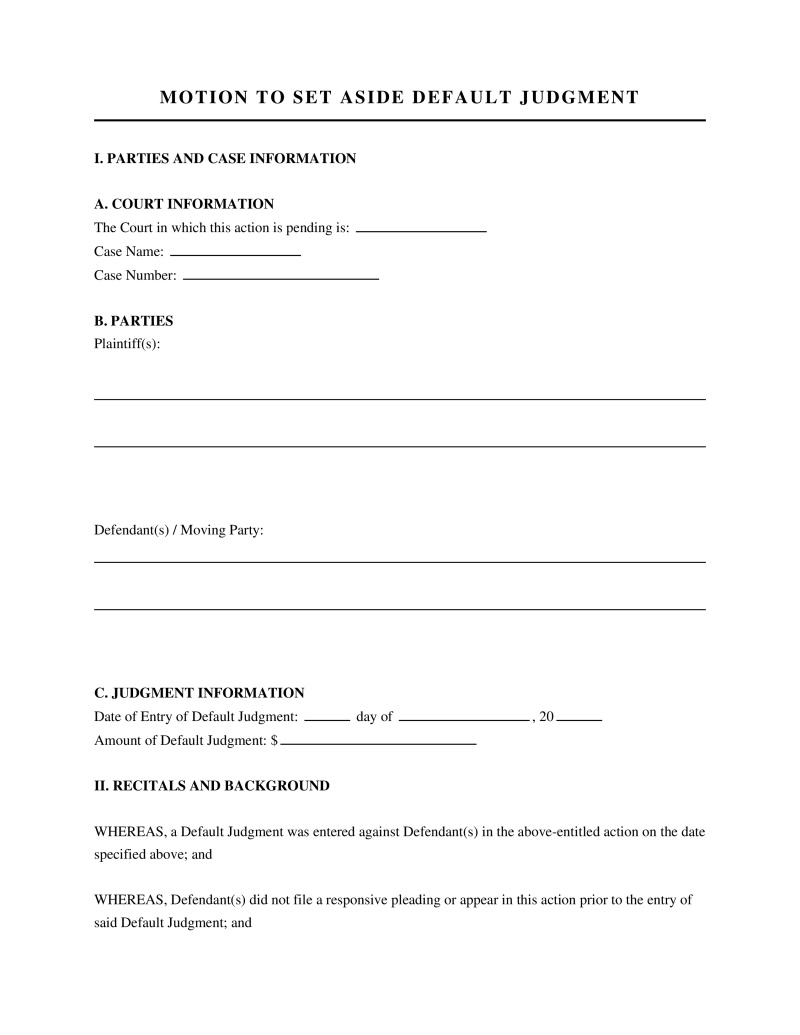
Motion to Set Aside Default Judgment
A Motion to Set Aside Default Judgment is a formal legal request filed with a court to vacate a judgment entered due to a party's failure to appear or respond.
Grounds For Motion
Select the main reason you believe the default judgment should be set aside. If more than one applies, select the most significant.
Provide a brief description of the ground if you selected 'Other'.
Table of Contents
What is a Motion to Set Aside Default Judgment?
A Motion to Set Aside Default Judgment is a formal request filed with a court by a defendant who has had a default judgment entered against them. This legal pleading seeks to vacate, or nullify, the default judgment, thereby allowing the defendant to present their defense on the merits of the case. Its primary purpose is to ensure that cases are decided based on the evidence and arguments of both parties, rather than on a procedural default. This motion is typically utilized by parties who missed a deadline to respond to a lawsuit or failed to appear in court.
Legal Requirements and Grounds for Setting Aside
To successfully file a Motion to Set Aside Default Judgment, the moving party must generally demonstrate specific legal grounds that justify vacating the judgment. Courts typically consider several factors, often requiring the movant to show both a valid reason for the default and a meritorious defense to the underlying claim. The most common grounds include:
- Excusable Neglect - This refers to a failure to act within a required timeframe due to circumstances beyond the party's reasonable control, or a good-faith mistake, rather than intentional disregard. The court evaluates the reasons for the default, the promptness of the motion, and the prejudice to the non-moving party.
- Meritorious Defense - The moving party must present a plausible defense to the plaintiff's claims, demonstrating that if the case were reopened, there is a reasonable likelihood they could prevail. This typically involves submitting a proposed answer or affidavit outlining the factual and legal basis of their defense.
- Lack of Proper Service - If the defendant was never properly served with the summons and complaint according to legal procedures, the court may lack personal jurisdiction over them, rendering the default judgment void. This is a fundamental due process issue.
- Fraud, Misrepresentation, or Misconduct by an Opposing Party - If the default judgment was obtained through deceptive practices or dishonest actions by the plaintiff, the court may set it aside to prevent injustice.
- Void Judgment - A judgment is considered void if the court lacked subject matter jurisdiction over the case or personal jurisdiction over the defendant, or if it was entered in violation of due process.
- Newly Discovered Evidence - In some cases, a default judgment may be set aside if significant new evidence is discovered that could not have been found earlier with reasonable diligence and would likely change the outcome of the case.
- Any Other Reason Justifying Relief - Courts often retain discretion to set aside a judgment for any other reason that justifies relief from the operation of the judgment, particularly to prevent manifest injustice, though this ground is typically reserved for extraordinary circumstances.
How to File a Motion to Set Aside Default Judgment
Filing a Motion to Set Aside Default Judgment involves a series of structured steps to ensure compliance with court rules and to present a compelling argument for relief. Adherence to these steps is crucial for a successful outcome:
- Gather Necessary Documents and Evidence - Begin by collecting all relevant documents, including the original summons and complaint, the default judgment itself, any proof of service, and any correspondence related to the case. Also, gather evidence that supports your grounds for setting aside the judgment, such as affidavits from individuals with knowledge of the reasons for the default or documents supporting a meritorious defense.
- Draft the Motion and Supporting Affidavits - Prepare the formal motion, which must clearly state the relief sought (setting aside the default judgment) and the legal grounds upon which the request is based. This document should cite relevant rules of civil procedure and case law. It is essential to include one or more sworn affidavits explaining the circumstances that led to the default and detailing the facts constituting a meritorious defense to the plaintiff's claims. A proposed answer or other responsive pleading should also be attached, demonstrating the defendant's readiness to proceed with the case.
- File the Motion with the Court - Once the motion and all supporting documents are prepared, they must be filed with the clerk of the court that issued the default judgment. Filing typically involves submitting the original documents and any required copies, along with paying the necessary filing fees. Some jurisdictions may allow e-filing.
- Serve the Opposing Party - After filing, the moving party must properly serve a copy of the Motion to Set Aside Default Judgment and all supporting documents on the opposing party (the plaintiff) in accordance with the rules of civil procedure. Proof of service, such as an affidavit of service, must then be filed with the court to demonstrate that the plaintiff received notice of the motion.
- Attend the Hearing - The court will typically schedule a hearing where both parties can present their arguments regarding the motion. The moving party should be prepared to explain why the default occurred and why the judgment should be set aside, emphasizing their meritorious defense and the lack of prejudice to the plaintiff. The opposing party will have the opportunity to argue against setting aside the judgment, often focusing on the moving party's culpability for the default or potential prejudice if the judgment is vacated.
Rights and Obligations of Parties
Both the defendant seeking to set aside the default judgment and the plaintiff who obtained it have distinct rights and obligations within this legal process. Understanding these roles is crucial for navigating the proceedings effectively.
The defendant, as the moving party, has the right to due process, which includes the opportunity to be heard and to defend against claims. Their primary obligation is to demonstrate to the court that the default was not willful, that they acted promptly to correct the default, and that they possess a valid defense. They must also comply with all procedural rules for filing and serving the motion, including providing supporting affidavits and a proposed answer.
The plaintiff, as the non-moving party, has the right to rely on the finality of the judgment and to oppose the motion. Their obligation is to present arguments to the court demonstrating why the default judgment should stand. This may involve showing that the defendant's reasons for default are insufficient, that the defendant lacks a meritorious defense, or that setting aside the judgment would cause significant prejudice to the plaintiff, such as loss of evidence or increased costs. The plaintiff must also adhere to court deadlines for filing responses to the motion.
Consequences of a Granted or Denied Motion
The court's decision on a Motion to Set Aside Default Judgment carries significant consequences for both parties, determining the future course of the litigation or the finality of the judgment.
If the Motion to Set Aside Default Judgment is granted, the default judgment is vacated, and the case is typically restored to the court's active calendar. This means the defendant is allowed to file their answer or other responsive pleading and proceed with defending the lawsuit on its merits. The parties will then engage in discovery, pre-trial motions, and potentially a trial, as if the default had never occurred. The court may impose conditions, such as requiring the defendant to pay the plaintiff's attorney fees incurred due to the default, to mitigate any prejudice caused to the plaintiff.
If the Motion to Set Aside Default Judgment is denied, the default judgment remains in full force and effect. For the defendant, this means they have lost the opportunity to defend against the plaintiff's claims in that court. The plaintiff can then proceed with efforts to enforce the judgment, which may involve wage garnishment, bank levies, or liens on property. The defendant's primary recourse after a denial is typically to file an appeal of the court's decision, arguing that the trial court abused its discretion in denying the motion.
Applicable Laws and Legal Framework
The legal framework governing a Motion to Set Aside Default Judgment is primarily found in rules of civil procedure at both the federal and state levels. These rules provide the specific grounds and procedures for seeking relief from a judgment.
Federal Laws and Rules
At the federal level, the process for setting aside a default judgment is primarily governed by the Federal Rules of Civil Procedure:
- Federal Rule of Civil Procedure 55(c) - Addresses setting aside a default judgment, stating that a court may set aside an entry of default for good cause, and may set aside a default judgment under Rule 60(b) (Fed. R. Civ. P. 55(c)).
- Federal Rule of Civil Procedure 60(b) - Outlines the specific grounds for relief from a final judgment, order, or proceeding, including mistake, inadvertence, surprise, excusable neglect, newly discovered evidence, fraud, void judgment, or any other reason that justifies relief (Fed. R. Civ. P. 60(b)).
State Laws and Requirements
State laws largely mirror the federal framework, with most states adopting rules of civil procedure that are similar to the Federal Rules:
- State Rules of Civil Procedure - Most states have provisions akin to Federal Rules 55(c) and 60(b), specifying the grounds and procedures for a Motion to Set Aside Default Judgment (e.g., California Code of Civil Procedure § 473, New York CPLR § 5015, Texas Rule of Civil Procedure 329b).
- Timeliness Requirements - State rules typically impose strict deadlines for filing such motions, with motions based on excusable neglect often requiring filing within a specified period (e.g., six months to one year) from the date the judgment was entered or the moving party learned of it.
- Affidavit of Merits - Many state rules explicitly require the moving party to submit an affidavit of merits, detailing a prima facie defense to the action, alongside the motion.
Penalties for non-compliance with these rules are not typically criminal, but rather procedural. Failure to timely file a Motion to Set Aside Default Judgment, or to adequately demonstrate legal grounds, can result in the court denying the motion, leaving the default judgment intact and enforceable. Additionally, attorneys who fail to meet their obligations may face professional discipline or sanctions from the court.
Frequently Asked Questions
Not the form you're looking for?
Try our legal document generator to create a custom document
Ask about a Motion to Set Aside Default Judgment
Example questions:
Disclaimer: The templates available on this website are provided for general informational purposes only and do not constitute legal advice. They are not intended to be, and should not be interpreted as, compliant with any specific legal, regulatory, or privacy requirements. These templates are not a replacement for professional legal guidance and should not be relied upon for any particular matter or circumstance. Users are strongly encouraged to seek advice from a qualified attorney licensed in their jurisdiction before using, modifying, or relying on any template.
All templates are provided on an "as is," "with all faults," and "as available" basis. The provider disclaims any and all warranties of any kind, whether express, implied, statutory, or otherwise, including without limitation warranties of merchantability, fitness for a particular purpose, title, or non-infringement.
LegalTemplates.com makes no guarantees or representations regarding the accuracy, completeness, expected outcomes, or reliability of the materials contained in these templates or any materials referenced or linked from them.