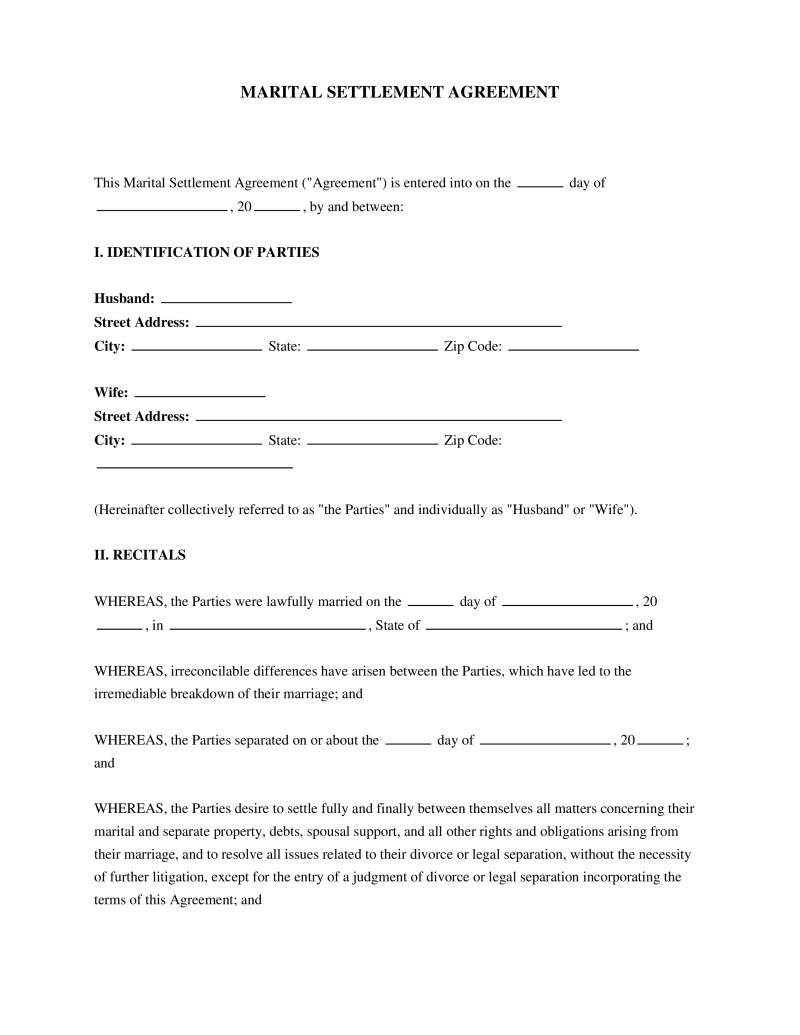
Marital Settlement Agreement
A Marital Settlement Agreement is a legal document that specifies the terms and conditions mutually agreed upon by divorcing or separating spouses concerning the division of assets, child custody, and support.
Case Resolution Type
Select the legal status the agreement is intended to support. Some jurisdictions treat divorce and legal separation differently.
Table of Contents
What is a Marital Settlement Agreement?
A Marital Settlement Agreement (MSA), often referred to as a Divorce Settlement Agreement or Property Settlement Agreement, is a legally binding contract entered into by spouses during the process of divorce or legal separation. Its primary purpose is to resolve all issues arising from the dissolution of their marriage, thereby avoiding the necessity of a court trial. This comprehensive document outlines the terms and conditions for dividing marital assets and debts, establishing spousal support (alimony), and, if applicable, determining child custody, visitation schedules, and child support obligations. Spouses utilize an MSA to achieve an amicable and often more efficient resolution to their marital dissolution, ensuring clarity and finality on crucial post-divorce matters.
Legal Requirements and Validity
For a Marital Settlement Agreement to be considered legally valid and enforceable, it must meet several fundamental requirements, primarily rooted in contract law principles and specific state family law statutes. The agreement represents a negotiated compromise between the parties, and its enforceability hinges on proper formation and substantive fairness. Courts review these agreements to ensure they are not unconscionable or the product of fraud, duress, or undue influence.
Key requirements for a valid Marital Settlement Agreement typically include:
- Mutual Assent - Both parties must freely and voluntarily agree to all terms of the agreement. This means they understand the terms and intend to be bound by them.
- Full and Fair Disclosure - Each party must fully and accurately disclose all material information regarding their assets, debts, income, and expenses. Failure to disclose can lead to the agreement being set aside.
- Capacity to Contract - Both spouses must be of sound mind and legal age to enter into a contract.
- Lawful Purpose - The terms of the agreement must not violate any laws or public policy.
- Consideration - Although sometimes implied in marital agreements, each party typically gives up something of value (e.g., a claim to certain property) in exchange for the other party's promises.
- Written Form and Signatures - The agreement must be in writing and signed by both parties. Many states also require the signatures to be notarized.
- Court Approval - While binding between the parties, an MSA typically requires court approval to be incorporated into the final judgment of divorce, making it an enforceable court order.
Courts generally favor Marital Settlement Agreements as they promote private resolution and judicial economy. However, if an agreement is found to be patently unfair, obtained through misrepresentation, or if the terms related to child support or custody are not in the children's best interests, a court may refuse to approve certain provisions or the entire agreement.
Key Provisions in a Marital Settlement Agreement
A comprehensive Marital Settlement Agreement addresses all significant aspects of the marital dissolution, aiming to provide a clear framework for the parties' post-divorce lives. The specific provisions can vary based on individual circumstances, but certain categories are universally included to ensure a complete resolution.
Common provisions found in Marital Settlement Agreements include:
- Property Division - This section details the identification, valuation, and distribution of all marital assets and debts. Assets can include real estate, bank accounts, investment portfolios, retirement accounts, businesses, vehicles, and personal property. Debts encompass mortgages, credit card balances, loans, and other financial obligations. States typically follow either an equitable distribution model or a community property model for division.
- Spousal Support (Alimony) - If applicable, this provision outlines whether one spouse will pay financial support to the other, the amount of such payments, the duration, and whether the support is modifiable or non-modifiable. Factors considered often include the length of the marriage, the earning capacities of each spouse, and their financial needs.
- Child Custody and Visitation - For couples with minor children, this section specifies legal custody (decision-making authority) and physical custody (where the children live). It also establishes a detailed parenting plan, including a visitation schedule, holiday arrangements, and vacation protocols. The overarching standard for these decisions is always the best interests of the child.
- Child Support - This provision determines the financial contributions each parent will make towards the children's upbringing. It typically includes a calculation based on state-specific child support guidelines, considering parental income, the number of children, and custody arrangements. It also addresses who pays for health insurance, uninsured medical expenses, and extraordinary expenses like extracurricular activities or college savings.
- Debt Allocation and Responsibility - Beyond general property division, this section explicitly assigns responsibility for all marital debts, including how joint accounts will be closed or refinanced, and indemnification clauses to protect one party if the other defaults on assigned debt.
- Tax Implications - An MSA may address how certain tax deductions, exemptions, or credits will be allocated between the parties, especially concerning children or property transfers.
- Insurance - Provisions regarding health insurance, life insurance, and property insurance for both spouses and children post-divorce are frequently included.
How to Complete a Marital Settlement Agreement
The process of completing a Marital Settlement Agreement involves several critical steps, from initial information gathering to final court approval. This structured approach helps ensure all necessary issues are addressed comprehensively and fairly, leading to a durable and enforceable agreement.
- Gather Financial Documentation - Both parties must collect and exchange all relevant financial records. This includes bank statements, investment account statements, retirement account statements, pay stubs, tax returns (typically the last three to five years), loan applications, credit card statements, property deeds, mortgage statements, and any documents related to business ownership or significant assets. Full disclosure is paramount to avoid future disputes and ensure the agreement's validity.
- Identify and Value Marital Assets and Debts - Systematically list all assets and debts acquired during the marriage, irrespective of whose name they are in. For each item, determine its current market value. This may require appraisals for real estate, businesses, or unique personal property. Clearly distinguish between marital property (subject to division) and separate property (typically retained by the owner).
- Negotiate Terms of Settlement - Engage in discussions to determine how assets, debts, and responsibilities will be divided. This often involves compromise on both sides. Negotiations can occur directly between the spouses, through their respective attorneys, or with the assistance of a mediator. The goal is to reach mutually agreeable terms for property division, spousal support, and, if applicable, child custody and support.
- Draft the Agreement - Once all terms are agreed upon, one party's attorney typically drafts the formal Marital Settlement Agreement. This document translates the negotiated terms into precise legal language, ensuring all provisions are clear, unambiguous, and legally enforceable. It must accurately reflect the parties' intentions and address all relevant aspects of their separation.
- Review and Sign the Agreement - Each party should thoroughly review the drafted agreement with their own independent legal counsel. This review ensures that the document accurately reflects the agreed-upon terms, protects their individual rights, and clarifies any potential misunderstandings. After careful review and any necessary revisions, both spouses sign the agreement, often in the presence of a notary public.
- File with the Court for Approval - The signed Marital Settlement Agreement is then submitted to the court as part of the divorce petition or response. The court will review the agreement to ensure it is fair, equitable, and, in cases involving children, serves the children's best interests. Upon approval, the court incorporates the MSA into the final divorce decree, making its terms legally binding and enforceable as a court order.
Rights and Obligations of Parties Involved
Upon entering into a Marital Settlement Agreement, both spouses assume specific rights and obligations that govern their conduct and interactions post-divorce. These are legally binding commitments that derive from the contract itself and, once approved by the court, from the final judgment of divorce. Understanding these elements is crucial for compliance and for upholding the integrity of the agreement.
The primary rights and obligations include:
- Adherence to Financial Provisions - Each party has the right to receive the assets, funds, or support payments as stipulated in the agreement (e.g., spousal support, child support, property distribution). Conversely, each party is obligated to make these payments or transfer assets as specified, including assuming responsibility for assigned debts.
- Compliance with Parenting Plan - When children are involved, both parents have the right to exercise their designated custody and visitation rights as outlined in the parenting plan. They are simultaneously obligated to facilitate the other parent's access to the children and adhere to the established schedule, holiday arrangements, and decision-making protocols.
- Full Disclosure and Honesty - An ongoing obligation exists for both parties to act in good faith and not conceal assets or income, especially if the agreement contains provisions for future modifications based on financial changes. The right to full and accurate information underpins the fairness of the initial agreement.
- Non-Interference - Parties generally have the right to live their separate lives free from undue interference from the former spouse, provided they are fulfilling their obligations under the agreement. This implies an obligation to respect boundaries and the terms of the settlement.
- Enforcement and Modification - Each party has the right to seek legal enforcement of the agreement's terms if the other party defaults on their obligations. Depending on the jurisdiction and the specific provision, parties may also have the right to seek modification of certain terms (e.g., child support or spousal support) if there is a substantial change in circumstances. However, the obligation is to follow the existing order until a modification is granted.
- Indemnification - Often, an MSA includes indemnification clauses, obligating one party to hold the other harmless for debts assigned to them. This provides the right for the indemnified party to seek compensation if the other party fails to pay an assigned debt, leading to adverse action against the indemnified party.
Applicable Laws and Enforcement
Marital Settlement Agreements are primarily governed by state law, specifically family law statutes and general contract law principles. While federal laws typically do not directly dictate the formation or content of an MSA, certain federal statutes can influence specific provisions or the enforcement of financial aspects.
Federal Statutes
Several federal laws may indirectly bear upon the terms or implications of a Marital Settlement Agreement:
- Employee Retirement Income Security Act (ERISA) - Governs most private sector employee benefit plans, including pension and health plans (29 U.S.C. § 1001 et seq.). When dividing retirement accounts like 401(k)s or pensions in an MSA, a Qualified Domestic Relations Order (QDRO) is often required to transfer funds without incurring immediate tax penalties, which must comply with ERISA guidelines.
- Consolidated Omnibus Budget Reconciliation Act (COBRA) - Allows eligible individuals and their dependents to continue health coverage after certain qualifying events, such as divorce (29 U.S.C. § 1161 et seq.). An MSA may specify which spouse will pay for COBRA coverage or if one spouse will maintain health insurance for the other for a transitional period.
- Internal Revenue Code (IRC) - Various provisions of federal tax law affect how spousal support payments are treated for tax purposes (though spousal support is generally no longer deductible for the payer or taxable for the recipient for divorce decrees entered after December 31, 2018), and how property transfers are handled (26 U.S.C. § 1 et seq.). MSAs often address these tax implications.
State Laws and Requirements
State laws form the bedrock for Marital Settlement Agreements, dictating their validity, scope, and enforceability:
- State Family Law Statutes - Each state has specific laws governing divorce, legal separation, property division, spousal support, child custody, and child support (e.g., California Family Code § 2550 et seq. for community property; New York Domestic Relations Law § 236 for equitable distribution). These statutes provide the legal framework within which MSAs must operate.
- Contract Law Principles - General contract law principles, such as offer, acceptance, consideration, mutual assent, and capacity, are applied to assess the formation and validity of an MSA. Courts examine whether the agreement was entered into voluntarily, without fraud or duress.
- Child Support Guidelines - All states have statutory guidelines for calculating child support obligations, which must be followed unless there's a compelling reason for deviation that is in the child's best interest. An MSA's child support provisions must comply with these guidelines.
- Best Interests of the Child Standard - Any provisions in an MSA related to child custody and visitation are subject to judicial review to ensure they serve the children's best interests, regardless of parental agreement.
- Uniform Marriage and Divorce Act (UMDA) - While not adopted by all states, the UMDA has influenced the family law statutes of many jurisdictions, particularly concerning no-fault divorce, property division, and maintenance.
Penalties for Non-Compliance
Failure to comply with the terms of a court-approved Marital Settlement Agreement can result in significant legal consequences. Since the MSA is incorporated into the final divorce judgment, its terms become court orders. Non-compliance is essentially a violation of a court order.
Potential penalties for non-compliance include:
- Contempt of Court - A party who violates an MSA provision may be held in civil contempt of court. Penalties can range from fines and orders to pay attorney's fees to, in extreme cases, incarceration until the party complies with the order.
- Enforcement Orders - The court can issue specific orders to enforce compliance, such as wage garnishment for unpaid child or spousal support, liens on property, or orders for the transfer of assets.
- Monetary Damages - For certain breaches, a court may award monetary damages to the aggrieved party to compensate for losses incurred due to the non-compliance.
- Attorney's Fees and Costs - The non-compliant party may be ordered to pay the attorney's fees and court costs incurred by the other party in seeking enforcement.
- Modification of Terms - In some instances, persistent non-compliance, particularly related to child custody or visitation, could lead the court to modify the original terms of the agreement to ensure compliance or protect the children's welfare.
Frequently Asked Questions
Not the form you're looking for?
Try our legal document generator to create a custom document
Disclaimer: The templates available on this website are provided for general informational purposes only and do not constitute legal advice. They are not intended to be, and should not be interpreted as, compliant with any specific legal, regulatory, or privacy requirements. These templates are not a replacement for professional legal guidance and should not be relied upon for any particular matter or circumstance. Users are strongly encouraged to seek advice from a qualified attorney licensed in their jurisdiction before using, modifying, or relying on any template.
All templates are provided on an "as is," "with all faults," and "as available" basis. The provider disclaims any and all warranties of any kind, whether express, implied, statutory, or otherwise, including without limitation warranties of merchantability, fitness for a particular purpose, title, or non-infringement.
LegalTemplates.com makes no guarantees or representations regarding the accuracy, completeness, expected outcomes, or reliability of the materials contained in these templates or any materials referenced or linked from them.