Living Together Agreement Template
A Living Together Agreement is a legal document outlining financial and property arrangements for unmarried couples cohabiting, addressing assets, debts,.
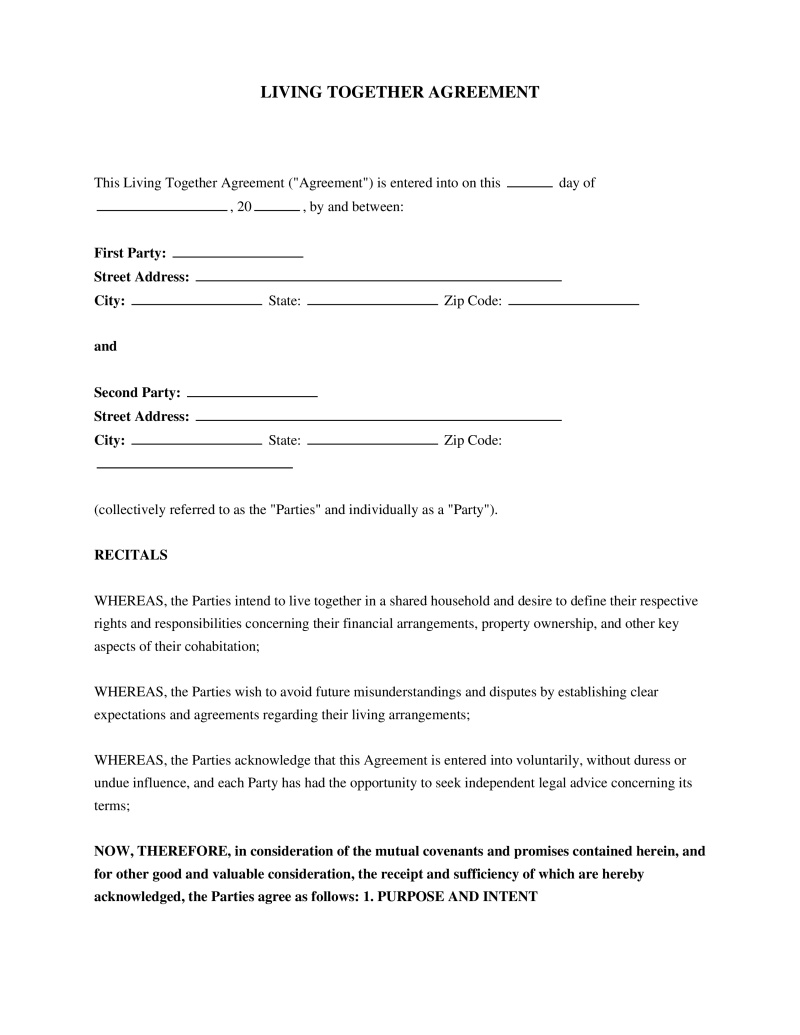
Agreement Effective Date
Enter the date when the agreement will take effect.
Table of Contents
What is a Living Together Agreement Template?
A living together agreement template, often referred to as a cohabitation agreement or domestic partnership agreement, is a legally binding contract entered into by two individuals who live together but are not married or in a registered civil union. Its primary purpose is to define the rights and responsibilities of each partner during their cohabitation and, importantly, to outline the terms of asset and debt division, support, and other financial or property matters should the relationship terminate. This document provides clarity and predictability, helping to prevent potential disputes that can arise when unmarried couples separate without a formal agreement.
Legal Requirements and Validity
For a living together agreement template to be legally enforceable, it must generally meet the fundamental requirements of a valid contract. While specific state laws may vary, common elements essential for its validity include:
- Mutual Assent - Both parties must voluntarily and knowingly agree to the terms of the agreement, demonstrating a "meeting of the minds."
- Offer and Acceptance - One party proposes terms (offer), and the other party agrees to them (acceptance).
- Consideration - Each party must provide something of value to the other, which can be a promise, an act, or a forbearance. For cohabitation agreements, this often involves mutual promises regarding financial contributions, property rights, or support.
- Legal Capacity - Both individuals must be of legal age (typically 18) and possess the mental competence to understand the nature and consequences of the agreement.
- Legality of Purpose - The agreement's terms must not violate any existing laws or public policy. Contracts for illegal activities are unenforceable.
- Written Form - While some oral contracts are enforceable, agreements concerning significant assets, real estate, or long-term financial obligations are almost universally required to be in writing under the Statute of Frauds (e.g., State Civil Code § XXXX for contracts involving real property or lasting over one year).
- Full Disclosure - Both parties must provide complete and honest disclosure of their financial assets, liabilities, and income. Failure to do so can be grounds for invalidating the agreement.
- Independent Legal Counsel - Although not always strictly mandated, each party having the opportunity to consult with independent legal counsel is highly recommended to ensure understanding and prevent claims of duress or undue influence.
Rights and Obligations of Parties Involved
A comprehensive living together agreement template typically outlines various rights and obligations that the cohabiting parties agree to uphold. These provisions are designed to clarify expectations and responsibilities, which are not automatically conferred by law for unmarried couples as they are for married spouses.
- Property Ownership and Division - Specifies how property acquired before and during the relationship will be owned (jointly, separately) and how it will be divided upon separation. This includes real estate, vehicles, bank accounts, and investments.
- Financial Contributions - Defines each party's responsibility for shared expenses such such as rent/mortgage payments, utilities, groceries, and other household costs. It may also address individual financial obligations.
- Debt Responsibility - Establishes who is responsible for existing debts and debts incurred during the cohabitation, clarifying whether debts are individual or joint.
- Support Payments - Outlines whether one party will provide financial support to the other during or after the relationship, particularly if one partner has foregone career opportunities to support the household. Unlike spousal support in marriage, this is not automatically granted by law for unmarried couples and must be explicitly stated.
- Healthcare Decisions - May include provisions for medical power of attorney or healthcare directives, allowing partners to make medical decisions for each other in certain circumstances (e.g., State Health Care Decisions Act).
- Estate Planning - Can address how assets will be distributed upon the death of one partner, often complementing wills or trusts, as intestacy laws (dying without a will) typically do not recognize unmarried partners as heirs (e.g., State Probate Code § XXXX).
- Dispute Resolution - Specifies methods for resolving disagreements, such as mediation or arbitration, before resorting to litigation.
How to Complete a Living Together Agreement Template
Completing a living together agreement template involves careful consideration and honest communication between partners to ensure it accurately reflects their intentions and is legally sound.
- Initial Discussion and Agreement Scope - Begin by openly discussing all aspects of your financial and personal lives that you wish to cover in the agreement. This includes income, assets, debts, living expenses, and any future expectations. Determine the scope of the agreement, whether it will be comprehensive or focus on specific areas like property.
- Gather Financial Information - Compile all necessary financial documentation, including bank statements, investment portfolios, property deeds, loan agreements, and a list of all significant assets and debts. Full and frank disclosure is critical for the agreement's validity and enforceability.
- Drafting the Agreement - Populate the template with the agreed-upon terms, ensuring that each clause is clear, unambiguous, and reflects the mutual understanding of both parties. Pay close attention to sections on property ownership, financial contributions, and provisions for separation, as these are common areas of dispute.
- Review by Independent Legal Counsel - Each party should seek independent legal advice from an attorney experienced in family law or contract law. Lawyers can identify potential pitfalls, explain legal implications, and ensure the agreement is fair, enforceable, and tailored to individual circumstances.
- Execution and Witnessing - Once both parties understand and agree to all terms, the agreement must be signed by both individuals. It is advisable to have the signatures witnessed by a notary public or other disinterested parties, depending on state requirements, to verify the identities of the signatories and the voluntariness of their signatures.
- Safekeeping and Future Review - Keep the original signed agreement in a secure location, with copies provided to each party and their respective attorneys. It is prudent to review the agreement periodically, especially after significant life events such as major asset acquisition, career changes, or the birth of a child, to ensure it remains relevant and reflective of current circumstances.
Required Elements of a Valid Living Together Agreement Template
For a living together agreement template to hold legal weight, it must contain several key components that establish its intent and enforceability:
- Identification of Parties - Full legal names and contact information for both individuals entering into the agreement.
- Date of Agreement - The specific date on which the agreement is formally entered into and signed.
- Statement of Intent - A clear declaration that the parties intend for the document to be a legally binding contract governing their cohabitation.
- Disclosure of Assets and Liabilities - Comprehensive schedules detailing each party's individual and joint assets, debts, income, and financial obligations.
- Provisions for Property Ownership - Clauses specifying how real and personal property acquired before and during the relationship will be owned, managed, and divided upon termination.
- Financial Contributions Clause - Details regarding how household expenses, joint accounts, and other financial responsibilities will be shared.
- Termination Provisions - Explicit terms outlining the procedures and consequences for ending the agreement, including property division, debt allocation, and any agreed-upon support.
- Governing Law Clause - A statement indicating which state's laws will govern the interpretation and enforcement of the agreement.
- Signatures of Parties - The legal signatures of both individuals, affirming their consent to the terms.
- Witness/Notary Acknowledgment - Depending on jurisdiction, the signatures may need to be witnessed by disinterested parties or notarized to enhance authenticity.
Applicable Federal and State Laws
While no single federal statute directly governs living together agreements, various federal and state laws indirectly influence their formation, content, and enforceability. The legal landscape for unmarried cohabitants is primarily shaped by state contract and property law.
Federal Considerations
Although living together agreements are largely state-governed, certain federal laws may have tangential implications for cohabiting couples:
- Fair Housing Act - Prohibits discrimination in housing on the basis of race, color, national origin, religion, sex, familial status, or disability (42 U.S.C. § 3601 et seq.). This is relevant if cohabitants are renting property and face discrimination based on their relationship status in jurisdictions where such status is a protected class under local or state law.
- Federal Tax Law - While not directly regulating the agreements, federal tax laws dictate how income, property transfers, and support payments between unmarried individuals are treated for tax purposes, often differently than for married couples (e.g., Internal Revenue Code).
State Contract and Property Law
State laws form the backbone for the enforceability and interpretation of living together agreements:
- General Contract Law Principles - Governs the formation, interpretation, and enforcement of all contracts, including cohabitation agreements. Key elements like offer, acceptance, consideration, legal capacity, and legality of purpose are derived from state common law and codified statutes (e.g., State Civil Code § XXXX for contracts).
- Statute of Frauds - Requires certain contracts, such as those involving real estate or agreements not to be performed within one year, to be in writing to be enforceable (e.g., State General Obligations Law § XXXX). This is crucial for cohabitation agreements dealing with significant assets.
- Property Law - Dictates how real and personal property is owned, managed, and transferred. State laws distinguish between joint tenancy, tenancy in common, and individual ownership, which directly impact how property is divided upon separation or death (e.g., State Property Code § XXXX).
- Equitable Remedies - In the absence of a formal agreement, state courts may apply equitable doctrines like unjust enrichment or implied contract to resolve property disputes between unmarried partners, particularly in jurisdictions that recognize Marvin actions (e.g., California's Marvin v. Marvin case law and similar doctrines in other states).
- Domestic Partnership Statutes - Some states or municipalities offer specific legal recognition for domestic partnerships, providing some of the rights and benefits traditionally associated with marriage. While distinct from a cohabitation agreement, these statutes can influence the legal context in which such agreements are made (e.g., California Family Code § 297 et seq. for registered domestic partners).
- Estate and Probate Law - State laws dictate inheritance rights when a person dies without a will (intestacy). Unmarried partners typically do not have automatic inheritance rights, making explicit provisions in a living together agreement or a will essential (e.g., State Probate Code § XXXX).
Enforcement and Remedies
Non-compliance with a living together agreement generally leads to a breach of contract claim, which is litigated in state civil courts. The aggrieved party may seek various remedies, including specific performance, where the court orders the breaching party to fulfill their contractual obligations, or monetary damages to compensate for any financial losses incurred due to the breach. Courts will typically uphold the terms of a valid cohabitation agreement, provided they do not violate public policy or statutory law. The absence of such an agreement often leads to more complex and unpredictable outcomes, as courts must then rely on general equitable principles or implied understandings, which can be difficult to prove.
Frequently Asked Questions
What is a Living Together Agreement Template?
A living together agreement template, often referred to as a cohabitation agreement or domestic partnership agreement, is a legally binding contract entered into by two individuals who live together but are not married or in a registered civil union. Its primary purpose is to define the rights and responsibilities of each partner during their cohabitation and, importantly, to outline the terms of asset and debt division, support, and other financial or property matters should the relationship terminate. This document provides clarity and predictability, helping to prevent potential disputes that can arise when unmarried couples separate without a formal agreement.
Legal Requirements and Validity
For a living together agreement template to be legally enforceable, it must generally meet the fundamental requirements of a valid contract. While specific state laws may vary, common elements essential for its validity include:
- Mutual Assent - Both parties must voluntarily and knowingly agree to the terms of the agreement, demonstrating a "meeting of the minds."
- Offer and Acceptance - One party proposes terms (offer), and the other party agrees to them (acceptance).
- Consideration - Each party must provide something of value to the other, which can be a promise, an act, or a forbearance. For cohabitation agreements, this often involves mutual promises regarding financial contributions, property rights, or support.
- Legal Capacity - Both individuals must be of legal age (typically 18) and possess the mental competence to understand the nature and consequences of the agreement.
- Legality of Purpose - The agreement's terms must not violate any existing laws or public policy. Contracts for illegal activities are unenforceable.
- Written Form - While some oral contracts are enforceable, agreements concerning significant assets, real estate, or long-term financial obligations are almost universally required to be in writing under the Statute of Frauds (e.g., State Civil Code § XXXX for contracts involving real property or lasting over one year).
- Full Disclosure - Both parties must provide complete and honest disclosure of their financial assets, liabilities, and income. Failure to do so can be grounds for invalidating the agreement.
- Independent Legal Counsel - Although not always strictly mandated, each party having the opportunity to consult with independent legal counsel is highly recommended to ensure understanding and prevent claims of duress or undue influence.
Rights and Obligations of Parties Involved
A comprehensive living together agreement template typically outlines various rights and obligations that the cohabiting parties agree to uphold. These provisions are designed to clarify expectations and responsibilities, which are not automatically conferred by law for unmarried couples as they are for married spouses.
- Property Ownership and Division - Specifies how property acquired before and during the relationship will be owned (jointly, separately) and how it will be divided upon separation. This includes real estate, vehicles, bank accounts, and investments.
- Financial Contributions - Defines each party's responsibility for shared expenses such such as rent/mortgage payments, utilities, groceries, and other household costs. It may also address individual financial obligations.
- Debt Responsibility - Establishes who is responsible for existing debts and debts incurred during the cohabitation, clarifying whether debts are individual or joint.
- Support Payments - Outlines whether one party will provide financial support to the other during or after the relationship, particularly if one partner has foregone career opportunities to support the household. Unlike spousal support in marriage, this is not automatically granted by law for unmarried couples and must be explicitly stated.
- Healthcare Decisions - May include provisions for medical power of attorney or healthcare directives, allowing partners to make medical decisions for each other in certain circumstances (e.g., State Health Care Decisions Act).
- Estate Planning - Can address how assets will be distributed upon the death of one partner, often complementing wills or trusts, as intestacy laws (dying without a will) typically do not recognize unmarried partners as heirs (e.g., State Probate Code § XXXX).
- Dispute Resolution - Specifies methods for resolving disagreements, such as mediation or arbitration, before resorting to litigation.
How to Complete a Living Together Agreement Template
Completing a living together agreement template involves careful consideration and honest communication between partners to ensure it accurately reflects their intentions and is legally sound.
- Initial Discussion and Agreement Scope - Begin by openly discussing all aspects of your financial and personal lives that you wish to cover in the agreement. This includes income, assets, debts, living expenses, and any future expectations. Determine the scope of the agreement, whether it will be comprehensive or focus on specific areas like property.
- Gather Financial Information - Compile all necessary financial documentation, including bank statements, investment portfolios, property deeds, loan agreements, and a list of all significant assets and debts. Full and frank disclosure is critical for the agreement's validity and enforceability.
- Drafting the Agreement - Populate the template with the agreed-upon terms, ensuring that each clause is clear, unambiguous, and reflects the mutual understanding of both parties. Pay close attention to sections on property ownership, financial contributions, and provisions for separation, as these are common areas of dispute.
- Review by Independent Legal Counsel - Each party should seek independent legal advice from an attorney experienced in family law or contract law. Lawyers can identify potential pitfalls, explain legal implications, and ensure the agreement is fair, enforceable, and tailored to individual circumstances.
- Execution and Witnessing - Once both parties understand and agree to all terms, the agreement must be signed by both individuals. It is advisable to have the signatures witnessed by a notary public or other disinterested parties, depending on state requirements, to verify the identities of the signatories and the voluntariness of their signatures.
- Safekeeping and Future Review - Keep the original signed agreement in a secure location, with copies provided to each party and their respective attorneys. It is prudent to review the agreement periodically, especially after significant life events such as major asset acquisition, career changes, or the birth of a child, to ensure it remains relevant and reflective of current circumstances.
Required Elements of a Valid Living Together Agreement Template
For a living together agreement template to hold legal weight, it must contain several key components that establish its intent and enforceability:
- Identification of Parties - Full legal names and contact information for both individuals entering into the agreement.
- Date of Agreement - The specific date on which the agreement is formally entered into and signed.
- Statement of Intent - A clear declaration that the parties intend for the document to be a legally binding contract governing their cohabitation.
- Disclosure of Assets and Liabilities - Comprehensive schedules detailing each party's individual and joint assets, debts, income, and financial obligations.
- Provisions for Property Ownership - Clauses specifying how real and personal property acquired before and during the relationship will be owned, managed, and divided upon termination.
- Financial Contributions Clause - Details regarding how household expenses, joint accounts, and other financial responsibilities will be shared.
- Termination Provisions - Explicit terms outlining the procedures and consequences for ending the agreement, including property division, debt allocation, and any agreed-upon support.
- Governing Law Clause - A statement indicating which state's laws will govern the interpretation and enforcement of the agreement.
- Signatures of Parties - The legal signatures of both individuals, affirming their consent to the terms.
- Witness/Notary Acknowledgment - Depending on jurisdiction, the signatures may need to be witnessed by disinterested parties or notarized to enhance authenticity.
Applicable Federal and State Laws
While no single federal statute directly governs living together agreements, various federal and state laws indirectly influence their formation, content, and enforceability. The legal landscape for unmarried cohabitants is primarily shaped by state contract and property law.
Federal Considerations
Although living together agreements are largely state-governed, certain federal laws may have tangential implications for cohabiting couples:
- Fair Housing Act - Prohibits discrimination in housing on the basis of race, color, national origin, religion, sex, familial status, or disability (42 U.S.C. § 3601 et seq.). This is relevant if cohabitants are renting property and face discrimination based on their relationship status in jurisdictions where such status is a protected class under local or state law.
- Federal Tax Law - While not directly regulating the agreements, federal tax laws dictate how income, property transfers, and support payments between unmarried individuals are treated for tax purposes, often differently than for married couples (e.g., Internal Revenue Code).
State Contract and Property Law
State laws form the backbone for the enforceability and interpretation of living together agreements:
- General Contract Law Principles - Governs the formation, interpretation, and enforcement of all contracts, including cohabitation agreements. Key elements like offer, acceptance, consideration, legal capacity, and legality of purpose are derived from state common law and codified statutes (e.g., State Civil Code § XXXX for contracts).
- Statute of Frauds - Requires certain contracts, such as those involving real estate or agreements not to be performed within one year, to be in writing to be enforceable (e.g., State General Obligations Law § XXXX). This is crucial for cohabitation agreements dealing with significant assets.
- Property Law - Dictates how real and personal property is owned, managed, and transferred. State laws distinguish between joint tenancy, tenancy in common, and individual ownership, which directly impact how property is divided upon separation or death (e.g., State Property Code § XXXX).
- Equitable Remedies - In the absence of a formal agreement, state courts may apply equitable doctrines like unjust enrichment or implied contract to resolve property disputes between unmarried partners, particularly in jurisdictions that recognize Marvin actions (e.g., California's Marvin v. Marvin case law and similar doctrines in other states).
- Domestic Partnership Statutes - Some states or municipalities offer specific legal recognition for domestic partnerships, providing some of the rights and benefits traditionally associated with marriage. While distinct from a cohabitation agreement, these statutes can influence the legal context in which such agreements are made (e.g., California Family Code § 297 et seq. for registered domestic partners).
- Estate and Probate Law - State laws dictate inheritance rights when a person dies without a will (intestacy). Unmarried partners typically do not have automatic inheritance rights, making explicit provisions in a living together agreement or a will essential (e.g., State Probate Code § XXXX).
Enforcement and Remedies
Non-compliance with a living together agreement generally leads to a breach of contract claim, which is litigated in state civil courts. The aggrieved party may seek various remedies, including specific performance, where the court orders the breaching party to fulfill their contractual obligations, or monetary damages to compensate for any financial losses incurred due to the breach. Courts will typically uphold the terms of a valid cohabitation agreement, provided they do not violate public policy or statutory law. The absence of such an agreement often leads to more complex and unpredictable outcomes, as courts must then rely on general equitable principles or implied understandings, which can be difficult to prove.
Frequently Asked Questions
Not the form you're looking for?
Try our legal document generator to create a custom document
Disclaimer: The templates available on this website are provided for general informational purposes only and do not constitute legal advice. They are not intended to be, and should not be interpreted as, compliant with any specific legal, regulatory, or privacy requirements. These templates are not a replacement for professional legal guidance and should not be relied upon for any particular matter or circumstance. Users are strongly encouraged to seek advice from a qualified attorney licensed in their jurisdiction before using, modifying, or relying on any template.
All templates are provided on an "as is," "with all faults," and "as available" basis. The provider disclaims any and all warranties of any kind, whether express, implied, statutory, or otherwise, including without limitation warranties of merchantability, fitness for a particular purpose, title, or non-infringement.
LegalTemplates.com makes no guarantees or representations regarding the accuracy, completeness, expected outcomes, or reliability of the materials contained in these templates or any materials referenced or linked from them.