Week to Week Lease Agreement
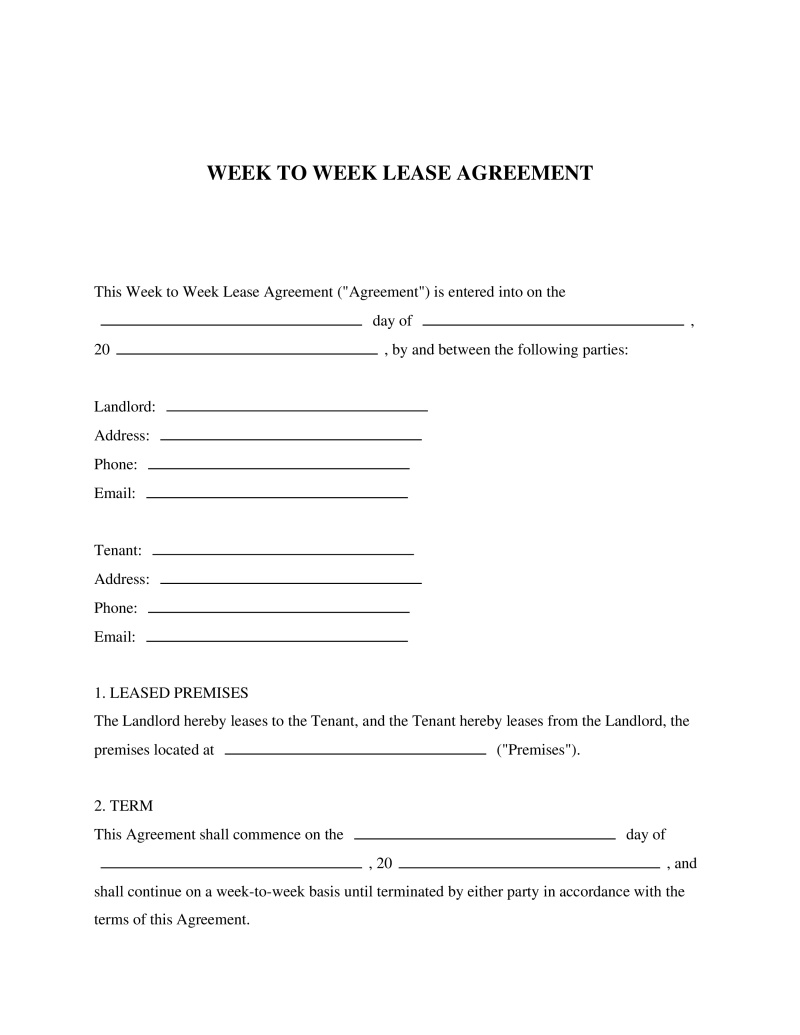
A Week to Week Lease Agreement is a legal document designed for landlords and tenants to establish a rental agreement on a weekly basis.
Property Type
Select the property type to tailor the agreement's terms.
Provide details if you selected 'Other'.
Table of Contents
What is a Week to Week Lease Agreement?
A Week to Week Lease Agreement is a short-term rental contract between a landlord and a tenant that renews automatically every week until either party provides proper notice to terminate it. This type of agreement offers significant flexibility for both landlords and tenants, making it suitable for situations where a long-term commitment is not desired or practical. It outlines the terms of the tenancy, including rent amount, payment schedule, and responsibilities of each party, on a weekly basis.
Legal Requirements
For a Week to Week Lease Agreement to be legally binding and enforceable, it must meet several fundamental legal requirements. While specific nuances can vary by jurisdiction, the core principles of contract law generally apply. Ensuring all necessary elements are present helps prevent disputes and clarifies the expectations of both the landlord and tenant.
- Offer and Acceptance - One party must propose the terms of the lease (the offer), and the other party must agree to those terms without material alteration (the acceptance).
- Consideration - There must be an exchange of value between the parties; typically, this is the tenant's payment of rent in exchange for the landlord's provision of housing.
- Legal Capacity - Both the landlord and tenant must be of legal age and sound mind to enter into a contract.
- Legal Purpose - The purpose of the agreement must be lawful and not violate any public policy or statute.
- Clear Identification of Parties - The full legal names of both the landlord(s) and tenant(s) must be clearly stated in the agreement.
- Property Description - A precise and unambiguous description of the rental property, including its full address, must be provided.
- Rent and Payment Terms - The exact weekly rent amount, the due date for payment, acceptable payment methods, and any late fees must be specified.
- Term of Tenancy - While week-to-week, the agreement should clearly state its initial weekly term and its automatic renewal mechanism.
- Notice Period for Termination - The required notice period for either party to terminate the agreement, typically seven days, must be explicitly stated.
- Signatures - All parties involved in the lease agreement must sign and date the document to indicate their consent and understanding of the terms.
Applicable Federal and State Laws
Rental agreements, including week to week leases, are subject to a complex framework of federal and state laws designed to protect the rights of both landlords and tenants. Adherence to these statutes is crucial for maintaining a lawful tenancy and avoiding legal complications.
Federal Statutes
Several federal laws govern aspects of residential tenancy, ensuring fair practices across all types of lease agreements:
- Fair Housing Act - Prohibits discrimination in housing based on race, color, national origin, religion, sex, familial status, or disability (42 U.S.C. § 3601 et seq.). Landlords must ensure all their practices, from advertising to eviction, comply with this act.
- Americans with Disabilities Act (ADA) - While primarily focused on public accommodations, aspects of the ADA can influence housing providers to ensure reasonable accommodations for tenants with disabilities (42 U.S.C. § 12101 et seq.).
- Lead-Based Paint Disclosure Requirements - For properties built before 1978, landlords must disclose any known lead-based paint hazards and provide tenants with an EPA-approved pamphlet on lead safety (42 U.S.C. § 4852d). This disclosure is mandatory even for short-term leases.
State Laws and Requirements
State laws play a significant role in regulating the specifics of week to week lease agreements, often dictating notice periods, security deposit rules, and habitability standards. While the Uniform Residential Landlord and Tenant Act (URLTA) provides a model, each state adopts and modifies its own version.
- Uniform Residential Landlord and Tenant Act (URLTA) - This model act, adopted in various forms by many states, standardizes the rights and duties of landlords and tenants, including provisions for lease termination, security deposits, and landlord access (e.g., Alaska Stat. § 34.03.010 et seq.).
- Notice to Terminate Tenancy - Most states require a specific notice period for terminating a week to week lease, often seven days, but this can vary. For example, some states may require 10 or 14 days' notice (e.g., Fla. Stat. § 83.57).
- Security Deposit Limits and Return - State laws typically cap the amount a landlord can charge for a security deposit (often 1-2 months' rent) and mandate a timeline for its return after lease termination, along with an itemized list of deductions (e.g., Cal. Civ. Code § 1950.5).
- Implied Warranty of Habitability - This legal principle, codified in most states, requires landlords to maintain the rental property in a safe, sanitary, and livable condition, providing essential services like heat, water, and electricity (e.g., N.Y. Real Prop. Law § 235-b).
- Landlord's Right of Entry - State laws typically stipulate the conditions under which a landlord can enter a tenant's rented premises, usually requiring reasonable notice (e.g., 24-48 hours) except in emergencies (e.g., Tex. Prop. Code Ann. § 92.0081).
Penalties for Non-Compliance
Failure to comply with federal and state landlord-tenant laws can result in significant legal and financial consequences for the offending party. These penalties are designed to deter violations and provide remedies for aggrieved parties.
- Illegal Eviction - Landlords who attempt to evict a tenant without following proper legal procedures (e.g., self-help evictions, changing locks) can face substantial fines, damages, and even criminal charges in some jurisdictions.
- Failure to Return Security Deposit - If a landlord wrongfully withholds a security deposit or fails to return it within the statutory timeframe, they may be liable for the deposit amount, plus additional damages, interest, or even treble damages in some states.
- Discrimination Violations - Violations of the Fair Housing Act can lead to investigations by the Department of Housing and Urban Development (HUD), substantial fines, civil penalties, and payment of damages to the victim.
- Lead-Based Paint Disclosure Penalties - Non-compliance with lead-based paint disclosure requirements can result in civil penalties of up to tens of thousands of dollars per violation, in addition to liability for damages if a tenant or child is harmed.
- Breach of Implied Warranty of Habitability - Tenants may be entitled to withhold rent (in an escrow account), terminate the lease, or sue for damages if a landlord fails to maintain habitable living conditions after receiving proper notice.
Rights
A Week to Week Lease Agreement clearly defines the legal rights and responsibilities of both the landlord and the tenant, ensuring a clear understanding of their respective roles during the tenancy.
Landlord's Rights and Obligations
Landlords have specific rights regarding their property and responsibilities towards their tenants, which are typically outlined in the lease agreement and governed by state law.
- Right to Collect Rent - Landlords have the right to receive timely rent payments as stipulated in the lease agreement.
- Right to Property Access - With proper notice (as defined by state law), landlords typically have the right to enter the premises for inspections, repairs, or showing the property to prospective tenants.
- Obligation to Maintain Habitable Premises - Landlords are generally responsible for ensuring the property meets basic health and safety standards, including providing essential services like water, heat, and electricity.
- Obligation to Follow Eviction Laws - Should a tenant violate the lease, landlords must adhere to strict state-specific eviction procedures, including providing proper notice and obtaining a court order.
- Obligation to Return Security Deposit - Landlords must return the security deposit, minus any lawful deductions for damages beyond normal wear and tear, within the timeframe specified by state law.
Tenant's Rights and Obligations
Tenants also possess specific rights and obligations that protect their tenancy and ensure they contribute to the proper maintenance of the rental unit.
- Right to Quiet Enjoyment - Tenants have the right to live in the property without unreasonable interference from the landlord or other parties.
- Right to a Habitable Dwelling - Tenants are entitled to a safe and livable environment, free from serious health or safety hazards.
- Obligation to Pay Rent - Tenants are legally bound to pay the agreed-upon weekly rent on time.
- Obligation to Maintain Cleanliness - Tenants must keep the premises reasonably clean and sanitary and dispose of all garbage properly.
- Obligation to Not Damage Property - Tenants are responsible for avoiding damage to the property beyond normal wear and tear and for notifying the landlord of any necessary repairs.
- Obligation to Follow Lease Terms - Tenants must adhere to all terms and conditions outlined in the week to week lease agreement, including any rules regarding pets, noise, or property alterations.
Executing a Week to Week Lease Agreement
Creating and formally entering into a Week to Week Lease Agreement involves several key steps to ensure clarity and legal enforceability for both parties.
- Draft the Agreement - Begin by drafting a comprehensive agreement that includes all essential terms, such as the full names of the landlord and tenant, the complete address of the rental property, the weekly rent amount, the due date for rent, and the specific notice period required for termination. Ensure that any unique clauses or rules specific to the property, like pet policies or parking regulations, are clearly articulated within the document.
- Review and Negotiate Terms - Both the landlord and the tenant should thoroughly review the entire document. This is the stage for asking questions, clarifying any ambiguous language, and negotiating any terms that may be unsatisfactory. It is advisable for both parties to seek legal counsel if they have significant concerns or wish to modify standard clauses.
- Include Required Disclosures - Attach any legally mandated disclosures, such as lead-based paint disclosures for properties built before 1978, or any state-specific landlord-tenant rights pamphlets. These disclosures are often a legal prerequisite and must be acknowledged by the tenant.
- Sign and Date the Agreement - Once all terms are agreed upon and any necessary disclosures are attached, both the landlord and all adult tenants must sign and date the agreement. Each party should receive an original signed copy for their records, ensuring they have access to the full terms of their tenancy.
- Provide Keys and Occupancy - Upon the effective date of the lease and typically after the first week's rent and any security deposit have been paid, the landlord provides the tenant with keys and grants them legal occupancy of the premises. A move-in checklist or condition report should ideally be completed at this stage to document the property's condition.
Week-to-Week vs. Month-to-Month Lease
While both week-to-week and month-to-month leases offer flexibility compared to long-term fixed leases, they differ significantly in their renewal periods and associated notice requirements. Understanding these distinctions is crucial for choosing the most appropriate rental arrangement.
A week-to-week lease automatically renews every seven days, providing the highest degree of short-term flexibility. This arrangement is particularly beneficial for individuals needing temporary housing or landlords with fluctuating property availability. The notice period for termination is typically shorter, often seven days, allowing either party to end the tenancy with minimal commitment. However, this frequent renewal can lead to more frequent administrative tasks, such as rent collection and lease management, and less stability for both parties.
In contrast, a month-to-month lease renews every thirty days. This offers a balance between flexibility and stability, providing tenants with a longer planning horizon and landlords with a more predictable income stream. The notice period for termination is usually longer than a week-to-week lease, commonly 30 days, though some states may require more, such as 60 days. This longer notice period grants both parties more time to adjust to a change in tenancy, whether it involves finding new housing or a new tenant. Month-to-month leases are often favored when there is uncertainty about the exact duration of a stay but a desire for more consistency than a weekly arrangement.
Frequently Asked Questions
Not the form you're looking for?
Try our legal document generator to create a custom document
Disclaimer: The templates available on this website are provided for general informational purposes only and do not constitute legal advice. They are not intended to be, and should not be interpreted as, compliant with any specific legal, regulatory, or privacy requirements. These templates are not a replacement for professional legal guidance and should not be relied upon for any particular matter or circumstance. Users are strongly encouraged to seek advice from a qualified attorney licensed in their jurisdiction before using, modifying, or relying on any template.
All templates are provided on an "as is," "with all faults," and "as available" basis. The provider disclaims any and all warranties of any kind, whether express, implied, statutory, or otherwise, including without limitation warranties of merchantability, fitness for a particular purpose, title, or non-infringement.
LegalTemplates.com makes no guarantees or representations regarding the accuracy, completeness, expected outcomes, or reliability of the materials contained in these templates or any materials referenced or linked from them.