Inheritance Advance Agreement
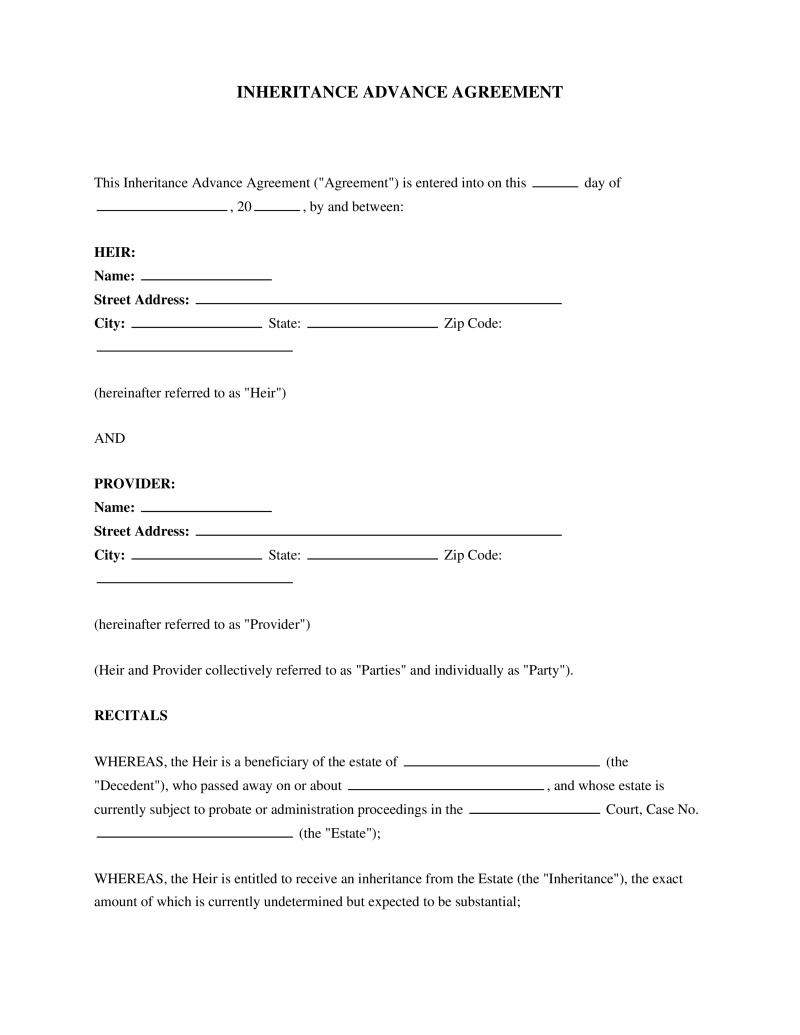
An Inheritance Advance Agreement is a legal contract through which an heir receives funds from an anticipated inheritance prior to its final distribution, often in exchange for a portion of the future estate.
Advance Type
Select whether the advance is a lump sum, installment, or line of credit arrangement.
Table of Contents
What is a Inheritance Advance Agreement Template?
An inheritance advance agreement is a financial arrangement where an heir receives a portion of their anticipated inheritance before the probate process is complete and the estate is settled. This document facilitates an immediate cash payment to the heir in exchange for an assignment of a specified portion of their future inheritance. It is primarily utilized by individuals who require liquidity quickly and cannot wait for the often lengthy probate proceedings to conclude. The agreement typically involves a third-party funding company that purchases a portion of the heir's interest in the estate.
Legal Requirements and Validity
For an inheritance advance agreement to be legally valid and enforceable, it must adhere to several fundamental legal requirements. These requirements ensure clarity, protect the interests of all parties, and comply with general contract principles and specific regulations governing such financial arrangements. Key considerations for validity include:
- Written Form - The agreement must be documented in writing, clearly outlining all terms, conditions, and disclosures. Oral agreements for inheritance advances are generally unenforceable and carry significant risks.
- Identification of Parties - All parties involved, including the heir, the funding company, and the deceased's estate, must be clearly identified with their full legal names and relevant contact information.
- Specific Estate Details - The agreement must precisely identify the deceased individual, the probate court handling the estate, and the relevant case number or file identifier. This establishes the specific inheritance being advanced against.
- Amount of Advance and Repayment Terms - The exact amount of the advance provided to the heir, along with the total repayment amount (which includes the advance plus any fees or charges), must be explicitly stated. It should also detail how and when the funding company will receive its payment from the estate.
- Assignment of Inheritance Rights - The core of the agreement is the heir's clear and unambiguous assignment of a specific monetary amount or percentage of their future inheritance to the funding company. This assignment typically authorizes the estate's executor or administrator to pay the funding company directly from the heir's share.
- Disclosure of Risks - The agreement must adequately disclose all material risks associated with the transaction, including the possibility of a smaller-than-expected inheritance, the non-recourse nature of the advance (meaning the heir generally isn't personally liable if the estate is insufficient), and the effective cost of the advance.
- Governing Law Clause - A clause specifying the jurisdiction whose laws will govern the interpretation and enforcement of the agreement is essential. This often defaults to the state where the heir resides or where the funding company is based.
- Notarization - While not always strictly required by law in all jurisdictions, notarization of the heir's signature is highly recommended. It adds a layer of authenticity and can help prevent future disputes regarding the heir's consent and identity.
Obligations
An inheritance advance agreement establishes specific rights and obligations for both the heir and the funding company. Understanding these is crucial for a transparent and legally sound transaction.
The heir, as the recipient of the advance, assumes certain responsibilities and gains particular rights:
- Right to Funds - The primary right of the heir is to receive the agreed-upon advance amount promptly, once all conditions of the agreement have been met and documents executed.
- Right to Clear Disclosure - Heirs have the right to a clear and comprehensive understanding of all terms, fees, and potential risks associated with the inheritance advance agreement before signing. This includes the total amount to be repaid by the estate.
- Obligation to Provide Documentation - The heir is typically obligated to provide all necessary documentation related to the estate, such as the death certificate, will, probate court filings, and identification, to enable the funding company to verify the inheritance.
- Obligation to Notify Funder of Estate Progress - The heir is usually required to keep the funding company informed about the progress of the probate process and any significant developments concerning the estate's administration.
- Obligation to Facilitate Payment - The heir must cooperate in ensuring that the funding company receives its assigned portion directly from the estate's executor or administrator when the estate is distributed. This often involves signing an authorization for direct payment.
The funding company, as the provider of the advance, also has defined rights and obligations:
- Right to Assigned Inheritance Portion - The funding company has the right to receive the specific monetary amount or percentage of the inheritance that was assigned to them by the heir, directly from the estate upon distribution.
- Right to Information - The funding company has the right to receive accurate and timely information from the heir regarding the status of the probate process and the expected distribution.
- Obligation to Disburse Funds - Once the agreement is finalized and all conditions are met, the funding company is obligated to disburse the agreed-upon advance amount to the heir in a timely manner.
- Obligation for Clear Terms - The funding company must provide clear, transparent, and unambiguous terms in the inheritance advance agreement, ensuring the heir fully understands the nature of the transaction, including all fees and charges.
- Obligation to Avoid Misleading Practices - Funding companies are obligated to conduct business fairly and avoid any deceptive or misleading practices regarding the nature or cost of the inheritance advance.
How to Complete
Completing an inheritance advance agreement involves several critical steps to ensure accuracy and legal compliance. Following a structured process helps both the heir and the funding company navigate the transaction effectively.
- Assess Eligibility and Estate Status - Before initiating an inheritance advance, the heir should confirm their eligibility by verifying they are a named beneficiary or legal heir to a probated estate. Gather essential estate documents such as the death certificate, the will (if one exists), and any initial probate court filings to understand the estimated value of the inheritance and the stage of the probate process. This initial assessment helps determine the feasibility and potential amount of an advance.
- Select a Reputable Funding Provider - Research and identify funding companies that specialize in inheritance advances. Compare their terms, fees, and customer reviews. It is crucial to choose a provider with a clear track record and transparent practices. Engage with multiple providers to obtain different quotes and understand the full scope of their offerings before committing to any single company.
- Gather Required Documentation - The funding company will require a comprehensive set of documents to evaluate the estate and the heir's claim. This typically includes the death certificate of the deceased, a copy of the will or trust, probate court documents (e.g., Letters Testamentary or Letters of Administration), the heir's government-issued identification, and any other evidence of the heir's entitlement to the inheritance. Promptly providing these documents can expedite the approval process.
- Review and Understand Agreement Terms - Carefully read the entire inheritance advance agreement. Pay close attention to the advance amount, the total repayment amount (which includes the advance plus the funding company's fees), the non-recourse clause (confirming the heir is not personally liable if the inheritance falls short), and any clauses detailing the assignment of inheritance rights. If any terms are unclear, seek clarification from the funding company or an independent legal professional.
- Execute and Notarize the Agreement - Once all terms are understood and agreed upon, sign the inheritance advance agreement. Many funding companies require the heir's signature to be notarized to verify identity and consent. Ensure all required signatures are obtained from all relevant parties, including any witnesses or co-heirs if applicable, and that the document is properly dated.
- Facilitate Fund Disbursement and Estate Communication - After the agreement is fully executed and verified, the funding company will disburse the advance funds to the heir, typically via bank transfer or check. The heir is then generally obligated to keep the funding company updated on the progress of the probate proceedings and to ensure that the estate's executor or administrator is aware of the assignment and is prepared to make the payment directly to the funding company upon final distribution of the estate.
Federal and State Laws
Inheritance advance agreements operate within a complex legal framework, primarily governed by state contract and probate laws, with some tangential influence from federal regulations related to financial transactions. While there isn't a specific federal law directly regulating inheritance advances as a distinct financial product, general legal principles apply.
Several federal and state laws are relevant:
- Uniform Commercial Code (UCC) - This model law, adopted in various forms by all U.S. states, governs commercial transactions, including the assignment of future interests and secured transactions. Article 9 of the UCC, pertaining to secured transactions, may be relevant in how an heir's interest in an estate is assigned and perfected by the funding company.
- State Contract Law - Each state has its own body of law governing contracts, including formation, enforceability, and interpretation. Inheritance advance agreements are essentially contracts, meaning they must comply with state-specific requirements for offer, acceptance, consideration, and mutual assent.
- State Probate Codes - Every state has a detailed probate code that dictates how estates are administered, debts are paid, and assets are distributed to heirs. These codes govern the underlying asset (the inheritance) against which the advance is made and may contain provisions affecting the timing and method of distributions, which can impact the repayment to the funding company.
- State Usury Laws - While inheritance advances are typically structured as non-recourse asset purchases rather than loans to avoid being classified as loans, the effective annual percentage rate (APR) of the fees can sometimes be very high. If a court were to re-characterize an advance as a loan, state usury laws, which cap the maximum interest rates chargeable, could potentially apply, leading to the invalidation of excessive fees.
- State Consumer Protection Laws - Many states have general consumer protection statutes that prohibit unfair or deceptive trade practices. These laws could be invoked if a funding company engages in misleading advertising, fails to disclose material terms, or employs predatory practices in offering inheritance advances.
Not the form you're looking for?
Try our legal document generator to create a custom document
Disclaimer: The templates available on this website are provided for general informational purposes only and do not constitute legal advice. They are not intended to be, and should not be interpreted as, compliant with any specific legal, regulatory, or privacy requirements. These templates are not a replacement for professional legal guidance and should not be relied upon for any particular matter or circumstance. Users are strongly encouraged to seek advice from a qualified attorney licensed in their jurisdiction before using, modifying, or relying on any template.
All templates are provided on an "as is," "with all faults," and "as available" basis. The provider disclaims any and all warranties of any kind, whether express, implied, statutory, or otherwise, including without limitation warranties of merchantability, fitness for a particular purpose, title, or non-infringement.
LegalTemplates.com makes no guarantees or representations regarding the accuracy, completeness, expected outcomes, or reliability of the materials contained in these templates or any materials referenced or linked from them.