Family Loan Agreement Template Parents To Child
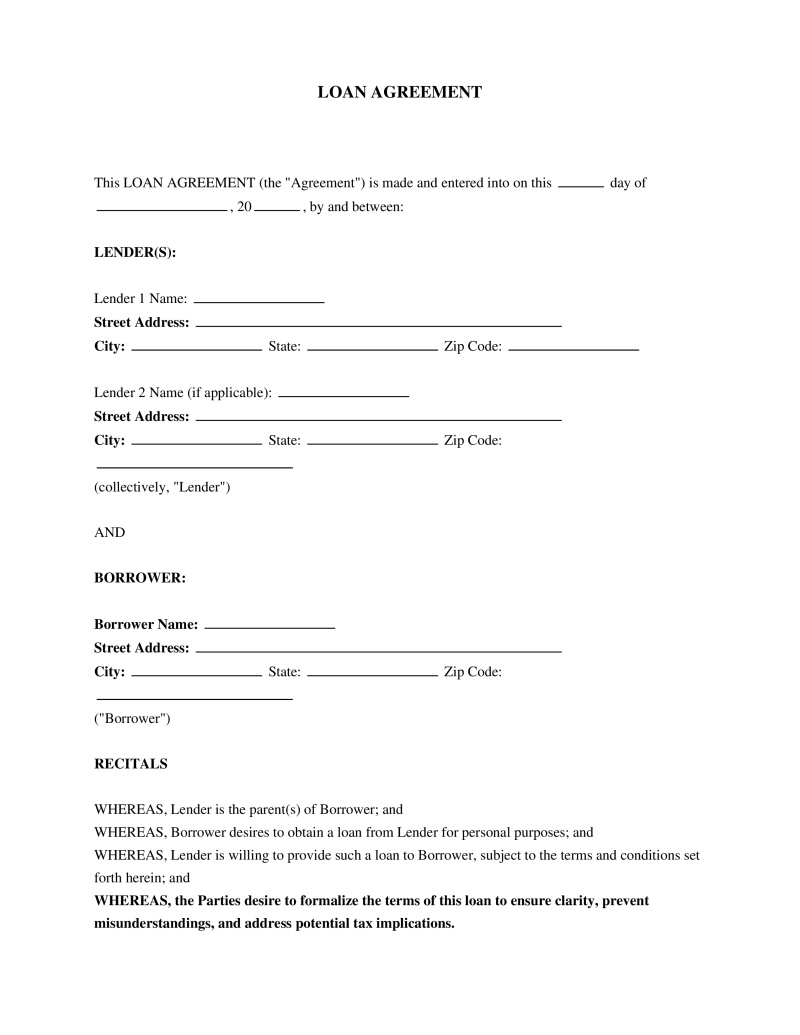
A Family Loan Agreement is a formal legal document that delineates the terms and conditions of a financial loan extended by parents to their child, establishing clear repayment obligations and interest, if any.
Loan Purpose
Select the main reason for the loan. This will be referenced in the agreement's recitals.
Provide a brief description of the loan purpose.
Table of Contents
What is a Family Loan Agreement Template Parents To Child?
A family loan agreement template parents to child is a legally binding document that formalizes a financial arrangement between parents, acting as lenders, and their child, acting as a borrower. This agreement outlines the terms and conditions under which money is loaned, ensuring clarity and preventing misunderstandings that can arise in informal family financial transactions. Its primary purpose is to treat the loan as a legitimate debt rather than a gift, which has significant implications for tax purposes, estate planning, and the overall financial health of both parties. By using such a template, families can establish clear expectations regarding repayment schedules, interest rates, and other crucial aspects of the loan.
Legal Requirements and Validity
For a family loan agreement template parents to child to be legally valid and enforceable, it must meet several fundamental requirements common to all contract law. These requirements ensure that the agreement is not only clear but also stands up to scrutiny by tax authorities or in a court of law if disputes arise. Without these elements, the loan could be reclassified as a gift, potentially incurring gift tax liabilities or being challenged during estate settlement.
- Offer and Acceptance - There must be a clear offer by the parents to lend money and an equally clear acceptance by the child to borrow it under the specified terms.
- Consideration - Both parties must exchange something of value. For the parents, it is the money loaned; for the child, it is the promise to repay with interest (or without, if explicitly stated and legally permissible).
- Capacity - Both parents and child must be of legal age (typically 18 years old in most jurisdictions) and possess the mental capacity to understand and agree to the terms of the contract.
- Legality - The purpose of the loan and its terms must be legal and not violate any public policy or statutes, such as usury laws that cap interest rates.
- Written Form - While some oral contracts are enforceable, a loan agreement, especially for significant sums, should always be in writing to provide clear evidence of the terms and prevent disputes.
- Definite Terms - The agreement must clearly specify the principal amount, interest rate (even if zero), repayment schedule, default provisions, and any collateral involved.
Rights and Obligations of Parties Involved
A family loan agreement template parents to child clearly delineates the rights and obligations of both the lending parents and the borrowing child, creating a structured financial relationship. Understanding these roles is crucial for the smooth execution of the loan and for maintaining healthy family dynamics while managing financial responsibilities. The agreement serves as a reference point for both parties, ensuring accountability and transparency throughout the loan term.
Parents (Lenders)
The parents, as lenders, assume certain rights and obligations aimed at protecting their investment and ensuring the loan is repaid as agreed.
- Right to Repayment - Parents have the right to receive timely payments of principal and interest according to the agreed-upon schedule.
- Right to Enforce Terms - In the event of default, parents have the right to pursue legal remedies outlined in the agreement, such as collecting on collateral or initiating legal action.
- Obligation to Disburse Funds - Once the agreement is signed, parents are obligated to provide the agreed-upon loan amount to the child.
- Obligation to Maintain Records - Parents should keep accurate records of all payments made and any outstanding balance for tax and accounting purposes.
- Obligation to Adhere to Tax Laws - Parents must ensure the loan terms comply with applicable tax laws, particularly regarding interest rates to avoid gift tax implications.
Child (Borrower)
The child, as the borrower, undertakes specific obligations and possesses rights related to the fair treatment and terms of the loan.
- Obligation to Repay - The child is legally bound to make principal and interest payments on time, as specified in the loan agreement.
- Obligation to Communicate - In case of financial difficulties, the child has an obligation to communicate with the parents to discuss potential adjustments or deferrals, as allowed by the agreement.
- Right to Clear Terms - The child has the right to a clear and unambiguous loan agreement that fully discloses all terms, conditions, and potential fees.
- Right to Privacy (within the loan context) - While parents are the lenders, the child's financial situation outside the loan terms generally remains private, unless explicitly agreed otherwise or required for loan enforcement.
- Obligation to Fulfill Collateral Requirements - If the loan is secured, the child is obligated to maintain the collateral as specified in the agreement.
How to Complete a Family Loan Agreement Template Parents To Child
Completing a family loan agreement template parents to child involves careful attention to detail and a clear understanding of the financial arrangement. Following a structured process helps ensure all necessary information is included, the terms are legally sound, and both parties are fully aware of their commitments.
- Gather Essential Information - Begin by collecting the full legal names and current addresses of all parties involved: the parents (lenders) and the child (borrower). Include the exact principal amount of the loan, the proposed interest rate, and the desired repayment schedule. It is also important to consider if the loan will be secured by collateral and, if so, to have a detailed description of that asset ready.
- Define Loan Terms and Conditions - Clearly specify the principal loan amount and whether interest will be charged. If interest is applied, state the annual percentage rate (APR) and clarify how it will be calculated. Establish a precise repayment schedule, detailing the frequency of payments (e.g., monthly, quarterly), the due date for each payment, and the total number of payments or the loan's maturity date. Include provisions for late payment penalties, early repayment options, and any associated fees.
- Address Default and Collateral Provisions - Outline what constitutes a default on the loan, such as missed payments or failure to maintain collateral. Describe the consequences of default, which might include immediate acceleration of the entire loan balance or the right to seize collateral. If the loan is secured, provide a comprehensive description of the collateral, including its value and how it will be handled in case of default.
- Include Miscellaneous Clauses and Signatures - Incorporate standard legal clauses such as a governing law clause, which specifies the jurisdiction whose laws will apply to the agreement. Include a severability clause, stating that if one part of the agreement is found invalid, the rest remains enforceable. Ensure spaces are provided for the dated signatures of all parties involved, including any witnesses, and consider having the document notarized to add an extra layer of legal validity.
Required Elements of a Valid Family Loan Agreement Template Parents To Child
To be effective and legally sound, a family loan agreement template parents to child must incorporate specific elements that clearly define the terms of the financial arrangement. These components ensure that the agreement is comprehensive, transparent, and enforceable, protecting the interests of both the lenders and the borrower.
- Identification of Parties - Full legal names and addresses of both the parents (lenders) and the child (borrower).
- Principal Loan Amount - The exact monetary sum being loaned.
- Interest Rate - The annual percentage rate (APR) charged on the loan, or a clear statement that the loan is interest-free.
- Repayment Schedule - Specific details on how and when the loan will be repaid, including payment frequency, due dates, and the total number of payments or loan term.
- Default Provisions - What constitutes a default (e.g., missed payments) and the consequences or remedies available to the lender.
- Collateral Description (if applicable) - A detailed description of any asset pledged to secure the loan.
- Governing Law Clause - Specification of the state or jurisdiction whose laws will govern the agreement.
- Signatures and Dates - Dated signatures of all parties involved (parents and child), and ideally, signatures of witnesses and a notary public.
- Prepayment Clause - Details on whether the borrower can repay the loan early without penalty.
- Waiver of Presentment and Protest - A clause indicating the borrower waives certain legal notices in the event of default.
Tax Implications of Family Loans
Family loans, while seemingly straightforward, carry significant tax implications that must be carefully managed to avoid unintended consequences for both parents and children. The Internal Revenue Service (IRS) scrutinizes intra-family transfers to distinguish between legitimate loans and taxable gifts. Proper structuring of the loan agreement is essential to comply with federal tax laws.
- Gift Tax Avoidance - If a loan is made at an interest rate below the Applicable Federal Rate (AFR) or is not expected to be repaid, the IRS may recharacterize the forgone interest or the entire principal as a taxable gift. This can trigger gift tax obligations for the parents if the amount exceeds annual exclusion limits.
- Applicable Federal Rate (AFR) - The IRS publishes minimum interest rates (AFR) for intra-family loans. To avoid gift tax implications on the interest portion, the loan must charge an interest rate at least equal to the relevant AFR for the loan term.
- Imputed Interest - For demand loans or term loans below the AFR, the IRS may impute interest income to the parents, even if no interest was actually collected. This
Not the form you're looking for?
Try our legal document generator to create a custom document
Disclaimer: The templates available on this website are provided for general informational purposes only and do not constitute legal advice. They are not intended to be, and should not be interpreted as, compliant with any specific legal, regulatory, or privacy requirements. These templates are not a replacement for professional legal guidance and should not be relied upon for any particular matter or circumstance. Users are strongly encouraged to seek advice from a qualified attorney licensed in their jurisdiction before using, modifying, or relying on any template.
All templates are provided on an "as is," "with all faults," and "as available" basis. The provider disclaims any and all warranties of any kind, whether express, implied, statutory, or otherwise, including without limitation warranties of merchantability, fitness for a particular purpose, title, or non-infringement.
LegalTemplates.com makes no guarantees or representations regarding the accuracy, completeness, expected outcomes, or reliability of the materials contained in these templates or any materials referenced or linked from them.